So this is happening on my rowan tree:
And some other rowans in the village, too. While the horse chestnuts and some other trees are already putting on their autumnal suits, the rowans can't decide on whether or not it's spring or autumn. It's not something I've ever seen before, though I'm sure it's not uncommon, and as far as the trees go it's only rowans that seem to be flowering again. The weather has been all over the place - further up north the first frosts have already been and gone, while here we're still basking in warm sunshine one minute, only to find howling winds and droves of rain hurling themselves our way the next. No wonder the plants are confused! The blackberries are starting to ripen but the main crop is still a week or two away, I think, unless we get more sunshine.
I've had to neglect the garden this year and things are pretty overgrown in the flower beds at the moment but I'm enjoying the wildness of it all, at least, and the bees certainly are too. This is the time where I should be cutting back all of the bulbs and so on that have finished flowering before they sow yet more bulbs to overcrowd the beds even further, but in the absence of being able to get my hands dirty right now, I'm trying to get out there and tend to things in my own way. I don't want to neglect my space completely, so instead of digging and pruning, decorating it is...
The rowan - which I planted four years ago now - has matured a little (after recovering well from getting Mungo'd in its first year - the dog managed to snap it in half in a manic frolicking session that ruined most of the plants. Sod) and the branches are thick enough to tolerate some things hanging from it. I think it will need a while yet before I can hang anything heavy, like a bird feeder, but some light decorations will do and I always intended to turn it into a clootie tree of sorts. So the first thing I've put on it are some 'wind-chimes', though I'm not sure bamboo can qualify as a "chime" per se:
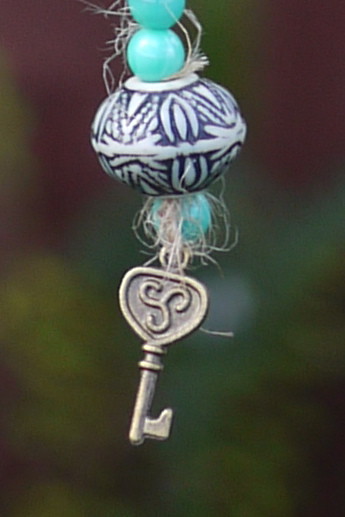
I bought one of those do-it-yourself kits from the kids section of the local craft shop, and my capable assistant, Rosie, helped with the painting, with blues and reds for health and protection. A while before I'd found some tiny wee key charms with triskeles on them that I couldn't resist, so on they went too:
I was supposed to have gone back to my hometown for a visit last month but I just couldn't manage the journey at the time and in the end I had to cancel, so my wonderful friends posted me the belated birthday present they'd been holding onto - a paint your own birdhouse (thank you so much!). It was a lovely surprise and Rosie helped with painting that too (one of Tom's friends has decided to basically adopt us these days, so as usual they were busy playing together while Rosie and I were hard at work). With starting school last month Rosie's needed a little more quality time lately as she settles in to her new routine and she loves to do anything creative, especially if it provides an opportunity to do something good for the garden too. So the arrival of another wee project for us was great, and will make a great addition to the tasteful aesthetic I'm going for...
I've yet to find a home for the bird house, I'm still deciding on whether or not I should try putting in on the fence or maybe donate it to one of the trees in the field behind us, but it's finished now. I told Rosie that rowan berries can be dried and worn as a necklace (traditionally for protection, as with amber) and she's quite keen on the idea; I'm not sure making her a necklace is practical, but maybe drying the berries to make a garland for her room is something we could make a project of. I made the kids a rowan charm a while ago but their room is in need of redecorating, so it might be nice to add something new once it's done.
Tuesday, 4 September 2012
Monday, 3 September 2012
Ice cream! And another review
Autumn is well and truly here now - no more wavering on the matter in these here parts. And with it comes the end of the school holidays (finally) and now, for me, a little more freedom than I'm used to. Both of the kids are in school now and as of tomorrow my daughter will be in school full-time, after spending the first couple of weeks only going in for the mornings.
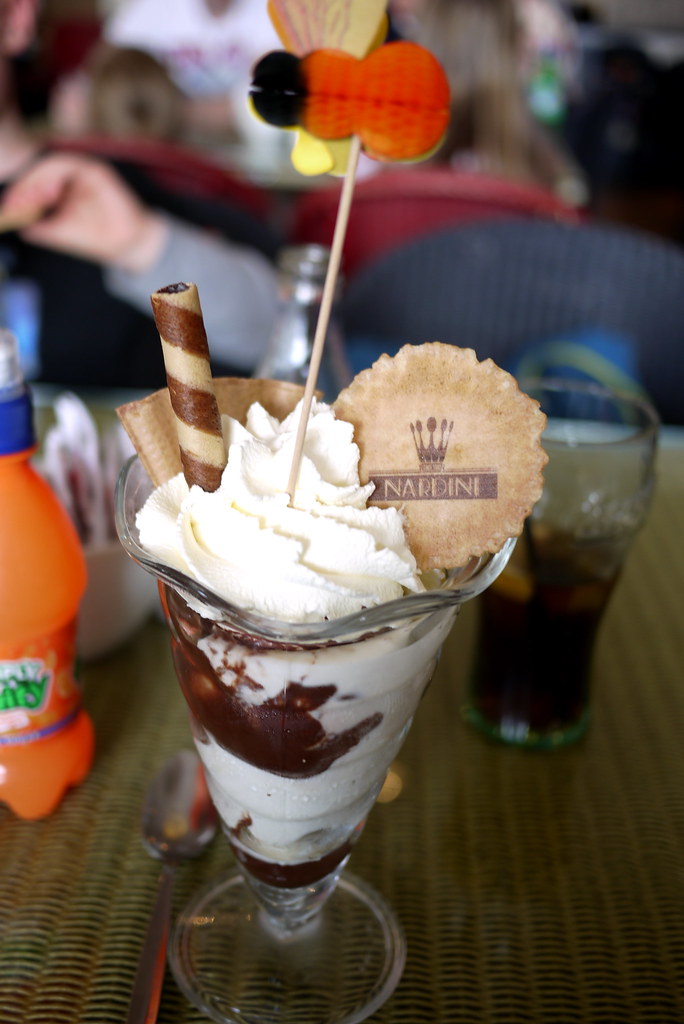
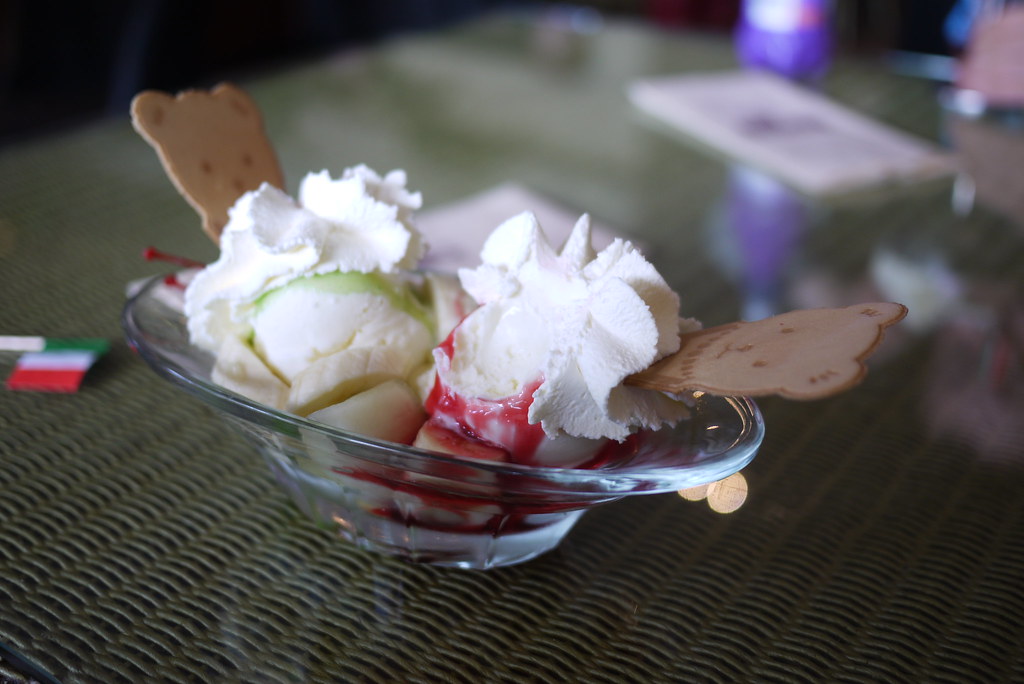
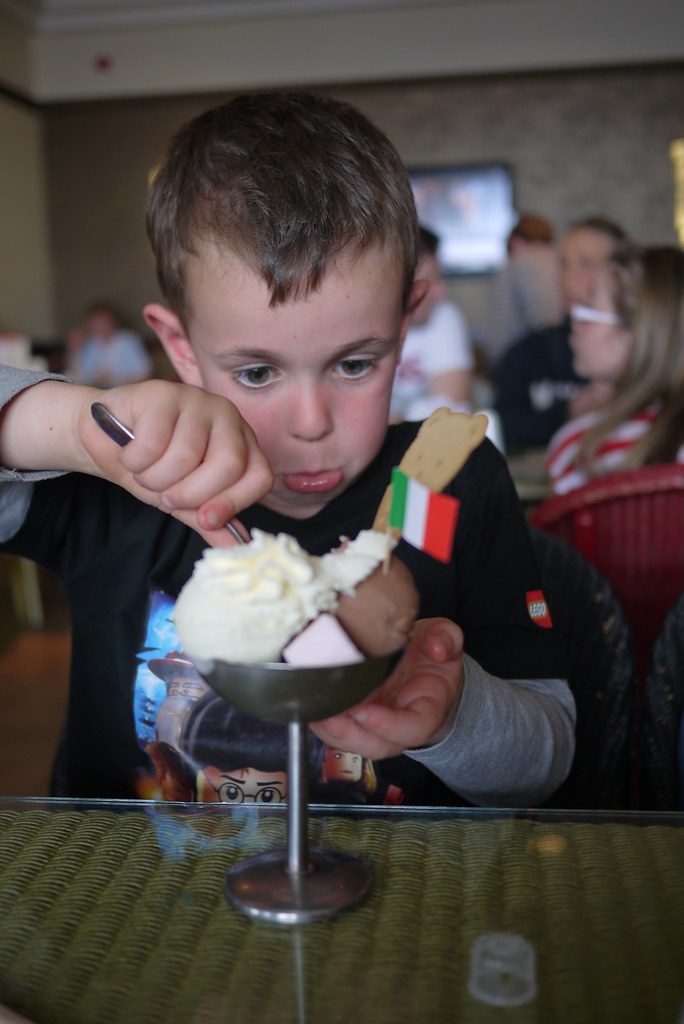
To celebrate the start of a new era, and finish our holiday in style, I took the kids out to Largs (a nearby town and something of a tourist trap) for an ice cream. Not just any ice cream:
Proper ice cream. It's definitely a perk of living in a place like this, even if the weather sucks a lot of the time.
Once my back problems are resolved - hopefully in the very near future - I shall have to start making myself useful again. In the meantime I'm sure I'll think of some things to do to keep me out of trouble, but for now, here's another review:
Celtic Christianity and Nature: Early Irish and Hebridean Traditions
Mary Low
A common problem when trying to figure out this whole Gaelic Polytheism thing is finding where the Christianity starts and the paganism ends when we look at all of the source material we have to work with. A lot of what we see might look pagan, but there are things that we really can't take at face value, because things are never that simple or easy. Otherwise we might end up getting a bit over-excited about things and leap to conclusions like deciding that if we just strip out the obviously Christian bits we'll get the paganism and it's all cool and groovy. It's not as simple as that, for sure, but the situation's not as dire as some academics might like to think when they try to see everything as irreconcilably Christian just because it comes from the hands of Christian scribes, so let's call the whole thing off...
This is a book that I think is invaluable in getting a more balanced view, and more than that, it's a fantastic resource for looking at the kind of things we might see that are pre-Christian in origin (and thus useful to us, as polytheists) as far as Gaelic belief is concerned. Or not, as the case maybe, and accounting for all of the various shades of grey in between (and I'm sure there's far more than fifty shades there, and none of them involve abusive relationships or bad fan-fic, so that's cool. Anyway).
The purpose of this book is to explore the relationship between Christianity, native belief (as evidenced in the earliest Irish literature through to the relatively modern Hebridean evidence primarily gathered by Carmichael), and what's come to be known as "Celtic Christianity." Given Celtic Christianity's emphasis on nature, each chapter looks at a different subject like the land and the landscape, trees, water, fire, birds, the seasons, and the elements and explores whether such attitudes towards them might be evidence of pre-Christian belief, Christianity, or a synthesis of the two. For the most part there can't be any solid conclusions drawn and to Low's credit she let's the evidence she compiles speak for itself, allowing the reader to draw their own conclusions.
The broad scope - from the earliest literature to the modern - is something that I particularly liked because it underscores the point that often seems to be missed in CR these days: It's not just about looking at the Iron Age, it's looking at the whole continuum from what we know of pre-Christian times to the survivals we find today, and all the bits in between.
This is all great stuff and there is so much food for thought it's difficult to cover everything. All of the usual things you'd expect to find are there - the relationship between the land, the goddesses, and the people, the tradition of the sacred tree - the bile - the associations of birds with the gods, and so on, along with parallels that might found in the Bible that ultimately may have led to the survival and adaptation of such pre-Christian concepts into a Christian context. And so on.
Of particular interest to me was the chapter on the seasons and nature, as we see it articulated in nature poetry. There is a lot of Christian poetry devoted to the subject in medieval Ireland, but Low (following Kenneth Jackson) suggests that some of the earliest examples - Finn's song to the summer, or the famous poem heralding winter - may be hangovers from pre-Christian belief, where the seasons were possibly heralded (in the case of summer) or lamented (in the case of winter) in the form of seasonal carols. In the chapter on fire and the sun Low gives an overview of the arguments for and against solar deities. Being firmly on the side of the no camp on that one - which I happen to agree with - it was great to see the argument laid out so plainly, but she does explore the alternative view as well, if only to refute it. It would be interesting to see what those who might argue in favour of solar deities might have to say about it, but personally I found it to be one of the most useful bits of the book.
This is not to say the book is without its flaws. I don't think there's anything major here but you might find yourself quibbling with some of the arguments given, but that kind of thing is par for the course with any book. It's a fairly slim volume so some things get glossed over more than you might like (or maybe that's a good thing if you don't want it to get too complicated), and there are certainly some things that are missing - including some references I was surprised not to see, which doesn't have a massive impact over all, but I would've been interested to see some comment about it all nonetheless. Noticeably absent was discussion or even mention of the three realms, but I'm fairly sure that this has more to do with the time of publication - a few years, at least, before Liam Mac Mathúna's work was published, for sure - so it might be that Low just wasn't aware of it. It does date it slightly, though.
My main issue is the fact that Low refers to pre-Christian beliefs and religions as "primal." I really think that it's maybe an instinctive thing because it does seem to be a valid term to use in an anthropological sense, but I was always taught to try and avoid terms that might imply judgement values; that something primal is less evolved, perhaps. I couldn't help but wonder, why not just say "pre-Christian"?
Aside from that niggle I really enjoyed the book and would put it on my highly recommended list for sure. I'm not convinced it's a good book for a total beginner, though. This far in it's hard for me to judge because I found it an easy and straightforward read - there aren't a lot of Teh Big Wurdz to have to keep up with, and where something that's been previously discussed is referenced again a page number is given to allow a quick jump back if needed - but I do wonder if it's maybe a bit more than a beginner might want. It's not a book that spells things out plainly, "this is what the pre-Christian Irish believed" and that's probably what beginners are looking for. I'd still appreciate a book like that, to be honest...Still and all, I think this is about as good as it gets right now. For the non-beginner, or the beginner who wants to stick with it, I think the book is absolutely invaluable.
Sunday, 26 August 2012
Book review: Fiery Shapes
I'm slacking in the post-department this month. This is not to say I'm slacking in general, just that I'm being relatively anti-social. No offence...
Anyway, as the deadline for the first batch of books I got from the library some months ago draws to a close I'm starting to make a concerted effort to really go through all the books I like the look of so I don't have to renew too many - if any. Term will be starting soon and I don't want to hog any books that might come in handy for actual y'know, students, and while I did bring home rather a lot of books over my previous few trips, I never intended to read them all. But I do have a bare minimum I'd like to get through, and getting distracted by the first four volumes of Game of Thrones/A Song of Ice and Fire didn't help with that. What can I say. I don't get out much these days.
I have to say, though, the bunch I picked out from the library (not including the birthday splurge I indulged in earlier this year) this time round are really inspiring and - for the most part - quality. This next book I'm going to review comes from the library pile:
Fiery Shapes: Celestial Portents and Astrology in Ireland and Wales, 700-1700
Mark Williams
I don't usually pick up books that deal mainly with Wales, but having seen a preview of some of it online and then finding it at the library, why not? The Irish stuff certainly whet my appetite.
This is a book that fills a much-needed hole, covering not just astrology, but the way in which magic and certain forms of divination are shown in literature, and the kind of writers or places that may have influenced such portrayals. A little bit of eschatology gets thrown in too, looking at the end of the world or the apocalypse, so it's all good as far as I'm concerned. These aren't things you see being dealt with very often.
The Irish chapters, which concentrate mostly on divination and eschatology as well as the evidence for an 'Irish astrology', inevitably deals with druids as well and while they aren't the main focus of the book, what you'll find here is good stuff, and I'd say a must-read. Every now and then I see questions about the use of the word 'magi' as an equivalent to druids crop up, and this book deals with the evidence showing that it really does relate to the druids, and that the connotations and connections between the two are significant. I suspect some folks might be disappointed by the conclusions that are drawn here, though: the main thrust of the argument is that a lot of how the druids are portrayed in Irish literature has been influenced by the works of non-native sources, especially Isidore of Seville, who was very influential in the way attitudes about magic and such evolved in early Christian Ireland. The arguments presented here offer some good food for thought, even if it might not be quite the taste you were hoping for. It's kind of inevitable when dealing with this stuff.
For the most part I've got no real quibbles - my old tutor gets a mention so some of what's presented here is already familiar to me, especially in relation to the story of the Death of Conchobar (brings back good memories...), and some old favourites like In Tenga Bithnua ('The Evernew Tongue'), part of the Irish apocrypha, get a mention too. As far as astrology and the kind of bonkers and out there stuff that The Evernew Tongue deals with in particular, I do wonder if there was more fodder to look at in this area; it would have been good to see a bit more background and discussion on this kind of thing but I suppose there are only so many things you can fit in without going off on long tangents. There are some good references I'd like to hunt up, so I'm sure I'll be more than entertained when I get round to it.
My only real disagreement in the Irish chapters is in the discussion on the Morrígan's prophecy. The author comments that the Morrígan is "the divinity of carrion and carnage" and that "she is a strange figure have deliver the first, positive, prophecy" (p30) in Cath Maige Tuired. I think when you consider that the first, positive, prophecy gives the view of a land in peace, plenty and harmony (which in Irish mythological terms would be the result of a good king ruling over the land), while the second prophecy gives an extreme view of the opposite - a bad ruler - it underlines the tale in general; the suffering caused by Bres, a stingy and inhospitable king, as a result of the Tuatha Dé Danann having to remove their 'good' king Nuadu. The removal of Bres and the ultimate healing of Nuadu restores good order, but the spectre of an unjust ruler is never far off. The Morrígan, as a shadowy and unpredictable figure in the tale (until the Dagda secures her help for the Tuatha Dé Danann) could easily be seen as representing the land and its changing state, according to who is ruling over it. An idyllic land of peace and plenty, or an apocalyptic one are pretty much two sides of the same coin.
Otherwise, my only other lament is that there are frequent references to the story Forbius Droma Damhgaire ('The Siege of Knocklong') without any decent English translation pointed to or offered. I'm sure this isn't the author's fault - there must be a reason he only references Marie-Louise Sjoestedt's French translation! But it's frustrating to see references to a tale you can't really read in its entirety, and if there was a chance of providing a translation that would've been most welcome (there's a translation by Seán Ó Duinn that I'm aware of but aside from being extortionate, I'm not sure if the translation is reliable enough for academic use...).
Skipping backwards a little, one thing that set me in a particularly good mood was a short overview of Why Robert Graves Is Wrong in the preface; it isn't just critical of Robert Graves' "idiosyncratic treatise" (a good way to describe The White Goddess, I think), but it also points out the shortcomings of Peter Beresford-Ellis' own critique of the subject, 'The Fabrication of Celtic Astrology.' This is invaluable.
After the first two chapters that deal with the Irish material ('Celestial portents and apocalypticism in medieval Ireland' and 'Druids, cloud-divination, and the portents of the Antichrist') comes a change in focus and a switch to Wales. Here we find Taliesin and Geoffrey of Monmouth, Morgan Llwyd and a little bit of John Dee amongst other things. These chapters would probably be of interest to anyone with an interest in the Welsh side of reconstructionism, for sure, and I particularly found the chapter on Taliesin and Geoffrey of Monmouth to be good food for thought as far as how 'authentically pagan' some of what we see here might be. There are lots of references to poetry, with excerpts and translations included here, so there isn't the same niggle about references to things that aren't otherwise easily accessible as I had with the Irish chapters.
All in all, this is a book that would certainly come in useful if any of the subjects dealt with are your kind of thing. I wouldn't say this book is for the beginner but I'd definitely recommend it for someone who really wants to get stuck into the nitty gritty. It's a shame the book is so expensive because it's something I'd otherwise want for the bookshelf, but such is the way of things in academia these days, I suppose.
Saturday, 25 August 2012
Irish-language toy company branches out
Now this looks interesting! A toy manufacturer that specialises in Irish-language toys is branching out:
Bábógbaby has announced that it will be available in English, Scots Gaelic and Welsh in October in Ireland and UK toy stores after its launch in the UK in September.
Based in Galway, Bábógbaby specialises in Irish speaking toys and is now branching out into other languages.
The article also mentions the launch of a Scots Gaelic app next month, which is something I'd be especially keen on. I've not really used any apps before now but something to help with building on my beginners knowledge of the language would be really good, and if it gets the kids interested then all the better. I won't be able to go back to classes until I'm recovered (if I recover!) so this is the next best thing; something to help with pronunciation would be extremely helpful.
Monday, 6 August 2012
Book review: The Sacred Tree
The Sacred Tree: Ancient and Medieval Manifestations
Carole M. Cusack
My only previous experience with this author is from an article on Brigid that's available available online, which I only mention because it might be of interest...
But anyway. You can find a good preview of the book online and it was certainly enough to pique my interest; the subject of the bile is one that I've long been keen on so it was only a matter of time before I gave in and bought the book, really. To be clear, though, the book doesn't just cover the Irish evidence of the bile as a sacred tree. Just as the title says it covers both ancient and medieval manifestations of it, and for the book that means chapters that cover Classical representations in Roman and Greek belief, as well as Germanic, Anglo-Saxon and Scandinavian sources.
It's a small book - hardly 200 pages all told - but it covers everything in a chronological order and certainly tries to cover a lot. It begins, sensibly enough, with giving some context by covering Indo-European (and at times, beyond) evidence and symbology, with a discussion of what the sacred tree expresses in very basic, fundamental terms - the tree as axis mundi or imago mundi, or both. In that sense, we take a look at how the sacred tree can represents a hub or axis of the world (the axis mundi), and as such acts as a sacred centre, a place of communication between people and the gods. Sometimes, however, it can be in itself a representation of the world, an important idea and element of creation. And so on. There are some familiar names in the references here (for anyone familiar with this kind of thing, anyway!) - Bruce Lincoln, Mircea Eliade and J. P. Mallory, to name a few - and a good amount of critical discussion of some of the theory involved, which I particularly appreciated.
The first chapter covers a good amount of Indo-European theory and - I found - explains a lot of concepts that I've come across before in just the right amount of detail. It gives just enough to explain what we're looking for, and what it all means, but doesn't go too far in insisting on "it's all the same in the end, regardless of the culture" as can sometimes can happen.
The second chapter deals with the Classical evidence. It's been a long while since I've dealt with Classical religion but as far as I can tell it was all good and interesting, though I'll leave any criticisms to the experts for those particular cultures. One thing that struck me here is that the writing can be a little rambly, and the digressions are not always relevant or obviously relevant at the time. It's interesting enough all the same but if there were a more brutal editor I think this book would have been a lot shorter.
Following on from the Greeks and Romans comes the chapter on the Celtic sources. What's covered here is primarily Irish evidence once we get passed talking about druids, which is fair enough, I think. I have to say I'm disappointed that Gaul wasn't covered in more detail because I was looking forward to some meaty discussion of the pillars or Jupiter columns common to Romano-Gaulish belief in particular, but there wasn't as much to be found as I was hoping for. The rest is dealing with the bile, and what you'll find here is solid enough and a good run down of the subject.
My only concern here is that once we get into the main discussion the author relies heavily on a limited number of authors in their references - primarily Mary Low's Celtic Christianity and Nature and Alden Watson's article 'The King, the Poet and the Sacred Tree' - plus a slightly dodgy and disappointing reference to Caitlin and John Matthews' The Encyclopedia of Celtic Wisdom: The Celtic Shaman's Sourcebook. The latter is used to reference a description of ogam being used in a possibly magical ritual and I don't see why Cusack didn't go straight to the source. What's quoted appears to be a translation and if it's Matthew's own then it's a little worrisome because they're notoriously selective and liberal in their translations or interpretations. Nigel Pennick's name comes up as well and the author is very sensitive towards modern paganism so perhaps a little too sensitive at times? They are certainly not the kind of sources I'd use in making an academic argument about historical practices, personally, anyway.
It's a mark against an otherwise decent rundown of what the bile is all about, although to be honest, I've got Low's book out from the library and reading the chapter that's primarily been referenced here isn't much different. In short, there isn't much that's new or different on offer in this particular chapter compared to what you can already find out there, so if you're just looking for an in-depth view of the bile, and that's all, then you may be disappointed. It's the context that makes this book a good read - providing both comparison with other cultures, and a run down of the kind of theories that give such trees meaning.
So all in all, the usefulness of the first chapter tempers the mild disappointment I felt about the third chapter. The rest of the book is taken up by Germanic, Anglo-Saxon and Scandinavian evidence and Cusack certainly seems to be more confident with the material she's dealing with here. As she notes in the preface, this book grew out from her doctoral research into the Christian conversion of the Germanic peoples so that's hardly a surprise, but it really does show because this is where the tangents I mentioned earlier are the most noticeable. There is a lot of discussion of the conversion process and to some extent it's relevant because it's certainly something that affects the sources we have to hand. I did feel at times that perhaps there was a little more detail than absolutely necessary at times, though. By the time it got back onto discussing trees I was sometimes a little lost as to why we hadn't got here sooner.
Having only a vague idea about things like Yggdrasil, I did learn a lot in these chapters, in general but also in terms of thinking about the potential similarities between Germanic/Scandinavian evidence and Irish evidence (or lack thereof). Considering my comments about the Celtic chapter not offering much new, and my lack of familiarity with the subjects covered in these latter chapters, I couldn't really say if they suffer in the same way.
In the end, in spite of some mild reservations I do think this is a useful book, and considering the cost for it's size I should bloody hope so! If anything, it provides a good introduction to the subject, and as far as a reconstructionist audience goes it does offer some good food for thought in terms of how the concept filters down into everyday practice - and, for the heathens amongst us, how the sacred trees might relate to particular gods.
Subscribe to:
Posts (Atom)