Showing posts with label gods. Show all posts

Sunday, 15 September 2019

The Grianán of Aileach

Further adventures on holiday...

After being generously indulged with all things archaeological on our last holiday to Ireland, back in 2014, this time around the only thing I really really wanted to do, besides visiting the statue of Manannán, was a trip to the Grianán of Aileach (the 'Sunny Place' of Aileach), which is situated just across the Irish border in Co. Donegal:

Credit to Mark McGaughey via Wikimedia Commons

As you can see from this overhead shot (most definitely not taken by me) it's an impressive stone hillfort with really thick walls – they're about 4.5m thick, or nearly 15ft for you imperialists.


Historically speaking, the site is thought to have been occupied as a hill-fort of some sort or another from as early as the Bronze or Iron Age, although evidence of activity may go back as far as the Neolithic. It's situated at the top of a hill that commands an impressive view. To one side there's a view of Lough Swilly, while to another there's a view of Lough Foyle, which heads off towards the Atlantic.


The walls as they stand today are thought to have originally been built some time in the sixth or seventh century, and the place was occupied for several centuries until it was destroyed in 1101 by Muirchertach Ua Briain, the king of Munster (and self-proclaimed king of Ireland at the time). By the nineteenth century it was in a state of disrepair, and restoration work was undertaken in 1874-1875. After the walls partially collapsed in the early 2000s, further restoration was undertaken, which proved rather controversial.

Given how exposed its situation is, the walls do a good job of protecting the interior of the fort from the elements.


There's only one entrance, so it's pretty good for defence, too.


The hillfort served as a royal capital for the Cenél nEógain ('the Kindred of Eógain,' or 'Owen' as the name is Anglicised), a branch of the Uí Néill ('Descendants of Niall'), but it's the mythology that's attached to the site that interests me. There are several Dindshenchas ('Placename Lore') stories that explain the origins of the site and how it got its name, and even within these stories there are several explanations that may be given.   


The main version of the story tells of how a son of the Dagda, Áed, had an affair with a married woman. The name of the woman is apparently irrelevant because we're never told it, but her husband, Corrcend, is not a particularly happy bunny upon discovery of the news. He murders Áed in cold blood and then decides to leg it right quick in order to avoid the consequences. The Dagda, however, being king at the time, marshals his resources and sends out a search party or two. Corrcend is eventually found and brought before the grieving king.

The Dagda decides to punish Corrcend for his crime and orders him to build a suitable grave for his son. Corrcend is forced to trudge down to one of the local loughs where he must then carry rocks back up to the top of the hill in order to build a grave-mound for Áed. As the grave is very near its completion, Corrcend carries an especially large rock up the hill. By this point Corrcend is exhausted and using every last ounce of strength in his reserves, but soon he finds he can't take it any more. As he reaches the top, he cries out from his exertions. First he shouts "Ail!" which pretty much means "the rock!" and then he shouts "Ach!" which pretty much means "ach!" And Corrcend's heart gives out and he dies on the spot.


The Dagda, evidently having a sense of humour even in the midst of a personal tragedy, declares that Corrcend has given the place a fitting name, and announces that Ailech shall be the name of his son's grave from that point onwards. Ailech, as it happens, can either refer to a pile of rocks, or else it can refer to a type of satire or an invective. By coincidence, the word aílech may refer to dung or manure.

So Corrcend's famous last words could effectively be interpreted as a rather stilted exclamation of "Shit!"


The Dagda then employs a couple of stonemasons to build a hillfort on top of the grave. When the hillfort is finished, the Dagda gives it to Néit and his wife Nemain.

A while later, after what we can only presume is a glorious reign because we know pretty much nothing about Néit's life, Néit is killed by Nemtuir the Red, a Fomorian. This is during the reign of Mac Cuill, Mac Cécht and Mac Gréine, the three sons of Cermait Milbél, another of the Dagda's sons, and their reign was long after the Tuatha Dé Danann defeated the Fomorians at the second battle of Mag Tuired. The fact that a member of the Fomorians is causing trouble – breaking the peace treaty that was agreed upon after the Tuatha Dé Danann won the battle – is a bad sign.

Upon hearing the news of Néit's death, the three kings make haste to the Grianán of Aileach, having heard rumours of a crap ton of treasure being up for grabs. There's no indication that the kings made any effort to retaliate or seek justice for Néit's death, their only concern is treasure and this is another bad sign – a king's job is to demonstrate good judgement and ensure justice is done (amongst other things, of course), but to all intents and purposes neither Mac Cuill, Mac Cécht, nor Mac Gréine have shown any concern in this. As traditional narratives go, this is a pretty big sign of impending doom...

While they're at the Grianán of Ailech, a member of the Milesians, Íth son of Breogán, arrives from Spain. Íth is the first of the Milesians to arrive in Ireland, having spotted land in the far distance while looking out to sea from the top of a great tower his father had built, and he decides then and there to sail over to this new land and see what it might have to offer. Having made his way to the Grianán, Íth finds the three kings of the Tuatha Dé Danann still bickering about the treasure, although they stop for a moment to welcome their new guest. During his stay, Íth acts as a peace broker, settling the matter once and for all.

Íth also comments on how rich and wonderful Ireland is, how pleasant the climate is, and how the country has everything one could want a home to offer. Mac Cuill, Mac Cécht, and Mac Gréine hatch a plan to kill Íth, seeing him as a threat. He hasn't made any threats outright, but his comments clearly imply an interest in muscling in on everything Ireland has to offer, and naturally Mac Cuill, Mac Cécht, and Mac Gréine aren't interested in sharing. Íth is killed on his way back to his ship, the site of his death then taking his name, Mag Ítha, or 'the Plain of Íth.'

The mysterious disappearance of their beloved relative prompts the sons of Míl, Eber, Donn, and Éremón to sail over from Spain in order to see what's going on. This ultimately ends up in a battle between the Tuatha Dé Danann and the Milesians over Ireland's sovereignty, which is fought at Tailltiu. In spite of the Tuatha Dé Danann's best efforts to fend off the invaders, the Milesians win, and the three sons of Cermait Milbél are killed. The impending doom that's foreshadowed by the three kings' bad behaviour is fulfilled. In the resulting peace agreement, the Tuatha Dé Danann take to the hills and the otherworldly síde, and Ireland is handed over to the realm of human mortals.

As it happens, the fort does appear to have been built on top of a Neolithic grave mound, which might have influenced the story of Corrcend. That's assuming the site's identification with Ailech is correct, however; since Ailech was originally destroyed in 1101, the place remained a symbol of political power in the area, and poets linked named various different places as being the 'real' Ailech, which has confused matters somewhat. In recent decades, a number of other sites have now been suggested as the possibly 'original' Ailech, but – as yet – these proposals have yet to gain much traction.


Whatever the case may be, it's a beautiful and unique place and well worth the visit. If you ever get the chance, go!

Tales:
Ailech I in the Metrical Dindshenchas
Ailech II in the Metrical Dindshenchas
Ailech III in the Metrical Dindshenchas
Ailech in the Prose Tales of the Rennes Dindshenchas
Inishowen
Lebor Gabála Érenn Part V

Thursday, 21 December 2017

Book Review: Lug's Forgotten Donegal Kingdom

Guess who's been back at the library...

I have a few book reviews to catch up on, but my kids have been spreading various viruses instead of festive cheer these past few weeks. So that happened.

Onto the review:

Lug's Forgotten Donegal Kingdom: The archaeology, history and folklore of the Síl Lugdach of Cloghaneely
Brian Lacey

One of the things I've always been interested in is learning more about how the gods relate to the landscape and the people of pre-Christian Ireland, because the two are so heavily intertwined. We know that certain kingdoms traced their origins back to certain deities, who they saw as ancestors, and then they named themselves after those deities, and they named important places after them, too. And so the gods became attached to places and people, and people being as they are, they tried to expand beyond the boundaries of their influence and spread their power into other territories. When they succeeded, new alliances were formed, dynastic families intermarried, and this meant that as smaller kingdoms became subsumed into more powerful dynasties, or aligned with them in other ways, they too adopted the genealogies and the connections to certain deities. And so we see one of the ways that the gods spread, working their way into the lives of other peoples and other places...

I've yet to find a book that gives a comprehensive view of what this might have looked like for Ireland as a whole, if it were to be mapped out, mainly because I think a huge amount of work is yet to be done before that can happen, and the idea itself presents a few problems that aren't necessarily easy to overcome. But this book here is a contribution to the topic, concentrating on a specific area and a specific people in Donegal, and exploring the connections that Lug has with a certain people who at one time claimed a part of Donegal as their home.

The connection has only relatively recently been established; as Lacey himself notes, the suggestion of Lug's involvement in the area was only posited in 1995, by Dónall Mac Giolla Easpaig, who noted that the area of the Síl Lugdach (whose name means "the offspring (seed) of Lugaid") was once occupied by a people who called themselves the Luigne, whose name means "the descendants of Lug." The question arose, then: Is the Síl Lugdach's eponymous "Lugaid" actually Lug in disguise?

Not to give a massive spoiler, but I think the answer is a convincing yes. The name Lugaid is obviously derived from "Lug" itself, and Lacey looks at the genealogical material that's survived, along with the early dynastic poetry and other historical materials to show how the genealogies were manipulated to essentially "invent" the Síl Lugdach's eponymous ancestor, who is really a euhemerised version of Lug himself, something that was obviously done in the Christian period. Place-name evidence, archaeology and folklore are also brought in to show just how entrenched Lug's associations are with the area, and how he survived for so long. One of the more interesting and unusual things that Lacey explores, in this respect, is the fact that Lug himself may have evolved into (or inspired) at least one local saint (Begley/Beaglaoch) in the area, just as saints such as Brigit, Latiaran and Gobnait are thought to have similar origins elsewhere in Ireland.

Broadly speaking the evidence is split up into a chronological order in the book, with the various chapters concentrating on a certain timeframe and bringing in the different types of evidence being introduced as necessary. The folklore helps to bridge the gap between the early evidence and the more modern period, and it largely concentrates on the Lugnasad sites, as well as the local legends in the area. The local stories of Balor's fight to avert his prophesied demise at the hands of an un-named grandchild is the most obvious example here, even though the stories don't tend to explicitly name Lug himself. This in itself may be significant. The archaeology supplements the evidence of the Lugnasad sites, and also points to possible sites where the Síl Lugdach kings would have been inaugurated, or where they ruled from. These also preserve the name of Lug, indicating their significance; when you think about it, it's remarkable how these things survived, even when so much has changed and so much time has passed.

Also included is a chapter that explores Lug himself – as an Irish god, but also as a god with Celtic counterparts to be found elsewhere, so that we get a broader context as well. I think this is possibly (and sadly) the weakest link in the book, but even here it's not that it's bad or wrong per se; it's mostly down to the fact that it seems clear that this isn't the area in which the author's most comfortable or perhaps knowledgeable in terms of the issues and the kind of research that's been done here (or it comes across that way, to me). Over all the chapter here felt a little superficial, and the references that are given aren't necessarily the best or most up to date. The discussion of the meaning of his name, for instance, gives a couple of ideas that have been put forth (neither of which are especially favoured these days). More than that, though, the subject is a debate that rages on, and I think the uncertainty and controversy surrounding it is worth mentioning, at least, even if there's no space to get into the nitty gritty of it.

Even at his least certain, Lacey does bring up some great points, though. One thing that stood out, to me, was where he points out that in Cath Maige Tuired, the text goes out of its way to note that Lug's foster-father is "Eochu Garb mac Dúach." Lacey comments that this is an "unidentified man," but he thinks that the name is suggestive, since one of the Síl Lugdach's neighbours were called the Cenél Duach (a kingdom they eventually expanded into). So there's a possibility that the name was chosen deliberately, because Eochu Garb could act as a mythological representative of the political ties that existed between the two neighbouring kingdoms at the time. To me, this is a fascinating suggestion, but it gets even more interesting when it becomes obvious that Eochu Garb isn't just some random name the author of the text came up with. He's not the most well-known figure, but he is well-established in the mythology as the husband of Tailltiu, and he is also the grandson of Bres – Lug's adversary in Cath Maige Tuired, whose life he eventually spares in exchange for some key agricultural knowledge. Given Lug's association with agriculture, through his associations with Tailltiu and through his bargaining with Bres to get the specific information he wanted (when is best to plough, sow, and reap), I think Eochu Garb may have more significance here than it otherwise might appear.

That's not to say that Eochu Garb doesn't, or couldn't, reflect the political connections as Lacey suggests. I think it's possible that the genealogical connections involved add a further element to all of it; one of the current trends that's developing in academic work relating to the myths is looking at the genealogies of the Tuatha Dé Danann as a whole and looking at what they can tell us. This is something Mark Williams touched on in his book last year, noting that some of the names in the genealogies seem to express processes relating to poetic composition. It's clear over all that the genealogies of the Tuatha Dé Danann (as outlined in the Lebor Gabála Érenn) are artificial to some degree, at least, and the filid may have used them to show off or enshrine certain ideas or ideals that were important to their profession. But where there do seem to be authentic elements, the connections we find do sometimes seem to reflect the landscape of Ireland as well – the Dagda and Bóand's connections to the Boyne region, with their affair resulting in the birth of Óengus, who wins the brug from his father (or his mother's husband, depending on the version of the story you're looking at). Etc.

This is actually a pretty minor point in the grand scheme of the book, but I wanted to mention it because this is the kind of thing I like to find in a book. I want to be informed, but I like to be inspired as well. Even on a relatively throw-away comment that doesn't form a major part of the book as a whole. The work that Lacey's done here is – if not totally unique – unusual, and it's refreshing, too.

So I really appreciate the work that Lacey's done here (and elsewhere – this is not the only place he's written on the subject, but I think it's perhaps the most accessible in terms of being able to physically own a copy). I think it's important to consider these sorts of connections in the way we view the gods in general. The way the gods relate to the landscape and the people are so intertwined, but these connections are clearly reflected in the way the gods interact with one another, and are related to one another, too. And it also tells us a lot about how they've survived.

It would be wonderful to see more books like this coming out, which concentrate on other areas of Ireland. What kind of picture would we see emerging then? I'd highly recommend this book to anyone – not just anyone who has an interest in Lug, or because they have heritage from Donegal and want to know more about the area (though both are good reasons to pick up the book as well), but because it reflects an important area of research that I feel is invaluable in terms of our understanding. On the whole, I think it's pretty good as an introductory level book, but the reader might benefit from having their own understanding of the basics, at the least. Since it's a fairly niche sort of topic, it's probably not going to appeal to the absolute noob anyway,

Monday, 25 April 2016

Behold the shiny things (with a surprising amount of penis)... Part two

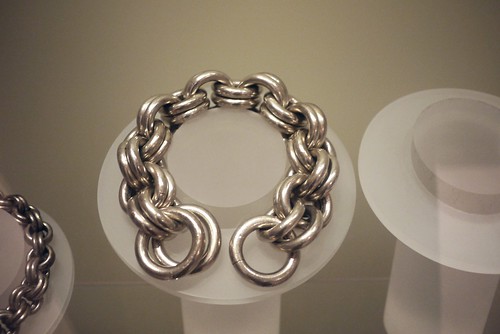
Some more pics from the National Museum over in Edinburgh, though this time with fewer shiny things per se... We'll start with a statement piece, though:


There were quite a few of these in the museum, though unfortunately I didn't spot any of the ones with Pictish symbols engraved on one end. As you might guess, the chains are typically thought to be Pictish in origin, probably dating to around the 5th to 9th centuries CE, and they're more than likely to have been worn by those of high status – not just the aristocracy, but royalty, the information board reckons. Just like the penanular brooches the Gaels wore (like the Tara brooch, for example), they were probably worn as an indication of rank. They were worn around the neck and fastened together with a "terminal link" – the bits that have the Pictish symbols engraved on them, which were originally highlighted with red enamel. Each link is made of solid silver (probably recycled Roman silver), and given the weight of them – up to 2.9 kilos (6.4 lbs) each – it seems unlikely that they were worn as regular, everyday pieces of jewellery. Instead it's thought that they were probably worn "during important ceremonies."

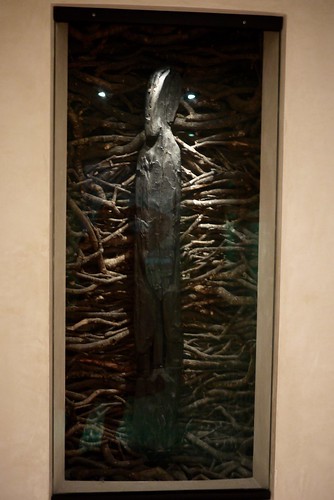
From a slightly earlier period – late Bronze Age – we have the Ballachulish idol:


Which is surprisingly huge – I didn't know it was actually life-size... The figure was discovered in a peat bog with the remains of some kind of wickerwork structure covering it. The site is situated overlooking a sea loch, so it's thought that the figure was meant to represent a goddess of some sort, "probably associated with fertility" – she's holding a "phallic object over her abdomen" so yeah, OK. I think equally the situation of it, overlooking the sea loch, could imply a protective purpose as well?

If you get up close then you can see the quartz pebbles that have been used for her eyes:


Given the long association of white quartz with the dead, could their use be significant? Or were they just convenient?

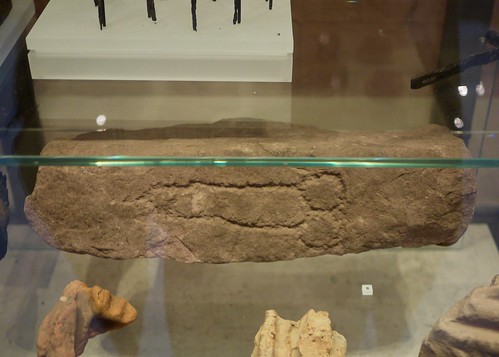
Speaking of phallic object, the museum has a surprising number of them. You can blame the Romans for this one:


It's described as "an undressed stone with carved phallus, Birrens," on the information plate, and dates to the first century CE.

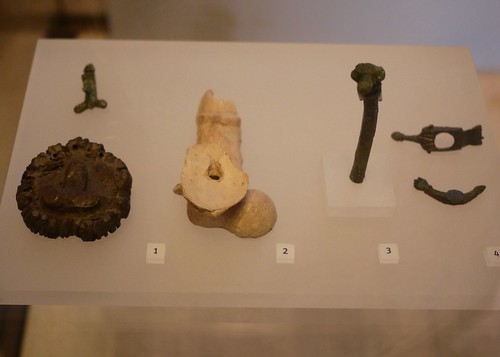
You can blame the Romans for these ones, too:


These are pretty small, and were used as amulets to ward against the evil eye, or perhaps as fertility charms.

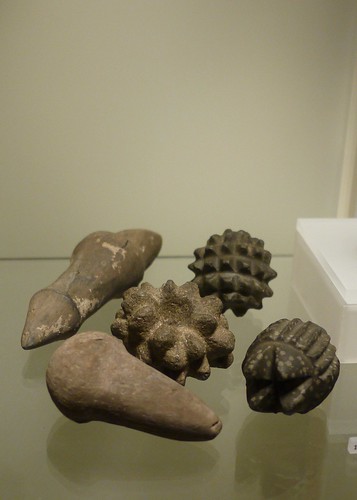
Here we have some "mysterious stones" from Neolithic Skara Brae, one of which looks pretty penile at the least:


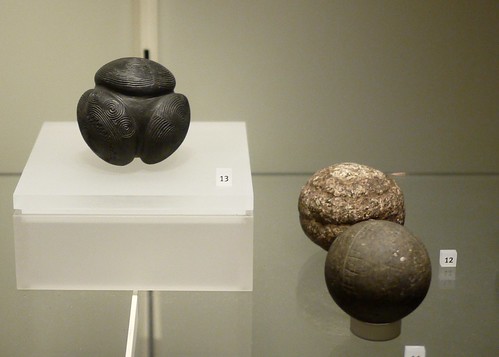
We don't know what these stones were for – maybe "ritual," perhaps simply decorative – but number 13 here is one of the better known examples:


I couldn't get a good close up, unfortunately, but the detailing is spectacular.

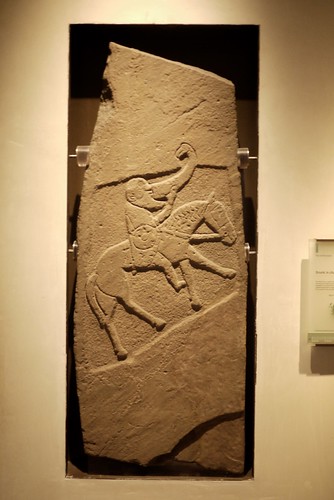
Finally, here we have an unusual carved stone, known as the Bullion Stone (taking its name from where it was found, Bullion, in Angus), which dates to around the tenth century CE:


It's unusual because it's not often that you find stones that have a comical or unflattering tone to them like this one does, and by this point in time carved stones were almost exclusively Christian in its symbolism. Clearly whoever this guy is, he's a little worse for wear and the bird's head on the end of his over-sized drinking horn is looking a little judgemental there. The man appears to be a warrior, with his shield, but he's old and bald – not a flattering look when baldness wasn't considered to be a desirable trait. His horse looks tired and is maybe a little past it, too, as it plods up the steep hill. The drinking horn is maybe intended to indicate a Norseman here, since they introduced them to Scotland, hence the unflattering imagery?


Monday, 11 August 2014

Book Review: A Single Ray of the Sun

Apparently it's been a whole year since my last book review...

I haven't had much of an excuse to splurge on books and fun stuff like that in quite a while, but this last week I decided it was time to treat myself. It was only going to be so long before I gave in and splurged on Celtic Cosmology: Perspectives from Ireland and Scotland, and if you think about it, waiting a whole month or so after its official publication is actually pretty restrained of me. Right?

I'm still waiting for that one to arrive, but the other two I ordered came pretty quickly. The first one I picked out is The Cailleach of Sligo, and I'm only two chapters in but finding it thoroughly disappointing. Oh well, you can't win every time, I guess; if I ever end up finishing it, I'll probably review it but I can see it's the sort of book I'll only ever be half-hearted about tackling. The second book I ordered is the one I'm reviewing just now, John Carey's A Single Ray of the Sun: Religious Speculation in Early Ireland. It's a short and quick read, and I really enjoyed it. It was also only a fiver, so yay.


A Single Ray of the Sun: Religious Speculation in Early Ireland
John Carey


I'd heard pretty good things about this book for a while now and I've always enjoyed John Carey's articles and the other books I've read by him. He tends to deal with areas that are especially useful for Gaelic Polytheists (for a start, I'd recommend getting your hands on his articles, 'The Name "Tuatha Dé Danann,"' and 'Notes on the Irish War-Goddess,' if you can), mostly dealing with the way Irish literature has evolved, and how it reflects pre-Christian ideas, and so on.

To be fair, this book focuses more on early Christian thought than anything pre-Christian, but there's still plenty of food for thought. The book is really a collection of three essays by Carey, collated here into one cohesive volume: The first essay (or chapter) is called 'The Baptism of the Gods,' and this is the most interesting and useful from a Gaelic Polytheist perspective. The second essay, 'The Ecology of Miracles,' has a few tidbits that would be of interest (a few references to druid teachings that will pique your interest if that's your thing), while the final essay, 'The Resurrection of the World,' doesn't have much to offer from the perspective of pre-Christian evidence, but it's one of those things that's good for background on some of the sources that deal with early Christian cosmology.

The first chapter is the most useful because it talks about the different ways the medieval writers, who recorded all of the myths in the manuscripts, dealt with the issue of the gods. There were obvious concerns about how the gods of their pre-Christian past could fit into a Christian framework, but the Irish seemed quite happy to embrace the gods and preserve their stories, tweaking them here and there to accommodate a Christian perspective. Carey talks about the two main ways the gods were dealt with - euhemerisation and demonisation. Euhemerisation was basically a way to argue that the gods of the pagan past were really human ancestors, who were elevated to divine status by the pagan Irish at some point because of their amazing deeds or achievements. That makes it easier to view the pre-Christian Irish as simply being mistaken, allowing the gods to be remembered for their merits while demoting them to human or Otherworldly status. In some ways it's a more forgiving way of reconciling them, because it allows for their being mistaken by virtue of the fact that the word of God hadn't got to Ireland yet. Demonisation is pretty self-explanatory - viewing them from the purely Christian perspective as demons who tricked and deceived the pre-Christian Irish into worshipping them as false gods. It's a less forgiving way of interpreting them, but although both viewpoints are articulated at various points in the myths, Carey argues that unlike elsewhere the Irish never really embraced either view wholeheartedly, which is why the gods persisted so stubbornly - in early Irish prayers, for one, but especially as the aes síde.

The whole subject is important to us in how we look at the myths and interpret the way the gods are portrayed. The gods are explicitly referred to as gods many times, in contradiction with Christian doctrine, so when we see them being reduced to nothing more than Otherworldly beings it raises questions. How do we reconcile all of this? How do we deal with it? We can't see them as less than divine, because they clearly are divine. But there are also hints (when we consider the idea of the Dé ocus an-Dé, for example) that there were always distinctions between divine and non-divine, but still Otherworldly, beings.

One of the things that really caught my eye is that Carey mentions that references to the mortality of the gods can only be dated to the end of tenth century, in a poem by Eochaid ua Flainn, and the concept then recurs in the Lebor Gabála Érenn a century later. So the implication is that this idea of their mortality is Christian in influence, not pre-Christian, and a product of euhemerisation. When we consider the references to their deaths, we can't take them literally, then.

The later chapters have their own merits but I don't think they're going to be of much interest for all but the seriously ie-hard Irish Studies fans. I enjoyed them, but I've studied this kind of thing, so it's probably fair to say that it's a pet subject of mine and I don't expect that most folks would find them as enthralling. But all in all, the book is a quick read and it's reasonably priced, so I think it's worth the splurge - at some point - even if it's not necessarily going to change your life significantly. If you're looking for something to help flesh things out beyond the basics and you have a keen interest in this area then this is a book I'd recommend adding to your wish list.

Friday, 21 March 2014

An Cailleach Bheara

 An Cailleach Bheara

I've posted a link to this short film before, but it's well worth another watch! 'Tis the season, and all...

Soon the Cailleach Bheur will make her lament as she gives up and admits defeat in trying to hold back the onslaught of Spring. As she throws down her wand, she shouts out:

‘Dh’ fhag e mhan mi, dh’ fhag e ‘n ard mi
Dh’ fhag e eadar mo dha lamh mi,
Dh’ fhag e bial mi, dh’ fhag e cul mi,
Dh’ fha e eadar mo dha shul mi.
    It escaped me below, it escaped me above.
    It escaped me between my two hands,
    It escaped me before, it escaped me behind,
    It escaped me between my two eyes.

Dh’ fhag e shios mi, dh’ fhag e shuas mi,
Dh’ fhag e eadar mo dha chluas mi,
Dh’ fhag e thall mi, dh’ fhag e bhos mi,
Dh’ fhag e eadar mo dha chos mi.
 
    It escaped me down, it escaped me up,
    It escaped me between my two ears,
    It escaped me thither, it escaped me hither,
    It escaped me between my two feet.

Thilg mi ‘n slacan druidh donai,
Am bun preis crin cruaidh conuis.
Far nach fas fionn no foinnidh,
Ach fracan froinnidh feurach.’
 
    I threw my druidic evil wand.
    Into the base of a withered hard whin bush,
    Where shall not grow 'fionn' nor 'fionnidh,'
    But fragments of grassy 'froinnidh.'

While the Irish An Cailleach Bheara doesn't have such firm associations with the seasons as the Scottish An Cailleach Bheur does, there are some hints. Cairn T, at Loughcrew (or Sliabh na Caillí) is thought to have an equinoctial alignment:

 Used under Creative Commons licence, by Sean Rowe

The light of the equinox sunrise illuminates the back chamber of the Cairn T at the Loughcrew complex, lighting up carvings that are thought to have astronomical meanings. Near to Cairn T is the Hag's Chair, and she is said to have created the tomb by accidentally dropping a pile of stones from her apron. But of course, in spite of her associations with the place today, we can't really say when the Cailleach came to be associated with the place – certainly not until after Christianity, when the word 'cailleach' came into the Irish language – or if her associations are meant to tie in with the equinoctial alignment. The coincidence with the Scottish Là na Cailliche is tantalising, however.

It does seem like she has other, older names as well, which offer further (possible) seasonal associations. In The Lament of the Old Woman of Beare, she calls herself Buí, who is referred to as a wife of Lugh in other sources, and is said to have been buried at Knowth (Cnogba). In the Dindshenchas of Nás (another of Lugh's wives) she is mentioned again, along with Tailtiu, so one wonders if she has an association with Lúnasa, which were often held at places that are thought to have been the burial place of supernatural women or goddesses who were married to Lugh, or otherwise associated with him? The Dindshenchas of Nás seems to hint that this was the case, since it mentions games and gatherings.

Another Dindshenchas, Lia Nothain, refers to two sisters, Nothain and Sentuinne, both of whom are "Old Women" and Sentuinne itself means "Old Woman" just as "Cailleach" can. The Dindshenchas associates them with May-day, suggesting further seasonal associations:
Nothain (was) an old woman [cailleach] of Connaught, and from the time she was born her face never fell on a field, and her thrice fifty years were complete. Her sister once went to have speech with her. Sentuinne (” Old Woman”) was her name: her husband was Sess Srafais, and Senbachlach (“Old-Churl”) was another name for him. Hence said the poet: 
      Sentuinne and Senbachlach,
     A seis srofais be their withered hair!
     If they adore not God’s Son
     They get not their chief benefit. 
From Berre, then, they went to her to bring her on a plain on May-day. When she beheld the great plain, she was unable to go back from it, and she planted a stone (lia) there in the ground, and struck her head against it and….and was dead. ” It will be my requiem….I plant it for sake of my name.” Whence Lia Nothan (“Nothan’s Stone”). 
     Nothain, daughter of Conmar the fair,
     A hard old woman of Connaught,
     In the month of May, glory of battle,
     She found the high stone. 

The association with Berre (Beare), just as Buí is associated with that place, suggests that they are probably one and the same. So there are some hints and bits of seasonal lore that may be associated with An Cailleach Bheara. It's guesswork, for sure, but I thought it's worth putting out there to ponder.

Thursday, 8 November 2012

Best laid plans and all that...

After all my planning ahead and idle musing on things a few weeks back - and then feeling all smug and organised - Samhainn rolls around and we here in our corner of the universe celebrate it with the delightful aftermath of Norovirus.

Which was nice.

If ever there's a sign that winter's here - you know, aside from the frost and snow we've had - the dreaded Great Affliction is pretty much a dead giveaway, I suppose. So things were a little more scaled back than planned, although all of the important stuff got done, fun was nonetheless had, and I think it was - all in all - a success.

The downside of being a parent is that your kids will inevitably bring varying kinds of snot and bugs home from school so you get to live it all vicariously through one child and then another before you get to experience the delights first hand (my child-free friends are grinning smugly at me through the internet, I can feel it...). By the time it comes around at least you know what to expect, I suppose. On the plus side, by the time the eve of Samhainn rolled around we were all over the worst of it and we were all feeling just a little tired and delicate rather than properly unwell, so at least we were able to celebrate. The feasting element of the proceedings were not something I was particularly keen on, though; nor was Mr Seren. But for some reason, as if my own body was trying to tell me something, I'd had a real craving for gingerbread at the weekend so I'd done some festive biscuits:


And that was all I could really stomach on the eve itself; the ginger helped settle any rumblings quite nicely. I was originally going to let the kids decorate them but Rosie couldn't stomach it and Tom only decided to help out once I'd done most of them. He was very proud of his efforts, though. "The red's blood, mum," he said helpfully. I'd baked a whole load of cake with the intention of sculpting a festive cake, too, but that just wasn't going to happen in the end - so much for great ideas.

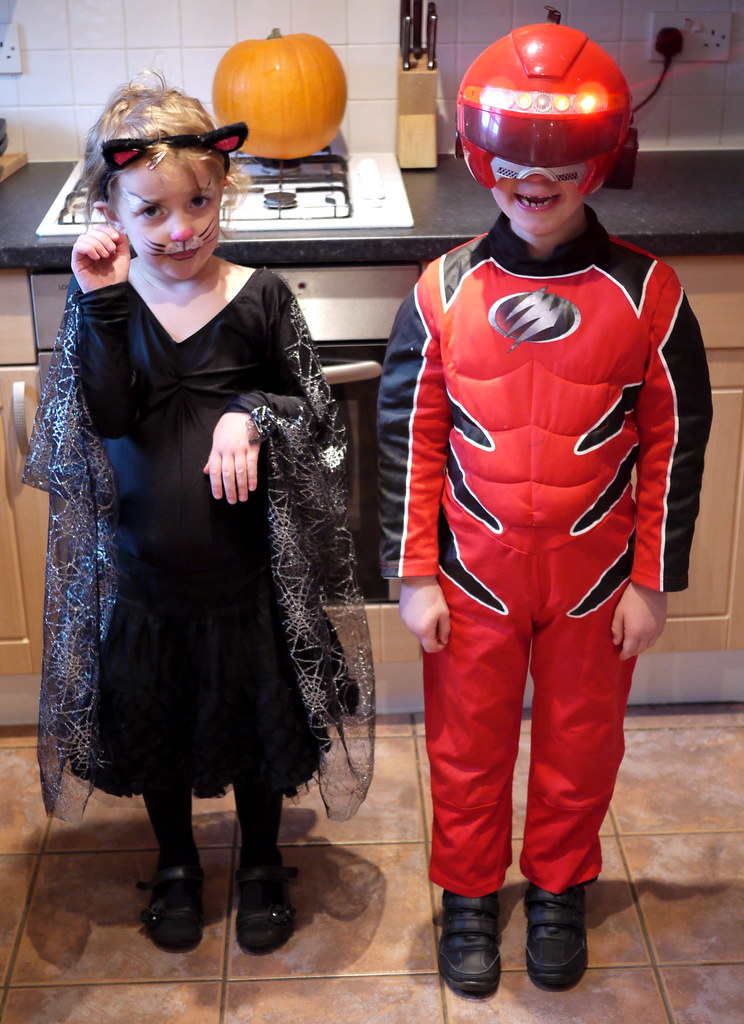
But the morning before the big evening rolled around, the kids came bouncing in excitedly to wake me up so they could have breakfast and get ready for the Hallowe'en parade at school. Tom was going to go as Optimus Prime, but after wearing the costume to the Hallowe'en disco the week before and finding it way too small he opted for his old Power Ranger costume instead. Rosie went as "Bat Cat," as planned. She wanted some face paints to complete the look so I did what I could there, with the hasty help of Google that morning:


So long as she had whiskers she didn't really care, so she was very pleased with her look in the end. I managed to drag myself along to the parade later that morning to cheer them on, and the school was awash with anticipation. And also Norovirus, probably. 

There's nothing like a good bout of lurgy to motivate a thorough housecleaning session, is there? So the house was shipshape and in good order for the evening festivities, and I got some decorations up at least, in between a nap or two during the day. While we did get round to making some more decorations during the half-term holiday we haven't done a seasonal mural yet; our Great Affliction scuppered any plans to do it at the weekend, along with a Hallowe'en party Tom was invited to and the party games I'd had planned.

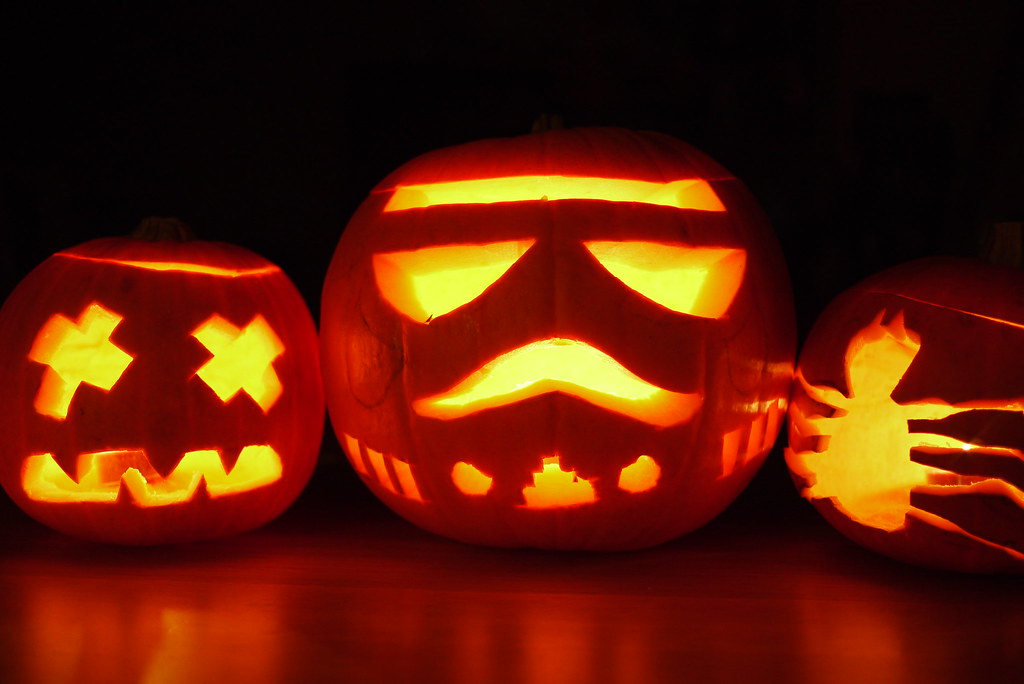
My mother-in-law had got us a large pumpkin for carving (they were on special offer so she got us one spare), so I'd bought two smaller ones for cooking - in the comments of my previous planning post Judith suggested a bread and butter pudding baked in a pumpkin that sounded delicious, and I was going to give that a go until the Great Affliction happened. The other small one was intended for soup and another lantern if I could manage to get the flesh out without having to cut it up. By Samhainn eve I'd already scooped out one of the small pumpkins so I could use the flesh for soup, which I'd done at the weekend while the kids were ill (and my husband promptly ate the whole lot before anyone else got some, barring a small mug I'd had, to see how it was). By Wednesday, although I had at least one pumpkin ready to carve I wasn't convinced I could stomach doing even that one. Mr Seren chipped in and carved the big one into a Stormtrooper's helmet (ish), though, so I knew we'd have at least one. But when I picked the kids up from school the fresh air did me good and I knew I'd have to keep them occupied until they could could go out guising, so they were set with the task of designing a lantern each. The flesh from the second smaller pumpkin went to another batch of soup, instead of pudding. For that we made do with cake (or the kids did, anyway).

I usually carve the lanterns the night before Samhainn, as a way of kicking off celebrations. That night I usually devote to the ancestors in particular, while I carve and make some opening offerings. But given the delicate nature of my condition that evening, carving was out of the question then. I didn't have the opportunity to get any tumshies at all so this year there were no turnip lanterns - that was a real shame, but while I wasn't convinced I'd manage the pumpkins, to begin with, I knew there was no way my nose/stomach would stretch to accommodate the stench of turnip. But what we ended up with still did the job nicely:


Tom designed the cross-eyed one, and Rosie decided the scariest thing she could think of was a spider after flicking through Google and being told that no, butterflies weren't scary and E.T. was way beyond anything I can manage. I royally ballsed up the legs on hers, but I think Tom's came out pretty good.  Young sir was very pleased with it, anyway, and we had fun talking about all the scary things that would be afoot that night as they got creative.

By the time the carving was done it was time to do dinner - I did stovies, since the soup needed a bit longer to cook (we had that the next day). And then we lit the lanterns and put them in the windows at the front of the house to let the guisers know that they were welcome, with great ceremony and excitment. Mr Seren did some games and dancing with the kids while I was doing the fiddly bits of carving and then dinner, but we just didn't have time for party games proper in the end. Seeing as many of the games are food-based, that was probably for the best! But after dinner the kids did go out guising and that's really all they wanted to do, so as far as they were concerned it was the best Samhainn EVAR. For me, though, it's another year without having tried treacle scones. A sad Gaelic Polytheist am I.

While Mr Seren was out with the kids, I had the opportunity to get my ritual on. The guisers were very thoughtful and managed to space their visits out between my opening offerings, then my prayers and devotions, saining and putting up some rowan and so on. It was a little piecemeal in some respects, but none the worse for that.

For once I could sain the kids' room properly without disturbing them - I usually have to do it after they've gone to bed, so I had some luxury to be more thorough there and give the room a good sprinkle. This time, seeing as no one was in the house, I tried burning some juniper, too - I couldn't do too much to get a good smoke going and fill the house, but I have to say the bit of smoke I did generate certainly has a powerful quality to it.

Tom was the first to come back, dashing in to go to the loo (and having to do battle with his costume first). Mr Seren and Rosie arrived not long after, Rosie sporting the manic grin of the happily E-numbered and well-sugared. They had been very successful on their tour of the street, with lots of generous treats from neighbours - it was a fairly quiet night compared to some years previous, but I know a lot of the kids' classmates had also been laid low by the bug that we'd had, too, so like us I think folks had a bit more to hand out to those that did turn up. Mr Seren said the kids did well with their entertaining; at the first couple of houses they were pretty much bricking it and Rosie didn't get much further than the first couple of lines from Twinkle Twinkle Chocolate Bar before trailing off into the Shy Mumble, but by the fifth house or so Tom had already fired into a festive cupcake and had to be held back by Mr Seren before he ended up spraying crumbs over whoever answered the door while Tom tried to do his joke through a mouthful of cake. I'd thought about going out with them, but I'd had such a busy day already I didn't want to over do things - my back is doing a whole lot better but I'm still being a little cautious.

After the kids were back we all gathered in the kitchen to share out the sweets (and a good number of apples and nuts, too), then it was time for homework while the last of the guisers knocked at the door, and then it was bedtime. For once, I didn't have to take the lanterns away from the window because the sweets had run out.

Seeing as I'd already done my ritualling before the kids went to bed I had the opportunity to spend a quiet, candle-lit evening in contemplation and just relaxing. Of course for Samhainn there's a big focus on the ancestors and I had a candle up in the window and invited them to come for a visit if they so wished. I had food out for them, and made offerings to them, and I spoke to them and drank a toast to their memory. And the same to the spirits too, with offerings of peace.

I made offerings to the Cailleach and an owl (the cailleach-oidhche in Gàidhlig) struck up a thoughtful song in the woods nearby. I made offerings to my ancestral deities and a crow cawed off in the distance. I thought back on the year and gave thanks for all the good things that have happened, and thought about the maybe not so good things too. I prayed for blessings, for my family and friends. And I looked up at the stars and out into the night and I listened for a while, and breathed in the cold, slightly smokey air, and that night I slept like the dead, and if I dreamed I've no idea what it was.

At the weekend we went to the beach and I made my offerings to the river and the sea. On Monday night - Bonfire Night, here - the fireworks filled the sky, and as the air was heavy with smoke I chopped up the pumpkin lanterns and buried pieces of them at four points around the outside of the house. I can't beat the bounds around the house with a flaming torch but I can reinforce the boundaries in my own way. We didn't manage to get to a fireworks show (they were at the weekend and we didn't realise, but the local event was Disney-themed anyway, so it was probably for the best - we don't do Disney in this house), but one of our neighbours always has a display in his back garden so the kids didn't miss out. Poor Mungo practically had a nervous breakdown, though, wrapped in a towel and cowering beneath Mr Seren's desk. Our older dog doesn't mind them (plus he's basically deaf now) but Mungo can't stand fireworks.

So that was Samhainn. Not quite how I'd planned but it all came together in the end, I think.

Sunday, 28 October 2012

The Gruagach, the Guaigean and the Geige

 A gruagach is a local land spirit in Scotland, who is said to look after cattle in the summer pastures, to make sure they don't wander off and come to any harm. It seems that to a certain extent the gruagach has come to be conflated with a brownie, which is probably not too much of a stretch considering the fact that they are both helpful to humans (with caveats), and will both take themselves elsewhere if you give them clothes.

In a lot of lore about spirits, you tend to find that offerings are very much encouraged when trying to build a relationship with them, but too much gratitude will backfire spectacularly. The gruagach is helpful so long as they are treated right; it is traditional to leave some milk for them in the hollow of a special stone, with offerings given to them at Bealltainn as well, and in some places the offerings are kept up (though unfortunately the one video I've seen about it has now been taken down). Traditionally, if their offerings are neglected the gruagach might not look after your cattle, or worse - they might deliberately lead them to harm. In many ways, the gruagach bears all the hallmarks of a pre-Christian local deity, even if their name might not be known anymore, but according to some the gruagach may be a ghost of someone local, who haunts the glens and looks kindly on people.

Thomas Pennant and Martin Martin both write about the gruagach in their work dating back to the late seventeenth and eighteenth centuries, and you can find an essay on the gruagach in one of Pennant's volumes. Their name refers to their long hair (a motif that points to their Otherworldly nature), and usually they're female. In some parts of Scotland, like on Skye, they're more likely to be male (and tend to be the default explanation for how a pretty young maid might have got pregnant out of wedlock while she was up on the summer pastures).

So in general, they seem to be the kind of spirits that we want to propitiate, and it all seems quite simple. Looking through the Carmina Gadelica late one night last week, though, I found some interesting notes on the gruagach in Volume II, which have coincidentally good timing for Samhainn:
Gruagach, a supernatural female who presided over cattle and took a kindly interest in all that pertained to them. In return a libation of milk was made to her when the women milked the cows in the evening. If the oblation were neglected, the cattle, notwithstanding all precautions, were found broken loose and in the corn; and if still omitted, the best cow in the fold was found dead in the morning. The offering was poured on 'clach na gruagaich,' the 'gruagach' stone. There is hardly a district in the Highlands which does not possess a 'leac gruagaich'--a 'gruagach,' flag-stone--whereon the milk libation was poured. I have seen such stones in Arran, Kintyre, Gigha, Islay, Mull, Lismore, Kerara, Lorn, Iona, Tiree, Coll, Barra, South Uist, Benbecula, North Uist, Heisgeir, St Kilda, Harris, Lewis, Sutherland, Ross, at Culloden, Cawdor, Lochaber, and in various other places. All these oblation stones are erratic ice-blocks. Some of them have a slight cavity into which the milk was poured; others have none, the libation being simply poured on the stone. In making the oblation the woman intoned a rune--

'A ghruagach, a ghruagach,
Cum suas mo spreidhe,
Cum sios an Guaigean,
Cum uap an Geige.'

Brownie, brownie,
Uphold my herds,
Keep down the 'Guaigean,'
Keep from them the 'Geige.'

There is probably no district in the Highlands where the 'gruagach' could not be fully described. A woman living in the remote island of Heisgeir described her so graphically and picturesquely that her interested listener could almost see moving about in the silvery light of the kindly moon the 'gruagach' with her tall conical hat, her rich golden hair falling about her like a mantle of shimmering gold, while with a slight swish of her wand she gracefully turned on her heel to admonish an unseen cow. At intervals he seemed to hear her mellow voice in snatches of eerie song as she moved about among the grassy ruins of the old nunnery--all silent now of the holy orisons of gentle sisters.

The thing that interested me the most was the mention of the 'Guaigean' and the 'Geige' - it's not something I've seen much about in Scottish lore in general. In another note from Carmichael (at the same link, as above), there is a description of the Geigean:
Geigean, Righ Geigean, Geigean, King Geigean. This was the term applied to the man who presided over the death revels. These were held in winter. Lots were cast, and the man upon whom the lot fell was elected king of the revels, over which he reigned from midnight till the old cock crew. A tub of cold water was poured over his head and down his throat, after which his face and neck were smeared with soot. When the man had been made as formidable and hideous as possible, a sword, scythe, or sickle was placed in his hand as an emblem of office...

A rhyme common among boys at play says:--

'Thaine mi o chri-chas,
Thaine mi o chruai-chas,
Thaine mi o Ghigean,
Thaine mi o Ghuaigean,
’S thig mi uat-s’ ma dh’f haodas mi.

I came from small peril,
I came from great peril,
I came from Geigean,
I came from Guaigean,
And I will come from thee if I can.

'Gigean' and 'Guaigean' are probably forms of 'Geigean.'
So the immediate conclusion seems to be that the offerings to the gruagach are in the hopes that the gruagach will then protect people against the Geige (or Géige, as it should be - Carmichael was terrible for not bothering with accents in the first two volumes especially) and the Guaigean. Considering Carmichael's comments on the Righ Geigean we might suspect that the latter perhaps represent spectres of wintry danger or death, effectively. And/or, considering one of the tales in the first link, of the ghostly gruagach who protected against murrain, she works against sickness spreading.

My first thought was to wonder if the rite described might have something to do with Samhainn (since the festival marks the start of winter); Carmichael was notoriously leery of mentioning Samhainn at all, albeit for a brief entry in the notes in volume II and a few other passing mentions, so he's unlikely to spell it out and it wouldn't be any wonder that he was vague on that point. Pulling out my trusty copy of The Gaelic Otherworld, Ronald Black's notes refers to the Righ Geigean ritual as being performed, specifically, at the beginning of winter (see p457), so that seems to confirm it. It's interesting that the taking of lots seems to mirror a similar practice from Bealltainn, where the men would come together and take turns, blindfolded, to pick out piece of bannock from a basket or cloth. In this case, at Bealltainn, whoever got the burnt piece of bannock called the cailleach beal-tine would effectively take on the burden of failure in the coming season; it would be assumed that they would struggle, in order to allow the rest of the community to prosper. It seems a similar idea is intended for the Righ Geigean - they suffer, so others don't have to.

It's not the only instance of Samhainn practices echoing those found at Bealltainn; it seems the practice of making offerings - by throwing pieces of bannock over the shoulder, with a prayer said - to keep away threats from livestock and family was performed at both Bealltainn and Samhainn. Interestingly, according to Dwelly, a guaigean can be defined as either "a thick, little round cake," or else "a short, stout man or boy." A géige, on the other hand, is primarily a branch or sapling, but can also refer to "a young, superfine female, nymph."

I've not found much else on the Géigean, aside from some hints that it may have been related to the urisk (or ùraisg) who often get lumped in with the brownie and gruagach as a kind of helpful spirit. This is a little confusing, because the ùraisg seems to have something of a more mischievous reputation than the others, but is generally harmless and solitary, preferring to hang around waterfalls or streams. If they happen to live near a farm they might also help out around the farmstead if given milk or cream. So not much like the dangers hinted at in Carmichael's prayer. They tended to have a wilder appearance than the gruagach, though, sometimes being described as half-goat, half-man or quite frightening to those who could see them. According to John Gregorson Campbell, at least some of them did have some association with wintry elements:
"A man passing through Srath Dubh-Uisg (near Loch Sloy at the head of Loch Lomond) on a keen frosty night heard an urisk on one side of the glen calling out: Reoth, reoth, reoth. "Frost, frost, frost."

This was answered by another urisk calling from the other side of the glen: Ceige-reoth, ceige-reoth, ceige-reoth. "Kick-frost, kick-frost, kick-frost."

The man, on hearing this, said, "Whether I wait or not for frost, I will never while I live wait for kick-frost." And he ran at his utmost speed till he was out of the glen."
Black, The Gaelic Otherworld, 2005, p106.

Ronald Black's notes on this say that Reoth and Ceige-Reoth more than likely refer to the names of the two urisks in the glen - Frost and Jack Frost, "as it were" (op. cit. p363). Furthermore, Ceige-Reoth here refers to the Géigean, ceige meaning "a mass of matted hair" and - aside from Ceige and Geige being very similar - the word denotes the "wild figure" of the Géigean himself.

All things considered, confusing though it might all be, it offers some food for thought for the coming season.

See also here, if anything, in case you're wondering how to pronounce guaigean!

Saturday, 9 June 2012

Notes!

Seeing as I got a few encouraging comments on the notes I did the other week I thought I could make it into an occasional "I'm-bored-and-I-have-nothing-better-to-do" feature. The kids are away for the weekend and I find myself in just such a position (though I'm not bored; I'm procrastinating), so how about we do this? I'm sure I'll come up with a pithy and imaginative title for such posts at some point...

I've created a new page at the top to make a list of all the articles I've written up so far, imaginatively titled "Notes." I'll also tag everything under that label. At the moment the list is in the order I've done them, but at some point as the it starts to get a little unwieldy I might organise them by subject instead. If you know of any articles that you think might be worth looking up, feel free to give me a prod, I'd really appreciate it!

Anyway, onto today's article.


Bendacht dee agus andee fort, a ingen (Táin Bó Cúalgne 2111, O' Rahilly)
David Rankin
Zeitschrift für Celtische Philologie Volume 51 (1999)

This is an article that proved useful when I was doing writing up some thoughts on the dé ocus an-dé or 'gods and un-gods' a while ago. The Irish in the title of the article translates as "A blessing of the gods and ungods on you, o woman!" and it comes from an episode in the Táin between Cú Chulainn and the Morrígan, where Cú Chulainn unwittingly heals the Morrígan with these very words.

Rankin argues that the formula and the context it's given in is significant, suggesting that it may be from an actual healing rite that may be of pre-Christian origin (although it doesn't come to us unchanged - 'Bendacht' is an Irish word that's been borrowed into the language from Latin, so it's clearly a Christian word). As far as that goes the idea is interesting - there are some actions and symbolism that are pointed out, like the cow have three teats, milk being involved, the formulaic blessings and responses given between the wounded and the healer...Rankin concludes: "We may have an archaic ritual in which one party contributes formulae and the other performative (and possibly verbal) responses. Also relevant is the profound ritual power of milk in ancient Irish culture. Milk as it flows may restore eloquence, and a trench filled with milk was said to have restored slain warriors." (118) It's not something that can be proved conclusively one way or another, but as these things go it certainly offers something to chew on. Maybe it's not a description of an archaic ritual as such but the symbolism and actions do seem to draw on plenty of cosmological ideas.

The main meat of the article discusses the meaning of the phrase itself, and in particular explores who the an-dee (an-dé, or in modern Irish, an-déithe) might actually be. Rankin points to other sources that mention the dé ocus an-dé, like Lebor Gabála Érenn, and casts a wider net and looks at possible avenues of comparative evidence too - the deva and adeva of the Rig Veda, and so on  (I've tried to cover the main points in my discussion over on the 'Gods and Spirits' article so there's no point going into it here again).

Rankin also makes a note of the fairly neutral wording of the statement - no specific gods or ungods are mentioned - and he argues that this itself is deliberate. On the one hand, the statement is far more all encompassing and so allows an appeal to as many different kinds of supernatural beings as possible. On the other hand, it might reduce the risk of causing any offence to those who would otherwise get left out with more specific phrasing. Then again, there are formulas like tongu do dia tonges mo thúaith ("I swear by the gods my people swear by") that seem to deliberately avoid naming any names for other reasons. Words and names have power, and so perhaps the names of one's gods (or certain kinds of gods) were kept secret - to a certain extent at least. In theory, if your enemies know the names of your gods, they might appeal to them and get them on their side instead of yours. That idea in itself is fodder for a whole other article; after all, plenty of Irish deities seem to be referred to by epithets than actual names - the Dagda, the Morrígan, the Badb...

There's not a lot that can be said for certain here, but there's definitely a lot of food for thought as far as considering how it all might apply in a Gaelic Polytheist context. It's definitely an article worth reading.

Friday, 21 January 2011

*Oink oink*

What else is there to do when you have swine flu than...do another article? This time, illustrated!

The swine flu (suspected, I should say) hasn't been so bad, but not a joyous occasion either - especially when the whole household comes down with it at pretty much the same time. Aaaand, I finally managed to get hold of Nagy's Wisdom of the Outlaw, only to have it recalled for another user. Aside from a quick skim I haven't managed to even get started reading it yet. So close, yet so far...Luckily my husband managed to leave his phone in a bookshop in Glasgow while he was working there yesterday, so he'll be able to drop the book off while he's in the city today and save me a flu-ridden train ride myself. Not that I'd complain about having to go to the library. I could do with a day to myself.

Anyway. As usual I started reading up on one thing and got completely sidetracked into writing about something else, probably because this one was easier to tackle in some ways. It started with me finding an article called Bendacht dee agus andee fort (i.e. Blessings of the gods and ungods on you) and ended with me thinking about how the gods are so closely tied to the land (every day's a party in my brain, I can tell you), and wondering what that would look like on paper. Well, 'puter. If anything, I thought it might be interesting from the perspective of looking at possible ancestral deities.

This resulted in me scribbling down a map and charting the places that the gods are said to inhabit (or have died, or created etc), which - with the aid of a hastily downloaded open source image editor - spawned:

Gods of Landscape and Lore

I'm sure there's a helluva lot more that could be added, but space constraints and Google maps limits me somewhat. So mainly I've concentrated on places and mountains, rather than the smaller features like plains that are harder to locate.

Other than that, I've been having some festive thoughts, and thoughts about getting back into the garden and so on, but that will have to wait for another exciting installment here on the Days of Seren's Life...