Monday, 19 February 2024

Tairis is Down (Sorry)

A number of people have got in touch this past while asking about the fate of tairis.co.uk, which has been unavailable for a while (and/or difficult to access). 

So first of all, I'm so sorry the site's been down for so long! I'm not actually sure what's happened but I've been assured it can be fixed, so the Tairis site will be back – at some point (I hope...). I'm just waiting for my husband (and resident person-who-knows-what-the-heck-they're-doing-with-this-sort-of-thing) to find a moment where he's actually able to sit down and take a look at it. Things are quite hectic at the moment, to say the least, though, so as much as I'm hoping that will be soon I can't make any promises. 

In the meantime, the site can still be accessed via the Wayback Machine, so try the following link below (I've chosen a snapshot from a time when the site was less broken than it's been in recent years... oof):

Tairis.co.uk

Second of all, I'd just like to say thanks to everyone who's got in touch in the past few months or so to ask what's going on and express their sadness that the site might have gone comletely. Your kind words have meant a lot, I really appreciate it.

Sunday, 15 September 2019

The Grianán of Aileach

Further adventures on holiday...

After being generously indulged with all things archaeological on our last holiday to Ireland, back in 2014, this time around the only thing I really really wanted to do, besides visiting the statue of Manannán, was a trip to the Grianán of Aileach (the 'Sunny Place' of Aileach), which is situated just across the Irish border in Co. Donegal:

Credit to Mark McGaughey via Wikimedia Commons

As you can see from this overhead shot (most definitely not taken by me) it's an impressive stone hillfort with really thick walls – they're about 4.5m thick, or nearly 15ft for you imperialists.


Historically speaking, the site is thought to have been occupied as a hill-fort of some sort or another from as early as the Bronze or Iron Age, although evidence of activity may go back as far as the Neolithic. It's situated at the top of a hill that commands an impressive view. To one side there's a view of Lough Swilly, while to another there's a view of Lough Foyle, which heads off towards the Atlantic.


The walls as they stand today are thought to have originally been built some time in the sixth or seventh century, and the place was occupied for several centuries until it was destroyed in 1101 by Muirchertach Ua Briain, the king of Munster (and self-proclaimed king of Ireland at the time). By the nineteenth century it was in a state of disrepair, and restoration work was undertaken in 1874-1875. After the walls partially collapsed in the early 2000s, further restoration was undertaken, which proved rather controversial.

Given how exposed its situation is, the walls do a good job of protecting the interior of the fort from the elements.


There's only one entrance, so it's pretty good for defence, too.


The hillfort served as a royal capital for the Cenél nEógain ('the Kindred of Eógain,' or 'Owen' as the name is Anglicised), a branch of the Uí Néill ('Descendants of Niall'), but it's the mythology that's attached to the site that interests me. There are several Dindshenchas ('Placename Lore') stories that explain the origins of the site and how it got its name, and even within these stories there are several explanations that may be given.   


The main version of the story tells of how a son of the Dagda, Áed, had an affair with a married woman. The name of the woman is apparently irrelevant because we're never told it, but her husband, Corrcend, is not a particularly happy bunny upon discovery of the news. He murders Áed in cold blood and then decides to leg it right quick in order to avoid the consequences. The Dagda, however, being king at the time, marshals his resources and sends out a search party or two. Corrcend is eventually found and brought before the grieving king.

The Dagda decides to punish Corrcend for his crime and orders him to build a suitable grave for his son. Corrcend is forced to trudge down to one of the local loughs where he must then carry rocks back up to the top of the hill in order to build a grave-mound for Áed. As the grave is very near its completion, Corrcend carries an especially large rock up the hill. By this point Corrcend is exhausted and using every last ounce of strength in his reserves, but soon he finds he can't take it any more. As he reaches the top, he cries out from his exertions. First he shouts "Ail!" which pretty much means "the rock!" and then he shouts "Ach!" which pretty much means "ach!" And Corrcend's heart gives out and he dies on the spot.


The Dagda, evidently having a sense of humour even in the midst of a personal tragedy, declares that Corrcend has given the place a fitting name, and announces that Ailech shall be the name of his son's grave from that point onwards. Ailech, as it happens, can either refer to a pile of rocks, or else it can refer to a type of satire or an invective. By coincidence, the word aílech may refer to dung or manure.

So Corrcend's famous last words could effectively be interpreted as a rather stilted exclamation of "Shit!"


The Dagda then employs a couple of stonemasons to build a hillfort on top of the grave. When the hillfort is finished, the Dagda gives it to Néit and his wife Nemain.

A while later, after what we can only presume is a glorious reign because we know pretty much nothing about Néit's life, Néit is killed by Nemtuir the Red, a Fomorian. This is during the reign of Mac Cuill, Mac Cécht and Mac Gréine, the three sons of Cermait Milbél, another of the Dagda's sons, and their reign was long after the Tuatha Dé Danann defeated the Fomorians at the second battle of Mag Tuired. The fact that a member of the Fomorians is causing trouble – breaking the peace treaty that was agreed upon after the Tuatha Dé Danann won the battle – is a bad sign.

Upon hearing the news of Néit's death, the three kings make haste to the Grianán of Aileach, having heard rumours of a crap ton of treasure being up for grabs. There's no indication that the kings made any effort to retaliate or seek justice for Néit's death, their only concern is treasure and this is another bad sign – a king's job is to demonstrate good judgement and ensure justice is done (amongst other things, of course), but to all intents and purposes neither Mac Cuill, Mac Cécht, nor Mac Gréine have shown any concern in this. As traditional narratives go, this is a pretty big sign of impending doom...

While they're at the Grianán of Ailech, a member of the Milesians, Íth son of Breogán, arrives from Spain. Íth is the first of the Milesians to arrive in Ireland, having spotted land in the far distance while looking out to sea from the top of a great tower his father had built, and he decides then and there to sail over to this new land and see what it might have to offer. Having made his way to the Grianán, Íth finds the three kings of the Tuatha Dé Danann still bickering about the treasure, although they stop for a moment to welcome their new guest. During his stay, Íth acts as a peace broker, settling the matter once and for all.

Íth also comments on how rich and wonderful Ireland is, how pleasant the climate is, and how the country has everything one could want a home to offer. Mac Cuill, Mac Cécht, and Mac Gréine hatch a plan to kill Íth, seeing him as a threat. He hasn't made any threats outright, but his comments clearly imply an interest in muscling in on everything Ireland has to offer, and naturally Mac Cuill, Mac Cécht, and Mac Gréine aren't interested in sharing. Íth is killed on his way back to his ship, the site of his death then taking his name, Mag Ítha, or 'the Plain of Íth.'

The mysterious disappearance of their beloved relative prompts the sons of Míl, Eber, Donn, and Éremón to sail over from Spain in order to see what's going on. This ultimately ends up in a battle between the Tuatha Dé Danann and the Milesians over Ireland's sovereignty, which is fought at Tailltiu. In spite of the Tuatha Dé Danann's best efforts to fend off the invaders, the Milesians win, and the three sons of Cermait Milbél are killed. The impending doom that's foreshadowed by the three kings' bad behaviour is fulfilled. In the resulting peace agreement, the Tuatha Dé Danann take to the hills and the otherworldly síde, and Ireland is handed over to the realm of human mortals.

As it happens, the fort does appear to have been built on top of a Neolithic grave mound, which might have influenced the story of Corrcend. That's assuming the site's identification with Ailech is correct, however; since Ailech was originally destroyed in 1101, the place remained a symbol of political power in the area, and poets linked named various different places as being the 'real' Ailech, which has confused matters somewhat. In recent decades, a number of other sites have now been suggested as the possibly 'original' Ailech, but – as yet – these proposals have yet to gain much traction.


Whatever the case may be, it's a beautiful and unique place and well worth the visit. If you ever get the chance, go!

Tales:
Ailech I in the Metrical Dindshenchas
Ailech II in the Metrical Dindshenchas
Ailech III in the Metrical Dindshenchas
Ailech in the Prose Tales of the Rennes Dindshenchas
Inishowen
Lebor Gabála Érenn Part V

Saturday, 7 September 2019

Visiting Manannán mac Lir

It's been a while...

Back in January 2015, if you recall, news broke that a statue of Manannán mac Lir, which had been erected at Gortmore Viewing Point on Binevenagh Mountain, near Limavady, just one year previously, had been stolen. After removing the statue (apparently using an angle grinder), the thieves left a large wooden cross in its place, which read 'You shall have no other gods before me.'

The theft, which appears to have been religiously motivated, received a huge amount of attention, both locally and internationally, and even prompted a (rather tongue in cheek) missing person's appeal by police to help raise awareness. Although the people responsible for the theft and vandalism of the site have never been caught, the statue was eventually found by a group of ramblers – exactly one month after its disappearance – just 300m from its original position. Aside from having been cut from its platform right at the feet, the thieves had tried to remove the head. It was decided the statue was beyond repair, and after some debate (with some vocal opposition railing against restoring the 'paganistic monument'), local councillors agreed to commission a replacement from the original sculptor, Darren Sutton. Just over a year after the original statue's theft, the new statue (which was made with additional reinforcements to make any future attempts at a repeat more difficult) was put in its rightful place. 

Back in 2014, Mr Seren and I took the kids on holiday to Ireland, basing ourselves in Dublin and taking in the Newgrange complex, Kildare, and Tara, amongst other things. In July this year, we decided to take a trip back over the water, and this time we based ourselves in Portrush, right in the far north near the Giant's Causeway and not too far a trek from Binevenagh Mountain itself. It's an amazingly beautiful area and we somehow managed to pick one of the hottest – and sunniest – weeks of the year to do it all, which was incredibly lucky. Being so close, the chance of visiting the statue was too much to resist, so one evening (on our 16th wedding anniversary) we took a drive up, an hour or two before sunset.


Close up it somehow seemed smaller than what I was expecting, just from having seen photos of it. The details and craftsmanship of the statue itself is absolutely breathtaking, though, from every angle.


Unfortunately, as you can see in the picture below, there's some minor damage to the statue, including what appears to be a gouge mark on the right leg.


I couldn't say if this is the result of deliberate, malicious attempts to damage it (again), or if it's accidental, though.

The statue was erected at the site because of Manannán's reputed connections to the local area; storms and rough seas are said to be the result of his fury. From the viewing point where the statue stands, you can see Lough Foyle as it meets the Atlantic Ocean.


 Looking out to sea it's absolutely stunning, and turning further inland isn't bad, either. 


The statue of Manannán himself stands on a ship, or part of it, at least. At the back of the ship, the sculptor has detailed some of the most iconic items that were found with the Broighter Hoard, which was discovered in a field near Limavady in the late nineteenth century:


You can see here the torcs and chains, collar, bowl (possibly representing a cauldron), and the miniature boat (replete with tiny oars, benches, and mast), which were all made out of gold.

When they were originally discovered, the items were squashed and badly damaged by the plough that had brought them up to the surface, and the finders – two men working the field, James Morrow and Thomas Nicholl – sold the hoard to the landowner (and their employer), Joseph Gibson, for just £5. At the time, items like this were often sold for scrap; their great age and significance wasn't really understood or appreciated so it wasn't unusual for old gold like this to end up being melted down and turned into something shiny and new, the original form of the items lost for good. Who knows what's been lost because of this, but luckily in this instance the hoard was saved from this sort of fate. It was sold to a private collector, Robert Day, who then had the items restored by an experienced goldsmith. It was only at this point that the form and intricacy of the boat was uncovered (for one), and Day then sold the whole lot to the British Museum for £600.

The Royal Irish Academy, who had become increasingly invested in rescuing items of this nature by this point in time, had tried to secure the hoard for themselves, but it had already been sold before a full inquest had been carried out to establish whether or not it qualified as treasure trove. The RIA believed it did, and were less than pleased that the British Museum had snapped the gold up for themselves. The dispute eventually ended up in court where it was argued the British Museum had bought the hoard unlawfully, because as treasure trove the hoard would belong to the Crown, not Robert Day himself.

The key point in the case was in deciding whether or not the person (or people) who had left the hoard in the field ever intended to recover the items. If the judge ruled that there had been the intention to recover the hoard (say if they'd been buried temporarily, for safekeeping), then they would qualify as treasure trove and the hoard would belong to the Crown. The British Museum would have to give up the gold, and that would pretty much suck for them. If they managed to argue that the items were never intended to have been recovered by the original owner(s) (or a rightful heir), however, the hoard would not be treasure trove and the British Museum would be able to keep them and do with them as they wished.

The British Museum set out to argue that the hoard had been deposited as a votive offering to an Irish sea god, and they brought in an expert to confirm to the judge that there was indeed such a deity – a 'mythical Irish Neptune,' as the judge later referred to him in his ruling – in the form of Manannán, who (crucially) was well-known in local legend. The British Museum also brought in experts who testified that the field in which the items had been found would have been under sea at the time of their deposition, some time in the first century B.C.E., and they further suggested that in order to deposit the items in that particular spot, they would have had to have done so from a boat. As an offering, then, there was no way anyone ever intended to recover them at a later date and that meant the hoard couldn't be considered to be treasure trove.

Hedging their bets a little, the British Museum then also argued that if the court accepted their argument that the hoard was a votive offering, then it couldn't be viewed as having been abandoned because clearly it did have an owner now – Manannán himself! This would mean the hoard couldn't be viewed as treasure trove on two accounts.

The judge, however, had little time or patience for any of this. He dismissed the whole idea as 'fanciful,' and instead accepted the ‘commonplace but natural inference that these articles were… hidden for safety in a land disturbed by frequent raids.’ The hoard was subsequently ruled to be treasure trove and the British Museum were instructed to turn the hoard over to the National Museum of Ireland in Dublin. Except for the occasional tour or loan, the hoard is still on display there today.

Since the court case in 1903, however, the controversy over the true nature of the hoard has continued. Rumours emerged that the hoard was not an ancient deposit at all – votive or otherwise – but had, in fact, been discovered wrapped up in a very modern umbrella, possibly having been hastily stashed after a robbery. Claims were also made that the bulk of the hoard was not Irish in origin (except, perhaps, the ornate collar), but had been imported from India. At around the same time as these claims were gaining traction, another gold hoard at the museum that had ultimately been revealed to be a fake was melted down. As doubts grew about the Broighter hoard, it could have easily suffered the same fate.

In more recent decades, studies have concluded that the hoard really is genuine. The gold itself is not local, and some of the items may be Roman in origin, but none of it is Indian in origin. The craftsmanship of the torcs and the gold collar are clearly Irish, and were probably made in the same area they were ultimately deposited in, around the first century B.C.E. The bowl and boat are so unique there is nothing really to compare them to, but the boat in particular appears to represent a large currach. The rings on the bowl suggest it was meant to have been suspended, just like a cauldron, although its shape doesn't appear to reflect any local examples of that period. Analysis of the local landscape has shown that while the place in which the hoard was deposited wasn't permanently underwater, it would most certainly have been intermittently flooded, and otherwise marshy.

Based on comparisons with other depositions from similar sorts of sites around Ireland, it now seems clear that the Broighter Hoard really was a votive deposit. Whether they were actually intended for Manannán himself is not something we can ever really know, but I think it's rather striking that these repeated controversies (and attitudes of religious intolerance, or dismissiveness towards anything pagan) have worked in favour of raising Manannán's profile so effectively on more than one occasion. Had the statue never been stolen by bigots, I don't think so many people would have heard about the statue in the first place – I certainly didn't know about it until the news broke, for sure. Clearly, Manannán wants to be seen.


Sunday, 4 February 2018

An update for Tairis with added plagiarism (again...)

Là Fhèill Brìghde arrived, and our little household welcomed in Brigid, and the Spring with ceremony and feasting. Rosie did the honours with making our dealbh Brìde this year, which now takes pride of place on the shrine in the kitchen, and she also took charge of inviting her to come visit us. Brigid was welcomed with the words of a very shy, but excited, ten-year-old.

As I posted a while ago, last year, I bought a mould with the idea of making some small candles, and I finally got around to having a go at them. For a first effort they came out pretty good, I think, in spite of the bubbles (I need to regulate the temperature of the wax better, I'm guessing is the problem). I tried out a few colours and the kids are still debating which ones they like the best. I think Rosie did a fantastic job with our Brigid doll – she made several and then picked out the one she thought was most appropriate for the occasion, which she kept under wraps until the big reveal:


We also put out our brat for Brigid to bless, and Rosie chose to put out a necklace she got for Christmas this year, so she has something she can carry around with her.

I made a few crosses while the kids were at school, and then when Rosie got home she decided to join in. I helped her make a three-armed cross out of rushes, and then she had a go at some more out of pipe-cleaners. They really are easier for kids to work with, though I have some reservations about the metal in them. If it contains iron, it kind of defeats their purpose, you know? But still, they weren't the only ones we made, so it's OK. The different colours helped Rosie keep track of where she was, as she tried her hand at a four-armed cross for the first time:


I felt like mixing things up a little so decided to try my hand at something new this year. I've made three- and four-armed crosses most years, as well as the "diamond" type crosses I grew up with, so this time I figured I'd try making a style of cross I've never made before. I settled on the "interwoven" type, which is when, during some searching for images I could work from as a guide, I found a web page that's plagiarised my own page on making the cros Bríde (or crois Brìghde, if you want to Gaelic it up). So that's nice.

On the plus side, it helped me realise that the type of cross I was looking to make was wrongly described on my own page, which has followed through on the plagiarist's page and had a knock on effect in wrongly describing other crosses as well (the Bogha Bríde is a cross inside a circle; they've shown the interwoven type as a Bogha Bríde instead). So I've corrected my own page and I apologise for the confusion, folks. My bad – I think an older source I looked at used the same term to describe an "interwoven" cross (referring to multiple crosses woven together) as other sources did to describe something else (the type of cross I was actually looking to make).

On the negative side, I'm a tad bit annoyed that once again someone is using my words to sell their own religion... I mean, come on. If you want to write about something, use your words! Do your own research! I suppose they at least acknowledge the original source this time, and haven't gone so far as to prevent other people from copying text on their own web pages because they don't want people to do to them what they do to others themselves. Like my previous plagiarist did. Twice.

It's still frustrating, though. And fucking rude. I could report the page with a DMCA takedown notice, but that requires giving my personal details, including home address etc, which is then publicly available online, and that sucks. You can be sure that negative comments to the blogger herself are ignored.

Still. Besides updating the original page, I've also added a new page on Tairis with a guide for making the interlaced or interwoven cross. It's an easy cross to make, with a little bit of preparation, and Rosie had a go at making one, too. I tried a simple version with only three strands along the horizontal and vertical (as did Rosie – in the picture below), and then I tried a bigger one with five strands each – that was all I could fit in, based on the length of the rushes.


From what I've read, these are common to Co. Cork, where much of my nan's side of the family come from. The three-armed crosses are common to Co. Antrim, where most of my husband's family come from.

Wednesday, 3 January 2018

Book Review: Landscapes of Cult and Kingship

Bliadhna Mhath Ùr! Happy New Year!

I hope your 2018 is off to a good start... Round these parts we celebrated Hogmanay in typical rock 'n roll fashion by cleaning the house from top to toe, feeling less smug once said cleaning magically produced a massive pile of laundry to get through, and then finally sitting down to relax of an evening with Shaun of the Dead before ringing the bells in with the Beeb, while Mungo looked rather worried about whether or not the house-cleaning meant my mother was coming to visit.

But onto another review!

Landscapes of Cult and Kingship: Archaeology and Text
Roseanne Schot, Conor Newman and Edel Bhreathnach (Eds.)

This is both one of the most amazing and most frustrating books I've ever read.

It's amazing because it's a collection of essays that are pretty much all firmly dealing with my areas of interest, while it's frustrating because – and do excuse my language – there's absolutely no fucking way to actually own this book at the moment. And that doesn't look like it's likely to change in the near future as far as I can tell.

The good news (ish) is that some of the chapters are available online in pdf format, so you can get a taster for yourself (hopefully these links all work):
The book itself is the product of a conference that was held at NUI Galway back in 2009 (the book being published two years later), and it aims to explore the sacral and religious aspects of kingship and how it relates to the landscape – both in terms of the archaeology its left behind, as well as the way these things are expressed in literature, historical practices, and so on. This inter-disciplinary approach is one of the things I appreciate the most about this book (besides the content itself), and it's very much becoming the in thing these days, so hopefully there will be more to come.

I mentioned in my last review, for Brian Lacey's Lug's Forgotten Donegal Kingdom, that I have a longstanding interest in exploring how the gods relate to the landscape and the people of pre-Christian Ireland (and Scotland and Man, of course, but they're not the focus here). This book is another one for the bookshelf if that's what you're looking for as well, though it concentrates less on the gods and more on what a ritual landscape really means and how it works (or, more to the point, how it might have). As a collection of articles that covers a broad selection of subjects relating specifically to cult and kingship, it's a very different book compared with Lacey's own, which has a far narrower focus.

There are plenty of familiar faces to be found contributing to this book, some of them like John Waddell and Brian Lacey have books I've previously reviewed, while others like Edel Bhreathnach are authors whose books I've yet to get around to reviewing, plus a few others who're on my wishlist (like this one). There are also some authors I've not heard of before, but for the most part they're all solid contributions. Out of them all I think there are only really two that didn't really blow me away – the first chapter, which just seemed to strike an odd tone, to me, considering the rest of the book, and a much later chapter, Marie Lecomte-Tilouine's "Imperial snake and eternal fires: mythified power in a Himalayan sacred site of royalty (Dullu, Nepal)," that had very little to do with anything Irish at all – I appreciated the striking similarities it suggests, but personally don't feel it's helpful to rely too heavily on a comparative approach.

I'll concentrate on some of the chapters that stood out to me the most here (though that by no means implies the others are less worthy of note... I just don't want to waffle on too much), and I'll start with Conor Newman's "The Sacral Landscape of Tara" as an especially thought-provoking contribution; while I sometimes struggled to keep up with some of Teh Big Wurdz and felt it relied on a comparative approach a little too heavily at times, I liked it because it gives an excellent overview of the subject but didn't shy away from offering an interpretation of what it all means, especially in terms of Tara as a ritual landscape. This means bringing together the historical traditions as well, like the stories of the Dindshenchas that relate to the area (not just Tara itself, but the broader complex of the Tara-Skryne valley), and I think that this is the sort of thing that's incredibly important to anyone who wants to try to reconstruct an ancient belief system – not in the sense of reviving an ancient concept of sacral kingship (tell me a hideous-looking hag sovereignty goddess came along and slept with you before transforming into a beautiful young maiden who then made you king and I'm going to think something's terribly wrong with your beer goggles, mm'kay?), but in the sense of how a landscape is seen in symbolic, ceremonial terms; how it's used, what it means, what it makes us see and think, how it helps channel the flow of our religious experiences and our senses on a personal and communal level... It's all deliberate, it all has a purpose.

This brings us neatly onto Bridgette Slavin article a couple of chapters later on, which is titled "Supernatural arts, the landscape and kingship in early Irish texts." Here she makes the point that since the landscape is experienced through our senses, and its form can be used to channel and shape our own sense of it, any change in the landscape therefore changes our perception of it, and how we relate to it. These changes are therefore significant, and this is true in a literal sense, but it's also something that's important in a literary sense, as we see in so many tales where the state of a king's reign is often reflected in the state of his kingdom around him. As Slavin adds, however, there is often a connection between the supernatural arts of the druids, filid and (later on) the saints, with that of the king; they act as a sort of intermediary between the king and the land, being both the king's protector, but also the human agent through which a king might ultimately meet his downfall (Cairbre's curse against Bres for his lack of hospitality, for example). This is a fascinating chapter and well worth a read, I think; it's a shame that this one isn't available online because it really does offer some great insights.

John Waddell's contribution builds on a similar sort of theme as Newman's chapter but with a broader scope, looking at the landscape as a whole (not just the Tara complex itself). He argues – convincingly, I think – that the landscape shouldn't be looked at in simple "ritual" terms, but in mythological and historical terms as well; the landscape, and the way it came to be used – as a ritual centre, as part of a mythological story, an expression of cosmology or cosmogony, as a legal, political boundary or centre – are all intertwined. Politics and religion are hard to untangle in pre-Christian terms, but as Waddell argues, this carried on well into the medieval period as well, precisely because it was so hard to untangle. He also gives some examples of how the gods in the landscape are used over time to articulate certain things; the continuing importance of Áine in the Knockainey area means that she crops up in prophecy poems that was intended to comment on certain political alliances in the thirteenth century, where she is still portrayed as a guardian spirit, if not goddess outright. He also points to an entry in the Annals of Tigernach where the poet Gilla Lugan describes the cause of a plague (spoiler: demons did it) based on information relayed to him personally by Óengus mac Ind Óc, son of the Dagda.* As Waddell himself comments, "There is no reason to suppose that the power of ancestors had diminished; if anything, they played as great a role as ever in the social and cosmological order of the tribal societies of the time." It seems the same goes for the gods, too, up to a point.

Roseanne Schot's exploration of Uisneach and its significance answered a lot of questions for me, and she focuses especially on the site's connections with fire as well as water, noting that the stories surrounding Uisneach itself often focus on origins – especially in terms of manifesting various "primordial waters." This has fascinating implications as far as the subject of creation myths go, but considering the frequent associations between rivers and sovereignty in general, it also brings up some food for thought in that area too. As Schot goes on to illustrate, it's no wonder that Uisneach also has associations with Lug. As Schot sees it, Lug is the "archetypal, omniscient 'king'," so his links with Uisneach, as a sacred centre, as well as a royal centre, make sense (but what about Núadu...?).

Lacey's chapter here, titled "Three ‘royal sites’ in Co. Donegal," is what prompted me to hunt out his book, and for the most part you'll find that they both complement one another nicely. To a degree this chapter is more of the same from the book itself, but that's no bad thing, really, since we get a bit more depth than the book itself has space for – especially in relation to the connection between Lug and local saints such as St Begley (Beag Laoch, meaning "little warrior" or, perhaps originally, Beg Lug, "little Lug"). It offers up some good food for thought for anyone who's interested in Lug, but the broader implications are fascinating too – if this happened to Lug, which other deities got the same treatment that we aren't yet aware of?

One more chapter bears a mention, and that's Elizabeth Fitzpatrick's (et al) "Evoking the white mare: the cult landscape of Sgiath Gabhra and its medieval perception in Gaelic Fir Mhanach," which gives a great overview of the whole horse controversy – the one where Giraldus Cambrensis described an inauguration ritual which involved the new king "embracing" a horse (yes, in that way) before killing it, bathing in its broth and then eating as much meat and drinking as much of the broth as possible. There's long been a debate on how accurate the description is; old Gerald certainly had an agenda and had no desire to be too complimentary about the Irish (he was reporting to the new Norman overlords, after all), so how far can he be trusted on this? Especially when it's unlikely that he ever actually witnessed such a ceremony himself. Some feel he went out of his way to describe as many lurid and frankly damningly barbaric details as he could possibly come up with. Others point to the similarities in the over all description with that of the ancient Vedic asvamedha ceremony, which suggests there may have been at least a grain of truth in Giraldus's description... Unfortunately it doesn't go into details about the significance of horses in Irish tradition (as they relate to sovereignty), but the chapter does go on to conclude that such a ceremony is unlikely to have taken place during the time of the Méig Uidhir inauguration ceremonies (from the thirteenth century), at least. It also goes on to describe another ceremony – the rite of the single shoe – which was used by various dynasties as a way of laying claim to the kingship; the shoe, being left at a certain spot, was meant to be symbolic of the claim the shoe's owner had to the succession.

On the whole this is a very academic book that I'm not sure has an especially mass appeal. In that respect I can understand that it's very niche, which probably explains its limited availability (print on demand, please?), and really it's not going to be of much help to the beginner – at first, anyway. Some prior knowledge of the subject would be useful, for sure. Nonetheless, I think it's an important contribution to the subject that would be complemented nicely by a number of volumes, some of which are – unfortunately – just as hard to get hold of now. That said, if you manage to get hold of Edel Bhreathnach's The Kingship and Landscape of Tara or Bart Jaski's Early Irish Kingship and Succession, Elizabeth Fitzpatrick's Royal Inauguration in Gaelic Ireland c.1100-1600: A Cultural Landscape Study, and Francis John Byrne's Irish Kings and High Kings, you're probably off to a good start.


The Annals of Tigernach – T1084.4
A great pestilence in this year, which killed a fourth of the men of Ireland. It began in the south, and spread throughout the four quarters of Ireland. This is the causa causans of that pestilence, to wit, demons that came out of the northern isles of the world, to with, three battalions, and in each battalion there were thiry and ten hundred and two thousand, as Oengus Óg, the son of the Dagda, related to Giolla Lugan, who used to haunt the fairy-mound every year on Halloween. And he himself beheld at Maistiu one battalion of them which was destroying Leinster. Even so they were see by Giolla Lugan's son, and wherever their heat and fury reached, there their venom was taken, for there was a sword of fire out of the gullet of each of them, and evey one of them was as high as the clouds of heaven, so that is the cause of this pestilence.

Thursday, 21 December 2017

Book Review: Lug's Forgotten Donegal Kingdom

Guess who's been back at the library...

I have a few book reviews to catch up on, but my kids have been spreading various viruses instead of festive cheer these past few weeks. So that happened.

Onto the review:

Lug's Forgotten Donegal Kingdom: The archaeology, history and folklore of the Síl Lugdach of Cloghaneely
Brian Lacey

One of the things I've always been interested in is learning more about how the gods relate to the landscape and the people of pre-Christian Ireland, because the two are so heavily intertwined. We know that certain kingdoms traced their origins back to certain deities, who they saw as ancestors, and then they named themselves after those deities, and they named important places after them, too. And so the gods became attached to places and people, and people being as they are, they tried to expand beyond the boundaries of their influence and spread their power into other territories. When they succeeded, new alliances were formed, dynastic families intermarried, and this meant that as smaller kingdoms became subsumed into more powerful dynasties, or aligned with them in other ways, they too adopted the genealogies and the connections to certain deities. And so we see one of the ways that the gods spread, working their way into the lives of other peoples and other places...

I've yet to find a book that gives a comprehensive view of what this might have looked like for Ireland as a whole, if it were to be mapped out, mainly because I think a huge amount of work is yet to be done before that can happen, and the idea itself presents a few problems that aren't necessarily easy to overcome. But this book here is a contribution to the topic, concentrating on a specific area and a specific people in Donegal, and exploring the connections that Lug has with a certain people who at one time claimed a part of Donegal as their home.

The connection has only relatively recently been established; as Lacey himself notes, the suggestion of Lug's involvement in the area was only posited in 1995, by Dónall Mac Giolla Easpaig, who noted that the area of the Síl Lugdach (whose name means "the offspring (seed) of Lugaid") was once occupied by a people who called themselves the Luigne, whose name means "the descendants of Lug." The question arose, then: Is the Síl Lugdach's eponymous "Lugaid" actually Lug in disguise?

Not to give a massive spoiler, but I think the answer is a convincing yes. The name Lugaid is obviously derived from "Lug" itself, and Lacey looks at the genealogical material that's survived, along with the early dynastic poetry and other historical materials to show how the genealogies were manipulated to essentially "invent" the Síl Lugdach's eponymous ancestor, who is really a euhemerised version of Lug himself, something that was obviously done in the Christian period. Place-name evidence, archaeology and folklore are also brought in to show just how entrenched Lug's associations are with the area, and how he survived for so long. One of the more interesting and unusual things that Lacey explores, in this respect, is the fact that Lug himself may have evolved into (or inspired) at least one local saint (Begley/Beaglaoch) in the area, just as saints such as Brigit, Latiaran and Gobnait are thought to have similar origins elsewhere in Ireland.

Broadly speaking the evidence is split up into a chronological order in the book, with the various chapters concentrating on a certain timeframe and bringing in the different types of evidence being introduced as necessary. The folklore helps to bridge the gap between the early evidence and the more modern period, and it largely concentrates on the Lugnasad sites, as well as the local legends in the area. The local stories of Balor's fight to avert his prophesied demise at the hands of an un-named grandchild is the most obvious example here, even though the stories don't tend to explicitly name Lug himself. This in itself may be significant. The archaeology supplements the evidence of the Lugnasad sites, and also points to possible sites where the Síl Lugdach kings would have been inaugurated, or where they ruled from. These also preserve the name of Lug, indicating their significance; when you think about it, it's remarkable how these things survived, even when so much has changed and so much time has passed.

Also included is a chapter that explores Lug himself – as an Irish god, but also as a god with Celtic counterparts to be found elsewhere, so that we get a broader context as well. I think this is possibly (and sadly) the weakest link in the book, but even here it's not that it's bad or wrong per se; it's mostly down to the fact that it seems clear that this isn't the area in which the author's most comfortable or perhaps knowledgeable in terms of the issues and the kind of research that's been done here (or it comes across that way, to me). Over all the chapter here felt a little superficial, and the references that are given aren't necessarily the best or most up to date. The discussion of the meaning of his name, for instance, gives a couple of ideas that have been put forth (neither of which are especially favoured these days). More than that, though, the subject is a debate that rages on, and I think the uncertainty and controversy surrounding it is worth mentioning, at least, even if there's no space to get into the nitty gritty of it.

Even at his least certain, Lacey does bring up some great points, though. One thing that stood out, to me, was where he points out that in Cath Maige Tuired, the text goes out of its way to note that Lug's foster-father is "Eochu Garb mac Dúach." Lacey comments that this is an "unidentified man," but he thinks that the name is suggestive, since one of the Síl Lugdach's neighbours were called the Cenél Duach (a kingdom they eventually expanded into). So there's a possibility that the name was chosen deliberately, because Eochu Garb could act as a mythological representative of the political ties that existed between the two neighbouring kingdoms at the time. To me, this is a fascinating suggestion, but it gets even more interesting when it becomes obvious that Eochu Garb isn't just some random name the author of the text came up with. He's not the most well-known figure, but he is well-established in the mythology as the husband of Tailltiu, and he is also the grandson of Bres – Lug's adversary in Cath Maige Tuired, whose life he eventually spares in exchange for some key agricultural knowledge. Given Lug's association with agriculture, through his associations with Tailltiu and through his bargaining with Bres to get the specific information he wanted (when is best to plough, sow, and reap), I think Eochu Garb may have more significance here than it otherwise might appear.

That's not to say that Eochu Garb doesn't, or couldn't, reflect the political connections as Lacey suggests. I think it's possible that the genealogical connections involved add a further element to all of it; one of the current trends that's developing in academic work relating to the myths is looking at the genealogies of the Tuatha Dé Danann as a whole and looking at what they can tell us. This is something Mark Williams touched on in his book last year, noting that some of the names in the genealogies seem to express processes relating to poetic composition. It's clear over all that the genealogies of the Tuatha Dé Danann (as outlined in the Lebor Gabála Érenn) are artificial to some degree, at least, and the filid may have used them to show off or enshrine certain ideas or ideals that were important to their profession. But where there do seem to be authentic elements, the connections we find do sometimes seem to reflect the landscape of Ireland as well – the Dagda and Bóand's connections to the Boyne region, with their affair resulting in the birth of Óengus, who wins the brug from his father (or his mother's husband, depending on the version of the story you're looking at). Etc.

This is actually a pretty minor point in the grand scheme of the book, but I wanted to mention it because this is the kind of thing I like to find in a book. I want to be informed, but I like to be inspired as well. Even on a relatively throw-away comment that doesn't form a major part of the book as a whole. The work that Lacey's done here is – if not totally unique – unusual, and it's refreshing, too.

So I really appreciate the work that Lacey's done here (and elsewhere – this is not the only place he's written on the subject, but I think it's perhaps the most accessible in terms of being able to physically own a copy). I think it's important to consider these sorts of connections in the way we view the gods in general. The way the gods relate to the landscape and the people are so intertwined, but these connections are clearly reflected in the way the gods interact with one another, and are related to one another, too. And it also tells us a lot about how they've survived.

It would be wonderful to see more books like this coming out, which concentrate on other areas of Ireland. What kind of picture would we see emerging then? I'd highly recommend this book to anyone – not just anyone who has an interest in Lug, or because they have heritage from Donegal and want to know more about the area (though both are good reasons to pick up the book as well), but because it reflects an important area of research that I feel is invaluable in terms of our understanding. On the whole, I think it's pretty good as an introductory level book, but the reader might benefit from having their own understanding of the basics, at the least. Since it's a fairly niche sort of topic, it's probably not going to appeal to the absolute noob anyway,

Friday, 22 September 2017

Finally an answer

It's been a weird, weird few weeks. I think, in fact, the last few weeks have been the weirdest of my life... It started with a terrible tragedy – we had to have Oscar put to sleep. It progressed with the sudden death of an old friend, which snowballed into some awful revelations for her flatmate. Then it was capped off with my kids receiving a suicide note over Skype from a friend of theirs (he's eleven! But no, it wasn't a joke, and yes, he's OK and getting the help he needs now). And those are just the "highlights."

I mentioned in my last post that Oscar had been diagnosed with epilepsy this last year, and also commented that it's been a bumpy ride... Well, he hit one bump too many after he ate something he shouldn't have, it got stuck in his stomach and it became clear he needed surgery, but the stress of his illness and inability to keep his medication down set off a massive cluster of seizures. In spite of truly heroic efforts (and doses of various medications), the vets were unable to stabilise him and just weren't going to be able to operate. He just didn't stand a chance and on their advice we had to do the kind thing and end his suffering.

As a parent, I think death is one of the worth things you have to deal with. Just seeing their faces crumple when the realisation hits. The emotions, the questions. It's certainly harder when it comes to losing a human member of the family – like their Papa, last year – but that's not to say it's easy when it comes to the furry members of the family. As wonderful and enriching as it is to have a small menagerie in the house, it's always upsetting when the inevitable worst comes to the worst for one of them.

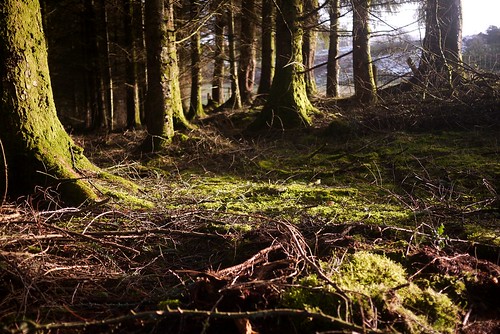
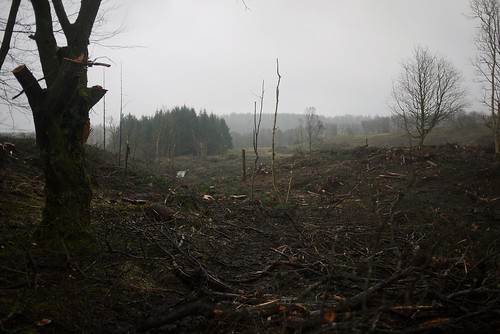
Poor Oscar wasn't yet three years old (it would have been his third birthday come Monday, in fact). It was just after we got him that I discovered a lovely woodland not far from our house that I hadn't known existed until my neighbour pointed me in that direction, and it soon became a favourite place of mine (and Rosie). Rosie loved it so much it even inspired her to poetry, so it was devastating to find the whole woods completely cut down only a couple of months later. It went from this:


To this:


In the blink of an eye.

At the time we didn't know what had happened – as far as I was aware there hadn't been any notices about logging in the area or anything like that, though I'd assumed that a commercial purpose was the likely cause. Well it turns out that wasn't the case...

I hadn't walked that way in quite a while but I suppose, with Oscar gone and Mungo all on his lonesome (no one will play Bitey Face with him in the morning now...), I was feeling a little nostalgic about our walks out that way. As a puppy, Oscar was terrified of water so he'd refuse to cross the shallow part of the stream you had to cross to walk deeper into the woods. His attempts at being brave and big were cute, with the noises he'd make like he was telling himself off as he tried and failed to muster up courage, and it was a big day when he finally succeeded in taking that leap into the unknown and got his paws wet.

So off I went with Mungo this afternoon, wondering (hoping) if they'd maybe replanted yet, and as I walked passed I noticed that there were a bunch of signs up everywhere. The signs explained that the trees were cut down due to a disease that's been spreading through larches in the area, and the only way to treat the disease is to cut the trees down. The signs said that quick action was needed, explaining the unceremonious nature of the logging, and they described what the disease is and how it's spread. And that in time, the woodland will be replanted.

It's a small consolation, I suppose.

Sunday, 27 August 2017

Fat cakes and kittens

Last week the kids started back at school for the new school year (and a new school for Tom – he started high school!), and it so happened that we made our celebrations for Lùnastal (on the "Old Style" date, seeing as the weather's kinda weird at the moment and the fruits are taking their time) in the run up to the holidays finishing. We did the usual cleaning and tidying from top to bottom, inside and out, and had the requisite feast and games, with a thorough saining for good measure. 

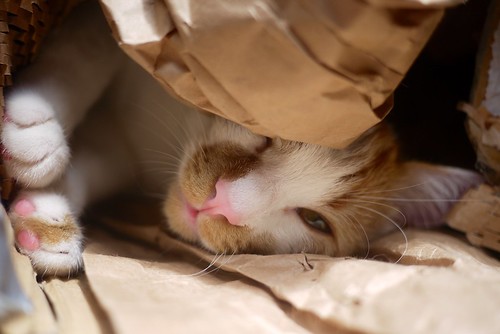
The next day we went into the neighbouring tourist-trap town and had a Proper Good Ice-cream Sundae, as has become our annual end of summer holidays tradition. And we picked up Oscar's medication from the vets, because Oscar is apparently engaged in an epic and seizure-inducing battle against the demons under the living room carpet epileptic. (Thankfully we're getting the kinks worked out and the right dosage sorted now, and he's doing a lot better; it's been a bit of a bumpy ride this past year). And we booked Coco in for his first round of vaccinations. Yes: we have a new addition to the family, our very own ginger ninja (cue shameless excuse to post a cute photo of a kitten):


Oscar is a happy puppy, having finally succeeded in making friends with a cat for the first time in his life. His greatest ambition has been achieved. Their favourite pastime is playing Bitey Face together. Coco doesn't seem to mind Oscar's doggy death breath.

With new school years, new schools, new uniforms, and new routines for the kids, times are changing round these parts. The seasons, however, seem to be stuck in a weird flux between summer hanging on for dear life as long as possible, while autumn valiantly tries to barge its way in. Meanwhile, a few brambles have decided it's time to ripen but the bulk of the harvest has a way to go just yet, and I'm holding off on trying to pick any just yet (you can't beat a good apple and bramble crumble).

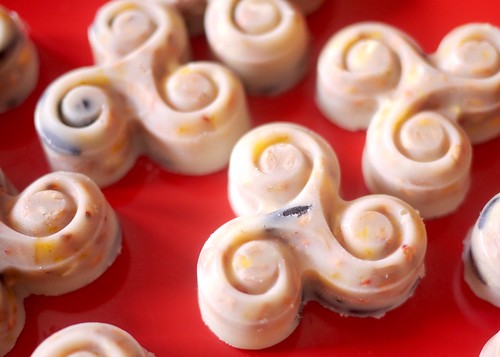
So while we're waiting, I decided maybe it would be a good idea to make some fat cakes to put out for the birds. It's something I usually do over the winter, but seeing as I had a new mould I wanted to try out, I decided why not whip up a batch a little early:


I was originally intending to use the mould to make some wee homemade candles – ones that aren't too big, so I can burn them in one go. The wicks I've ordered are taking forever to arrive, though, so I figured the individual triskeles would make a nice offering to put out (I forgot we have a brain mould... those would've been cool, too).

I'm always conscious of the fact that while birds will usually eat pretty much anything, not everything they'll eat is necessarily good for them nutritionally, so I like to put bird-food out as often as I can. If they're going to eat my offerings, I might as well try and give them a balanced diet, you know? So I mixed some bird seed in with some melted suet until the proportions seemed about right and left them to cool and harden – they don't take long. Rosie, who was off sick on Friday (schools being little more than germ factories, really), helped. We also made a cow and a star, which are considerably bigger and we'll keep those to put out later.

As it is, the crows seem to be enjoying the triskeles, and I'm sure once the weather clears up the smaller birds will be out in force as well. In the meantime, we're just waiting for the blackberries to ripen. It looks like it will be a good harvest this year, they're just taking foreeeeeever.

Wednesday, 23 August 2017

Shony revisited

One of the traditions that has long piqued my interest is the tradition of offering porridge or ale to Shony and its possible connection to Manannán, and since I was poking around a few old journals and found some stuff that provoked some Thoughts, I figured I'd work them all out here.

The custom has been most famously described by Martin Martin, who wrote about it in his A Description of the Western Islands of Scotland, first published in 1703:
"John Morison of Bragir told me that when he was a boy, and going to the Church of St. Malvay, he observed the natives to kneel and repeat the Paternoster at four miles distance from the church. The inhabitants of this island had an ancient custom to sacrifice to a sea-god called Shony, at Hallow-tide, in the manner following: The inhabitants round the island came to the Church of St. Malvay, having each man his provision along with him; every family furnished a peck of malt, and this was brewed into ale; one of their number was picked out to wade into the sea up to the middle, and carrying a cup of ale in his hand, standing still in that posture, cried out with a loud voice saying, "Shony, I give you this cup of ale, hoping that you'll be so kind as to send us plenty of sea-ware for enriching our ground for the ensuing year"; and so threw the cup of ale into the sea. This was performed in the night time. At his return to land they all went to church, where there was a candle burning upon the altar; and then standing silent for a little time, one of them gave a signal, at which the candle was put out, and immediately all of them went to the fields, where they fell a-drinking their ale, and spent the remainder of the night in dancing and singing, &c.
The next morning they all returned home, being well satisfied that they had punctually observed this solemn anniversary, which they believed to be a powerful means to procure a plentiful crop. Mr. Daniel and Mr. Kenneth Morison, ministers in Lewis, told me they spent several years before they could persuade the vulgar natives to abandon this ridiculous piece of superstition; which is quite abolished for these 32 years past."

Some of the key points that have been debated over the years include who, exactly, Shony is, and what Martin meant by "Hallowtide."

Some academics argue that "Shony" is Gaelic for Johnny (Seónaidh), possibly St John the Baptist, and that it's related (in a very roundabout way) to Manannán:
The porridge, gruel or ale was dedicated to a god or saint called Manannan (Manntan, Bannan) or Shony (Seónaidh)... As it involved immersion and was usually performed on the night of Holy Thursday in Easter Week, it appears that Seónaidh is St John the Baptist, having undergone gradual Christianisation from Manannan mac Lir through St Bannan. Some writers, notably Banks and Hutton, have misunderstood Martin's 'Hallowtide' as meaning that the ceremony took place at Hallowe'en. In one recorded instance in Lewis (MacPhail 1895, p.166) Manannan turned into St Brendan the Navigator (Brianailt, Brianuilt) instead, and the ritual took place on his feast-day, 15 May... 
Black, The Gaelic Otherworld (2005), p590. 

Others favour a Scandinavian influence in the name, suggesting that "Shony" comes from the Old Norse son-, meaning "an atonement, a sacrifice:"
As ö from Norse would become o, an fn became nn, one thinks of Sjöfn, one of the goddesses in the Edda. In any case the word is Norse. Captain Thomas thought the word was són, a sacrifice; sjóni, a nickname in the Landnámabók, and akin, suggested Vigfusson, to són, atonement, sacrifice; German sühne, ver-söhnung. In the Hebrides they gave what they had, which would account for the departure from ancient usage. The ancient Norse sacrifice of atonement was thus performed: “The largest boar that could be found in the kingdom was on Yule-eve laid before the king and his men assembled in hall; the king and houseman then laid their hands on the boar’s bristly mane and made a solemn vow… The animal being sacrificed, divination took place, probably by chips shaken in the boar’s blood…. Són was the name of one of the vessels in which the blood of Kvásir, the mead of wisdom and poetry, was kept” (Cleasby-Vigfusson). But cf. N. sjóli, which occurs in an epithet of Thor: himin-sjóli, heaven-prop, heaven-defender (?), hence perhaps king.
Henderson, The Norse Influence on Celtic Scotland (1910), pp101-102.

Henderson has a tendency to assign Norse origins to a lot of things, rightly or wrongly, and it has to be said that the description of the sacrifice doesn't suggest much in the way of similarities with Shony's offerings. This doesn't rule out any Norse influences, conclusively, but (personally) I'm skeptical. Stiùbhart mentions the possible Norse connection, but also suggests that the word may have originally been something like "Sionn" or "Sionnaidh," giving a cognate with Gaelic words like sionn (something mysterious, uncanny, supernatural), sionnach (a fox), sionnachan (Will-o'-the-wisp), and sionnaich (bright). Clearly something Otherworldly or supernatural, either way, and the people of Lewis long had a tendency to refer to supernatural beings and other kinds of phenomena with euphemisms – the sìth being muinntir Fhionnlaigh, for example, or an Otherworldly whirlwind that has a tendency to spring up on the moors being known as uspag Fhionnlaigh. Stiùbhart further suggests that the "Fhionnlaigh" in question here may well be "a modern 'rationalisation' of the original 'Sionnaidh'." Although on the surface this might seem like a bit of a stretch, both "Shionn" and "Fhionn" would sound quite similar to the ear, since the lenition (the addition of the "h" after the consonant) kills the sound of the consonant before it and you'd end up with a "h" sound instead.

If this is the case, we're probably not looking at an association with Manannán, as far as the offering to Shony goes, but more an offering to the spirits of the place (though presumably originally a deity, before Christianity?). Looking to Dwelly's Dictionary, we find an entry for seonadh that supports this idea:
seonadh -aidh, sm Augury, sorcery. 2 Druidism. Martin says that seonaidh is the name of a water-spirit which the inhabitants of Lewis used to propitiate by a cup of ale in the following manner. They came to the church of St. Mulway, each man carrying his own provisions. Every family gave a pock of malt and the whole was brewed into ale. One of their number was chosen to wade into the sea up to his waist, carrying in his hand a cup filled with ale. When he reached a proper depth, he stood and cried aloud “Seonaidh, I give thee this cup of ale, hoping that thou wilt be so good as to send us plenty of seaware for enriching our ground during the coming year.” He then threw the ale into the sea. This ceremony was performed in the night-time. On his coming to land, they all repaired to church, where there was a candle burning on the altar. There they stood still for a time, when on a signal given, the candle was put out, mid straightway they adjourned to the fields where the night was spent mirthfully over the ale. Next morning they returned to their respective homes, in the belief that they had insured a plentiful crop for the next season.
It seems clear that as far as the issue of timing goes, Black is right and Maundy Thursday (or Holy Thursday) was the traditional date, though he kind of glosses over what Hutton actually says about the matter. Hutton doesn't just state that it was held at Hallowe'en, but argues that:
The ceremony was ended in the 1670s after a determined campaign against it by the two ministers, but it simply migrated to, or resurfaced upon, the midnight before Maundy Thursday at the opening of the sailing season. 
Hutton, The Stations of the Sun: A History of the Ritual Year in Britain (1996), p369.

Quite why it supposedly shifted from one part of the year to another isn't commented upon or explained by Hutton, making the claim seem less than convincing.

Returning to Ronald Black's commentary on the subject, after noting a possible connection with Manannán (above), he goes on to note that R. C. Maclagan records a "development" of the rite, which began involving animal sacrifice:
Dr R. C. Maclagan was told of a development of the custom as practised in Lewis c. 1800. Just as the porridge, gruel or ale had formerly been given to the sea to stimulate a supply of seaweed to fertilise the fields, so was a living creature now given to it to encourage the fish (Tocher 20, p.162): "A sheep or goat was offered as a sacrifice. The oldest man of the sea was expected to take the lead, assisted usually by the one who came second in respect of seniority and experience. The animal was brought down to the edge of the sea, and after a certain order of procedure was observed, the officiating person, who was a kind of priest for the occasion, in the midst of dead silence, and surrounded by the whole company of those interested, who stood looking on, went down on his knees, and proceeded to kill the victim, whose blood was carefully caught in a dish. This over, the officiating man waded out into the sea as far as he could, carrying the vessel in which the blood was, and scattered the blood as widely as he could on the water round about him. Then followed the disposing of the carcase, which was cut up into pieces corresponding to the number of poor persons in the district, and a piece was sent to each such person, to be eaten by them; but none else would touch it."
Black, The Gaelic Otherworld (2005), pp590-591.

However, Domhnall Uilleam Stiùbhart has since published a letter from 1700 that describes animal sacrifice being involved already, a hundred years before Maclagan described this "development"; even more interesting is that the letter was written by John Morison (Iain mac Mhurch' 'c Ailein), the same person who Martin says was his informant in describing the offerings to Shony that he included in his A Description of the Western Islands of Scotland.

The letter that Stiùbhart published and provides commentary on is "Ane Accompt of some heathenish & superstitious rites used in the Isle of Lewis given by a friend to Mr Alan Morisone Minister of Ness 15 April 1700," and in it the author lists a number of "paganish customes," some of which he fears are "not as yet abolyshed." In giving a list of these customs, he includes:
Others contribut a quantity of Corn & make malt of it, & brew it into ale, and drink it in the kerk pouring the first coigfull into the sea, that they may have fish the better that yeir and sea ware for there land, And all the town with joyn in this work but now its abolyshed, they called this kynd of sacrifeceing Shion, but the Etymology of that word I know not. Others killed ane heiffer or bullock and threw the blood of it into the sea wt certaine rites and ceremoines promiseing to themselves therby the more abundance of fysh and sea ware to be brought ashore to them.
Stiùbhart, "Some Heathenish and Superstitious Rites: A Letter from Lewis, 1700," Scottish Studies: the journal of the School of Scottish Studies 34 (2000-2006), pp205-205.

According to Morison, then, the sacrifice of a cow was an alternative method of doing the same thing (perhaps something that was reserved for more desperate times?)

In spite of the author's claims that the rite was already "abolyshed" by his time of writing, references to such efforts continued up into the 1900s, though it's not entirely clear if the descriptions are from contemporary accounts, or are a recycling of Martin Martin's own description. Alexander Carmichael mentions the custom in the Carmina Gadelica, saying:
Maunday Thursday is called in Uist 'Diardaoin a brochain,' Gruel Thursday, and in Iona 'Diardaoin a brochain mhoir,' Great Gruel Thursday. On this day people in maritime districts made offerings of mead, ale, or gruel to the god of the sea. As the day merged from Wednesday to Thursday a man walked to the waist into the sea and poured out whatever offering had been prepared, chanting: 
'A Dhe na mara,
Cuir todhar ’s an tarruinn
Chon tachair an talaimh,
Chon bailcidh dhuinn biaidh.' 
O God of the sea,
Put weed in the drawing wave
To enrich the ground,
To shower on us food.
Those behind the offerer took up the chant and wafted it along the sea-shore on the midnight air, the darkness of night and the rolling of the waves making the scene weird and impressive. In 1860 the writer conversed in Iona with a middle-aged man whose father, when young, had taken part in this ceremony. In Lewis the custom was continued till this century. It shows the tolerant spirit of the Columban Church and the tenacity of popular belief, that such a practice should have been in vogue so recently. 
Carmichael, Carmina Gadelica Volume I (1900), pp162-163.

Although Carmichael doesn't mention Shony explicitly, it's clear that he's describing the same rite as Martin and our letter-writing friend up above. Mark Williams favours the idea that Carmichael was drawing from Martin and argues that "Carmichael was drawing, not on oral tradition, but on a text that was already two centuries old," (p366) and that he "hedged" with referring to "A Dhe na mara" rather than explicitly naming Shony:
Carmichael's version generalized Martin's highly local account... and ignored his testimony that it had long been extinct. He also gave a Gaelic version of Martin Martin's invocation which looked so suspiciously like a verse from one of the Carmina that it may well have been his own back-translation from Martin's English. If this is so, he inserted another significant hedge, replacing the outlandish 'Shony' with the tactful A Dhè na mara, which he translated 'O God of the sea.' The difference between the 'God of the sea' and the 'god of the sea' exactly encapsulates the tension between piety and paganism that Carmichael was negotiating.
Williams, Ireland's Immortals: A History of the Gods of Irish Myth (2016), p368.

If this is the case, Carmichael's prayer is effectively artificial, "back-engineered" from Martin's account. One thing that isn't explained here, however, is Carmichael's reference to having spoken with a man from Iona who's father had taken part in the rite; in spite of the problems with Carmichael's work, he very obviously did speak to a lot of people and collect information from them directly. I think here it seems likely that while Carmichael did draw on Martin's description (consciously or not), he also noticed a similarity between Martin and his informant's description. To what extent he may have embellished or blended things to reflect what he thought was "true" is unclear.

Carmichael also doesn't ignore Martin's reference to the fact that the custom was "long extinct" by his time as Williams writes, but neither does he present the custom as being current to his day. Claims like that – of customs "surviving until recently" – are a common trope amongst folklorists of his day, and if it weren't for the fact that other writers mention the custom as being recently observed it would be tempting to explain Carmichael's portrayal as just that: a common trope. There really does seem to be more to this than authors like Carmichael rehashing Martin and adding their own touches to things, and John Gregorson Campbell might be a good start in helping to explain why and how it survived, in spite of the Church's disapproval and attempts to stamp it out: Campbell mentions the custom a couple of times, first of all commenting that the rite was only observed during stormy weather in the spring after a sparse winter that was lacking in seaweed being brought to shore:
BIG PORRIDGE DAY (LÀ A' BHROCHAIN MHÒIR)
In the Western Islands, in olden times (for the practice does not now exist anywhere), when there was a winter during which little seaware came ashore, and full time for spring work had come without relief, a large dish of porridge, made with butter and other food ingredients, was poured into the sea on every headland where wrack used to come. Next day the harbours were full. 
This device was to be resorted to only late in the spring – the Iona people say the Thursday before Easter – and in stormy weather. The meaning of the ceremony seems to have been that by sending the fruit of the land into the sea, the fruit of the sea would come to land.
Black, The Gaelic Otherworld (2005), p134.

In his commentary on the Gaelic year, Campbell reiterates this point:
SHORE OR MAUNDY THURSDAY
This was the Thursday before Easter, and was known in the Hebrides as là Brochain Mhòir, 'the day of the Big Porridge'. It was now getting late in the spring, and if the winter had failed to cast a sufficient supply of seaweed on the shores, it was time to resort to extraordinary measures to secure the necessary manure for the land. A large pot of porridge was prepared, with butter and other good ingredients, and taken to the headlands near creeks where seaweed rested. A quantity was poured into the sea from each headland, with certain incantations or rhymes, and in consequence, it was believed, the harbours were full of sea-ware. The ceremony should only be performed in stormy weather. Its object no doubt was, by throwing the produce of the land into the sea, to make the sea throw its produce on the land.
Black, The Gaelic Otherworld (2005), pp548-549.

So it seems plausible that it was only done during times of need (or at least ended up that way, after the Church succeeded in stopping it for a time), and this could easily explain why it keeps on popping up over the centuries after having "died out." As Alexander Carmichael points out, seaweed was incredibly important to the local economy in the Western Isles because it was used as manure:
The people of the Western Isles are greatly dependent upon seaweeds for the manuring of their lands. The soil, being for the most part either peaty or sandy, and containing little lime, mineral salts, etc., is poor and infertile unless constantly refreshed by seaweed, which, though rather poor in quality, is available in large quantity. Seaweed is detached by the action of storms and thrown upon the shores by the prevailing westerly winds. The scarcity of seaweed caused by a prolonged calm period is a serious matter; the people watch and hope and pray for the coming of seaweed, and are anxious at the prospect of impending famine. When the seaweed comes they rejoice and sing hymns of praise to the gracious God of the sea Who has heard their prayers.
Carmichael, Carmina Gadelica Volume IV (1941), pp32-33.

This is something that Carmichael had previously written about in his Grazing and Agrestic Customs of the Outer Hebrides (1884), which he produced for the Crofter Royal Commission. It's pretty clear that without the seaweed, things could get pretty dire. Old ways die hard, and tried and tested tradition are easy to fall back on when the stakes are raised. 

Returning to the Carmina Gadelica, Carmichael goes on to give an example of a prayer (or hymn) that celebrates the arrival of the seaweed, and then follows it with an Ortha Feamainn, "Prayer for Seaweed." What's interesting about this prayer – published in Volume IV of the Carmina, which came out posthumously in 1941 and well after John Gregorson Campbell had died as well – is that the first two lines of it echo – almost exactly – the last line of Campbell's about "throwing the produce of the land into the sea, to make the sea throw its produce on the land." The Ortha goes:
Toradh mara gu tìr,
Toradh tìre gu muir;
Neach nach dèan 'na ìr,
Crìon gum bi a chuid. 
Feamain 'ga cur gu tìr,
Builich, a Thì na buil;
Toradh 'ga chur an nì,
A Chrìosda, thoir mo chuid! 
Produce of sea to land,
Produce of land to sea;
He who doeth not in time,
Scant shall be his share. 
Seaweed being cast on shore
Bestow, Thou Being of bestowal;
Produce being brought to wealth, [fruitfulness being caused in kine]
O Christ, grant me my share!
Carmichael, Carmina Gadelica Volume IV (1941), pp34-35.

The similarities here makes me wonder if Campbell was (independently) aware of the prayer himself and was referencing it, consciously or not.

But still, Campbell doesn't mention Shony, and Carmichael uses the term "God of the sea" on more than one occasion, which gives a clear hint that he was well aware of something going on but for whatever reason didn't go into details. So far, though, we only have Black's speculation on Manannán's connection with the custom. Both Carmichael and John Gregorson Campbell make clear references to Manannán in other prayers, so clearly they weren't shy of mentioning him or other figures they may have seen as pagan. The fact that they didn't make a connection with him in relation to the offering to Shony, or mention Shony either, suggests that they weren't aware of anything like that, not that they didn't want to say.

Looking elsewhere, we find a key piece of information that might help to explain what's going on here. Alexander Macbain gives us this tidbit after rehashing Martin's description of the offerings to Shony:
This superstition is but lately dead, though the sacrifice had been repressed, for they proceeded in spring to the end of a long reef and invoked “Briannuil” to send a strong north wind to drive plenty sea-ware ashore. 
Macbain, Celtic Mythology and Religion (1885), p100.

This is presumably corroborated by the source that Black references above (an article I can't access), which links Brendan the Navigator (Brianailt, Brianuilt) with Manannán, and was apparently observed on May 15. Either way, it seems clear that the custom continued, and as it did so, it continued under a slightly different guise. This goes a long way to explaining why it's so difficult to pin down just who we're dealing with here.

So are we looking at Manannán in one form or another here? Or some kind of local spirit? Or what? Following up the references that Black gives in his notes in relation to all this (the ones I can access), I've found an explicit reference to Manannán being connected to the custom from Eoghan Mac a Phi, in his Am Measg nam Bodach (1938), but he doesn't say where this information comes from. The comparatively late date of publication here doesn't help to inspire confidence... Poking around elsewhere, however, brought up an intriguing piece of commentary from Malcolm MacPhail that adds a slightly more convincing link (assuming Black's equation between Manannán and Banann/Manntan is correct):
Lite-cuire (Sowing-porridge), otherwise Lite-Mhanntan (Manntan’s porridge), was porridge made of Ulag-meal, and made once a year only, of what remained over, after sowing, of the grain that had been prepared and set apart for seed-corn. Thick porridge was made of this Ulag-meal. The thicker and richer the porridge the heavier and richer would be the crops in harvest. 
This custom came down almost to our own times embodied in the following rhyme: 
“Là lite Mhanntain,
Lá ‘us fearr air bith;
An coire ‘us an croucan,
’S a’ maide crom air chrith.” 
“The day of Manntan’s porridge,
The best day of all;
Kettle-crook, and crooked-stick,
Shaking like to fall.” 
Ulag was grain expeditiously dried for the quern, either in a pot over the fire or by a red-hot stone that was being kept perpetually rolling among the grain in a tub. The operator preserved his hands from being injured by the hot stone by keeping both his hands full of grain as he rapidly rolled the stone round. Ulag so made is the origin of the Gaelic proverb, which not many understand now: “Clach fo shiol” (stone under grain); or in full: “Tionndadh na claich fo’n t-siol” (turning the stone under the grain); in other words, “A rolling stone gathers no moss.”
MacPhail, "Folklore from the Hebrides IV," Folk-Lore Volume IX (1900), pp440-441.

It doesn't say what happened with the porridge, but presumably at least some of it was given as an offering, if not all of it. What's interesting, though, is that the custom described here is explicitly associated with the fields, not bringing the seaweed to shore. If offerings were made to the sea to bring the seaweed, it would make sense that similar customs would be observed when sowing the seeds in the very fields that are fertilised with that seaweed, too.

The frustrating thing is that all of this doesn't exactly add up to much that's especially conclusive... But it does offer a bit more perspective, I think. Clearly there's something going on here and it's a lot more complex than it might seem on the surface.