Friday, 22 April 2016

New video! New(ish) article! Daily Rites in Gaelic Polytheism

So as we announced over on the Gaol Naofa site last week (yes I'm way behind on things...), we've got a new video out:


And also a new (or at least improved) Daily Rites article to accompany it, which now has a number of prayers offered in both Gaelic and English translation. To be honest, there was no particular rhyme or reason in choosing to do this particular subject right now, aside from the fact that it seemed like a good idea to continue the more practical theme like our last video on Offerings in Gaelic Polytheism had.

I'm really not sure when the original Daily Rites article was written (I'm pretty sure it was before my time as a member of the GN council), but for the sake of those who prefer the original prayers given there, we've archived that version of the article on the site, and it's cross-referenced to the new version, too. Kathryn took charge of the article's overhaul of the piece, and I think the contrast between the prayers given in the original version, and the ones that Kathryn chose to adapt from the Carmina Gadelica in the new version, gives a good contrast and illustration of how different people have different styles.

When I was first starting to explore CR and then Gaelic Polytheism specifically, the idea of daily prayers seemed kind of restrictive and off-putting. Coming from a completely secular background it was a concept that was alien to me, and it seemed kind of dull... Wouldn't it get boring and become rote? But I kept coming back to the idea for reasons I've never really fully understood, aside from the undeniable urge that I should, and eventually I started looking at the kinds of prayers that were out there, that maybe I could adapt or work with in coming up with some of my own. After a bit of fiddling around I found a routine that felt like it was a good fit, and since I started I've not stopped, really. It was a gradual process as I figured things out, but now I say the same prayers every day (or night...) – at the very least I will pray each night, just as I've got into bed and I'm lying down, since that's most comfortable for me – and it's become an integral part of my bedtime routine now. Even when I'm absolutely exhausted I find it hard to get to sleep until I've said them now.

I think it's important that the prayers we say as part of our practice have meaning to us, and they flow from the heart. My preference is for the more traditional, like the ones we've given in the new article, and the ones I have over on Tairis, but I also tend to add in prayers of my own making, too – off the cuff prayers that aren't poetic, perhaps, but they're no less heartfelt or meaningful. But the traditional types of prayers – the same words I say over and over again from year to year – form the barebones of my daily routine.

I'm sure the idea of a daily routine of prayer doesn't appeal to some people and I don't think it's the only way things should or can be done. For one, there are simple traditions and customs that can become a part of your day, too... It doesn't make anyone lesser, or greater, just because of what they do or don't do, though. Religion isn't a competition or a pissing contest, you know? Or it shouldn't be. I'm sure a lot of people do maintain a daily routine of some sort, even if it doesn't follow a particular outline or isn't even a conscious thing. Maybe somedays or most days the sum total is little more than a mental "hey."

What matters is that it works for the individual, and that – at its core – it helps maintain that connection with An Trì Naomh. It's about being mindful of who you are, who you honour. I've seen some people say they try to keep up a daily routine of some sort but somedays, for whatever reason, it just doesn't happen and then there's a sense of guilt or failure, and it becomes hard to get back into the routine because the sense of whatever starts to snowball... But we're only human, after all. We all have our limits and if it happens, it's OK. If it keeps happening, maybe it's better to scale things back a bit and go easier; don't bite off more than you can chew. At the end of the day... Just do you.


Saturday, 9 April 2016

Catching up

We're well past Là Fhèill Brìghde and Là na Caillich but neither went unnoticed for us here. Although given the weather it seems the Cailleach didn't go to her rest without a fight this year...

Since near the end of last year I've been struggling a lot more with chronic pain issues and I'm awaiting the results of another MRI to see if scar tissue from my previous surgery is the problem, or if the disc has just gone caput again (or maybe something else is up...) and will be attending a group physio session, that's intended to help me live within my limitations a little better, in the coming weeks.  All of this – and being busy with other work and some ongoing projects – means I haven't been up to much here on the blog, and celebrations have been scaled back to just about the bare bones lately. As I've written about before, when it comes to being somewhat challenged in the mobility area, it generally means that my devotions are dictated by how much I can handle at the time. I do, but I only do if I can, and as much as I can. And I'm OK with that.

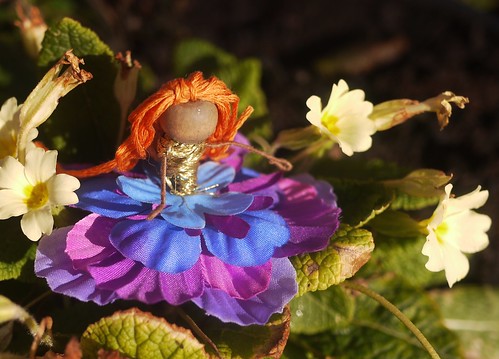
So Là Fhèill Brìghde was pretty low key, although Rosie joined in with enthusiasm and gusto because this is her favourite time of year. I bought a new doll-making kit for us to make our dealbh Brìde with, and invited the kids to join in. Tom wasn't so keen – he's less interested in crafting than Rosie is – so it was just me and Rosie this year. As usual we made a few dollies and picked the one we thought worked best, and this is what we ended up with:


We feasted and sained, and lit some candles for Brìde to put in the window. I offered the honours to the kids, if one of them wanted to the lighting, but they both wanted to do it so we ended up deciding they should do a candle each; they lit, and I said the prayer, then went to invite Brìde in. Rosie was very excited to put our dealbh Brìde to bed, and Tom joined in by arranging a cow next to her.

Then we picked out a few pieces to put out for Brìde to bless on her nighttime rounds – this is serious business for Rosie, because she's taken the idea to heart. Ever since we left her favourite blanket out for Brìde to bless, she's insisted on having it on her bed every night so "Brìde will keep the bad dreams away." The blanket must go under the duvet so it's touching her directly; this is important. So important, in fact, that she didn't want to let go of the blanket for even one night, and even though I told her it's traditional so Brìde can bless it again. In the end we left out a different blanket instead.

The weather was pretty nasty so I put them in the shed, which I left propped open a little, so they'd stay put, but as it happened Mr Seren's plaid ended up on the opposite side of the garden by morning. It was only thanks to the fence post that it didn't get blown away entirely, and Mr Seren was pretty bemused to find his plaid flapping around. I guess it was a good job it wasn't his underwear...

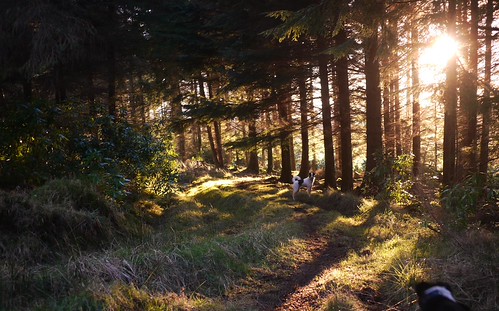
A little later on in the month we went on a big long walk up to the forest I took a walk to last year at Là Fhèill Brìghde. This time I took the kids as well as the dogs and we got there right at the golden hour:


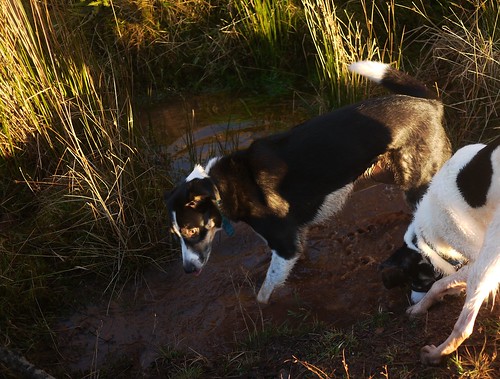
It's been a pretty mild winter but spring seems to have got off to a slow start in spite of the fact that a lot of trees started blossoming even before Hogmanay. Nature seems a little confused lately, and we didn't see many signs of spring on our walk. Plenty of mud, though:


For Là na Caillich we had a pretty vicious storm so we had to hold off on our usual a visit to the beach for the few days, but we got there in the end and made our offerings to the Cailleach and the Cailleachan. Now I'm just waiting for a bit of a dry spell so I can get out in the garden and start tidying things up (though I might have to get a gardener in this year, just to keep on top of the lawn). It's been such a wet winter that the lawn is more bog than anything at the moment and it's going to need resowing in places. Some of the plants I put in around the new pond are going to have to be replaced, too, because they just weren't able to cope with all the rain – I was worried that might happen. I have a gooseberry bush to put in, though, which I'm pretty pleased about (we'll hopefully be able to pick them for Lùnastal, as is traditional, though I'm not anticipating a crop for a while yet), but so far that's it. I haven't thought about what else I'm going to put in but I'm thinking about expanding the containers – bigger ones so I can maybe put a small fruit tree in, too.

So spring is officially here and a quarter of the year is gone already. Hopefully next week I'll be going to Edinburgh to see the Celts exhibition (again).


Thursday, 24 March 2016

Book Review: The Origins of the Irish

The Origins of the Irish
J. P. Mallory

Given the recent announcement that proof of an Irish Paleolithic has finally been discovered, this review is both timely and a perfect example of how quickly things can change and our whole idea of history (or prehistory, in this case) can be rewritten thanks to something so small and seemingly insignificant as a few scratches on a bear bone...

So all in all, in spite of the fact that this book was only released in 2013 it's already out of date in some respects. Such is the way of things in this field, no?

Up until recently I'd heard of this book but didn't know much about it. More than that, I have to admit the title kind of put me off wanting to know more because it struck me as one of those books that was going to be little more than guff and wind that failed to hide a sad and slightly racist agenda behind some dodgy attempts at science. If I hadn't picked it up in a bookshop I would probably still be thinking that.

I'm glad to say I was wrong in my assumption, and that I did, in fact, really enjoy this book. In searching for the origins of the Irish  where, exactly, the people of Ireland came from, including how they got there  Mallory takes a look at the archaeology, the early historical evidence, linguistics, and (still fairly fledgling area of) genetics. Before we get to all of that, though, we begin right at the beginning, with a whistlestop tour of the Big Bang and how the Earth changed over the first few billions of years until we reach the general layout of continents we have today. We are, ultimately, star dust, after all.

The book is pretty ambitious in its scope, in trying to weave all of these various strands together to give a coherent answer to the initial question. The answer we end up with isn't conclusive, by any means, but it would hardly be reasonable to expect one given the kind of evidence we're dealing with here. It's inevitable that a book like this is going to raise more questions than it answers, and there's a risk that the reader will be left confused or dissatisfied rather than illuminated. My feeling, by the end of it all, is that there may be uncertainty, unknowns, and unknowables, but it's a great ride. This is an extremely well-written book  engaging, witty, clearly and logically structured with the minimum of jargon thrown at the reader. It's not glossy or colourful, perhaps, but it doesn't need to be.

Right at the beginning we're introduced to Niall of the Nine Hostages, an Irish king who Mallory suggests is our ideal "Irishman"  an identifiably historical figure who lived right at the cusp of Ireland's early historical period when, it's suggested, Irish people had a definite sense of being "Irish." This is, of course, open to debate, but for the sake of argument let's just go with it. Throughout the book we return to Niall as we wonder about all the things that had to happen throughout the pre-history of Ireland for such a person, in such a time and such a place, to come about  someone who, as Mallory points out, had a non-Irish mother. It's not ethnicity we're looking for here; it's about identity. With all the various peoples and influences that have had a bearing on Ireland, the real point of this book is how do we define an "Irish" person anyway?

A good chunk of the book is taken up with the archaeology as we stroll through the Mesolithic period, the Neolithic, the Bronze Age and then the Iron Age (bearing in mind, of course, that there was no discernible Paleolithic period in Ireland at the time of writing). Mallory does a good job of laying out the evidence for what life was like for people of each of these periods  how they lived, what they might have believed, how society and technology changed and evolved, and why these things happened. Of course, we can only deal with theories and speculation for the most part here, and Mallory deftly outlines old theories and new, and discusses the pros and cons for each of them. It's clear which theories Mallory himself favours as we go along but he allows room for the reader to draw their own conclusions, too.

Once we've dealt with the archaeology, there's a chapter on the literary evidence  looking at the origin story of Lebor Gabála Érenn especially  followed by chapters on genetics and linguistics. I have to admit that I instinctively balk when genetics tend to come up, because it's so often used as thinly veiled attempts at arguing about genetic purity and crap like that, but I think Mallory deals with the subject sensitively and evenly here. I'm no linguist but the content here is solid and brings up some nifty points, too. Finally, the last chapter brings everything together to make the final conclusions,

A book like this could easily be dry and dense, but that's really not the case here. It packs in a lot of detail, and I think perhaps it would be of benefit if you have at least a vague idea of archaeology and the basics of the field; the jargon is kept to a minimum but for the total noob it might be a bit overwhelming or distracting; not a major problem, but something some might appreciate knowing going in. Each chapter finishes with a very simplified summary of the major points raised, which is a definite plus.

I can't say I agreed wholeheartedly with everything in the book. In particular I quibbled with a few details in the chapter on the literature, but any disagreements I had were minor and there's nothing that I'd say was just plain wrong. Over all this is a fantastic overview of the subject and it's something I've been looking for for a long time. This is a book I'd highly recommend to anyone.

Thursday, 10 March 2016

Book Review: The Celtic Evil Eye and Related Mythological Motifs in Medieval Ireland

The Celtic Evil Eye and Related Mythological Motifs in Medieval Ireland
Jacqueline Borsje

Not the pithiest of titles, but it tells you just about everything you need to know here; what you see is what you get.

I'd had my eye on this book for a good while now, but given the price tag – not actually that bad, for an academic book, but more than I usually spend on myself – I'd been hoping it would turn up at the university library sooner rather than later. I'm often hesitant to buy books without a good preview because you never know what you're going to get – there's a book, The Seer in Celtic and Other Traditions by Hilda Ellis-Davidson that I was intrigued by for a long while, and it costs just a wee bit more than this one. When I found a copy at the library, though, it turned out there was only one or two essays in it that I was interested in (the book mostly deals with "Other Traditions"). If I'd bought it myself I would've been disappointed.

This time, though, Borsje's book didn't seem like it was going to be available via the library any time soon so I eventually broke down and decided to splurge; as much as I may be cautious, I'm also kind of impatient... I figured that given everything I've ever read by Jacqueline Borsje, I wasn't likely to be disappointed here – I'm a big fan of her work. And lucky for me I wasn't disappointed at all – this one is well worth the price tag (would that I could afford this one, though. That's definitely going to be a "wait for the university library").

So here's a quick idea of what this book is all about – it's a collection of articles written by Borsje over the years, all of them dealing with various aspects or elements about the concept of the evil eye, or drochshúil, in Irish mythology. Each article forms a chapter, and you might already be familiar with some of them since some of the articles are available elsewhere (though I'm not sure most of them are published in English?). Chapter One, for instance, is 'The Evil Eye' in early Irish literature and law, co-written with Fergus Kelly, though here Kelly's contributions (on the law texts that deal with the subject of the evil eye) have been updated and are split off into an appendix. The other articles have been adapted a little as well, so that they make a more coherent volume all together. The final chapter is specially written for the book, and while Borsje notes that the book can be read in any order – each chapter is self-contained – the over all layout has a logic and flow to it that works well.

really enjoyed this book and found so much here that's useful to my interests or just plain interesting. I started off using little post-its to tag bits I knew I'd want to come back to and ended up giving up trying to colour code things with some semblance of order because I ran out of post-its in the requisite colour. Given the nature of the evil eye the book touches on folk practice (and how it relates to, or reflects, the beliefs articulated in the myths) as well as the mythology itself, and it also deals with certain areas of magical practice – corrgúinecht and the power of words in particular. The ritual nature of this practice, and the bestowing of the evil eye (in certain instances) is also dealt with. As much as it might be tempting to thing of the evil eye as little more than a literary motif, it's clear from the early Irish laws as much as folk practice that the concept is very real. Even today it's still a very relevant part of everyday life (as I've experienced myself – when the kids were babies people were always very keen to bless them and show their goodwill by giving them a silver coin).

As far as the mythology goes, there's a lot of focus on The Second Battle of Mag Tured (CMT) and The Destruction of Da Derga's Hostel (TBDD) because of the characters found there – Balor of the Evil Eye in CMT, and Nár Túathcháech in TBDD, for example – and the instances of corrgúinecht that are mentioned (or implied), which may involve the casting of the evil eye. There are plenty of other tales referenced as well, like the Death of Cú Chulainn, but given the importance of the first two, Borsje includes translations of both tales in the appendices. These are primarily based on the translations given by Whitley Stokes (partly because they're out of copyright now), with some updates and additional bits (mainly the more obscure rosc parts, though not all of them, unfortunately) based on the work of academics like Kim McCone and Ralph O'Connor (who's book on Da Derga's Hostel is referenced in glowing terms). The translation of TBDD includes a note, from O'Connor's book, on the meaning of the stream of names given by the hag (Cailb, though identified as Badb, or the Morrígan), which is something I've been looking for for a while; O'Connor's book is definitely bumped up my reading list now. Really, the translations and notes that accompany them are almost worth buying Borsje's book for that alone.

Because the chapters were originally published as individual articles there's a bit of repetition in places, especially (I noticed) when it comes to the discussion of the meaning and nuances of the term "túathcháech." It's not so repetitive that I minded it, though, and there's some genuinely meaty stuff to get stuck into. In particular, I'd wondered about the relation between the Tuatha Dé Danann being said to have come from the "north" and the traditionally negative connotations of that direction for a while now, and this is something that Borsje touches on (chapter 4, 'Encounters with One-Eyed Beings'). There's also a good discussion on why it's the eyes, or specifically an eye, that's so intricately associated with ill-wishing or cursing.

The last chapter, which is titled 'The Power of Words: The Intricacy of the Motif of the Evil Eye' (though it covers somewhat similar ground as in Druids, Deer, and Words of Power) was an especially good read, though it's hard for me to pick just one stand-out chapter. It gives a good overview of who might cast the evil eye the methods used to protect against the evil eye, in the form of prayer like St Patrick's Lorica (otherwise known as The Deer's Cry, or Faíd Fiada), amongst others. A common element of these prayers is protecting against the evil eye by surrounding oneself in spiritual armour – binding blessings to yourself in every direction, and every part of the body. This "surrounding" is also founds in other means of protection, like the crios Bríde ('girdle of Bríde') and the practice of leaving things like ribbons out for the saint's blessing – something that has intriguing implications about how old these practices might be. It brought up a lot of comparisons with the caimeachadh prayers in the Carmina Gadelica for me, which I think may be an avenue to explore.

One thing I would've liked to have seen is more of a discussion on the way Boann loses an eye (and a leg and an arm) in the Dindshenchas tale about the Boyne, and the similarities between that and the stance taken during the performance of córrguinecht and the prophecy performed by Cailb in TBDD. It's something I've wondered about for a while, and it was something that came to the fore again when Borsje delved into the symbolism of "one-eyedness" and its association with knowledge (just one possible meaning, and depending on context). An index would have been nice too...

This is a very dense read – engaging but certainly not the kind of thing you're likely to devour in one sitting – and I think it's only going to appeal to people who have a real interest in the subject. If you do have any interest in this kind of thing, though, then I think it's an essential book to add to your shelf. It's certainly a book I'm going to be referring back to a lot.

Sunday, 31 January 2016

Vreeshey, Vreeshey, tar gys my thie...

A little bit of a late start to this year's blogging but better late than never, eh?

While I have a wee rest and – finally – a bit of a sit down before I go and welcome Brigid in, I just wanted to share this video (which I saw posted over on The Ever-Living Ones). It's beautifully sung, and timely too:


The lyrics are a traditional invitation to Brigid, which is sung (or recited) on the eve of Laa'l Breeshey (Imbolc) so that she might visit and bless the house and household at night. The original Manx, with translation are:
Vreeshey, Vreeshey, tar gys my thie, 
Tar gys y thie aym noght.  
Vreeshey, Vreeshey, tar, o tar,
Gys y thie aym noght.  
O foshil jee y dorrys da Vreeshey,
Lhig da Vreeshey çheet stiagh. 
Vreeshey, Vreeshey, tar oo
Gys y thie aym noght.
Bridget, Bridget, come to my house,
come to my house tonight. 
Bridget, Bridget, come, oh come,
To my house this night. 
Open the door to Bridget,
and let Bridget come in. 
Bridget, Bridget, come to my house,
come to my house tonight.
As Manx As the Hills posted a version of this a couple of days ago, and included the sheet music and a sound file to help with pronunciation if you'd like to learn it yourself.

Whatever you're doing, and whenever you're celebrating, I hope you have a good one!