Monday, 28 December 2015

Tairis has (finally) been updated...

Tairis: Gaelic Polytheism
As I mentioned a few posts ago, I was hoping to – finally – get on with fixing Tairis. It was obvious, by this point, that "fixing" it meant basically starting from scratch, and (ta da!) that's exactly what I've had to do.

Over the last two or three weeks (I've honestly lost track...) I've been moving everything over onto a brand new Wordpress. The new site is now live and you should find the following fixes and improvements:

Front page blog

Instead of a static home page I've decided to use a blog format so I can post and keep track of any updates as necessary. You'll find a bit of waffle about the changes I've made there, too. I'll still do my main blogging here, though.

New pages and some overhauled/re-written pages

It's hard to resist fiddling about with stuff, especially given the fact that some of the articles were first written almost ten years ago now. In those ten years I've had a bit more practice at writing, learned a whole lot more about Gaelic Polytheism, and the internet has opened up a huge amount of resources that I didn't have at my fingertips way back when. Because of that, some of the pages have simply been smoothed out and given a bit of spit and polish – editing out the clunkier bits of writing – while others have been almost completely rewritten or at least majorly overhauled. Some of the pages I feel could still do with scrapping and starting again but I just don't have the time to tackle them given everything I've got going on. Maybe that will happen in future.

The major overhauls/rewrites that are worth noting:

  • The Celebrations section has been majorly rewritten
  • As has the Offerings page
  • The Types of Offerings has been overhauled
  • The Gaelic has been added to the prayers in the Daily Practices section (and the 'thees and thous' removed from the translations)
  • Updates have been made to the liturgy outlined in the Practices section, too

New pages include:

Making a cros Bríde – including an overview of the history and practices associated with them
Celebrating Yule – now in addition to Hogmanay

For the cros Bríde page, this includes an example of an Irish prayer that's traditionally used in hanging up the crosses, which I was pretty excited to find in an article I stumbled across. Before now I've only seen such prayers referred to in passing, with no specific examples given.

I've also removed the Article Downloads page from the Resources section. Given the fact that Google Scholar and JSTOR have opened up so many more articles than I can ever keep up with, it seems pointless to maintain this one.

Slightly different ordering and new sections/names

This one's fairly minor but I've changed around the order of some of the sections. The section on Life Passages comes after Festivals and Celebrations now (I feel like it flows better, from the day to day stuff, to the seasonal stuff, to life events), and the section named Gods is now called An Trì Naomh to reflect the fact that it encompasses not just the gods but also the spirits and ancestors.

I've also added in a completely new section – Values – where I've moved the four-part article on Values, and the article on Gessi and Buada. These were originally housed in the Cosmology section, but that was rather large and unwieldy so splitting things up seemed to make more sense. The Values section now follows on from Cosmology.

Fixed footnotes

Updating the site has been a big job, mainly thanks to the huge amount of footnotes I've got on there. While I'd rather err on the side of caution and make it easy for people to look up stuff if they want to (never take my word for it, right?) there are a lot of footnotes. Which is never more apparent than when you're having to code every single one by hand. Now, however, in addition to actually working again, you can also hover over the footnote number and you'll get a preview of what the footnote says below. You'll still have to click down for any links there, but it should be a lot more convenient now.

A more consistent focus

Seeing as it's been nearly ten years since I started the site, a lot's changed in that time. In particular, identity politics and labels have evolved within the wider Celtic Reconstructionist community and those labels are something I struggled with in the beginning. To start with, when I first began writing stuff for Tairis, I used "CR." Then I began to use "Scottish Reconstructionism" as well as CR because I wanted to be more specific. And then, when Gaol Naofa was founded and they began using "Gaelic Polytheism," I came to feel that was the better term and switched to that. Apparently I didn't change everything on the site to make it all consistent, though, so I've gone through everything and tweaked the bits that needed tweaking: Gaelic Polytheism it is.

New links

Unfortunately this isn't an improvement per se, but it is a necessity. Moving the site over to Wordpress means that all the link paths are different now, so if you link to any articles on the site I'm afraid they're going to be broken now. I'm very sorry for the inconvenience!

*   *   *   *

I hope you find these changes are (mostly) for the better. If you don’t, older versions of the site can be accessed on archive.org, where you’ll be able to find the original versions of rituals or articles. So there's always that...

There's still a bit to do, however. I'm not entirely happy with the menu system, but with almost 115 articles on the site there are just too many to make the current menu bar house them all with drop-down sub-menus. I think it cuts off after a hundred articles, and then it shows everything in alphabetical order instead of the order I want to appear in (and it does with several themes I've tried so I think Wordpress is basically telling me that I talk too much). So my resident webmonkey husband is looking into finding a widget or something that might help with that. In the meantime, I'll work on putting up a site map.

Sunday, 20 December 2015

Links and things for grian-stad a' gheamhraidh


As the winter solstice approaches, questions about whether or not the day (or, more to the point, the night) should be observed by Gaelic Polytheists. My feeling is: If you wanna.

Personally, I don't think the solstices or equinoxes were ever observed by the pre-Christian Gaels – not to the same degree as the Quarter Days, anyway. It's obvious they were aware of them, as were their Stone Age(s) and Bronze Age not-Gaelic-speaking ancestors; the fact that several ancient monuments are aligned to the solstice or equinox sunrises is evidence enough of that, and indicative of probable religious significance, too. So from that perspective I acknowledge the day as having been important to my ancestors, since I have some Irish and Scottish heritage flowing through my veins. Their wisdom isn't something I like to ignore, you know?

The solstices and equinoxes have also come to be significant in the modern calendar thanks to other influences, too. Granted these are influences from other cultures and some people aren't comfortable with adding those into the mix, but to me, I see the way these days are expressed – in spite of the outside influences – as having been thoroughly Gaelicised. It's a prime example of what syncretism is, and so I don't feel the need to separate it out; it's all part of the continuum and especially here in Scotland it's pretty hard to avoid anyway. Your mileage may vary, of course.

So. If you're interested in looking into solstice traditions, you might want to start with Gaol Naofa's video, which we released on our Youtube channel last year:


I gave a little overview of the kinds of things we tend to do for the solstice here at home in my post about the videos when we released them last year; it's generally a pretty low-key event for us since Hogmanay is what it's all about at this time of year (I'll do a separate post on that later), and we've already had a go at a chocolate Yule log in celebration of the kids finishing school for the Christmas holidays. We did a buttercream version to accommodate my husband's inability to digest cream, but it just wasn't as good as our usual squidgy chocolate log. I'm going to get hold of some lacto-free cream and do it properly on Tuesday so we can have a good one that doesn't end up making my husband wish he were dead when he has some...

The kids are both very keen on lighting candles to put in the window; traditionally it's a custom observed by the daughters of the household, but Tom wants to do it too so they'll both get a candle to light. I think we might have some beeswax sheets left so we might be able to make some, even.

If you're looking for some light (arf) reading then there's the two-part article I've done on Tairis along with a bit in the festival bannocks and caudle section that will be useful, too:
I'm sorry the internal links are still broken – I've tried fixing them but I can't get them to work, at all! That will be fixed on the new and improved site, when it's ready (I'm still working on it, but it's happening!). For some reason I didn't do a "celebrating Yule" article in the Celebrations section, which I'll rectify for the new-and-improved site, too.

For the morning of the solstice the focus is usually on the sunrise at Newgrange. The sunrise has been webcast in previous years but it doesn't seem it will be this year; you can take a look at some photos over at knowth.com, though, and there are videos there too. 

If you'd like to greet the sun as it rises, you might find this prayer useful. It's not necessarily only for the winter solstice, but on the morning after the sun is certainly a welcome sight when you know the days are going to be getting longer and longer from here on out. 


Thursday, 10 December 2015

Manannán set to return to Binevenagh mountain

As you may recall, a statue of Manannán mac Lir, which had been erected at the Gortmore Viewing Point on Binevenagh mountain in 2013, was stolen in January of this year. In its place, the thieves left a cross with the message "You shall have no other gods before me." A month later, after an extensive search, the statue was found by ramblers just 100m from its original position.

It's still not known whether or not the statue had been there all along, or if the thieves had dumped it at a later date (it was found exactly one month after the theft, suggesting the latter), but after a thorough examination it was decided that the sculpture was too badly damaged to repair – the back of the head had been hacked off and attempts had been made to remove the limbs. It was eventually resolved – after much deliberation and tense waiting, and a huge public outcry – that a new statue would be commissioned to replace the original, with the costs to be covered by the local council.

Yesterday, the sculptor Darren Sutton uploaded five photos of the new statue, announcing that it's almost ready to take its rightful place, which is great news! The BBC have since reported that – as yet – it hasn't been decided when this will happen. The Derry Journal, meanwhile, have spoken with Darren Sutton, who's given his thoughts on the culprits:
Mr Sutton said they had a job on their hands when removing it, and he doesn’t believe the culprits did it as a prank. 
“It took too much effort because you can see where they tried to saw it off at the beard, the neck and the arms,” said Mr. Sutton. “They obviously went to some effort, but they shot themselves in the foot. I don’t think they realised there would be such a backlash. Everybody was talking about it. They obviously didn’t think it through.”
Which makes sense. The cross that was left behind could easily have been some kind of attempt at throwing people off the scent of the actual vandals, but the effort involved in both removing and then trying to destroy the statue suggests that this was no mere prank. This was serious business.

Considering this fact, when the local council commissioned the new statue it was announced that the replica would have some extra reinforcements built into it to help strengthen it and prevent a repeat of the theft. Given the reaction by even some of the councillors – a minority of whom were vehemently against replacing the statue at all because it was too "paganistic" and for their tastes – we can only hope these measures will be enough to protect it against the religious extremists who stole the first statue, once it takes its rightful place on the mountain. At the moment there don't seem to be any other preventative measures planned beyond hoping in common decency:
SDLP councillor Gerry Mullan said: "I'm very excited at the prospect of Manannán Mac Lir returning home. 
"People from all over the world came to get photographs with it. Lets hope that happens again. 
"I urge people to take care of him and we hope a similar act doesn't happen again. 
"Santa may even stop by to see him."
Ho ho ho. But yes, let's hope it doesn't happen again. Let's hope that the reaction and support the statue received from all over the world will help deter those thieves or anyone else from trying again.

And personally, I'm still praying for justice to be done. There are still questions that need answering here.


Tuesday, 1 December 2015

Tairis update


So it's been well over a year since the Tairis website had a catastrophic crap out...

As you've probably noticed the website has been limping along in a barely functional and sorry manner since then. A lot of the links are broken, the footnotes don't work, and the header is non-existent (although to be honest, I never liked the font. Don't tell my husband...). The formatting in general is somewhat iffy. It's been a while since I updated anything because the back-end of the site has been barely functional. Or, more to the point, I'm too lazy to code everything when I don't have to.

After finally finding some time to figure out how to get the WYSWYG editor back, I've tried fixing the footnotes so they at least link where they're supposed to. Unfortunately, even trying to code a simple anchor isn't working like it should do, and it's clearly time to start over from scratch on a new platform...

Hopefully that will happen soon – as soon as I save all the pages safely copied and can transfer them to a new platform before transferring it over to the domain name. And finished with the inevitable tweaks and additions I'll end up making (at the very least, updating the book review section). The current version will stay up for now, and seeing as I was fiddling about with things anyway I'll point you to the now updated and expanded How To Get Started page, along with the slightly revised Quick and Dirty 'Where Do I Start?' Booklist. I'll keep you posted on any further updates (which I hope won't take another year and then some), but in the mean time I hope you enjoy.


Friday, 6 November 2015

Oran Buaile – Teiris a bhò

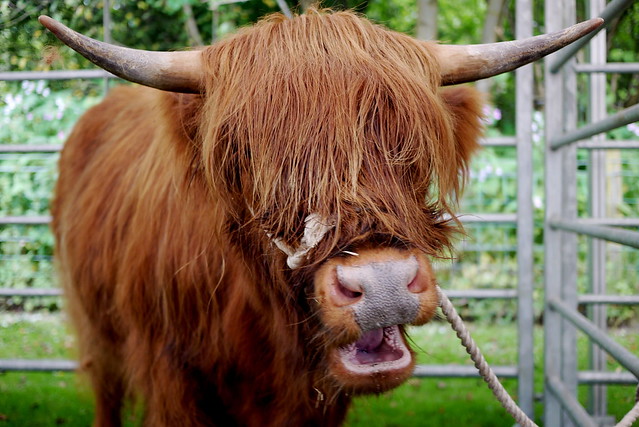
You may have noticed I have a bit of a thing about cows...


Part of the reason I chose "Tairis" as a name for my website is that I found a definition given in Macbain's Dictionary that described its meaning as:
tairis! int. The dairymaid's cry to calm an unruly cow at milking. 
Ordinarily, however, it means:
tairis -e, a. Kind, sincere, loving. 2 Compassionate, tender-hearted, soft, tender, kindly, urbane. 3 Confidential. 4** Trusty, faithful, loyal. 5** Acceptable. Cha tairis leam ur fàilte, your invitation is not acceptable to me; guth tairis nam bàrd, the mild voice of the bards.
And while the latter definition seems apt in itself, the former meaning tickled me enough for it to stick in my head. When the time came to buy a domain name I couldn't think of anything else so that's what I went with.

One thing I always wondered, though, was that in all of the milking songs I'd seen (in places like the Carmina Gadelica), the term was always absent. I figured maybe it was either a very localised term that Carmichael never came across, or else perhaps Macbain himself had kind of... made it up? Misheard it? Today, though, I came across the following song thanks to Google, and things make a bit more sense now. The song itself was recorded by the folklorist "Nether Lochaber," the pen name of Rev. Alexander Stewart, who lived in the area he took his pseudonym from. In the song we have teiris, not tairis, though Dwelly gives Macbain's spelling and lists teiris! as a local variant of the same word, recorded in Poolewe – which is in the Nether Lochaber area. As a plain old verbal adjective, however, the word teiris is listed as meaning:
teiris ** va & n. Tame, quiet, as unruly cattle. 2 Stop. 3 Be at peace.
So it all makes a bit more sense to me now.

Gaelic milking songs were kind of legendary – folklorists of the nineteenth century often liked to note that Highland cattle were some of the best milkers in the world, and it was said that a cow of the Highlands wouldn't give milk unless the dairy maid sang to it a soothing song. Since I can't find the song recorded by Rev. Stewart published anywhere else, I thought I'd transcribe it here (the site I found it on has a poorly done OCR transcription).

As this piece notes, the song was originally published in the Inverness Courier, though no date's given for that. In the copy I found, though, the date given is Saturday 23 March 1895, and it's interesting that this is from an Australian newspaper, the Northern Star from New South Wales. Anyway, here it is, with the newspaper's own write up. I've transcribed it as best I can, though some of it was difficult to read. I'll note that some of the words have the accents in the wrong place, as far as I can tell, but I've kept it all as-is and I haven't updated any spellings either. The translation is as given in the paper, though it's not completely literal – there's an extra line added in (and hopefully the table comes out OK; Blogger can be finicky with tables so if the formatting's off, apologies):
The following Oran Buaile or Shieling song, as sung in the Highlands of Scotland, was taken down from the words of a woman still living in Adnamurchan, and sent to “Nether Lochaber,” who gave it a place in the INVERNESS COURIER. It will be interesting to Highland readers, many of whom have perhaps heard it sung:
ORAN BUAILE

A MILKING SONG

Teiris a bhò
Teiris an t’ aghan beag
Teiris a bhò
Teiris a Chaòmhag;
Bleoghnaidh mi bhò
Le lamh bhog nach goirtich i,
Mo dhearn mar an sìde,
Bleoghnaidh mi ‘Chaòmhag.

Gently my cow.
Gently my little heifer, gently!
Gently my cow,
Be gently and quiet, my darling:
I will milk the cow
With soft hand that will not hurt her;
With the palm of my hand soft and smooth as silk,
I will milk my darling.

Bi laghach, a bhò,
Bi laghach, bi ceanalta,
Bi siòbhalta, ceanalta,
Laghach, a runag;
Gheibh i bad feoir,
Is leaba de’n rainnich ‘nam,
Gheibh i min air burn lainnir,
’S am bainne cha diult i.

Be nice, now, my cow.
Be nice and be gentle,
Be quiet and gentle, [And all you should be now –]
Of all pets the dearest!
She will get a nice wisp of hay,
And a soft bed of ferns from me,
With (a drink) of meal on crystal-clear water,
And (meantime) she will not refuse me her milk.

Bheir i am bainne dhomh,
’S i bheir am bainne dhomh,
Criosalt no buarach
Cha luaidh mi ri m’ eudail,
Cha thog i eas idir,
’S cha teann i ri crosdachd,
Mar a ni an crodh mosach nach tuig ach a bhéurla!

She will give me her milk,
Ay, her milk she will freely give me;
Foreleg fetter or handset shackles
Shall not be so much as mentioned in connection with my darling;
She will not lift a leg,
Nor will she show any ill-temper,
Such as is only shown by the nasty cows
That understand only the English language!

Tha’n t’sine bhog, bhlàth
Aig martan an aigh,
Tha ‘bainne bog, blàth,
‘Se fo bharr a ta cùraidh;
Mo ghaol is mo chíali
Air an aghan bheag, lurach,
Fhuair mise do ghealladh,
Am bainne orm nach diult thu.

Soft and warm is the teat
Of my charming little cow;
Soft and warm, too, is her milk
Under its froth of delightfullest odour.
My dear and delight
Is the beautiful little heifer;
She has given me her promise
That she will not refuse me her milk.

Mach thu ’n an ionaltraidh,
Moch maduinn a màireach,
Bi’dh ‘m féur thu’n na glùn dhuit
‘An Doire-na-Giubhsaich,
Bheir thu dhachaidh làn ùth,
’S cinnt’ nach diult thu dhomh pàirt deth!

Out to the grazing ground,
To-morrow morning early!
The grass will reach well up to thy knee
In Doire-na-Giubhsaich (the Fir Tree Woodlands);
She will thence carry home a full udder,
And sure I am that she will not there-of refuse me a fair, full share.
There is considerable humour in the song, as in the way the heifer’s character is exalted at the expense of the Ayrshire cattle of the township, who are spoken of with contempt as only understanding English, while her own heifer (a genuine West Highlander, we warrant her!) is so thoroughly up in Gaelic that she understands its every word! TEIRIS is a term of conciliation and kindness used in soliciting the friendship and good behaviour of cattle in stall – something like the “Gently, now,” of a good-natured groom when astride a steed disposed to be skittish. To be of effect it has always to be uttered in a conciliatory, or in what may be called a wheedling tone of voice. It is never addressed to horses; only to the bovine race, in their every stage of growth from clashed to extremest old age.