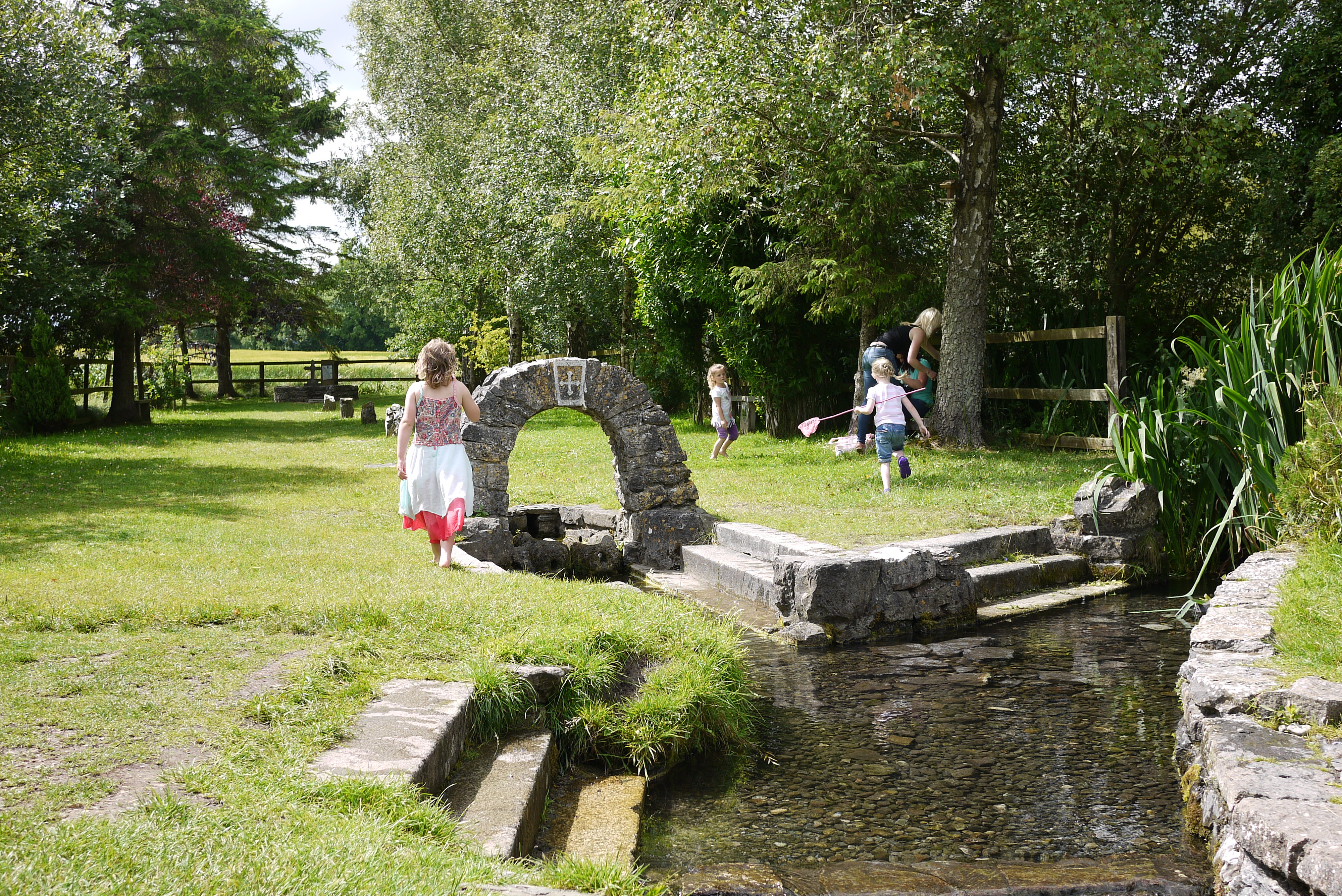
It's been a quiet month, blogwise here, mostly because I've not been up to much up until recently, and partly because I started writing this post and then kind of forgot to finish it... But as far as the "not being up to much" part goes, I'm making up for that now that I'm a little more mobile. And I have a new macbook to play with! I'm still trying to remember the old shortcuts for everything...
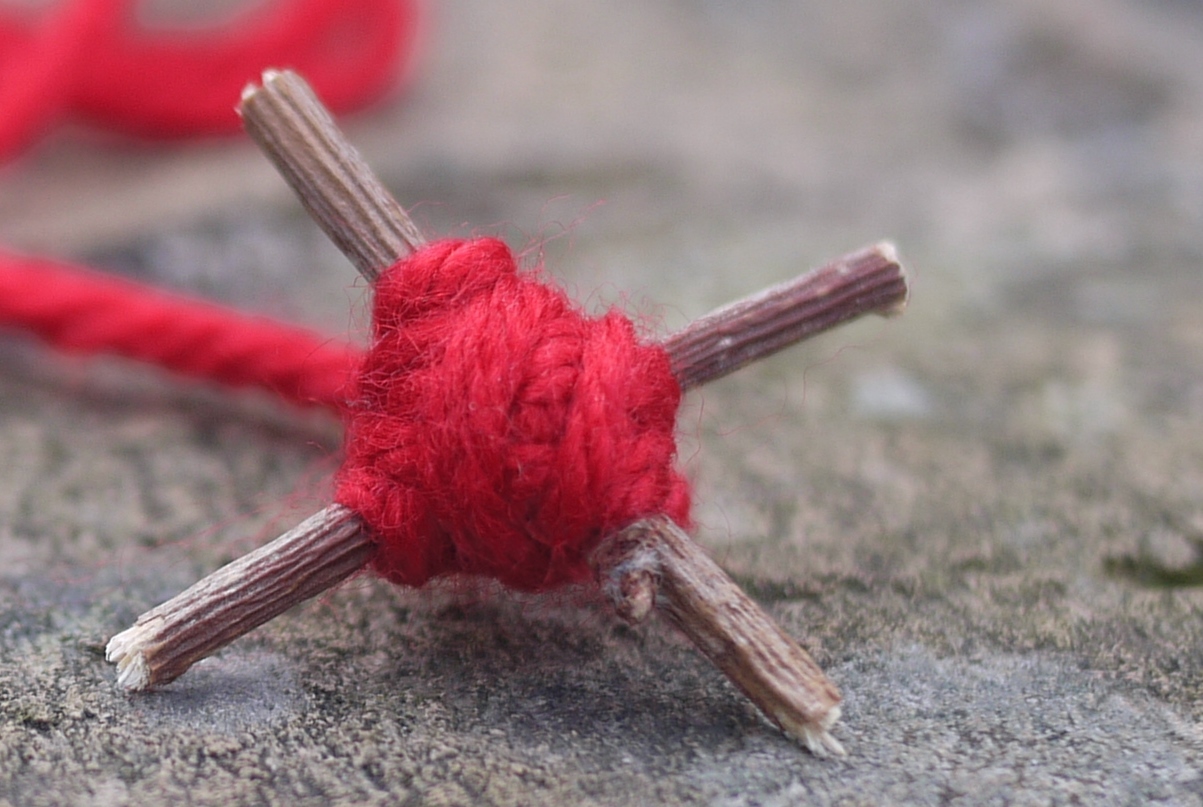
But Bealltainn came and went without much of a hitch. We had to spread things out a little, but there was the requisite cleaning and tidying, followed by the churning and feasting, baking and eating, offerings, devotions, saining, and the making of charms:
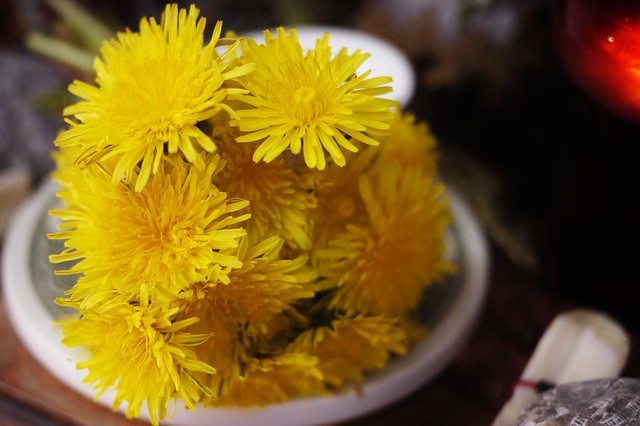
We also collected some dandelions from the garden to make a posy:
And that became part of an offering to a nearby rowan when we collected some of the wood.
Thanks to my drug-addled brain convincing me that there are in fact 31 days April, we were a little slow off the mark and most of our celebrations began on the day instead of the eve, but that didn't seem to impact anything negatively; if anything, it gave me more time to myself to get things done while the kids were at school. Somehow, in spite of all the planning and preparation, these things always seem to manage to sneak up on me, anyway...
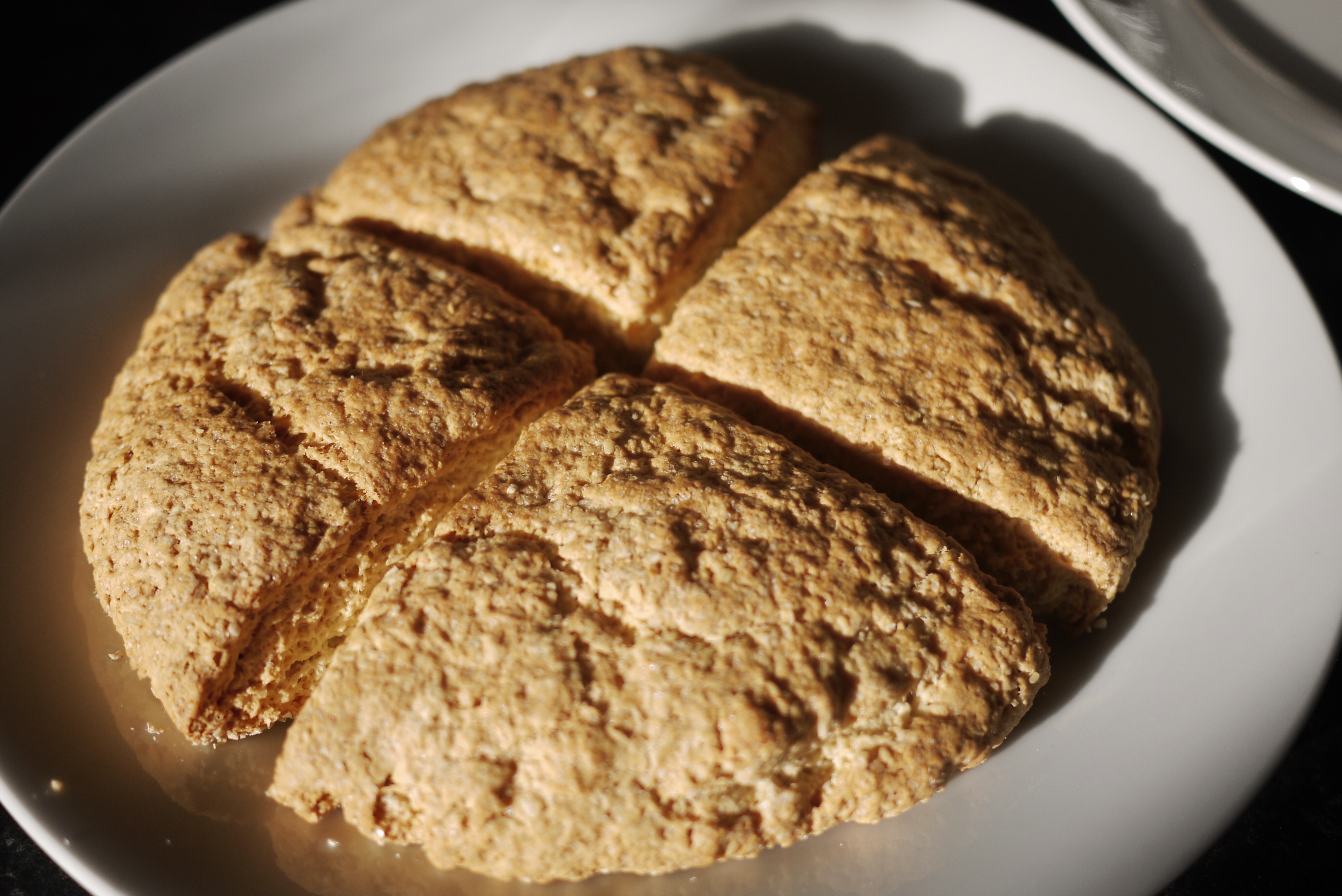
For our feast we had some roast lamb, which I was intending to serve with some bannocks; I didn't quite have the energy or strength to make them at that point, so the bannocks came a day or so later with some stovies for dinner; I made two lots, one a Fife bannock, one a Brodick bannock. The Brodick bannock is still my favourite:
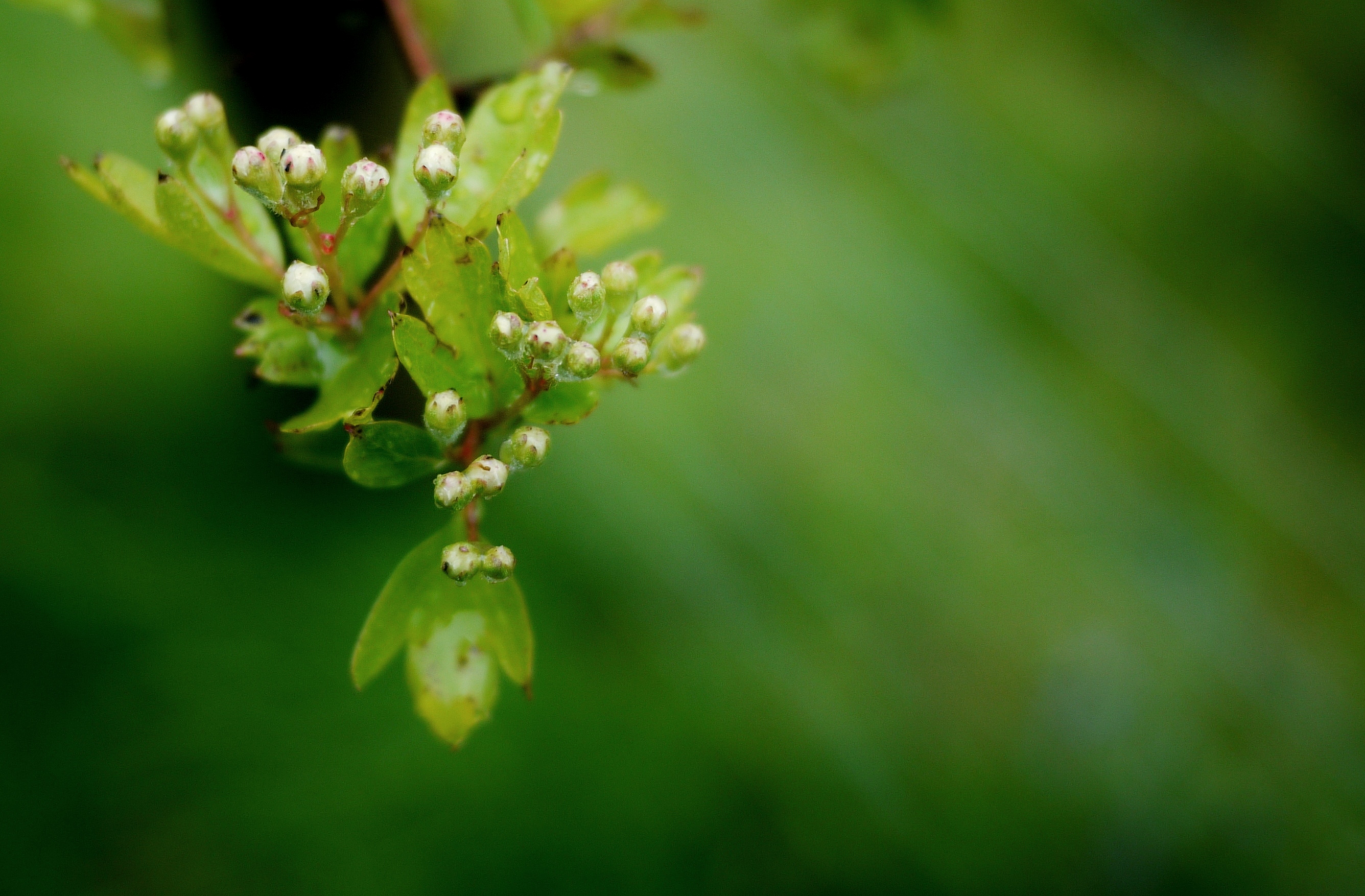
And best laid plans and all that, but we haven't yet managed to obtain a tree (or raised pond), although we now have a picnic table for the patio (although of course, since we got it it's rained nonstop). We're still intending to get a tree, though it may be a little too late in the season now, but as I've improved, physically, I've managed to get out and about a bit at least. On my travels a few weeks ago the hawthorn was just about to come into flower:
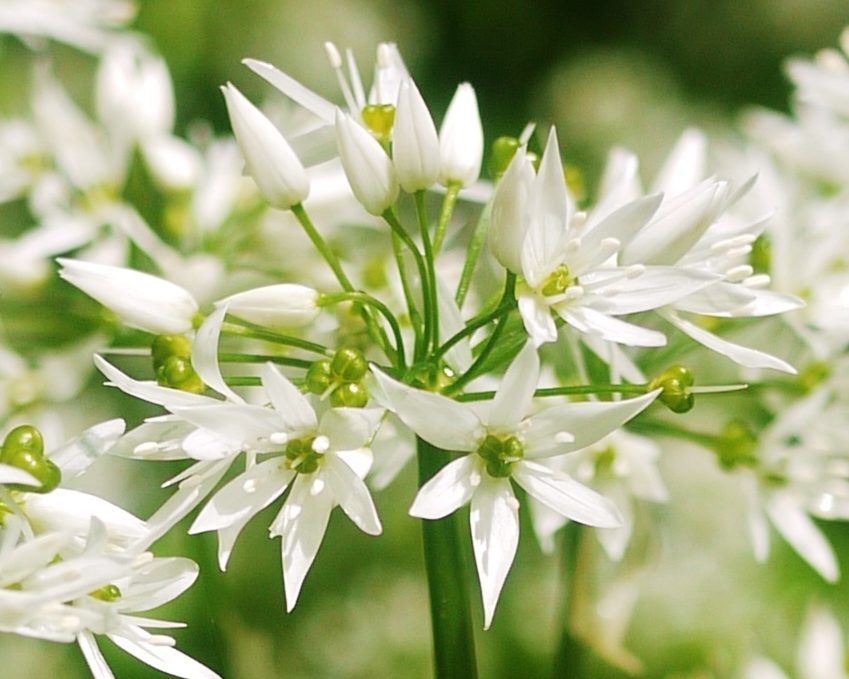
And now its bloom is in full swing. The bluebells are on the wane now, but there's been plenty of it along with the wild garlic, which is extremely fragrant:
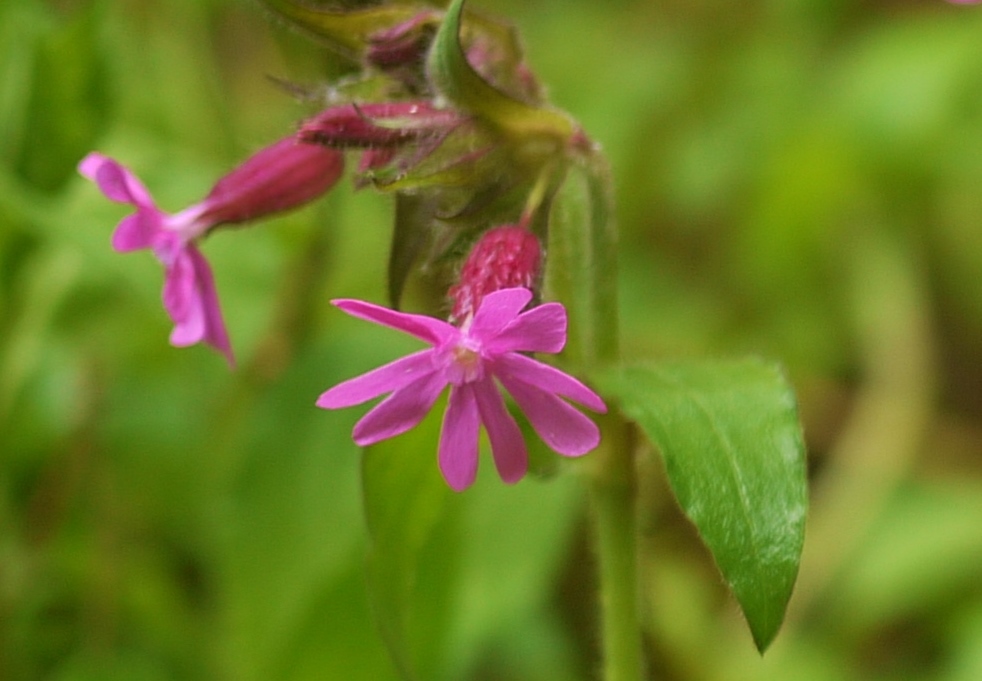
And the red campion is starting to come out in full bloom, too:
After the loss of our favourite wooded area to logging a few months ago, my travels have gone further afield to find a new spot:
It's a little less remote and peaceful, but beautiful, nonetheless, and there are lots of little wooden bridges over streams that flow into the burn, and plenty of waterfalls:
On my way home, the dogs and I stopped in at the beach to make some offerings to Manannán, a sort of belated Bealltainn visit which has unofficially rounded off the celebrations. All in all, I got just about everything I wanted to do done, although I didn't succeed in involving the kids as much as I'd like to have – my drug-addled brain's fault, really, but still. Hopefully our Midsummer celebrations will go more according to plan.
Saturday, 6 June 2015
Wednesday, 29 April 2015
Spring in the woods
Not being up to much lately, I took pity on the dogs yesterday and dosed myself up and hobbled out to the woods to see if the bluebells are out yet. It's my favourite time of year when the woods are awash in a carpet of blue(ish), so it's something I always look forward to and come hell or high water I'll get out and enjoy it dammit. And being the caring sharing type, I took some pictures to put on here...
The bluebells seem to be a little late this year (compared with previous years, anyway), but they are indeed just starting to come out:
This is from the woods right behind my house, which gets pretty boggy in places, and I think I found some marsh marigold as well:
Or, in Gaelic, lus buidhe Bealltainn, the yellow plant of Bealltainn. Tempted though I am to go back and pick some to hang above my front door for Bealltainn, I've been brought up to think that picking wildflowers is Bad, so I'll leave them be. Way back when we first moved here I'd hoped to get some for the garden, but I couldn't find any at the local garden centre, which is a shame. But as the almost unfurled flower there shows, summer is very nearly here.
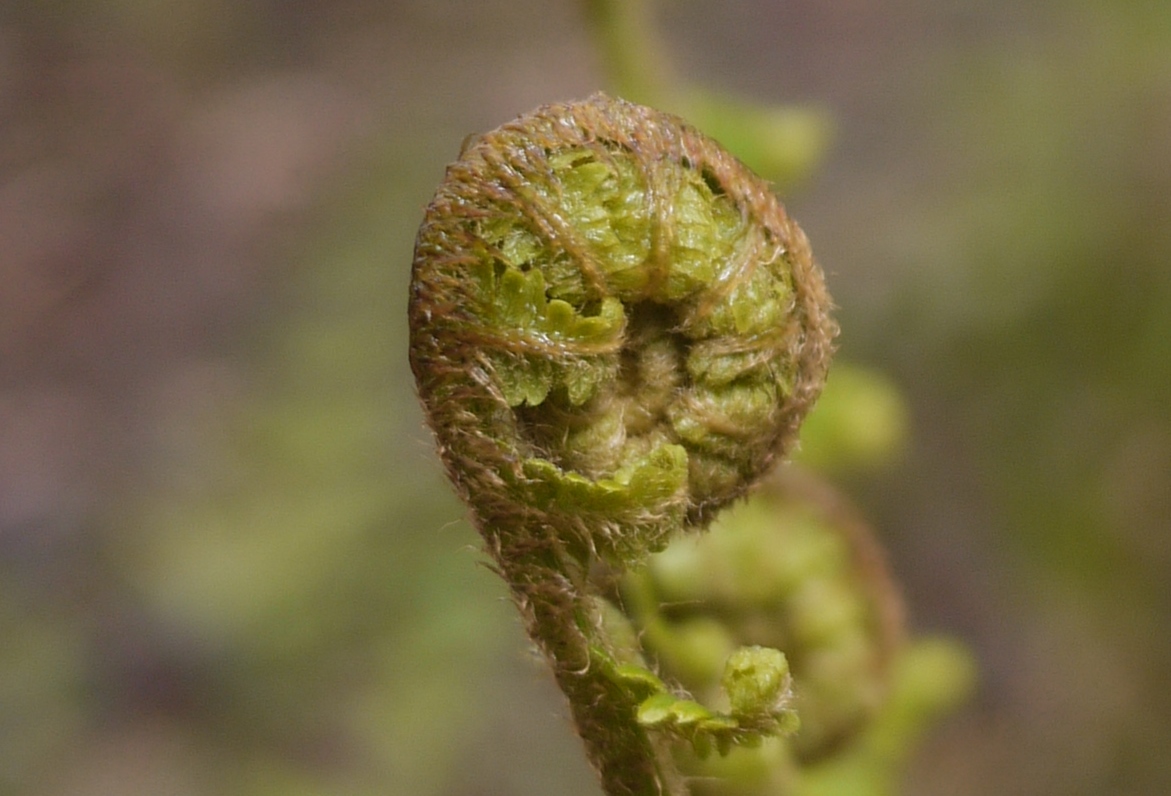
Along with the bluebells and the budding marsh-marigolds, the ferns are starting to unfurl, too:
Over the mild winter we had, it seemed quite a few of the ferns lasted a lot longer than usual in the more sheltered spots around the village, but the cold snap at the start of the year killed them off. Soon they'll be back again, trying to take over my flower bed.
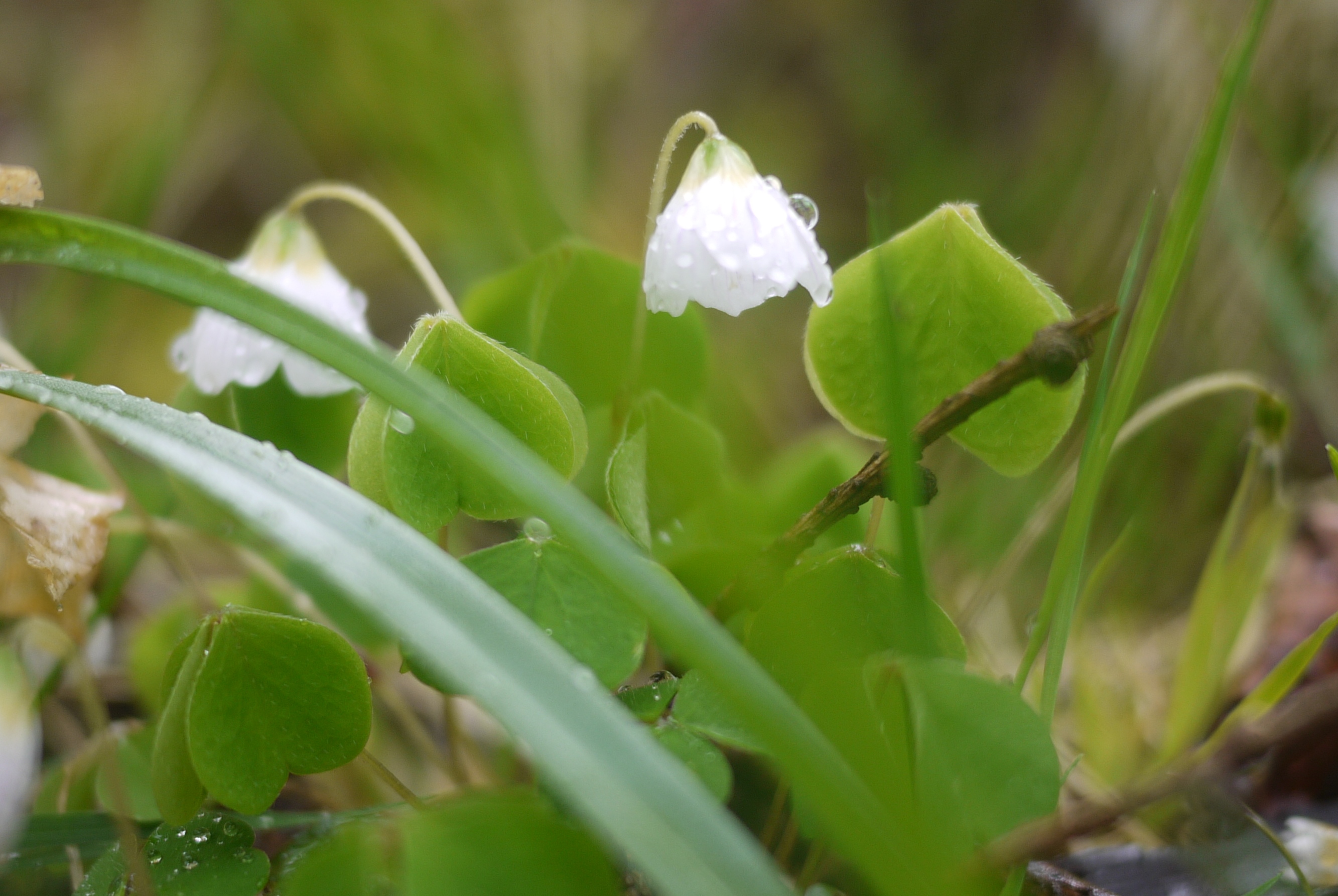
Along with the ferns and the bluebells, there's a smattering of wood sorrel (again, I think...) here and there, hanging around in clumps at the foot of trees:
Our walk yesterday started off sunny, then came the April showers. It's good for the garden, at least; we've had some beautiful weather lately and things have started to get a little parched. Not usual for round here at all!
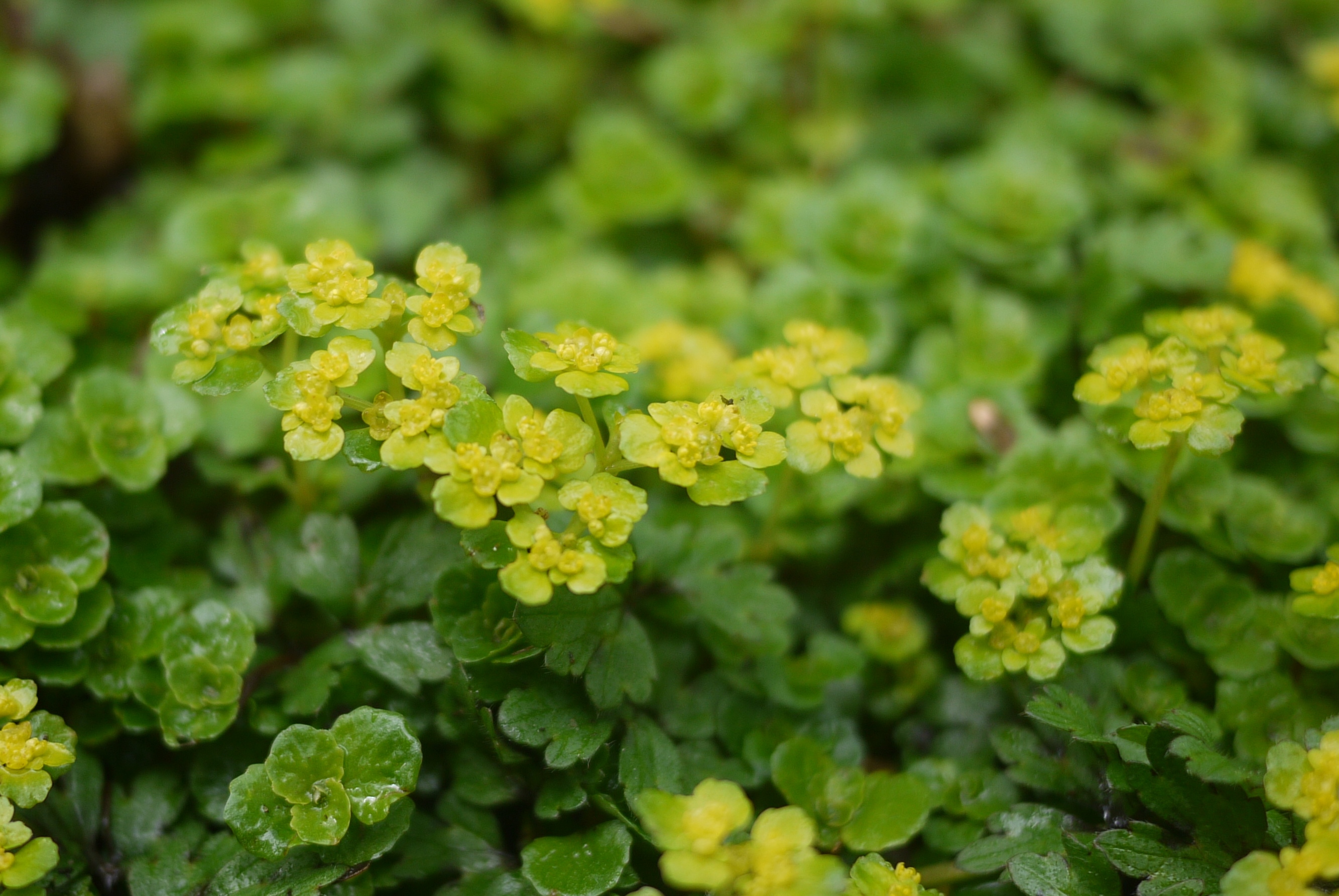
And then we have some golden saxifrage, which seems to like hugging the side of the woodland paths wherever the bluebells and ferns take a break:
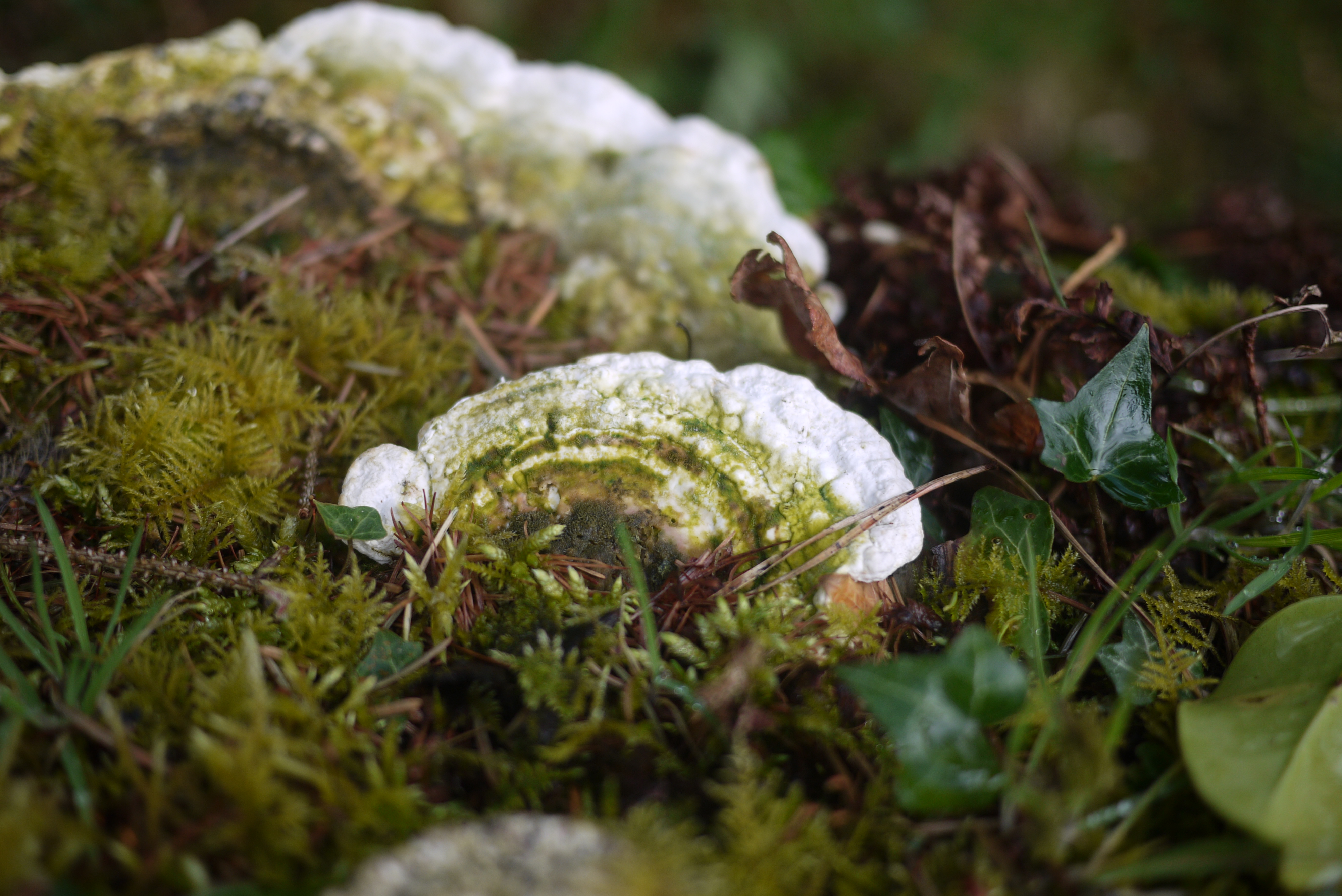
There's not much else in flower yet, but there's plenty of fungus around, helping the dead wood rot down:
Just as I did a year or two ago, I'd like to get back into learning more about the local flora and the rhythm of it as the months roll on. Learning more about the bioregion, as it were, to keep in touch with the place. If I get anything wrong then please let me know!
The bluebells seem to be a little late this year (compared with previous years, anyway), but they are indeed just starting to come out:
This is from the woods right behind my house, which gets pretty boggy in places, and I think I found some marsh marigold as well:
Or, in Gaelic, lus buidhe Bealltainn, the yellow plant of Bealltainn. Tempted though I am to go back and pick some to hang above my front door for Bealltainn, I've been brought up to think that picking wildflowers is Bad, so I'll leave them be. Way back when we first moved here I'd hoped to get some for the garden, but I couldn't find any at the local garden centre, which is a shame. But as the almost unfurled flower there shows, summer is very nearly here.
Along with the bluebells and the budding marsh-marigolds, the ferns are starting to unfurl, too:
Over the mild winter we had, it seemed quite a few of the ferns lasted a lot longer than usual in the more sheltered spots around the village, but the cold snap at the start of the year killed them off. Soon they'll be back again, trying to take over my flower bed.
Along with the ferns and the bluebells, there's a smattering of wood sorrel (again, I think...) here and there, hanging around in clumps at the foot of trees:
Our walk yesterday started off sunny, then came the April showers. It's good for the garden, at least; we've had some beautiful weather lately and things have started to get a little parched. Not usual for round here at all!
And then we have some golden saxifrage, which seems to like hugging the side of the woodland paths wherever the bluebells and ferns take a break:
There's not much else in flower yet, but there's plenty of fungus around, helping the dead wood rot down:
Just as I did a year or two ago, I'd like to get back into learning more about the local flora and the rhythm of it as the months roll on. Learning more about the bioregion, as it were, to keep in touch with the place. If I get anything wrong then please let me know!
Tuesday, 28 April 2015
Book review: A Golden Treasury of Irish Poetry A.D. 600 to 1200
A Golden Treasury of Irish Poetry A.D. 600 to 1200
Edited and with translations by David Greene and Frank O'Connor
Not too long ago I reviewed Kenneth Jackson's Studies in Early Celtic Nature Poetry, which I really enjoyed. This book here would make a nice complement to that volume...
I'll start this review with the caveat that I'm not a poet. When it comes to poetry I both suck at it and have very little clue when it comes to the technical stuff beyond the fact that "poems don't always have to rhyme." I covered early Irish poetry as part of my studies at university, but since I both suck at it and have very little clue about it I can probably sound pretty convincing when it comes to pointing out alliteration and the kind of tricks that were used, like starting a poem and finishing it with the same word... And that's about it. Metres? Technical terms? No clue...
But this book starts off with a good introduction to the history of Irish poetry and covers some of the tricks and techniques that were used as they evolved throughout the ages, and even a person like me could understand it. It's not jargon heavy, so won't overwhelm, but at the same time it's perhaps rather superficial. In fairness to the authors, this book isn't intended to be scholarly -- aimed at an academic audience -- so that's hardly a surprise. It gives just enough to allow for some context and that's about it.
Greene and O'Connor mark out four distinct periods of Irish poetry, giving a basic idea of the different kinds of techniques, genres and phases the came into or fell out of fashion with each period. These kinds of things can help identify a timeframe for a particular poem, which is useful when looking at language alone might not be helpful; sometimes poems are written in a deliberately archaic fashion, so they might appear older than they actually are, etc.
After the introduction we move on to the poems themselves, each of which have a brief introduction to them and are then given in the original Irish and then the translation. This was one of the downsides of Jackson's book I noted, so here it's a definite plus. It's worth noting that the editors are selective with some of the poems -- the more difficult pieces, or the longer ones, aren't necessarily presented in their complete form, and any mention of truncation is usually just in the opening commentary rather than explicitly marked out. They don't necessarily go into the whys and wherefores of the editing choices they makes, so if you're looking for something that gives a rigid academic approach with copious notations and references, this is not thedroid book you're looking for... *mystical handwave* But they are up front about this and they do give references so you can hunt up the full version if you want to (most of them are scattered about online).
As for the poems, some of them are pretty obvious choices that you kind of have to add to a book about early Irish poetry -- The Lament of the Old Woman of Beare, The Deer's Cry... Yes, you'll find them in most volumes on early Irish poetry, but the translations/interpretations given here may be of interest, to see where Greene and O'Connor's efforts might differ to other translators, and in some cases there's some useful commentary given on what certain words mean, or how interpretation may be ambiguous, and so on.
Otherwise, there's a selection of early Christian poems, nature poems, excerpts of poetry from various myths, and some excerpts and fragments taken from marginalia in manuscripts, a selection of the triads, and so on. What you get is pretty diverse, which gives a good overview of Irish poetry in general, and amongst these there were a number of poems that I've not seen anywhere else. Some of them are of interest to me as a Gaelic Polytheist -- there's the poem by Blathmac where the famous line muir mas, nem nglas, talam cé (translated here as "the fair sea, the blue sky, the earth") comes from, which is often used as an example illustrating the concept of the three realms (I'd wondered about the context of this line -- for reference, it comes from a poem on The Crucifixion). There are a couple of casual references to deities that I wasn't familiar with, too -- a reference to Donn in the afterlife in a poem that's otherwise full of Christian references. Some of them are just interesting because they're beautiful, or because they illustrate the time and place they come from so perfectly. Or they're just amusing -- my son found this satirical quatrain to be hilarious:
I only have one more comment to make, and that's on the rather overly critical nature of the commentary by the editors at times. While on the one hand the editors show a genuine appreciation for the poetry, there were some bits that struck me as a kind of undercurrent attitude of "how quaint" that some of these poems, that are so beautifully written, may be the product of people who weren't professionals in such a field: "Their aim was instruction and edification, and the literary beauty which they so often achieved might almost be described as accidental. The author of the versified 'Apochryphal Gospel of St Thomas,' for example, was unaware of the stupidity of the text on which he was working, but he wrote with the freshness and charm we associate with the beginning of literature in any country." That kind of commentary, to me, does a great disservice to the authors of those poems, the movers and shakers of their day. It also seems a little simplistic to say that their achievements were "accidental," even with the qualifier of "almost" thrown in. But if you disagree with their assessment, as I do, then it's not a huge mark against the book over all.
If you're interested in Irish poetry and looking for inspiration then this is a book I'd definitely recommend. Although you can find almost everything in here online, you have to know where to look and the translations given -- if any -- may be out of date. Here, you'll certainly find them in a more convenient package. I'd say it's one for the bookshelf for sure.
Edited and with translations by David Greene and Frank O'Connor
Not too long ago I reviewed Kenneth Jackson's Studies in Early Celtic Nature Poetry, which I really enjoyed. This book here would make a nice complement to that volume...
I'll start this review with the caveat that I'm not a poet. When it comes to poetry I both suck at it and have very little clue when it comes to the technical stuff beyond the fact that "poems don't always have to rhyme." I covered early Irish poetry as part of my studies at university, but since I both suck at it and have very little clue about it I can probably sound pretty convincing when it comes to pointing out alliteration and the kind of tricks that were used, like starting a poem and finishing it with the same word... And that's about it. Metres? Technical terms? No clue...
But this book starts off with a good introduction to the history of Irish poetry and covers some of the tricks and techniques that were used as they evolved throughout the ages, and even a person like me could understand it. It's not jargon heavy, so won't overwhelm, but at the same time it's perhaps rather superficial. In fairness to the authors, this book isn't intended to be scholarly -- aimed at an academic audience -- so that's hardly a surprise. It gives just enough to allow for some context and that's about it.
Greene and O'Connor mark out four distinct periods of Irish poetry, giving a basic idea of the different kinds of techniques, genres and phases the came into or fell out of fashion with each period. These kinds of things can help identify a timeframe for a particular poem, which is useful when looking at language alone might not be helpful; sometimes poems are written in a deliberately archaic fashion, so they might appear older than they actually are, etc.
After the introduction we move on to the poems themselves, each of which have a brief introduction to them and are then given in the original Irish and then the translation. This was one of the downsides of Jackson's book I noted, so here it's a definite plus. It's worth noting that the editors are selective with some of the poems -- the more difficult pieces, or the longer ones, aren't necessarily presented in their complete form, and any mention of truncation is usually just in the opening commentary rather than explicitly marked out. They don't necessarily go into the whys and wherefores of the editing choices they makes, so if you're looking for something that gives a rigid academic approach with copious notations and references, this is not the
As for the poems, some of them are pretty obvious choices that you kind of have to add to a book about early Irish poetry -- The Lament of the Old Woman of Beare, The Deer's Cry... Yes, you'll find them in most volumes on early Irish poetry, but the translations/interpretations given here may be of interest, to see where Greene and O'Connor's efforts might differ to other translators, and in some cases there's some useful commentary given on what certain words mean, or how interpretation may be ambiguous, and so on.
Otherwise, there's a selection of early Christian poems, nature poems, excerpts of poetry from various myths, and some excerpts and fragments taken from marginalia in manuscripts, a selection of the triads, and so on. What you get is pretty diverse, which gives a good overview of Irish poetry in general, and amongst these there were a number of poems that I've not seen anywhere else. Some of them are of interest to me as a Gaelic Polytheist -- there's the poem by Blathmac where the famous line muir mas, nem nglas, talam cé (translated here as "the fair sea, the blue sky, the earth") comes from, which is often used as an example illustrating the concept of the three realms (I'd wondered about the context of this line -- for reference, it comes from a poem on The Crucifixion). There are a couple of casual references to deities that I wasn't familiar with, too -- a reference to Donn in the afterlife in a poem that's otherwise full of Christian references. Some of them are just interesting because they're beautiful, or because they illustrate the time and place they come from so perfectly. Or they're just amusing -- my son found this satirical quatrain to be hilarious:
A-tá ben as-tír,ní eprimm a hainm;maidid essi a deilmamal chloich a tailm.
There's a woman in the country (I do not mention her name) who breaks wind like a stone from a sling.To be fair, fart humour is a guaranteed winner with a ten-year-old (OK... and his mother...but if you're interested it's discussed in Robin Chapman Stacey's Dark Speech: The Performance of Law in Early Ireland), but I'll give this as an example of the formatting as well -- the translations aren't given in the same layout as the Irish, which is kind of annoying. I suppose on the one hand it doesn't matter because you won't get the same sense of rhythm as you would in the original, but I like to see how the sentences are split up if I'm looking at a poem in more depth, and it's not east to see like this.
I only have one more comment to make, and that's on the rather overly critical nature of the commentary by the editors at times. While on the one hand the editors show a genuine appreciation for the poetry, there were some bits that struck me as a kind of undercurrent attitude of "how quaint" that some of these poems, that are so beautifully written, may be the product of people who weren't professionals in such a field: "Their aim was instruction and edification, and the literary beauty which they so often achieved might almost be described as accidental. The author of the versified 'Apochryphal Gospel of St Thomas,' for example, was unaware of the stupidity of the text on which he was working, but he wrote with the freshness and charm we associate with the beginning of literature in any country." That kind of commentary, to me, does a great disservice to the authors of those poems, the movers and shakers of their day. It also seems a little simplistic to say that their achievements were "accidental," even with the qualifier of "almost" thrown in. But if you disagree with their assessment, as I do, then it's not a huge mark against the book over all.
If you're interested in Irish poetry and looking for inspiration then this is a book I'd definitely recommend. Although you can find almost everything in here online, you have to know where to look and the translations given -- if any -- may be out of date. Here, you'll certainly find them in a more convenient package. I'd say it's one for the bookshelf for sure.
Sunday, 26 April 2015
Stuff and things in the garden
As Bealltainn approaches I've had a mind to get the house and garden ready. For once, I'd like to be on top of things instead of having to do a mad dash at the last minute. Seeing as the garden's been somewhat neglected in recent years there's been a fair bit to do...
Oscar, Exhibit A:
Is something of a digger. So in spite of my initial plans to plant some vegetables this year it seemed a little pointless seeing as the remainder of the grow bags I've been using are now in something of a state -- age and Oscar combined have had their way. So instead I've decided to recycle the remainder of the compost and try to condition the soil in the flowerbeds a little, and try to save the few strawberry plants that have miraculously clung onto life after Oscar rehomed them on the ground. I managed to mow the lawn without breaking myself as well, which is no mean feat for me.
Things are a little overgrown in the flowerbed so I've tried to tidy things up a little without overdoing it. Which mainly involves throwing compost over the weeds and pretending it's all neat and tidy now... But the raspberries, blueberries and blackcurrants seem to be springing to life again without my help, and while the primroses seem to have suffered somewhat, the cowslips are blooming:
The rowan might be blooming in time for Bealltainn this year:
After a trip down to England to visit my sister and her family, Rosie's decided we need a pond like they have (but BIGGER), so instead of replacing the veg containers we might concentrate on that instead -- a raised pond (we don't have the soil depth to dig a proper one, and I don't envisage Mr Seren going outside for any length of time to dig one anyway. The sun. It burns the precious...). There's a rush plant that needs rehoming, and we could put some other plants in as well, with some sturdier pots planted with some bee-friendly plants to give some foliage around it, perhaps. Hopefully it will give a nice outdoor space for devotional work, too, although Rosie's already had the idea that instead of a pond, per se, maybe we could just recreate the whole of the well at Kildare in our garden...
Or something like it.
Umm. No. Much as I'd love that, it's a little beyond our budget.
But after discussing things with the kids, we've decided we want to put in a new tree as well. A fruit tree, like a plum tree. When I was a kid, I grew up in a house with a pretty big garden that had been part of an orchard before the houses were built there and we had a champagne apple tree, two Victoria plums, a yellow plum (that I can't remember the name of) tree, and a damson tree (or bush?). Every autumn we'd fill up bags and bags with the plums from the tree and we'd end up giving them away because we had more than we knew what to do with. Sometimes people would come into the garden at night to steal them... But I miss having that (the fruit, not so much the thieves), and the kids like the idea of free fruit. So why not.
So big plans are ahead, tidying the garden has been continuing apace. And it was all going so well until Exhibit A decided to join us on a walkies when he wasn't invited -- I was supposed to be taking Tom to Judo and Oscar shot out of the house as we were about to go. After running half way up the road and having a sniff around inside someone's garage (the owner was very understanding, thankfully), we managed to corner him and grab him by the collar, and I had to carry the wee sod back home. My back is none too happy about this, although on the upside I have some lovely drugs making me feel extremely relaxed right now. On the downside, I was supposed to be doing my civic part in a few weeks time by serving jury duty and I'm having to excuse myself now.
So it seems that Bealltainn will probably be a simple affair for us again this year. I was planning on doing a roast lamb with some bannocks and a bit of veg and we were going to churn some butter, make some decorations and rowan charms, sain the house, maybe get a tree in time to plant it. Theminions kids will be able to help a bit more now so we'll see just how much we get done.
Oscar, Exhibit A:
Is something of a digger. So in spite of my initial plans to plant some vegetables this year it seemed a little pointless seeing as the remainder of the grow bags I've been using are now in something of a state -- age and Oscar combined have had their way. So instead I've decided to recycle the remainder of the compost and try to condition the soil in the flowerbeds a little, and try to save the few strawberry plants that have miraculously clung onto life after Oscar rehomed them on the ground. I managed to mow the lawn without breaking myself as well, which is no mean feat for me.
Things are a little overgrown in the flowerbed so I've tried to tidy things up a little without overdoing it. Which mainly involves throwing compost over the weeds and pretending it's all neat and tidy now... But the raspberries, blueberries and blackcurrants seem to be springing to life again without my help, and while the primroses seem to have suffered somewhat, the cowslips are blooming:
The rowan might be blooming in time for Bealltainn this year:
After a trip down to England to visit my sister and her family, Rosie's decided we need a pond like they have (but BIGGER), so instead of replacing the veg containers we might concentrate on that instead -- a raised pond (we don't have the soil depth to dig a proper one, and I don't envisage Mr Seren going outside for any length of time to dig one anyway. The sun. It burns the precious...). There's a rush plant that needs rehoming, and we could put some other plants in as well, with some sturdier pots planted with some bee-friendly plants to give some foliage around it, perhaps. Hopefully it will give a nice outdoor space for devotional work, too, although Rosie's already had the idea that instead of a pond, per se, maybe we could just recreate the whole of the well at Kildare in our garden...
Or something like it.
Umm. No. Much as I'd love that, it's a little beyond our budget.
But after discussing things with the kids, we've decided we want to put in a new tree as well. A fruit tree, like a plum tree. When I was a kid, I grew up in a house with a pretty big garden that had been part of an orchard before the houses were built there and we had a champagne apple tree, two Victoria plums, a yellow plum (that I can't remember the name of) tree, and a damson tree (or bush?). Every autumn we'd fill up bags and bags with the plums from the tree and we'd end up giving them away because we had more than we knew what to do with. Sometimes people would come into the garden at night to steal them... But I miss having that (the fruit, not so much the thieves), and the kids like the idea of free fruit. So why not.
So big plans are ahead, tidying the garden has been continuing apace. And it was all going so well until Exhibit A decided to join us on a walkies when he wasn't invited -- I was supposed to be taking Tom to Judo and Oscar shot out of the house as we were about to go. After running half way up the road and having a sniff around inside someone's garage (the owner was very understanding, thankfully), we managed to corner him and grab him by the collar, and I had to carry the wee sod back home. My back is none too happy about this, although on the upside I have some lovely drugs making me feel extremely relaxed right now. On the downside, I was supposed to be doing my civic part in a few weeks time by serving jury duty and I'm having to excuse myself now.
So it seems that Bealltainn will probably be a simple affair for us again this year. I was planning on doing a roast lamb with some bannocks and a bit of veg and we were going to churn some butter, make some decorations and rowan charms, sain the house, maybe get a tree in time to plant it. The
Sunday, 19 April 2015
Links and things for Bealltainn...
Now that Bealltainn is officially less than two weeks away, I thought I'd do a round up of some bits and pieces that you might find useful if you're looking for some inspiration, or an idea of what the hell it is!
First off, last year I did a video for Gaol Naofa's Youtube channel that gives a good introduction:
And if you want to do some reading for a more in-depth view then you might find the two-parter I did on Tairis a while ago useful:
There's also a piece on Celebrating Bealltainn, and a short article on Rowan and Red Threads with a ritual for hanging the charms as well.
Over on Gaol Naofa, there are some songs and ideas for Bealltainn crafts. The songs include:
The latter link is a churning song (with links to a few others), since churning butter at Bealltainn is an important activity. Bannocks and caudle also form an important part of the celebrations (in Scotland), and you can find more information, along with some good reads about Irish customs, at the following links:
There's also a wealth of poetry relating to the coming of summer that can provide inspiration and make a nice addition to celebrations and devotions:
First off, last year I did a video for Gaol Naofa's Youtube channel that gives a good introduction:
And if you want to do some reading for a more in-depth view then you might find the two-parter I did on Tairis a while ago useful:
There's also a piece on Celebrating Bealltainn, and a short article on Rowan and Red Threads with a ritual for hanging the charms as well.
Over on Gaol Naofa, there are some songs and ideas for Bealltainn crafts. The songs include:
The latter link is a churning song (with links to a few others), since churning butter at Bealltainn is an important activity. Bannocks and caudle also form an important part of the celebrations (in Scotland), and you can find more information, along with some good reads about Irish customs, at the following links:
- Beltane Bannocks at the Carmichael Watson Project
- Festival Bannocks and Caudle
- Caudle Recipe
- Traditional May Day Customs
There's also a wealth of poetry relating to the coming of summer that can provide inspiration and make a nice addition to celebrations and devotions:
- Laa Boaldyn
- Summer Has Come
- Song of Summer
- In Praise of May
- Seasonal Quatrain: Bealtaine
- The Old Woman of Lia Nothain
Subscribe to:
Posts (Atom)