Thursday, 24 July 2014

Tairis is down (for now)

Taking a break from my mini-travelogue for a second...

I've been getting some concerned messages from folks about the Tairis site, so I might as well post about it here - unfortunately Tairis is currently offline while it's undergoing some essential maintenance. It's a bit of a pain, but I'm hoping that it won't be offline for too long. In the meantime you can access it via The Wayback Machine at archive.org.

Seeing as Lùnastal is almost upon us (for those of us in the northern hemisphere), you can find the articles on it here:

For those of you in the southern hemisphere, you may be interested in:
And for a brief introduction to the subject, you might want to watch:


There's also a brief overview of the festivals at the Gaol Naofa site, and some practical ideas on what to do in our Ritual within Gaelic Polytheism. Our article on Children and Family in Gaelic Polytheism will also be useful too (even if you don't have kids, honest!). The festivals section starts on page 32.

Wednesday, 23 July 2014

Kildare

Ever since our celebrations for Là Fhèill Brìghde, Rosie's been desperate to visit Brigid's Well at Kildare, so while a few of our plans had to get put aside, Kildare was going to happen come hell or high water.

So on Wednesday (I'm skipping the museum for now because there's so much to get through...) we set off to Kildare. We headed to the town centre first and stopped to stretch our legs and have a spot of lunch. There's quite a lot to see in the centre, though given the kids we didn't do everything. I nipped in to the heritage centre and picked up a map of all the sites, and then we let the kids have a run around in a play park for a while. Our first stop after that was to the round tower, which is in the cathedral grounds:


It's originally sixth century, but was majorly rebuilt in the twelfth and I think the detail above the doorway there is a flame. The tower itself is the second-highest in Ireland, and the tallest one that you can still climb up (it was closed when we got there, though).

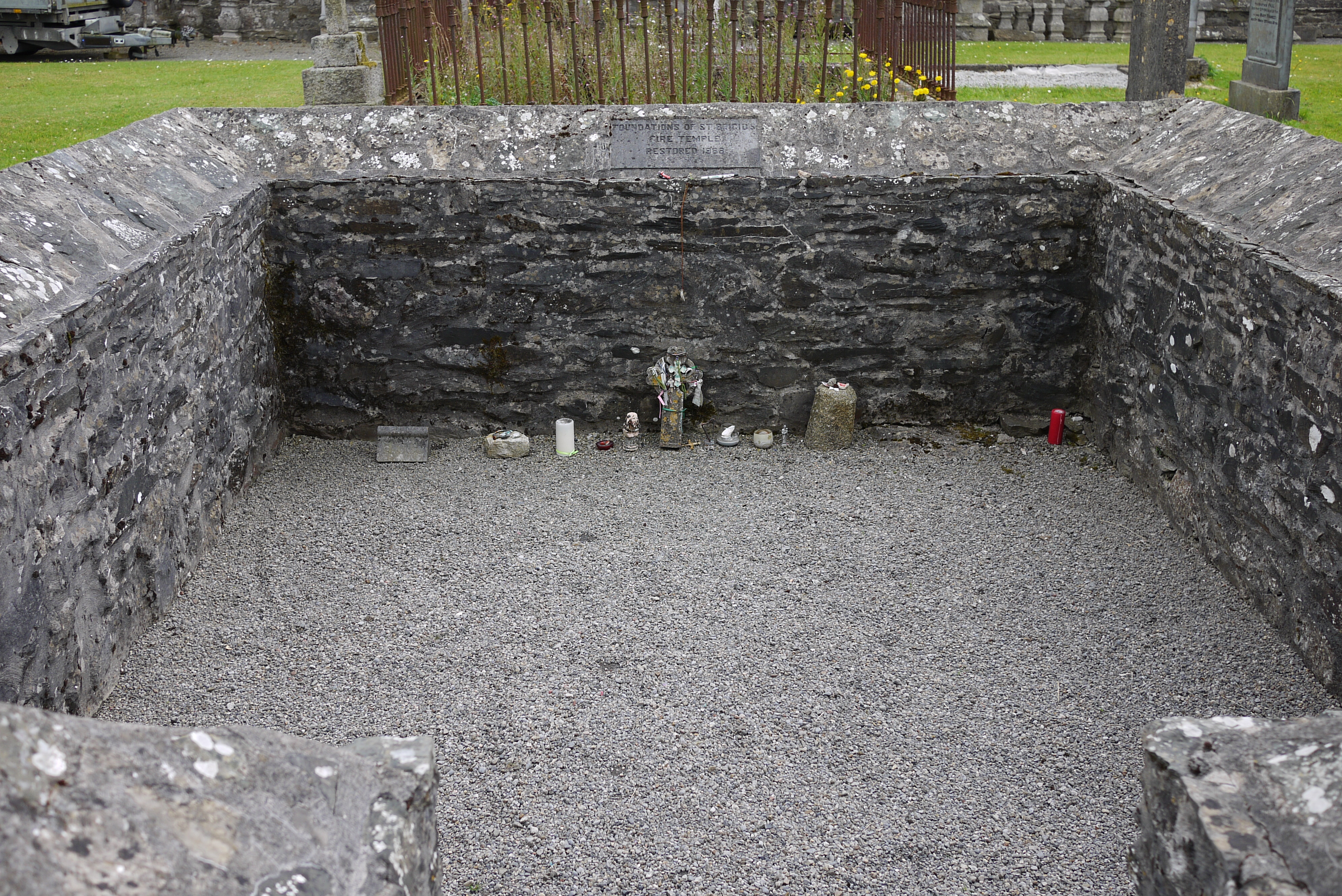
Also in the cathedral grounds is the remains of Brigid's Fire Temple, which is still used to light a fire on Lá Fhéile Bríde. When it's not home to a giant fire, it seems it acts as a shrine:


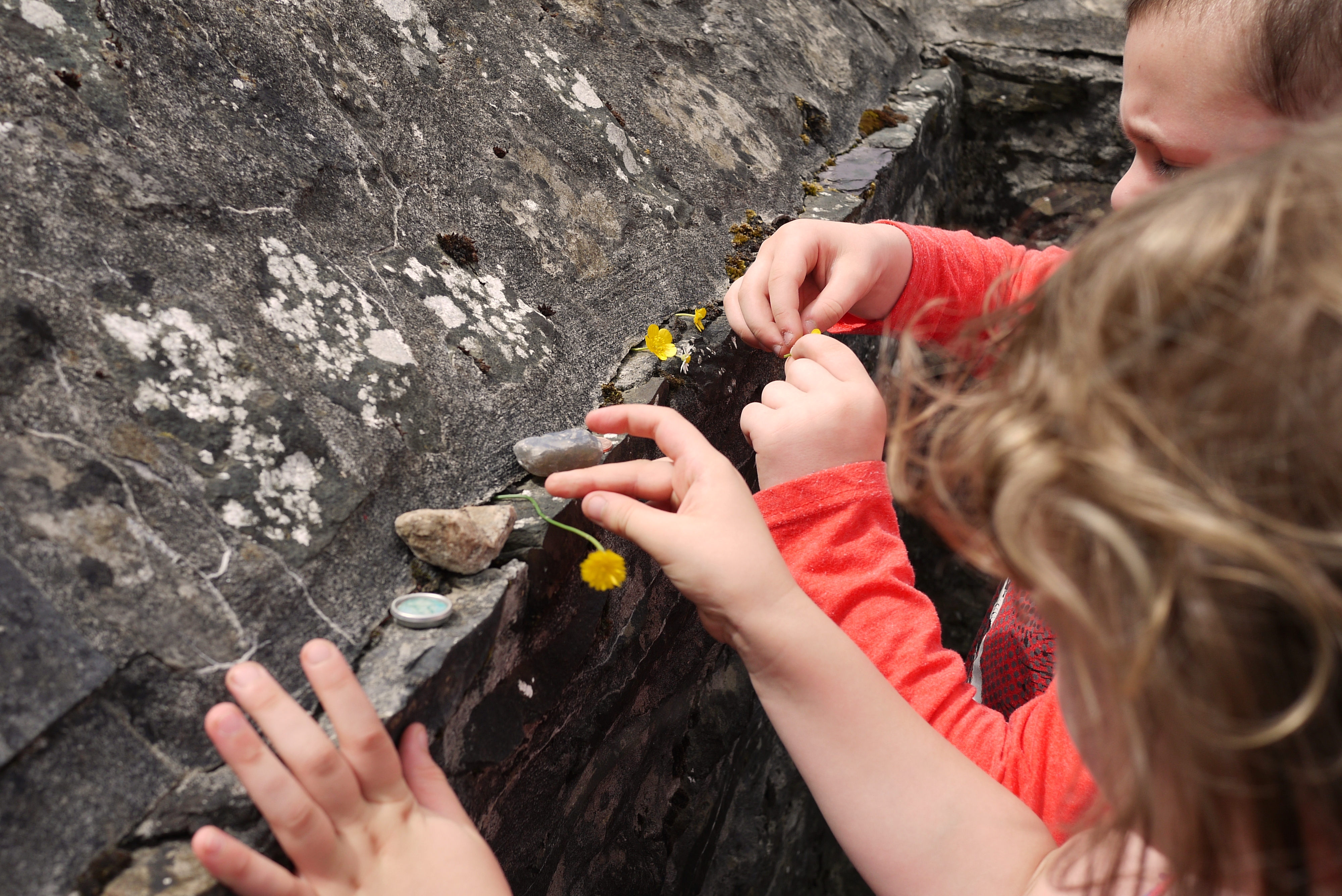
The kids decided they needed to add some offerings of their own, so they went to pick some flowers - buttercups and dandelions:


And I made some, too. Mr Seren wandered off around the graveyard, quietly being an atheist.

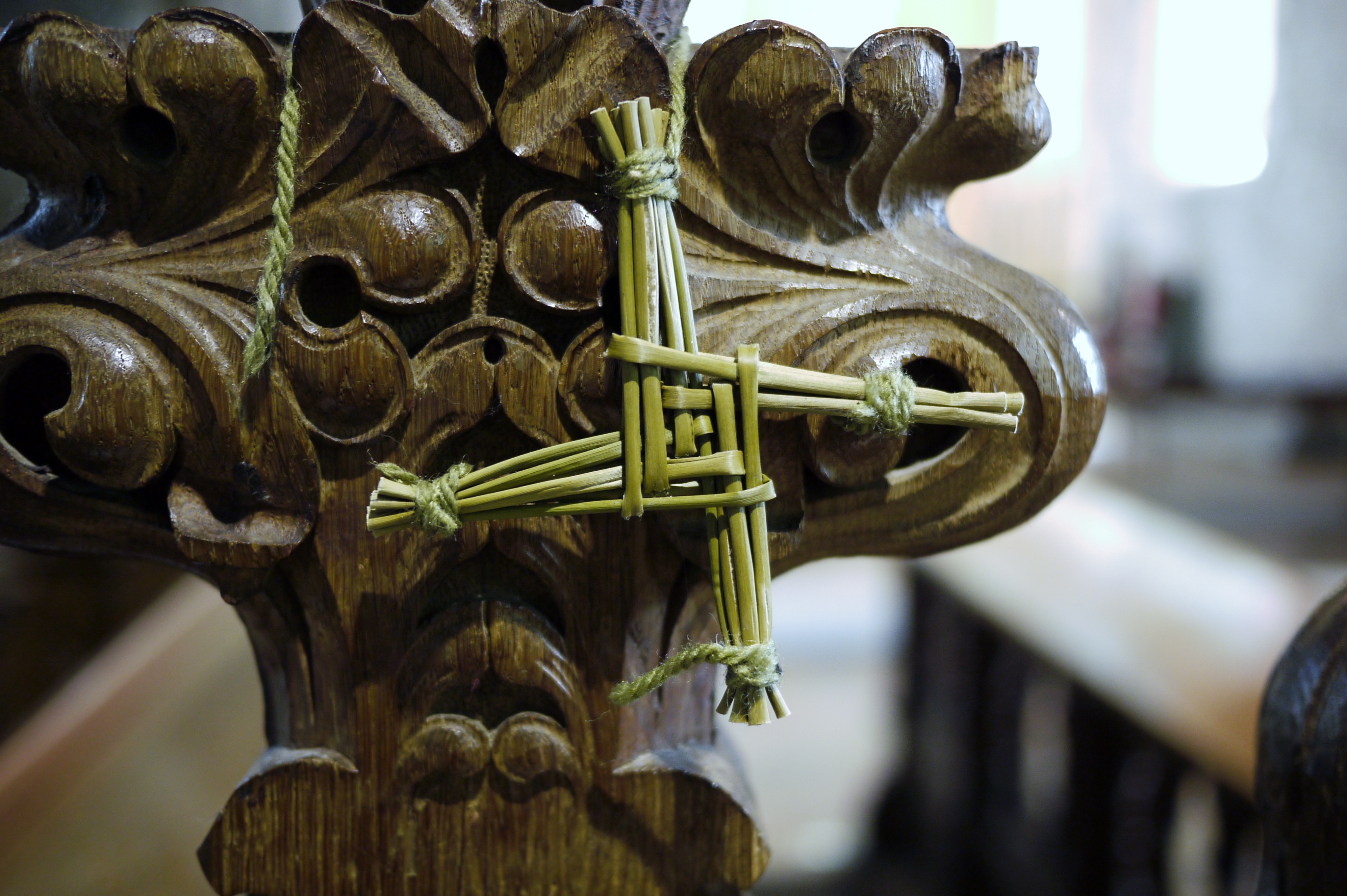
The cathedral itself pretty small, and full of Brigid's crosses up on the window ledges and hanging off the pews:


You can buy them from there for a good price, but at that point I didn't have any cash on me. I didn't feel comfortable taking too many photos because my camera beeps and the cathedral began to fill up with people as we were looking around, so it seemed a little intrusive. Back outside, near the entrance to the cathedral building, there's something called "Brigid's Kitchen," which was actually some sort of tomb. Built in the 14th century, it's empty now and you can go down and take a look. There's also some amazing gargoyles on the cathedral, although they don't beat the xenomorph at Paisley Abbey. Still, you can't bitch about gargoyles with cows:


There's a castle lurking in the town, and a fair few abbeys about the place, but we didn't venture that far. After lunch we went to the well (and thanks to my excellent map-reading skills from the leaflet I got from the heritage centre, we got a little lost along the way...). But we got there in the end, and the trip is so worth it. From what I understand, it's not the original well - that's on the roadside, but because the road is pretty narrow and there's no parking, it was eventually moved to the current site to prevent accidents and road blockages (the newer well gets its water from the same spring as the original, though). The guy at the heritage centre marked down the vague location of the original well on the map I took, but it's not very obvious and we didn't spot it - not that we really made much effort to find it.

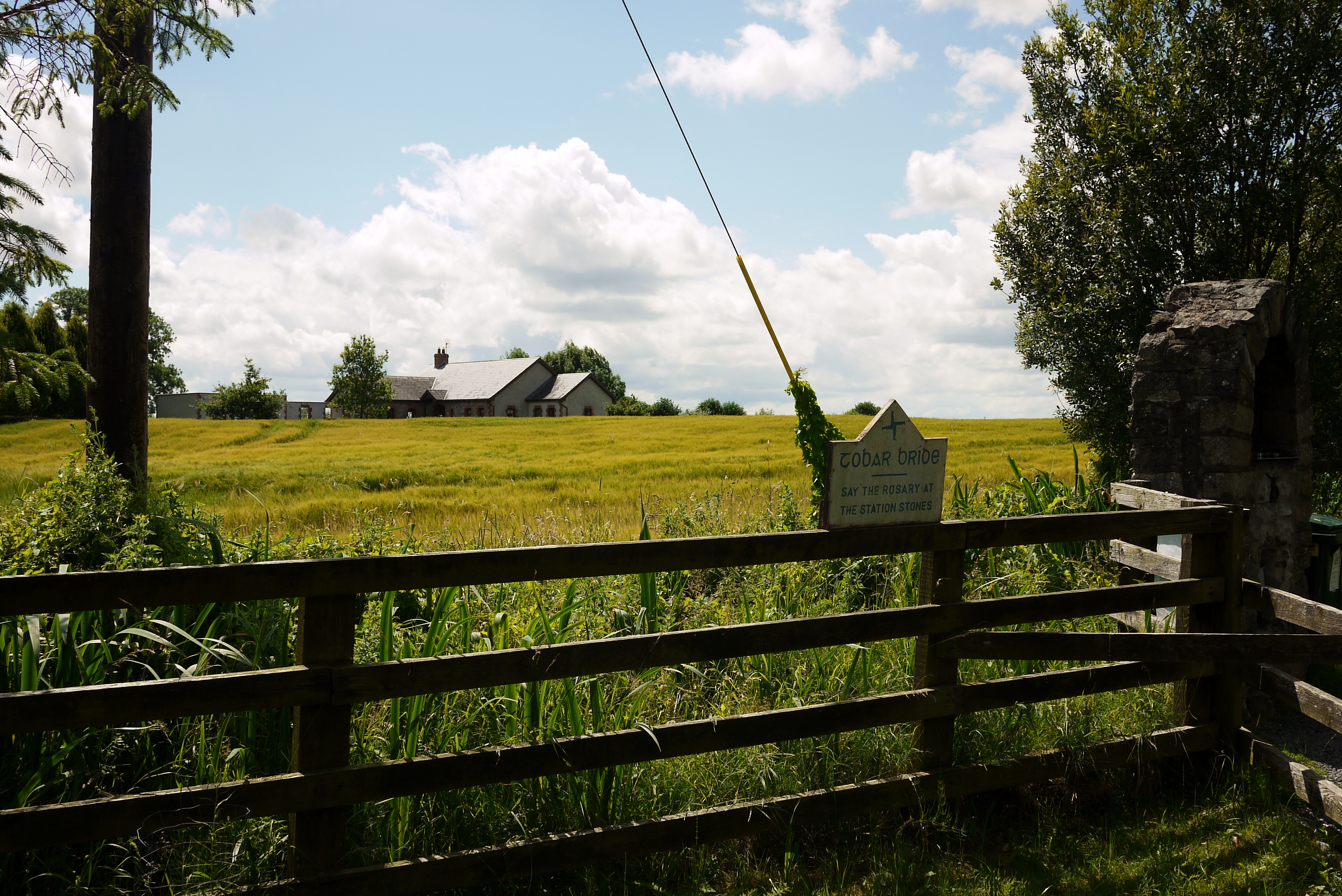
But the current site is beautiful - it's set away from the road and it's all fenced off and lined with trees, so it's like going into a quiet garden. Once you've parked up you go alongside a shallow stream and then walk through an archway into the site itself, and there's a notice telling you what to do (if you're Catholic, I suppose...) just before you go through the arch:


The corn's very nearly ready in that field there...

After you've passed through the arch there's a small shrine to the left, with a polite notice asking for donations to help with the upkeep:


Further along and over to the right is the statue and larger shrine, which is separated off from the rest of the place by a shallow stream that you have to step or jump over to get across to the statue:


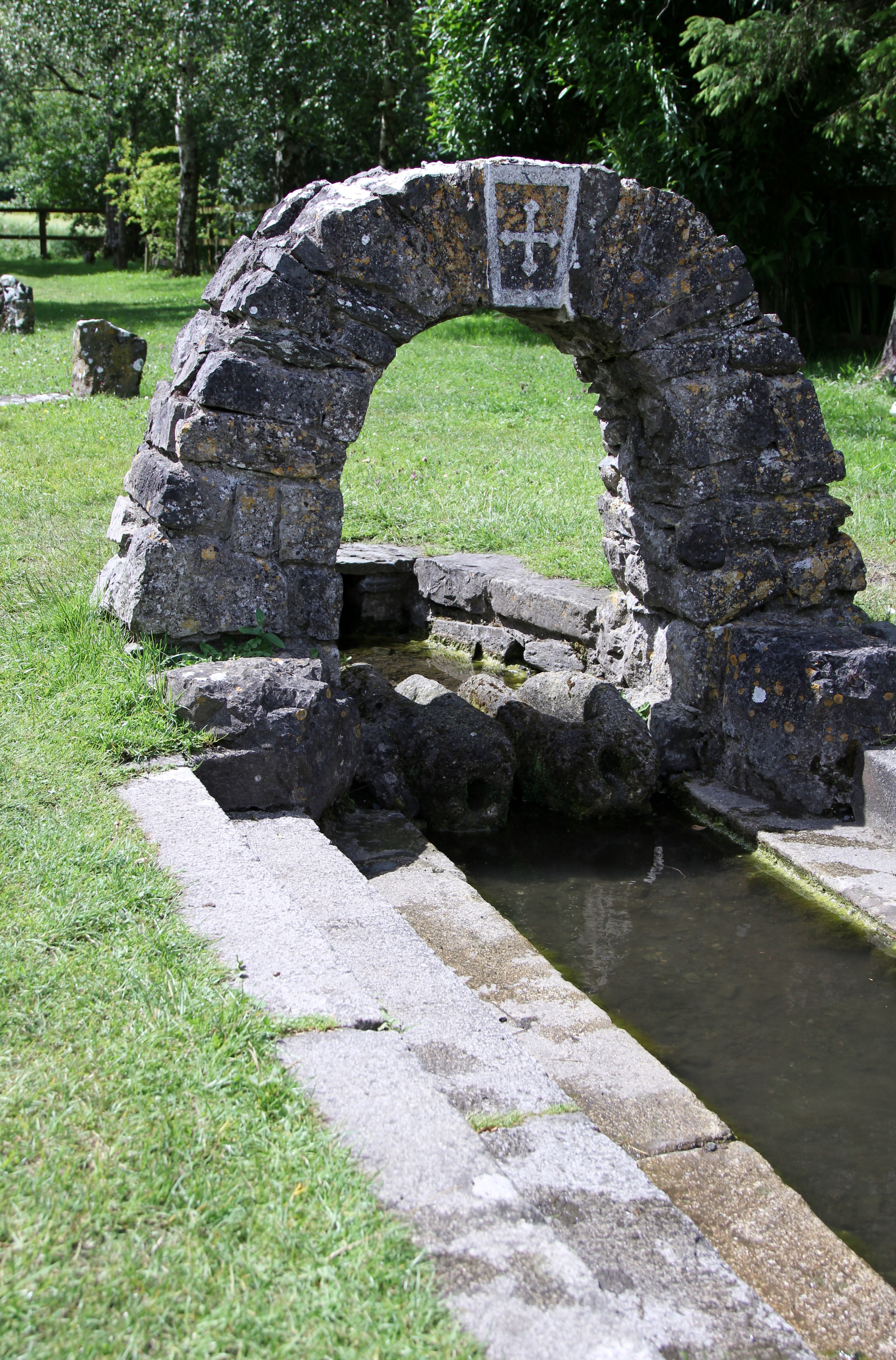
Off to one side there's a little archway where water from the well itself trickles along to join the stream, and then behind the archway there are several stations that lead up to the well, which is right at the end of the site:


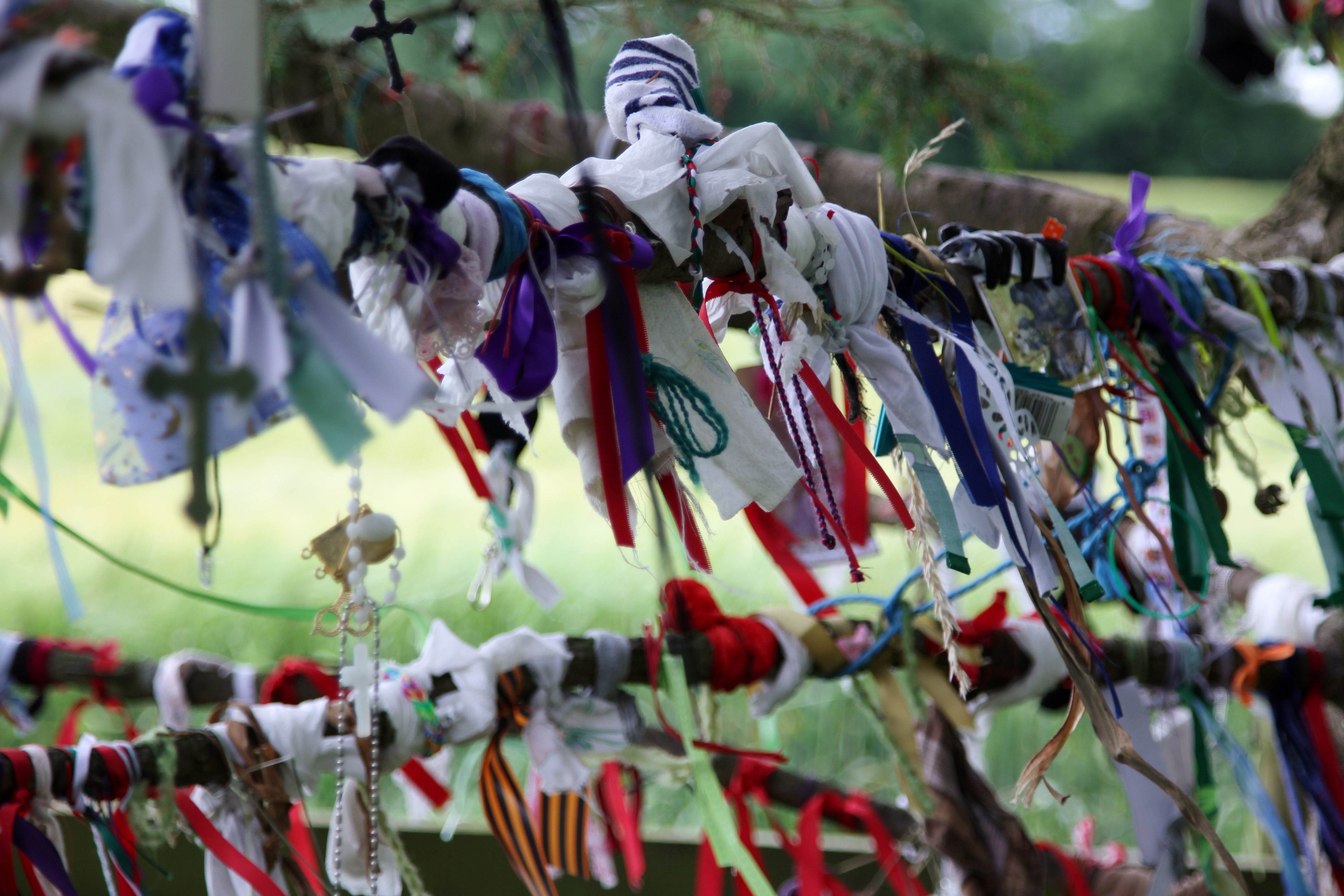
In the left-hand corner, right at the back, there's a wishing tree that's covered in rags, socks, gloves, crosses, pieces of jewellery, and all other kinds of offerings:


We didn't leave anything at the tree ourselves, and I have to say it was looking a little worse for wear - if you're going to tie a clootie, leave some room for it to grow, mm'kay? And make sure it's easily biodegradable - some of these look like they're tied on a little too tightly, at that's not going to be good for the tree. There's a large cluster of baby socks on a couple of the branches, though, and you just know why they're there. It's heartbreaking to see, but at the same time it's almost comforting as well, because it's a way for people to express their grief, and maybe to hope and to heal. Just before we left a man and his son (I'd say about nine years old) came in, and they went straight to the tree. They obviously had some business to attend to.

When we arrived at the well there were a couple of families already there, and there were five or six kids running around splashing in the water. Tom and Rosie joined in and I went up to the well to make my prayers and offerings to Brigid. Just as I did at Newgrange, I made prayers for some people who asked me to, and I prayed for myself and my family, as well as Gaol Naofa. I gave my thanks and collected some of the water to take home with me, too, and just before I did I caught sight of a tiny wee fish darting about. It disappeared not long after that, but I took it as a good sign.

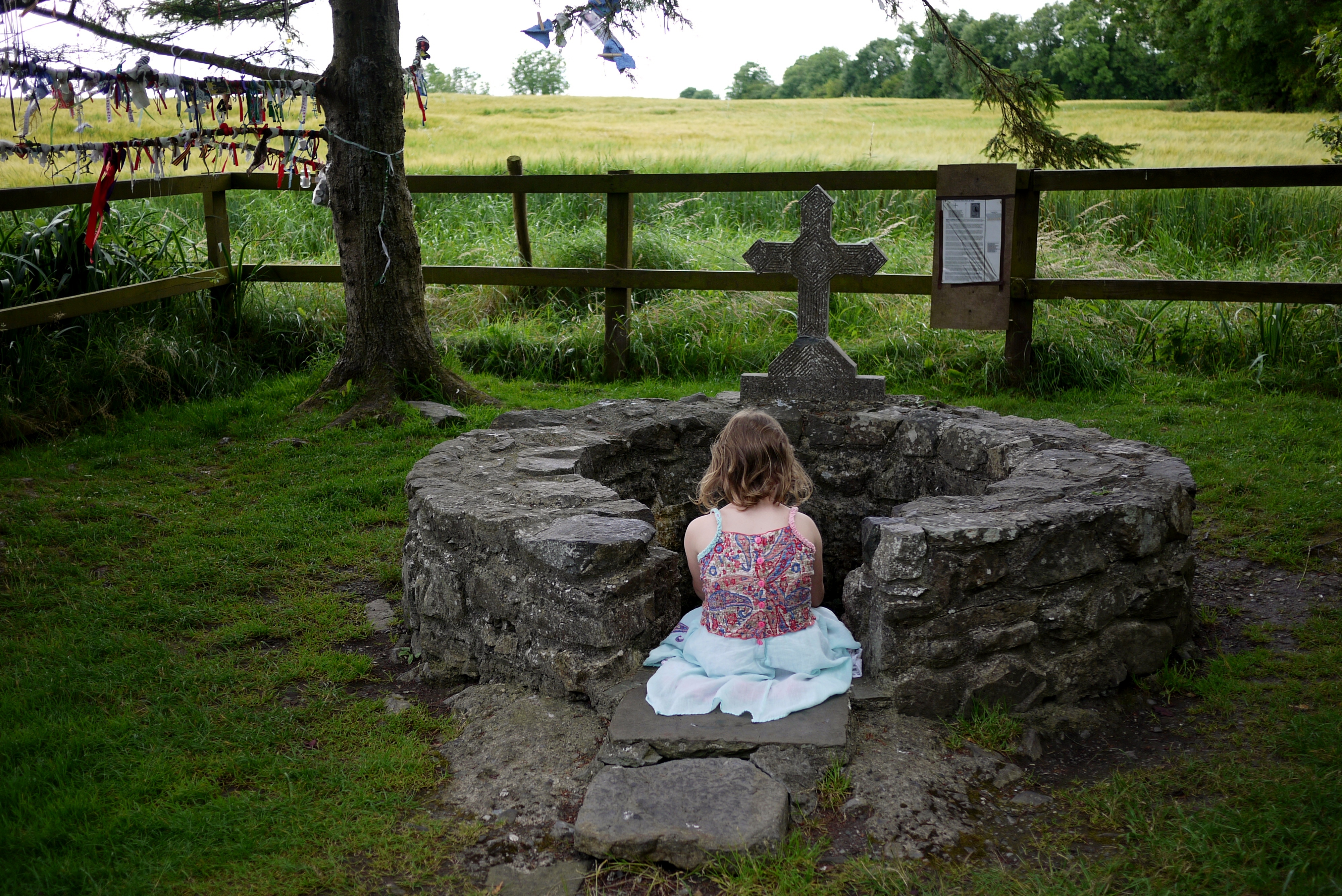
The kids were having a whale of a time and eventually, after doing my own thing, I wandered about taking photos and joined in. The kids came to have a look at the well and wanted to make offerings there, so I helped them do that. They went a little shy and tongue-tied, so I made a little prayer of thanks for them. Rosie in particular liked the well, and spent a fair amount of time contemplating life, the universe, and pretty much everything. Also probably trying to spot the wee fish:


Eventually the other families left - they seemed nice and the kids got on well with them, but I was glad when they went because it was nice to have a chance to just be there by ourselves. But even with the kids running riot the place still has that inherently peaceful and sacred feel to it. The kids splashing around seemed to be welcomed, rather than disrespectful; they were enjoying the place and it just seemed right and as it should be.

Rosie was mesmerised by the statue, and once the other folks had left she made some offerings there as well, then poured out a libation, and poured some more at the wishing tree and a hawthorn tree right by the stream inlet. She was determined not to leave anyone out, and then she set about righting some of the smaller statues that had been left, which had fallen over. She and Tom eventually began to get restless, so we made our farewells and went back to the car. We decided to take a little detour before heading back to the hotel, and ended up taking a drive through Glendalough, which is a beautiful place but it's difficult to stop and take photos when you're sandwiched between a logging lorry and a tiny car hellbent on tailgating you all the way along. Right at the top we found somewhere to park up safely, so we could take in some of the scenery:


This is an old pilgrimage route, apparently.

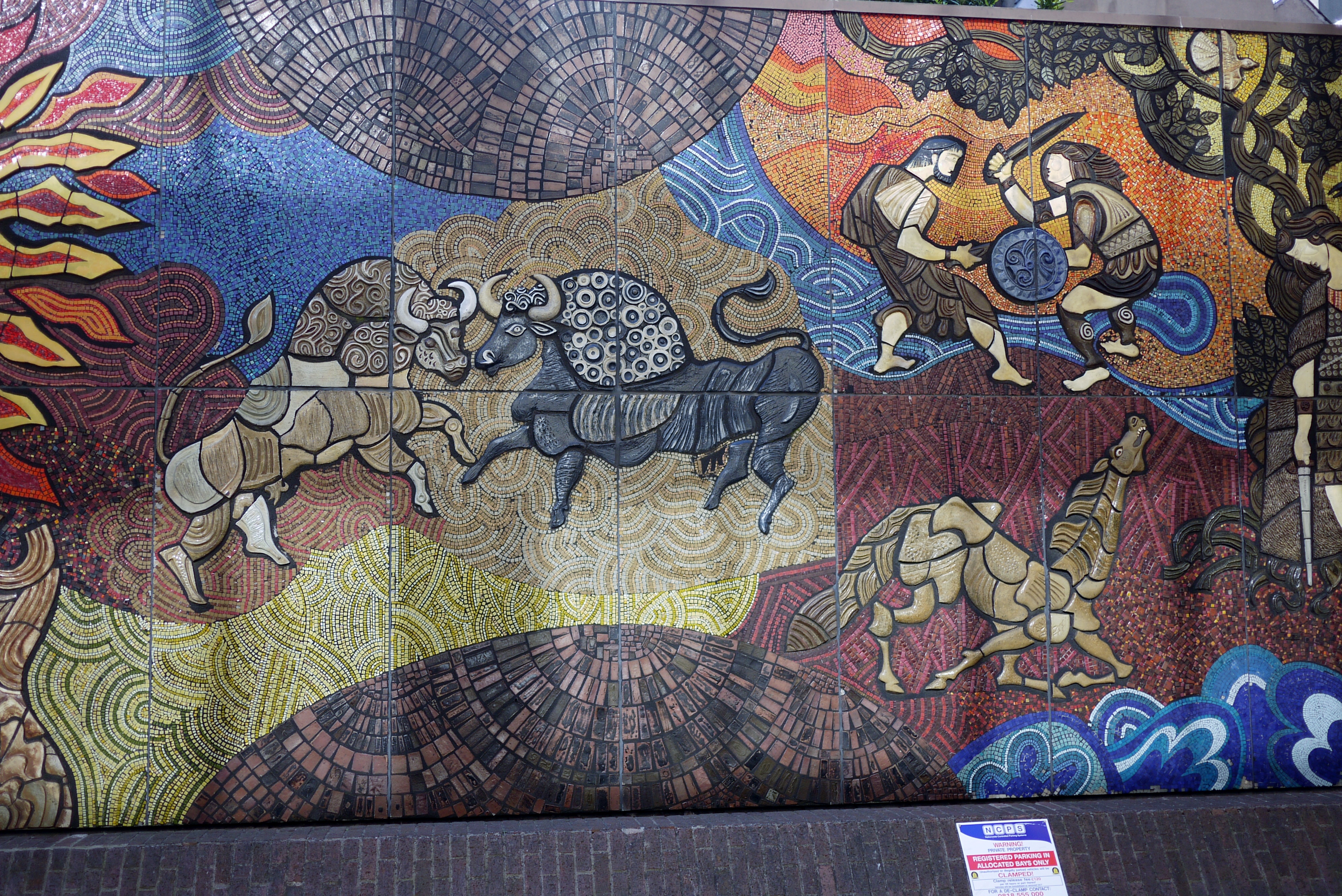
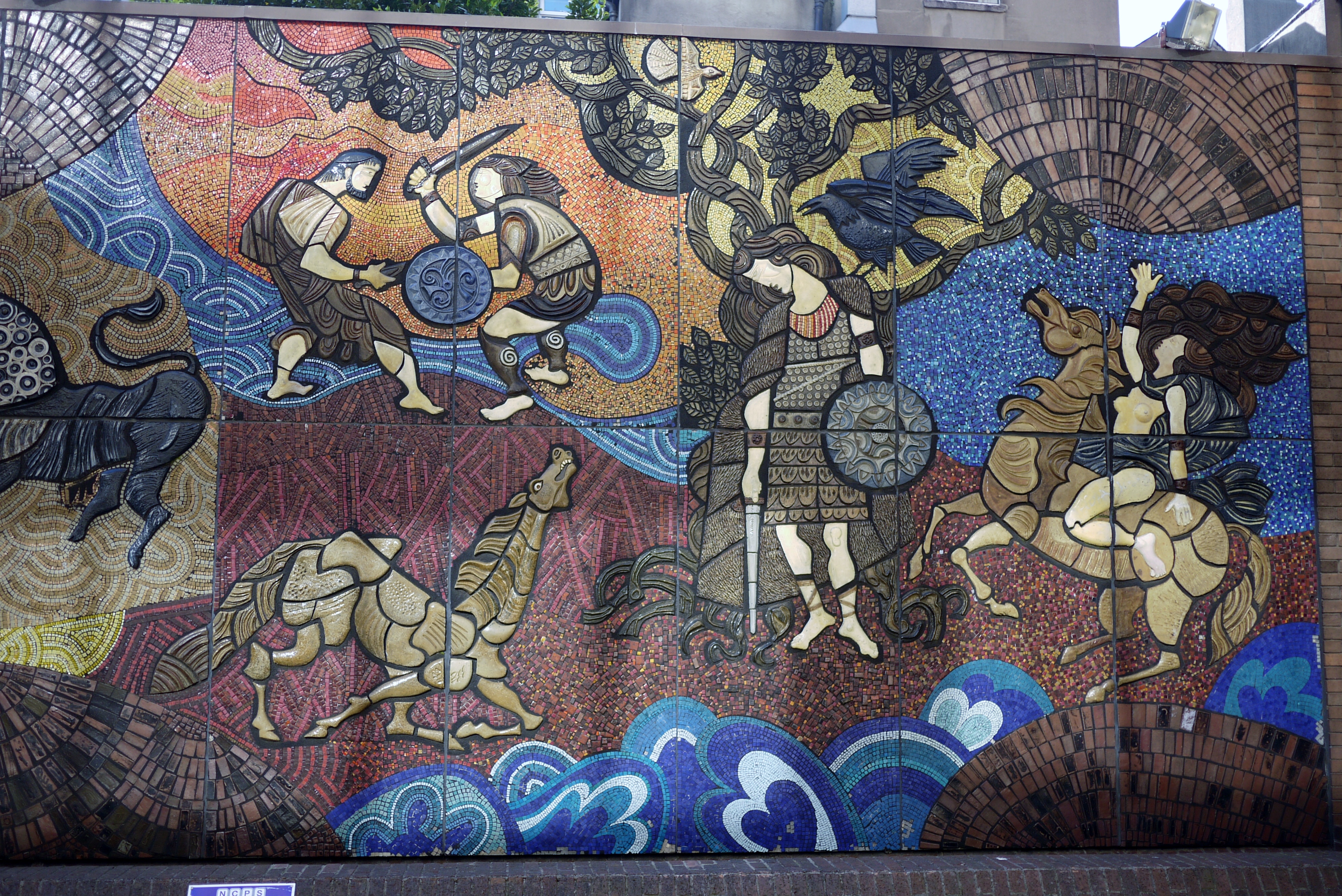
Then we headed into Dublin to get some dinner, and after we parked up I spotted a mural of the Táin:


Which is really long and I couldn't fit the whole thing in one go, unfortunately. But over dinner I ended up telling the kids about the Táin, and all about the scenes that are depicted in the mural, much to Tom's amusement and horror when it got to the part about Ferdiad's demise.

The next day we took the kids to a water park as a surprise, but before that Rosie begged to go back to the well. I promised her we'd definitely go back one day...

Monday, 21 July 2014

Newgrange

I might as well keep going while the laundry pile is slowly being reduced...

After a short break back at the heritage centre, we traipsed back over to the bus stop, pausing to take in the view of the Boyne and its clear waters - here's a view of the river downstream this time:


We got on the bus and headed to Newgrange. I'd heard from a lot of people who've visited the site before me that the place is pretty disappointing in some ways; a lot of folks aren't too happy with the reconstruction, either because they disagree with the way it's been done, and/or because the place feels a little too precise and neat. A little clinical, with all the straight edges and tidy walls, when we're used to things being a little slumped and lumpy when it comes to ancient monuments.

Personally, I'm not massively keen on the reconstruction, but it's not that it's "too tidy." It's that it just feels like a little bit of the spirit of the place has been trodden on, picked up, and stuffed back in, if that makes sense. The monument itself is truly impressive to look at:


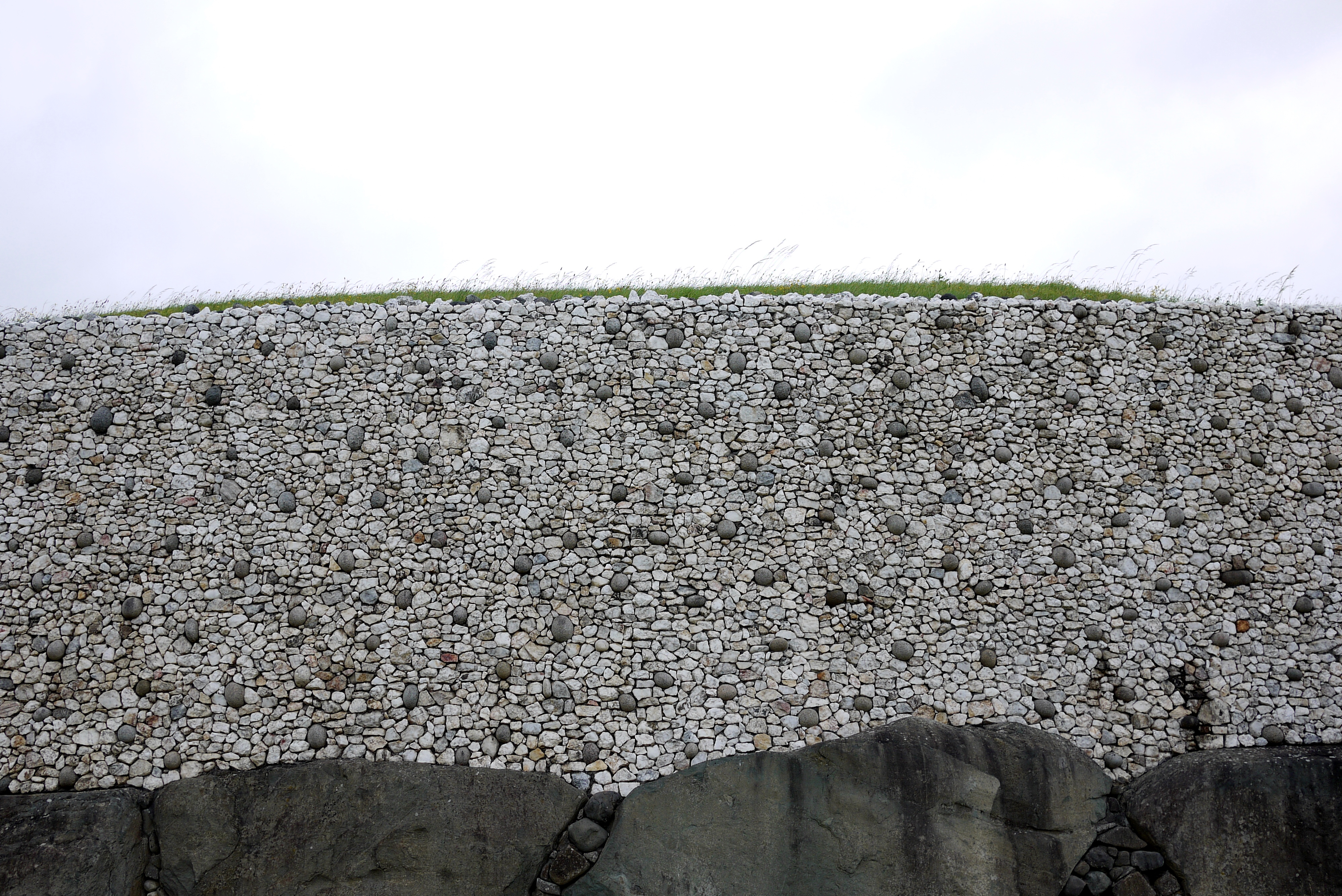
Personally, I tend to err on the side of the quartz having been on the floor originally, and as my mother-in-law (also an archaeologist) commented, "Well I think we can all accept that Newgrange was a big mistake." But regardless of where you stand on the issue of the quartz walls, it's a really impressive site, whether you're far away or close up:


On a sunny day it's probably even more amazing to look at...

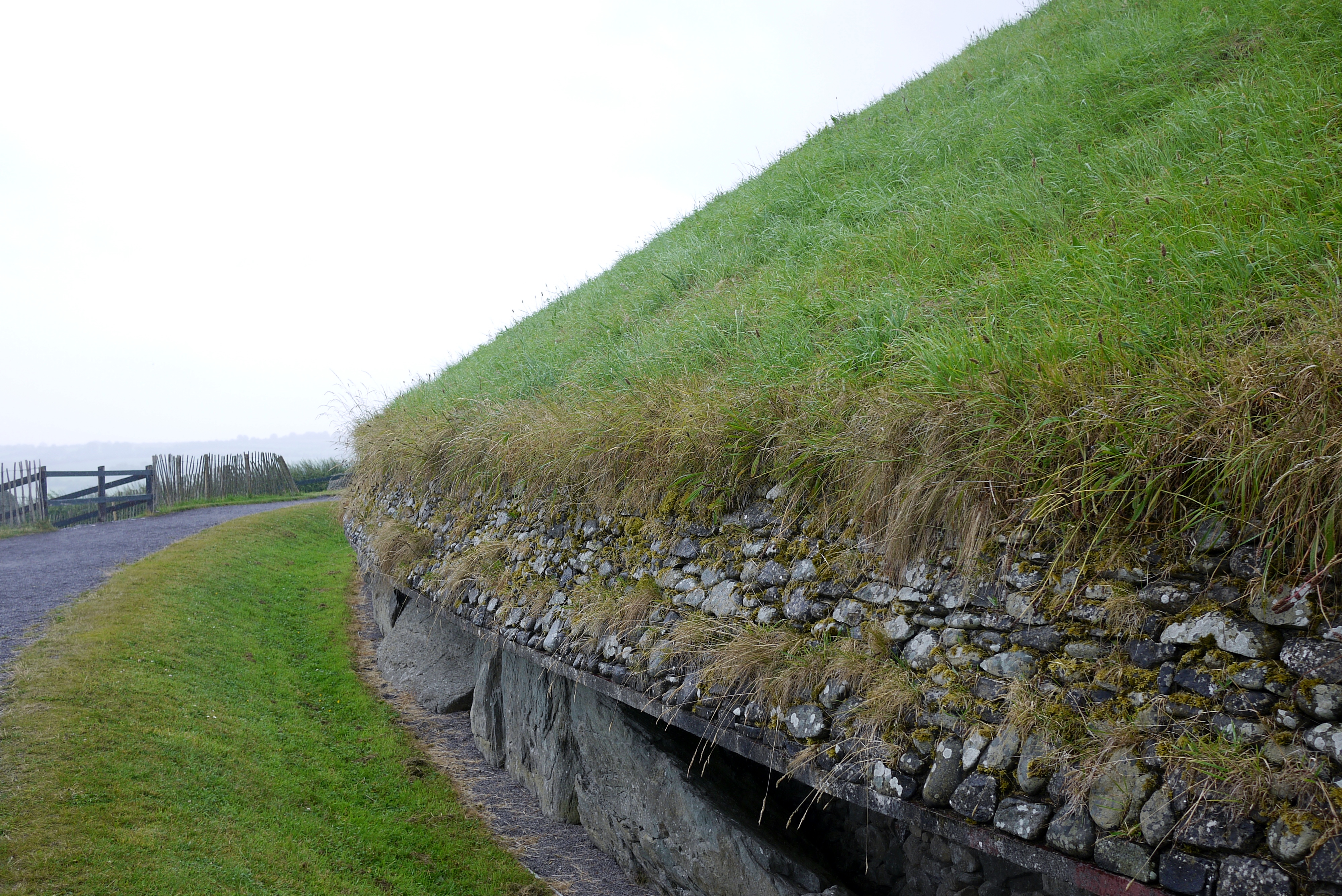
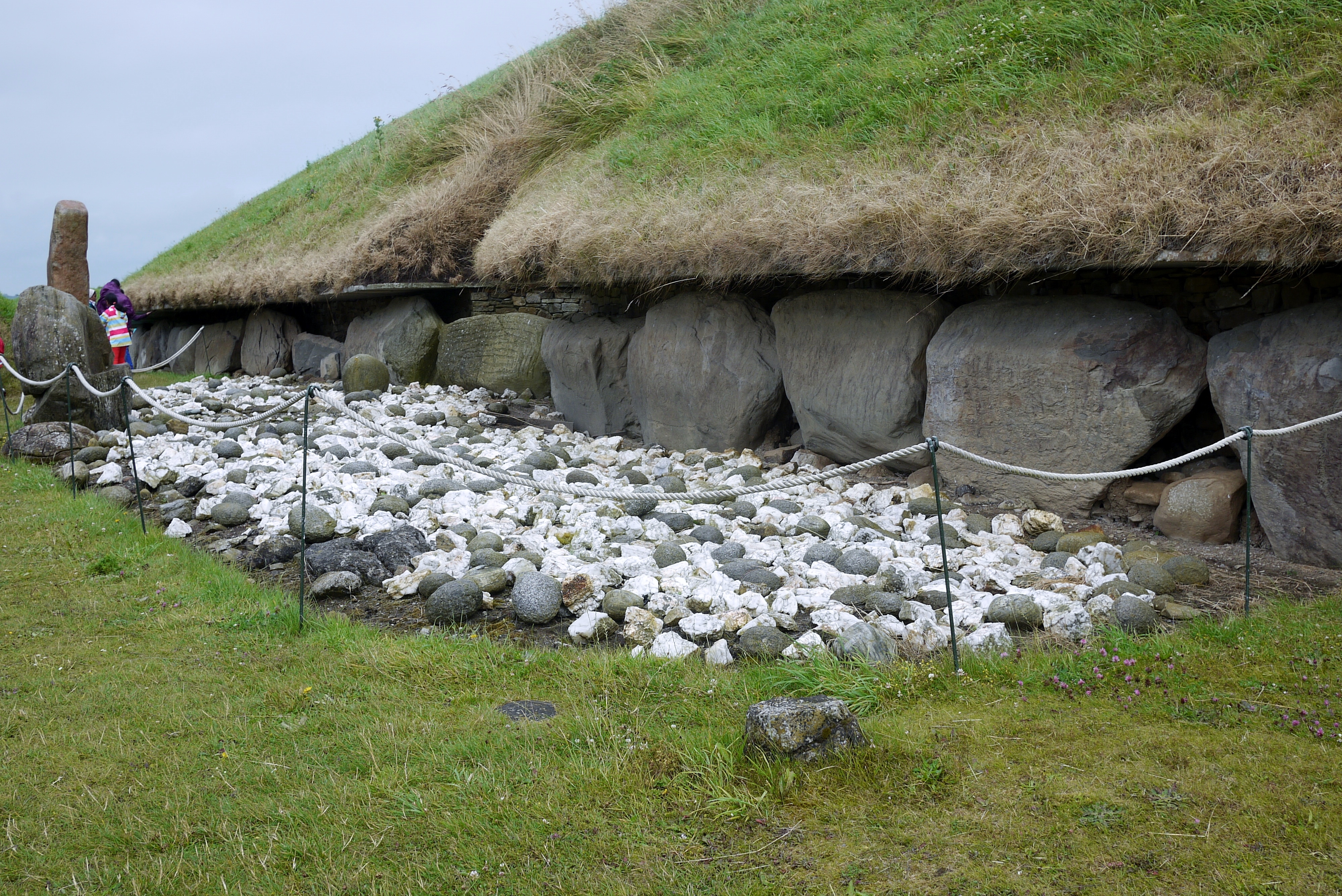
The quartz doesn't go all the way round, as you can tell from the wide shot. The back is similar to Knowth, with a protective ledge jutting out over the stones, but above the ledge there's a continuation of the wall (though not as high) in a grey stone (I'm not sure what kind):


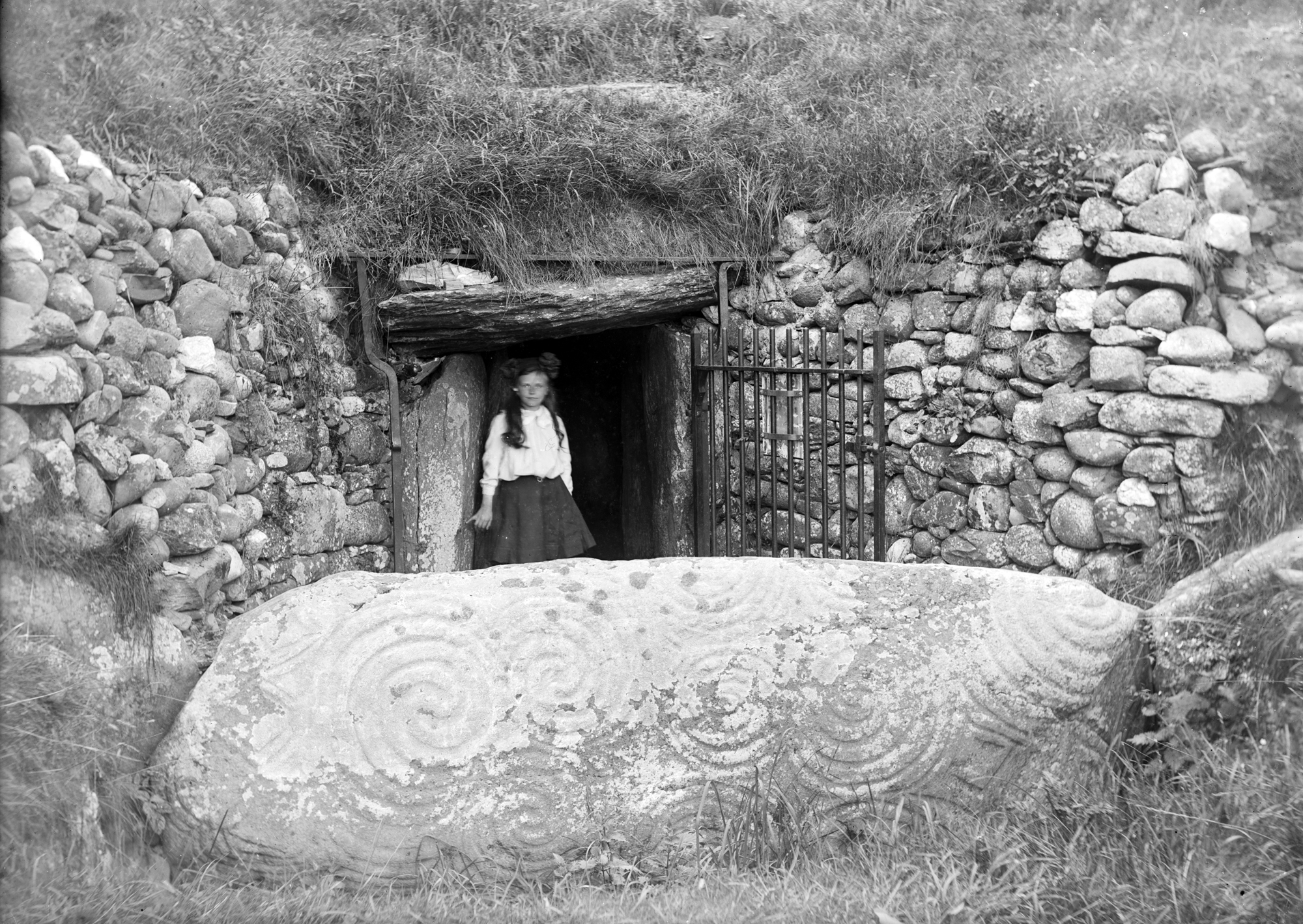
If you want to compare and contrast the old and the new look, this is a picture from the early twentieth century:


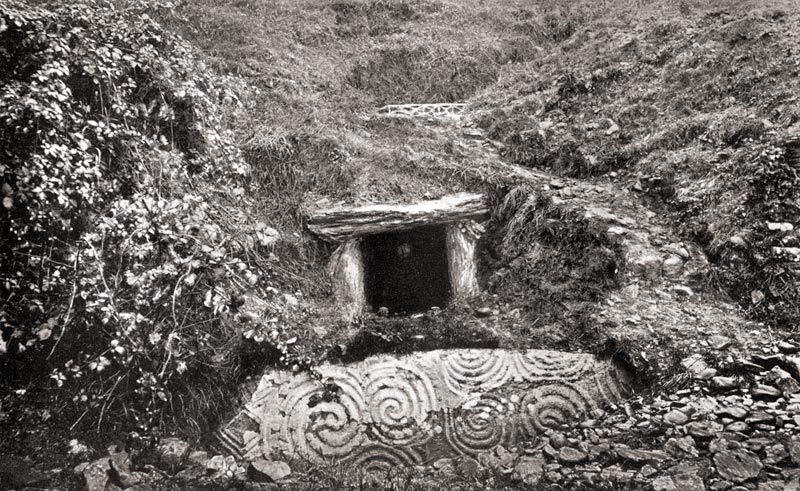
Which is itself after an attempt at tidying the place up during the nineteenth century. Before then, it looked like this:


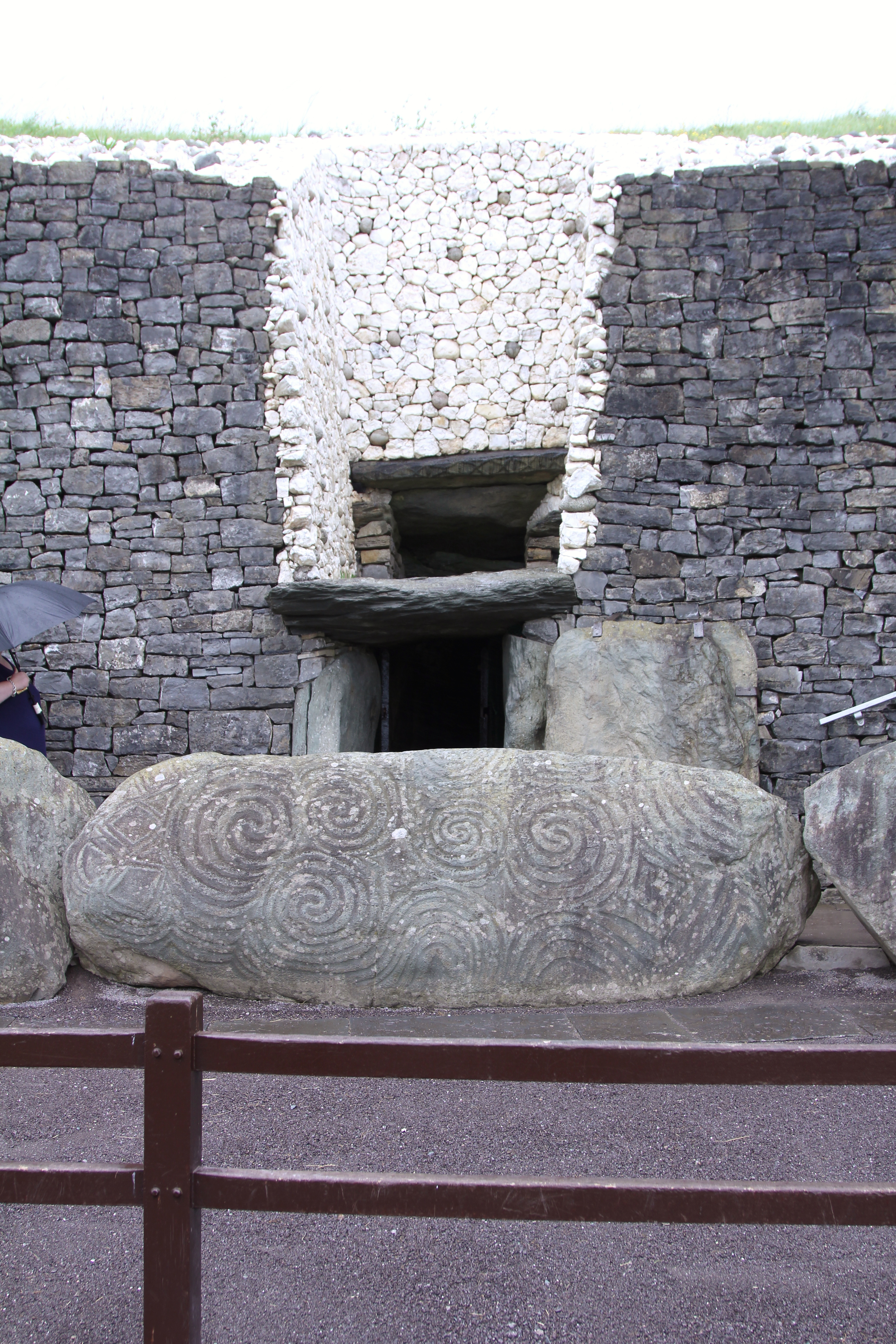
The whole mound was badly collapsed, so whatever your view of the reconstruction, it was never going to be an easy job. This is a picture of the entrance today:


From what the guide said, if I remember right, the grey limestone they've used here in the reconstruction isn't original to the monument itself. It doesn't seem to be the same stone from the early twentieth century picture, anyway.

You'll notice that the famous decorated stone there completely blocks the entrance, so you can't just walk inside. You have to climb over the stone to get in, and this a feature at Knowth and other sites of this type. The theory is that it forms a physical as well as psychological barrier between the space of the living and the dead. A literal as well as symbolic delineation.

You can also see the light box above the entrance, which lets the sun right into the chamber during the period of the winter solstice at around 9am (it doesn't just happen on the solstice, it happens for a few days before and after as well, for about a week. The solstice is the peak period of time where the light shines in. Assuming there's any actual sunlight, and not just cloud...). There's a theory knocking around at the moment that suggests the light box could have been adjusted periodically, to let the sun shine in at other times as well, but I've not seen much discussion of the arguments for or against the idea to have much of an opinion on it at the moment.

When you're bused over to Newgrange, you go in groups of up to 50 people or so. The guide takes you into the chamber inside the monument, but because there are so many people you're split into two groups so everyone can fit in. It's still a tight fit, and you're instructed not to touch the walls or wear your bag on your back in case you accidentally scrape against anything. You're not allowed to take photos inside the chamber, and the guide insisted that this was out of respect (completely ignoring the fact that the chamber has been installed with lights and electricity cables, and she regularly invites groups of 20 or so people to come and gawk inside an ancient burial place that's been thoroughly disturbed over the years). The guide at Knowth (where photos are absolutely fine) said to ignore whatever excuse the guide at Newgrange gave; the restriction on photos was purely practical and due to time constraints. Because it's so crowded when everyone's in there, it's difficult to get any good pictures and people would end up hanging around and waiting for everyone else to leave, thus resulting in a game of burial chamber chicken... Fair enough, I suppose.

But anyway. When you go inside, you start off making your way along a very low, narrow passage until you reach the chamber, which has a corbelled chamber (like a beehive), and you can stand up comfortably again. The chamber is cruciform, with a shallow recess right at the back and recesses to the right and left as well, making a cross shape. The recess on the right (as you're facing inwards) is the largest and most heavily decorated, and it contains one of those large stone basins that I included in the waffle about the displays at the heritage centre, yesterday. The basins are so large that the people who built the place must have set them in position first and build the chamber, passage, and then mound around it. Although the chamber was heavily disturbed by the time it was excavated, they found the cremated remains of four or five people, mostly on the floor but possibly originally in the basins.

The chamber is nicely lit when you first get there, but after a little introduction the guide switches off all of the lights to give an idea of what the solstice sunrise rise (using a specially placed light). At this point the guide began speculating about the meaning of the light as it works its way inside, and she began going on about the ancient mother goddess and sky god, to which I let out a quiet sigh and banged my head against Mr Seren's shoulder...

Back outside there's a little time to have a look around by yourself (we were part of the first group to go inside), and it's apparent that there isn't as much decoration on the stones as there is at Knowth - pretty much every stone is decorated there, but here only a few are. Whether that's because most of them have been robbed out and then lost or destroyed over the years, or because that's just the way it is, I'm not sure. I know some of the stones were robbed, at least.

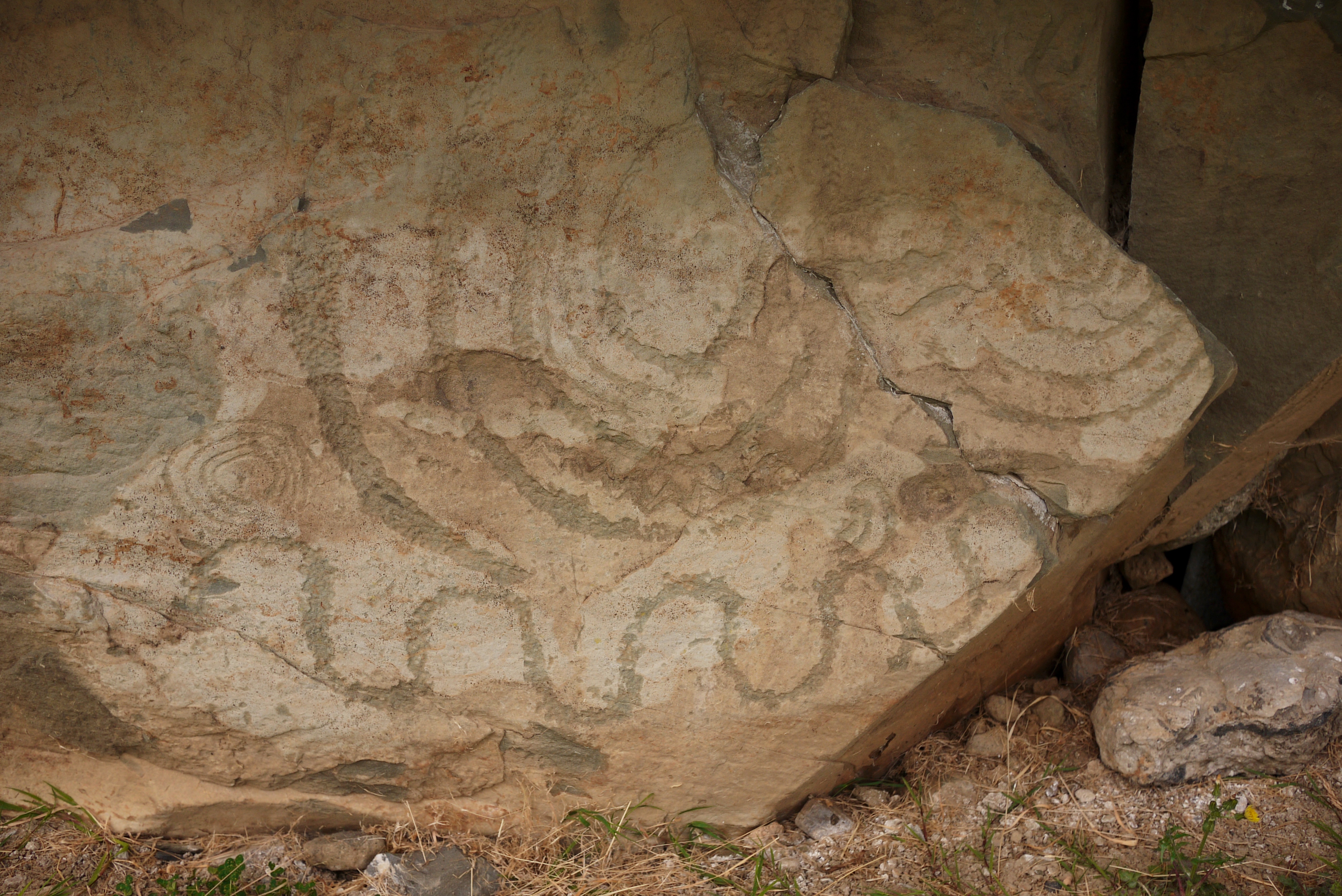
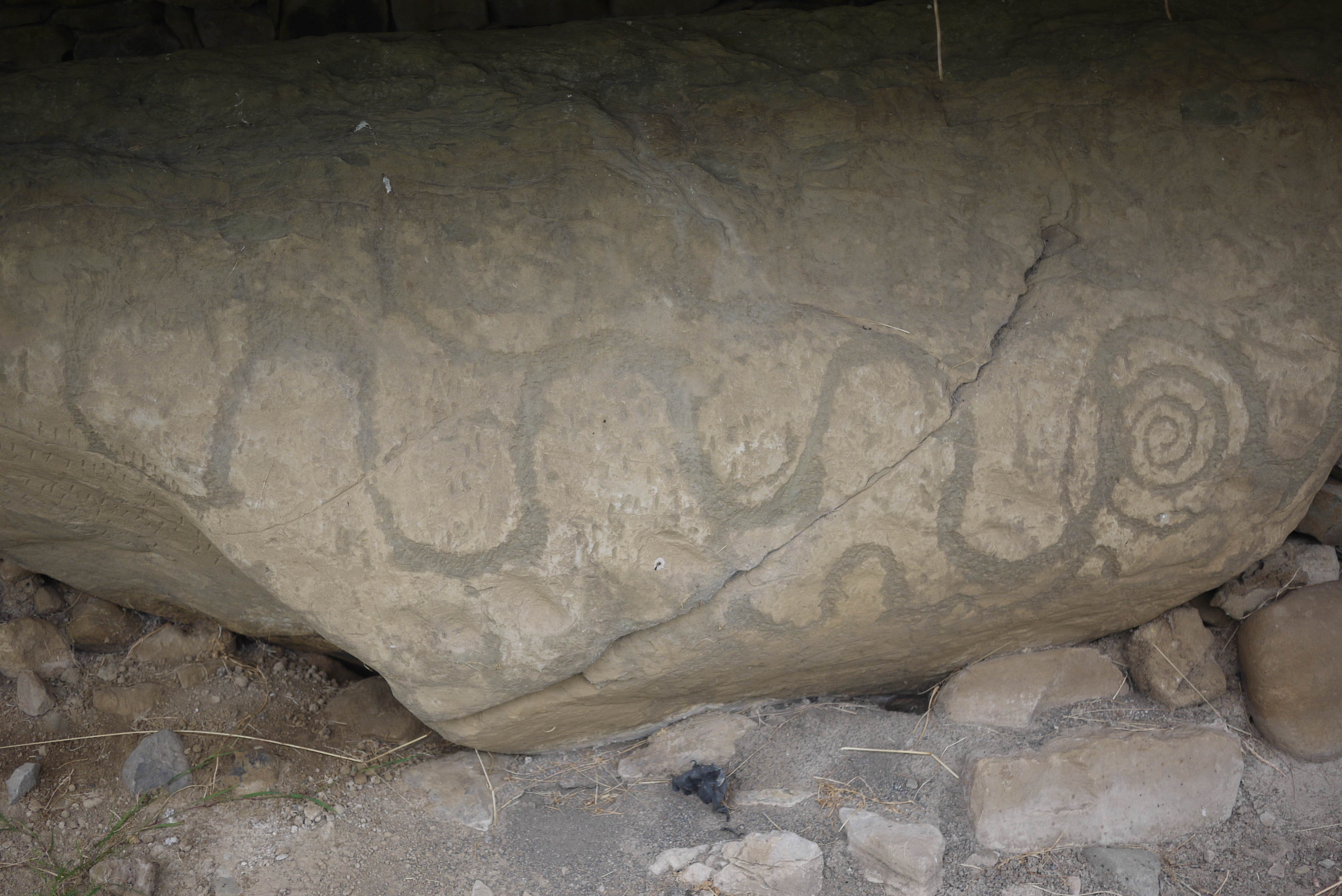
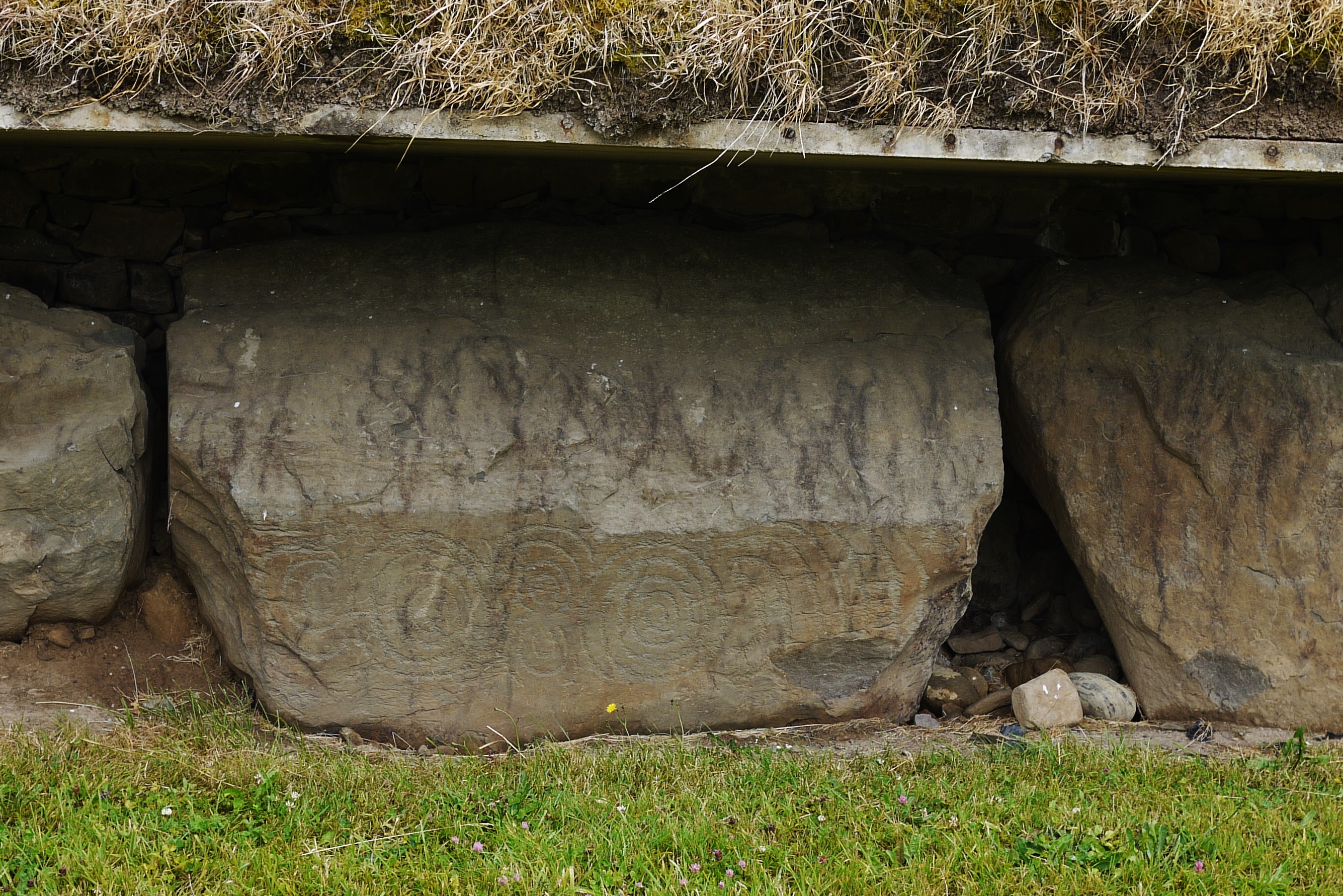
Although you see the same kind of circles and spirals as you do at Knowth, there are also a lot of geometric shapes at Newgrange, giving a very different look and feel to the art (or symbols, if you will):


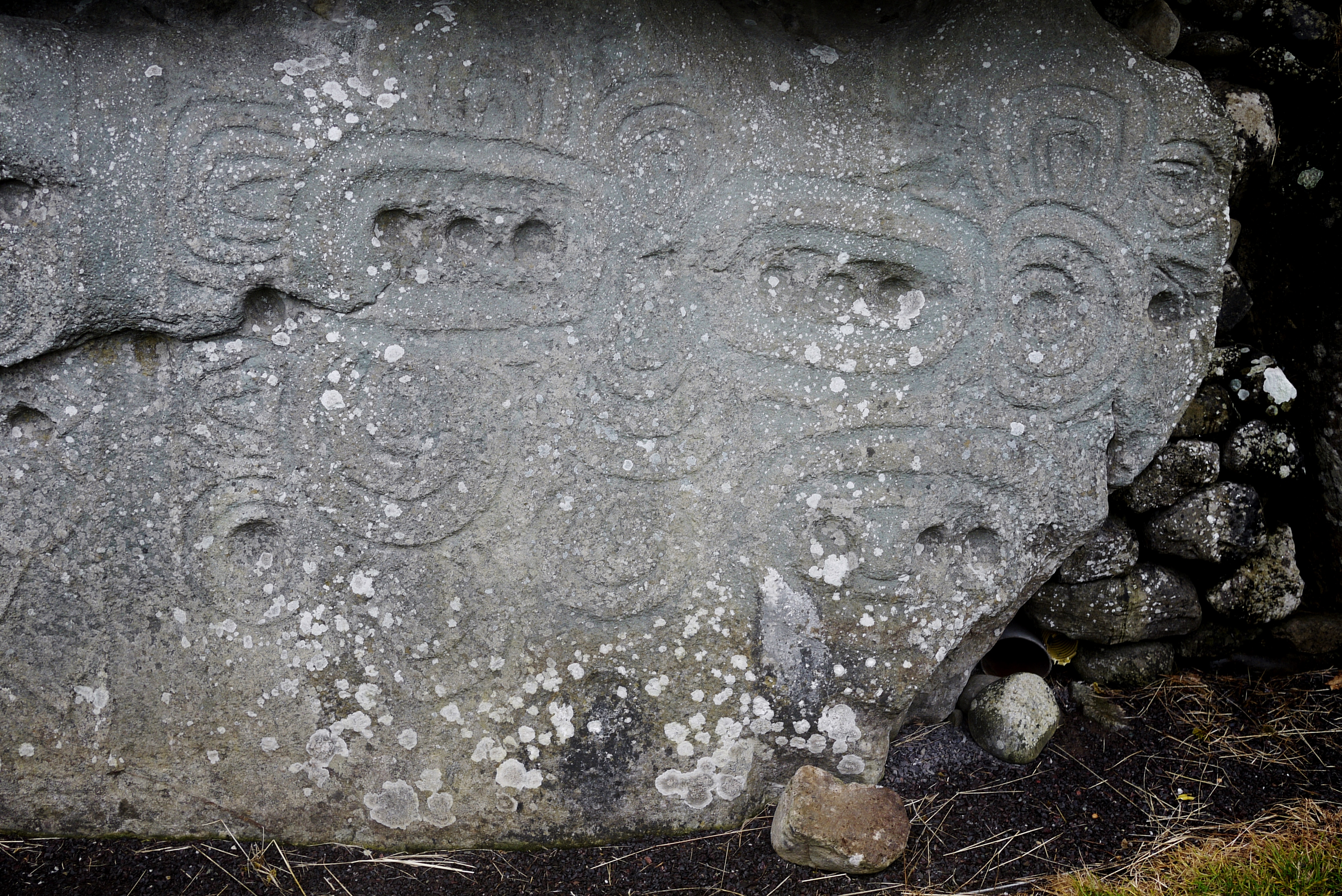
These pictures are of one stone, it was so large I took two pictures just to get the details. There's also this one:


Again, what these symbols mean, we can only guess. Of course, the most spectacular stone is the one at the front of the tomb, and it would be remiss of me if I didn't give you a close up:


The detail is truly amazing on this one, and I could happily trace those spirals all day long...

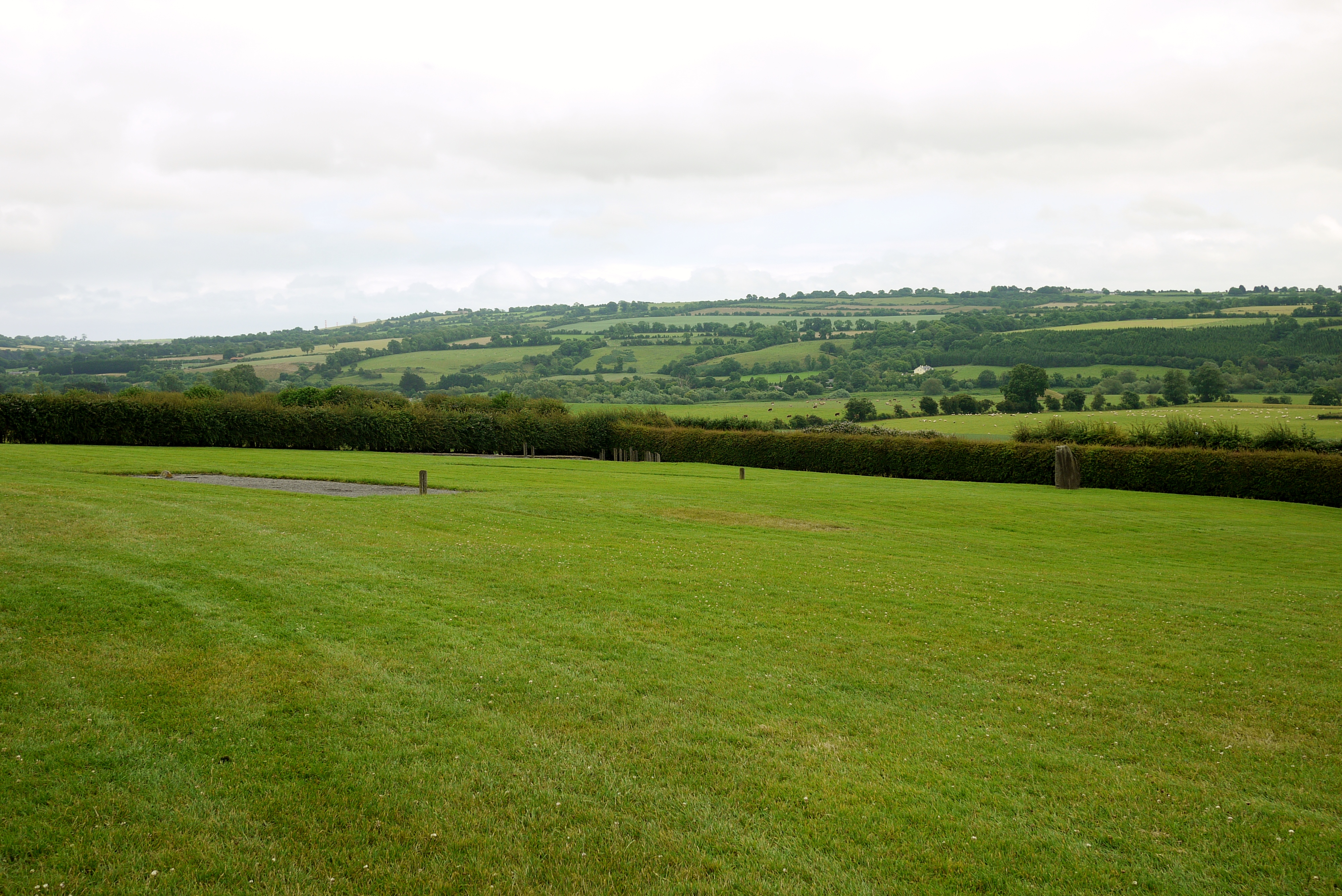
Before I finish up, let's take a look at the surroundings. Like Knowth, Newgrange is situated in a spot that commands a fantastic view of the area around it:


Though not quite as expansive as the view at Knowth:
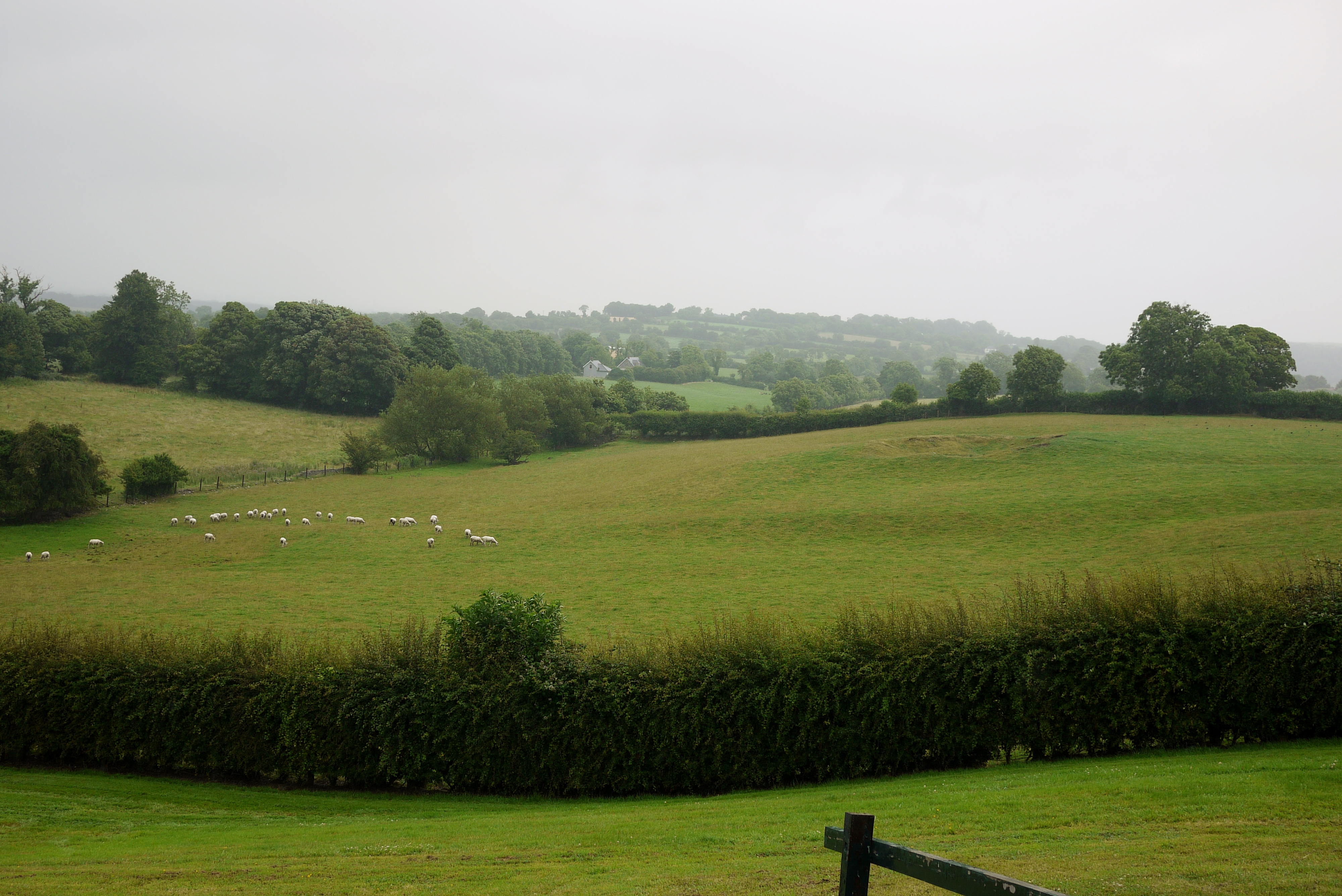

You can see a lumpy bit in the field there, and that offers a reminder of the fact that the passage tomb at Newgrange isn't isolated. There's a huge amount of Stuff (it's an official archaeological term, honest...*ahem*) surrounding it, it's just not as obvious, or accessible, today as the Knowth complex is. That's a big shame, and it's not something that the guide spoke about either. But we can't really consider Knowth or Newgrange in isolation, in and of themselves. They're part of a bigger ancestral landscape, as the heritage centre went some way in showing, and although they're very much a part of the time they were built and then used as passage tombs, they're also both very much a part of the Iron Age and beyond, up until today. Even after they fell out of use they remained significant and were tended to and revisited again and again (although at some point Newgrange was "forgotten" and then accidentally rediscovered in the seventeenth century). Knowth became a settlement, and people continued to inter their loved ones into the mound of Newgrange - or Brú na Boinne, to give it its proper title - and made offerings there. 

The two sites are pretty close together and have their own legends and myths attached - Knowth is said to be the resting place of Buí, while Newgrange is the home of the Dagda or Oengus. There's also another passage tomb nearby, Dowth, which isn't included in the tours on offer (unfortunately), and which we didn't manage to visit - though you can if you can find it. Signposting is often rather haphazard in Ireland (as is the driving)... But we have to consider the bigger picture: Their position and relation to each other, as well as their relation to other nearby sites like the Hill of Tara and the places we don't know any more, or don't know as much about. It's all a part of a landscape we only have glimpses of, really. We're missing so many of the pieces today, which is frustrating, but we also know more today than we used to. But we'll never truly know what these sites meant to the people who built them. It's unlikely that we'll ever be able to read the symbols as they were meant to be read, or understand the kinds of rituals that were held at these places. We can speculate, and we can generalise and imagine. 

But most of all we can look at these sites and know what they mean to us today. Whether they're a home of our gods or ancestors, a testament of human achievement, a symbol of a nation's heritage... They're something that will always fascinate and inspire us, however we think of them, and whatever they mean to us on a personal level. 

Sunday, 20 July 2014

Knowth

To get to the buses that take you to the passage tombs, you have to leave the heritage centre and go along a path that takes you over the Boyne and some boggy bits to the bus stop. This is pretty different to how things used to be (before Newgrange was designated a UNESCO World Heritage Site), but it keeps the tourists from traipsing all over the farmland and so forth. I was at least hoping to get down to the Boyne (named after Boann, of course), but it was not to be, so I stuck to making my offerings at the monuments. The view of the river is stunning, though, especially when the sun comes out:


The weather was pretty moody when we got to the centre, and we got rained on a lot at Knowth, to start with, but the sun came out eventually. Like Newgrange, Knowth has been reconstructed, though of the two I think they've done a better job of Knowth; it retains the ancient feel a little better, I think.

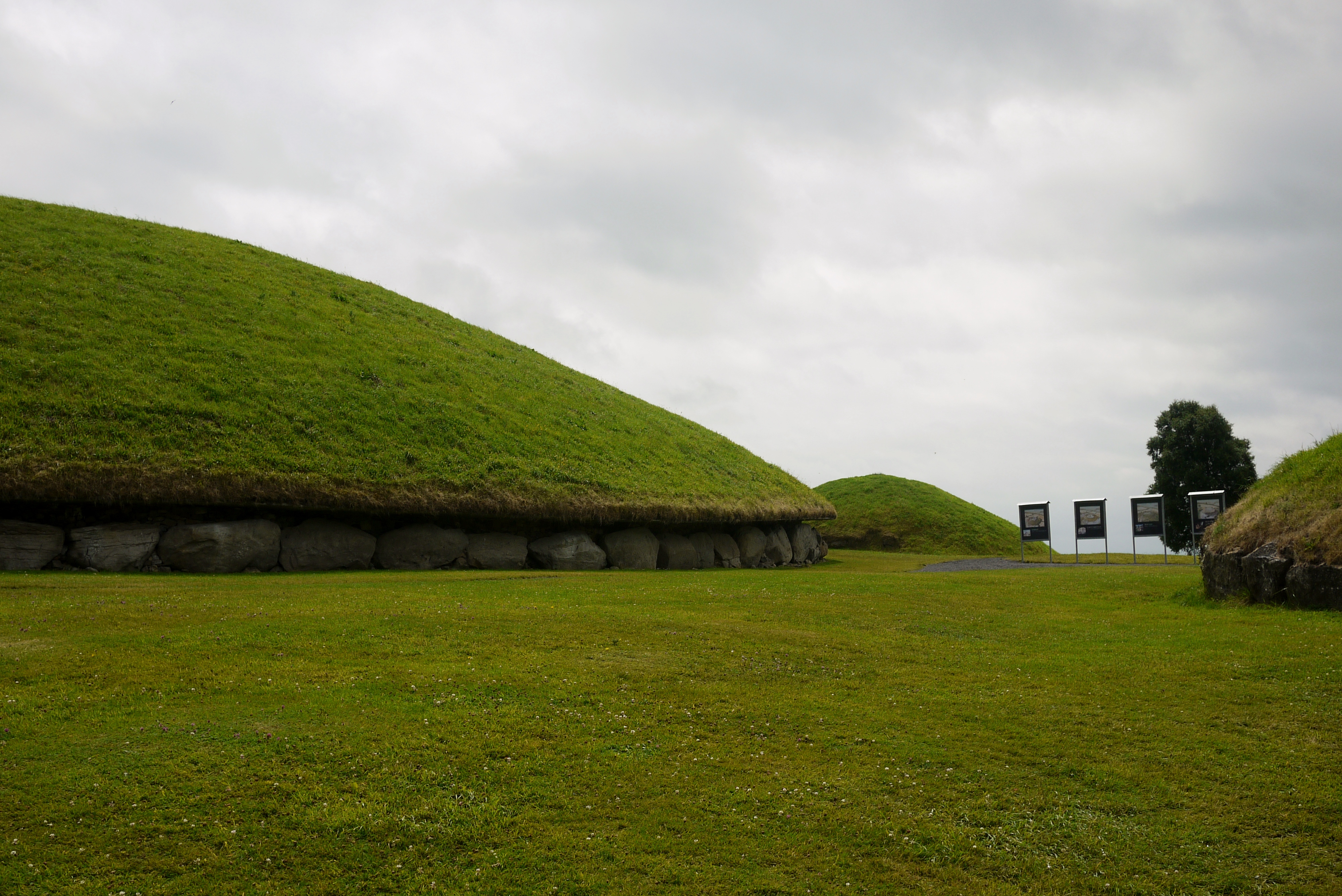
Unlike Newgrange, Knowth is a complex of passage tombs that are situated close to one another. There's a large mound, pretty much in the middle of it all, and this one has the decorated megaliths around it. Then there are seventeen smaller mounds situated seemingly randomly about the place, some close to the largest mound, while others are slightly further away. There's also a soutterain from the Christian period, and a small reconstructed "wood circle" near the main mound (that wasn't explained by the guide, unfortunately).

So the main mound has been reconstructed, as I said, and today it looks like this:


Each of these stones is decorated with carvings - all kinds of circles, spirals, squiggles, and lines. Some of them are in better condition than others (bear in mind they're about five thousand years old), and in the winter the site's closed and the stones are wrapped up to protect them from the elements. There wasn't originally that shelf that overhangs the large stones at the base, that was put in during the reconstruction to offer some additional protection, so you just have to imagine that the earthen part of the mound slopes down to meet the stones like it does on other tombs of this type.

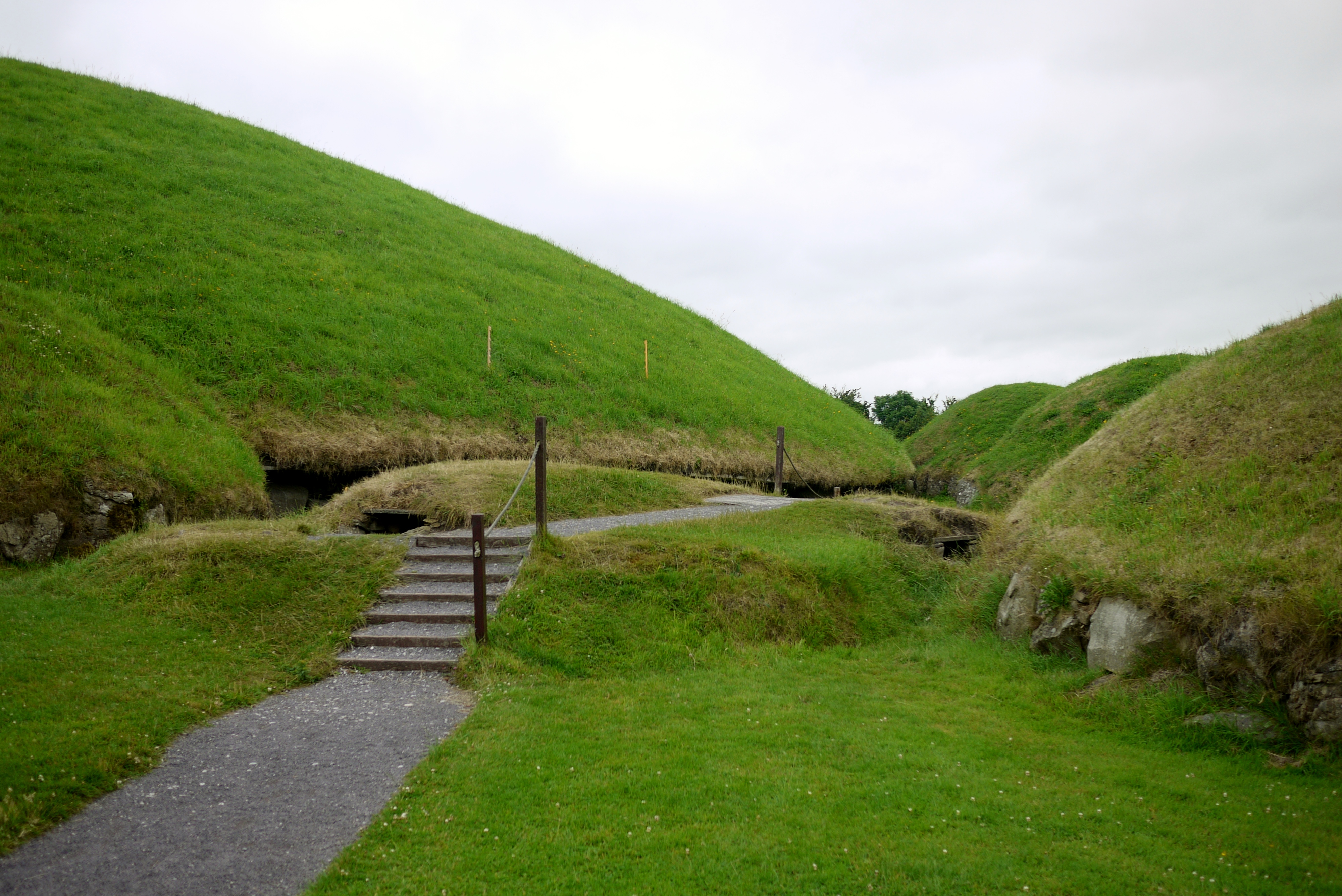
The main mound is a lot bigger than the others, and eventually a settlement was built on top of it, which lasted from around the Bronze Age into the early Christian period. There's also a souterrain from the early Christian period, which you can usually go inside (but we were advised not to because of the heavy rain that had been pouring down on and off all day). It's the wee lump just by the stairs there, nestling in beside the largest mound and a series of smaller ones to the right:


Up on the top of the main mound there's the remains of a ditch that was dug into it, but that's about all you can see. The view would've been spectacular on a clear sunny day, and it would've been a good defensive site. There wouldn't be much that you couldn't see coming...

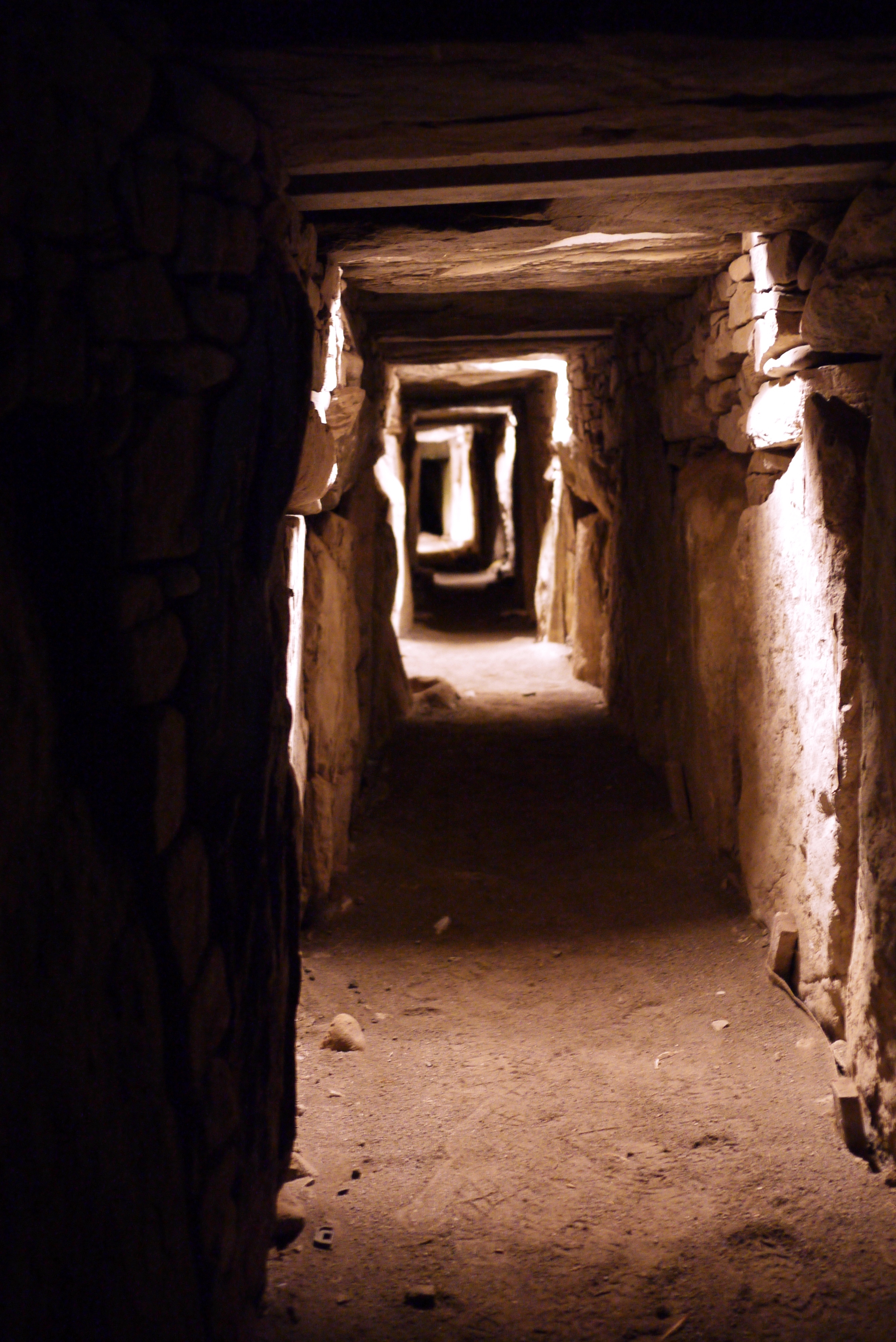
You can go into a small chamber inside the main tomb, but these days you can't go any further, to where the actual chambers are. The passage that goes deep into the mound is artfully lit, though, so I took a quick picture:


There's another passage as well, but that came out fuzzy...

The most spectacular part of Knowth, for me, is the megalithic art that surrounds the main tomb. Some of the smaller tombs have stones around the base as well, but these aren't decorated, for the most part. Nobody can really say what these symbols mean, but I'd say there's a good chance that some of them represent the surrounding landscape. This one:


Gives the impression of the some of the mounds or sites - perhaps Knowth, Newgrange, and Dowth (which are all pretty close together)? With the squiggly line at the bottom being the river?

Here's another one with the same kind of symbols:


A lot of them are just circles, though. Some are kind of like spots, others are more like concentric circles or spirals, either spaced out or squished together like this one:


You see echoes of this on the stones at Newgrange, too. Some of them give the feel that they're probably articulating some sort of astronomical information. One of the most interesting and complicated designs at Knowth might even be a calendar (I've heard it speculated, anyway):


This is a picture I took from the heritage centre, seeing as it came out better than the actual stone in situ. Knowth is thought to have an alignment to the equinoxes, with the sun illuminating the main chamber, although this is a little controversial - some archaeologists don't agree, because the alignment was only "discovered" after reconstruction, so the idea basically relies on assuming the reconstruction is accurate. I don't see why not, though - Newgrange's solstice alignment is still quibbled about in some quarters, but there's a tendency from the naysayers to assume the people who built the monuments were "primitive" or not advanced enough to figure out complex astronomical things. I think recent discoveries like the earliest known calendar in Europe, found in Scotland, along with alignments in other monuments, show this isn't the case.

Another controversy about the reconstruction is the presence of the white quartz. It's something that's often found at sites like this, and the brightness of the quartz means that we can assume it was used for a reason - to make the sites stand out. The bright white stones would practically glow on a bright sunny day, but the stones might also have something to do with beliefs about the dead (their use in these kinds of contexts persists long after the Neolithic and Bronze Age, too).

If you've ever seen a picture of Newgrange you'll know the reconstructed walls at the front are almost entirely white quartz, except for the limestone at the entrance (which is modern). Here at Knowth, though, the quartz is laid on the ground as it was found during excavation:


So effectively, if the white quartz was used to make the site stand out, the quartz at Knowth would be most marked from above, suggesting that perhaps it had something to do with celestial/astronomical purposes; people wouldn't really appreciate the full effect from the ground. At Newgrange, it would have stood out to people in particular, but not so much from above.

However... The quartz was also found on the floor at Newgrange (it was in a pretty bad state of collapse before reconstruction), but O'Kelly did some experiments to determine whether or not the quartz had always been on the floor, or had collapsed from the wall. He "back-engineered" a stone wall and collapsed it, and decided that the pattern of deposition - the way the stones fell - was consistent with how they had been found during excavation. The archaeologist at Knowth disagreed, and felt that the stones had always been on the floor. Of course, that doesn't mean it has to be either/or; each site could have used the stones differently, but it's an issue that's worth bearing in mind when considering how we see and interpret the sites today.

On the last post I included a picture of a "phallic" stone, which had two "horseshoe" shapes carved near the base. We see these shapes again at Knowth:


The stone is badly worn at the top, but you can just make out the two "horseshoes," side-by-side, on the main body of the remainder of it, with a straight line above them. Either this stone or another stone (that's basically the same layout), has another two "horseshoes" above this line, placed upside down this time, reflecting the two "horseshoes" below the line. What these shapes mean, nobody knows, but their recurrent usage is presumably significant.

One final picture, and then the blether is done for this post (promise!). Mr Seren was convinced that the carving on this stone is tantamount to a prehistoric goatse:


If you've no idea what goatse is, you probably don't want to know. Save yourself and don't Google it...

Up next: Newgrange.

Here we go... Newgrange Heritage Centre

When you arrive at the heritage centre - which is pretty far from the monuments - you have the choice of just going around the centre itself, or paying extra to go and see Knowth and/or Newgrange. We chose to do the whole lot, seeing as we'd come so far and all, and were given stickers so we could get on the buses that would take us up to the sites. Knowth was the first bus for us, but we had some time before we needed to get to the stop so we took in the heritage centre first.

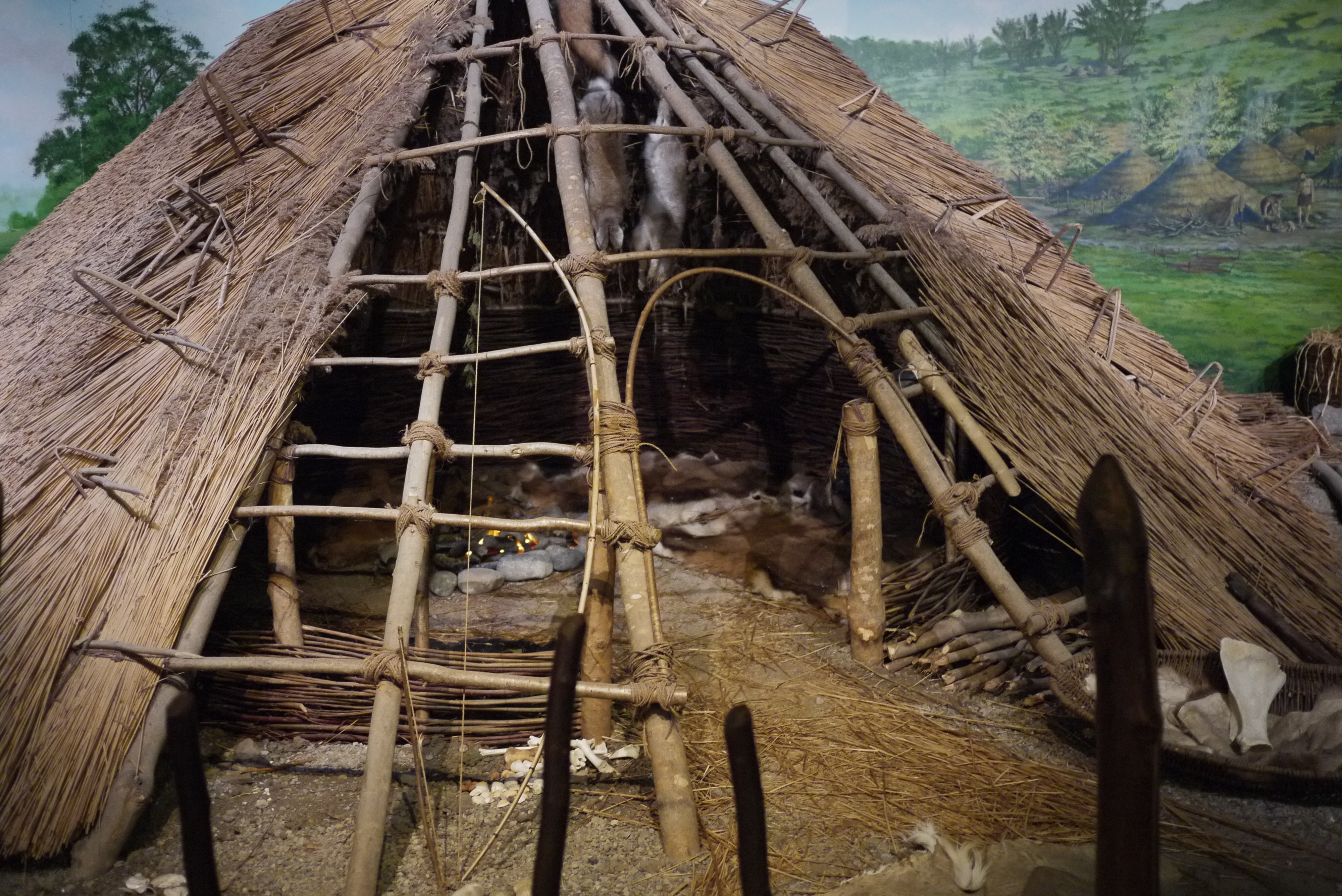
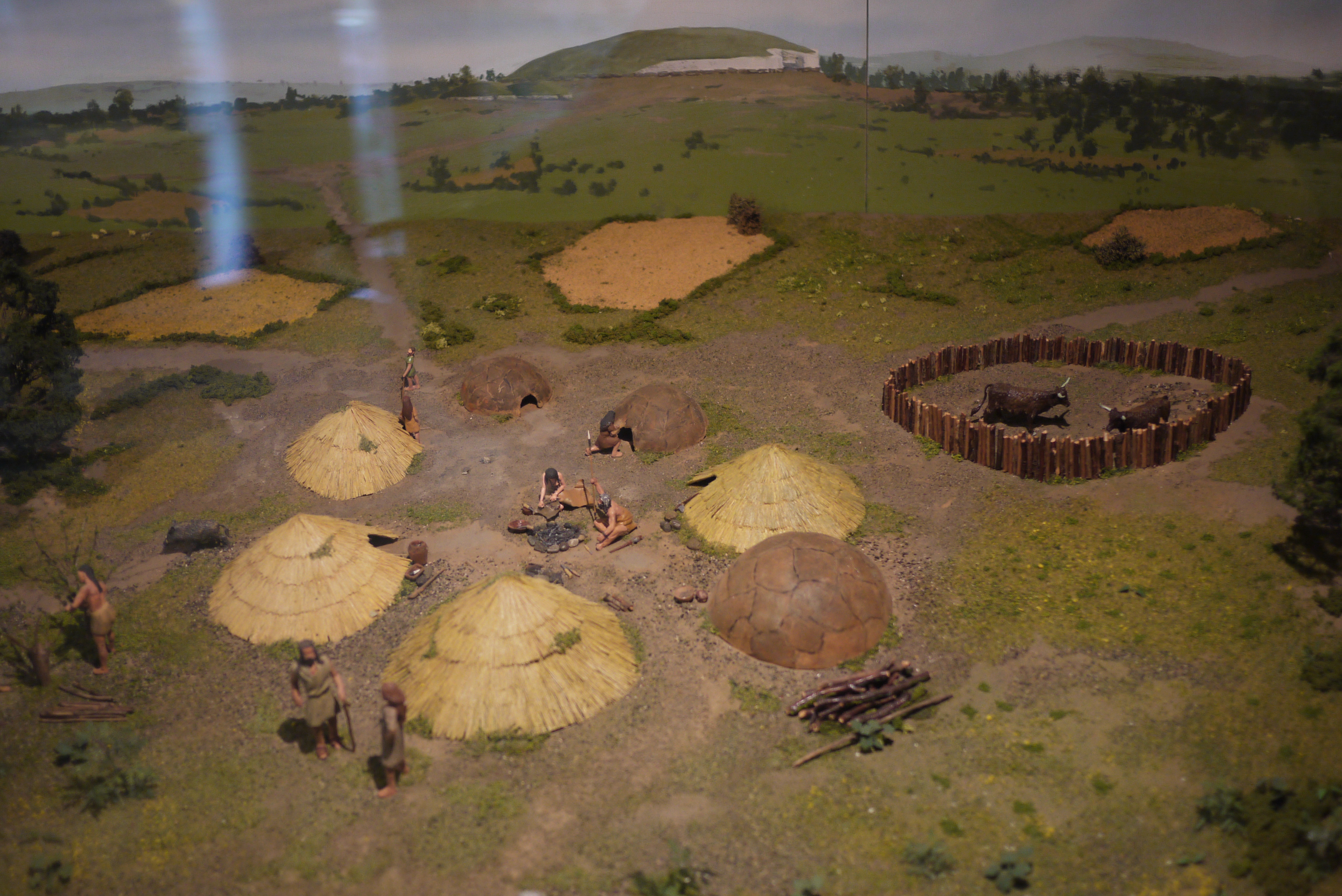
If you decide not to take in the sites themselves then the heritage centre gives you a pretty good idea of the background and what the most important bits look like (and there are some things aimed at kids as you go round, so they won't be too bored). There's a reconstruction of a late Neolithic/Early Bronze Age house:


Which I think shows just how much work was done outside. There's not much space to stand up comfortably in the house, especially with the smoke from the fire, so really this is a place to sleep and eat. This kind of house would have been situated in a small settlement, like this (with Newgrange in the distance, there):


The Neolithic is the period when people began to work the land, and moved away from a hunter-gatherer sort of existence. They domesticated grains to grow crops, and domesticated animals to keep herds of meat and milk more handy. This allowed a more more settled existence - they didn't have to keep moving around so much, to follow herds of wild animals for meat, or gather wild fruits as they became available, and so on. This new way of life also meant that new kinds of tools were needed, to help grind the corn, or store it, for example, so this is the kind of background and context that we can consider the huge passage tombs that began to be built in this period. It took serious organisation, effort, and there was inevitably a reason for these passage tombs and the way people were interred inside them, on a religious, symbolic and spiritual level. 

There are examples of what people might have worn at the heritage centre:


Although the direct evidence for this clothing is sparse, so take it with a grain of salt, perhaps. This example is based on the kind of tools, like scrapers, that are often found at Neolithic or Bronze Age sites, which tell us that leather was a common material that was used. There are also lots of decorative items, like bone pins and things like that, which would have been used as fasteners for clothes, or as decorative hair pieces. 
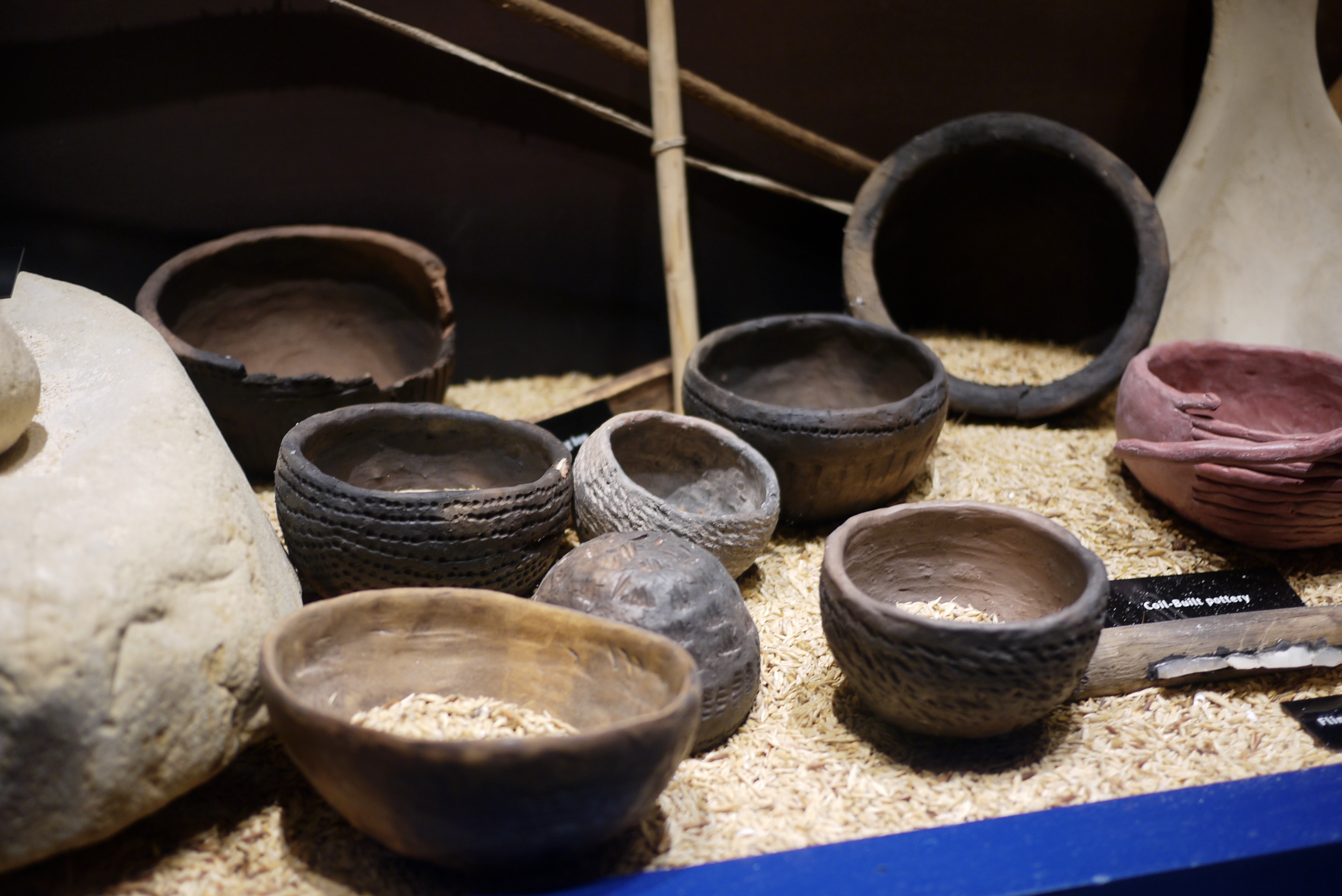
Here's some pottery, with an example of a friction tool lurking at the back, to help start a fire. It's a rod of wood looped through a piece of sinew that's attached to a "bow," which could be used to spin the rod quickly and cause enough friction to light the kindling pretty quickly and without too much effort:


Some of the pottery here is pretty similar to pottery you find in England from the same period - I couldn't say for sure about Wales or Scotland, off the top of my head, but when I worked for a rescue archaeology unit down in England I saw a lot of this kind of pottery, and there's certainly evidence of contact between England and Ireland at this point in time (like beads and jewellery from the Wessex area, which is a pretty important area at this time period). Just to the left in this picture there's a saddle quern - a large stone with a slight depression in the middle where the grain would be placed, then ground down by rubbing a stone back and forth over it to make a rough flour. It's hard work, and this kind of quern was eventually replaced by the larger "wheel" types, which can grind a bit more grain, and do it quicker.

There are a number of artefacts from the passage tombs on display as well, like this decorated "basin":


The decoration is pretty typical of the period, and a stone like this is often found inside the passage tomb's chamber, set into a recess off to one side. Because most of the tombs have been disturbed by the time archaeologists get to them, it's difficult to know exactly what they were used for, but the general idea is that they held the cremated remains of the people interred into the chamber. Not just the remains of one person, but several mixed together, usually, and sometimes there's evidence of animal bones too. These might have been burned with the individual as they were cremated, or else they might be evidence of ritual feasting at the site. 

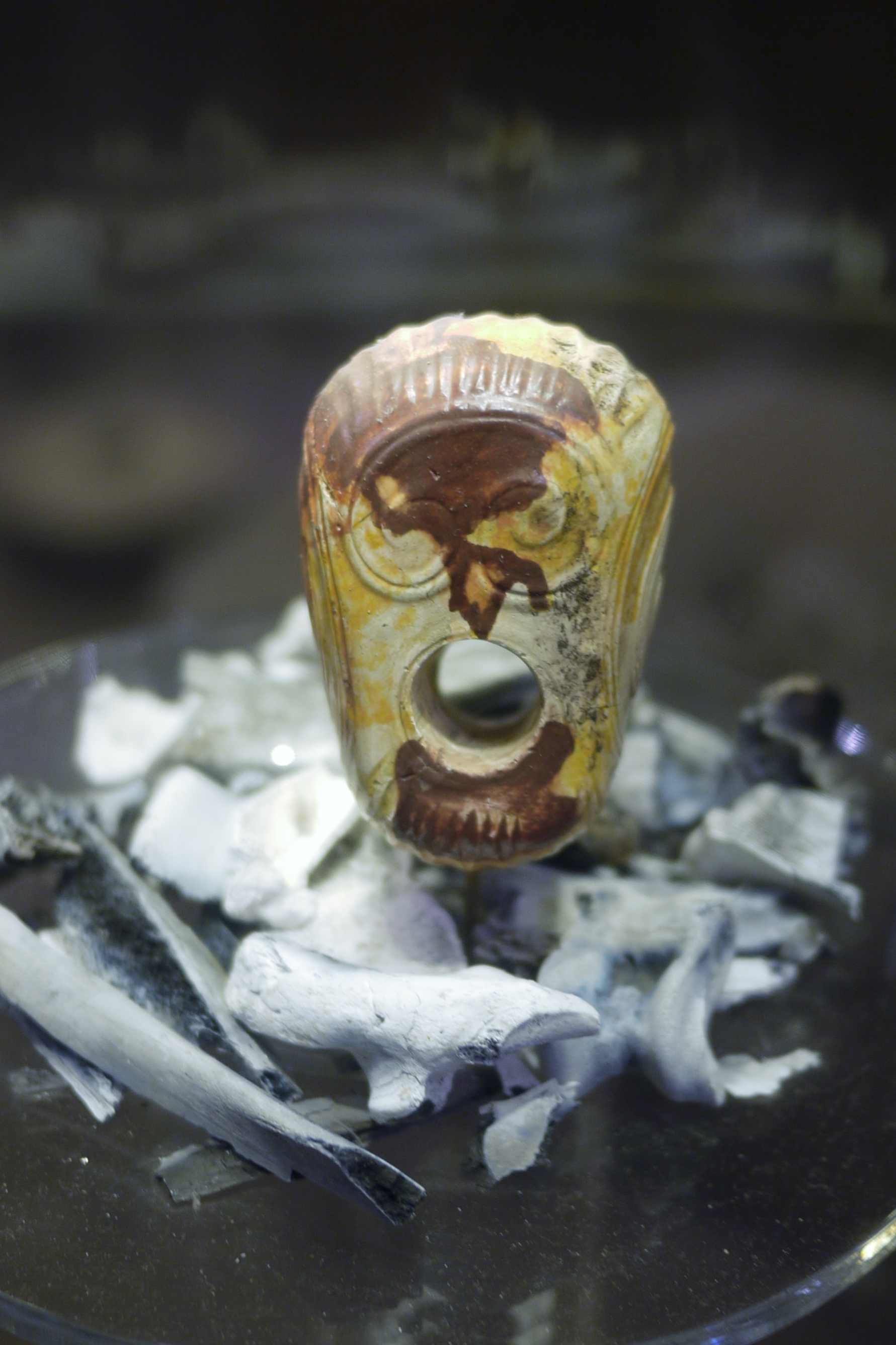
Around the basin there are some artefacts on display, one of which is a decorated flint mace-head:


The decoration looks like a face - you can see the eyes, the suggestions of hair, a beard, and stylised "ears." Working flint like this - smoothing it, and putting a hole through it so the handle can be slid through it and fixed in place - is a laborious process, and it might have involved the use of a drill that was highly advanced technology for this time period. The flint would have to be worked carefully so as not to crack or break it, and whoever made it would have been extremely skilled. 

The mace head was found in the chamber of the main passage tomb at Knowth, and given the amount of disturbance in the tomb - people breaking in to look for goodies over the centuries and millennia - it's a wonder it managed to stay undiscovered until archaeologists got there.

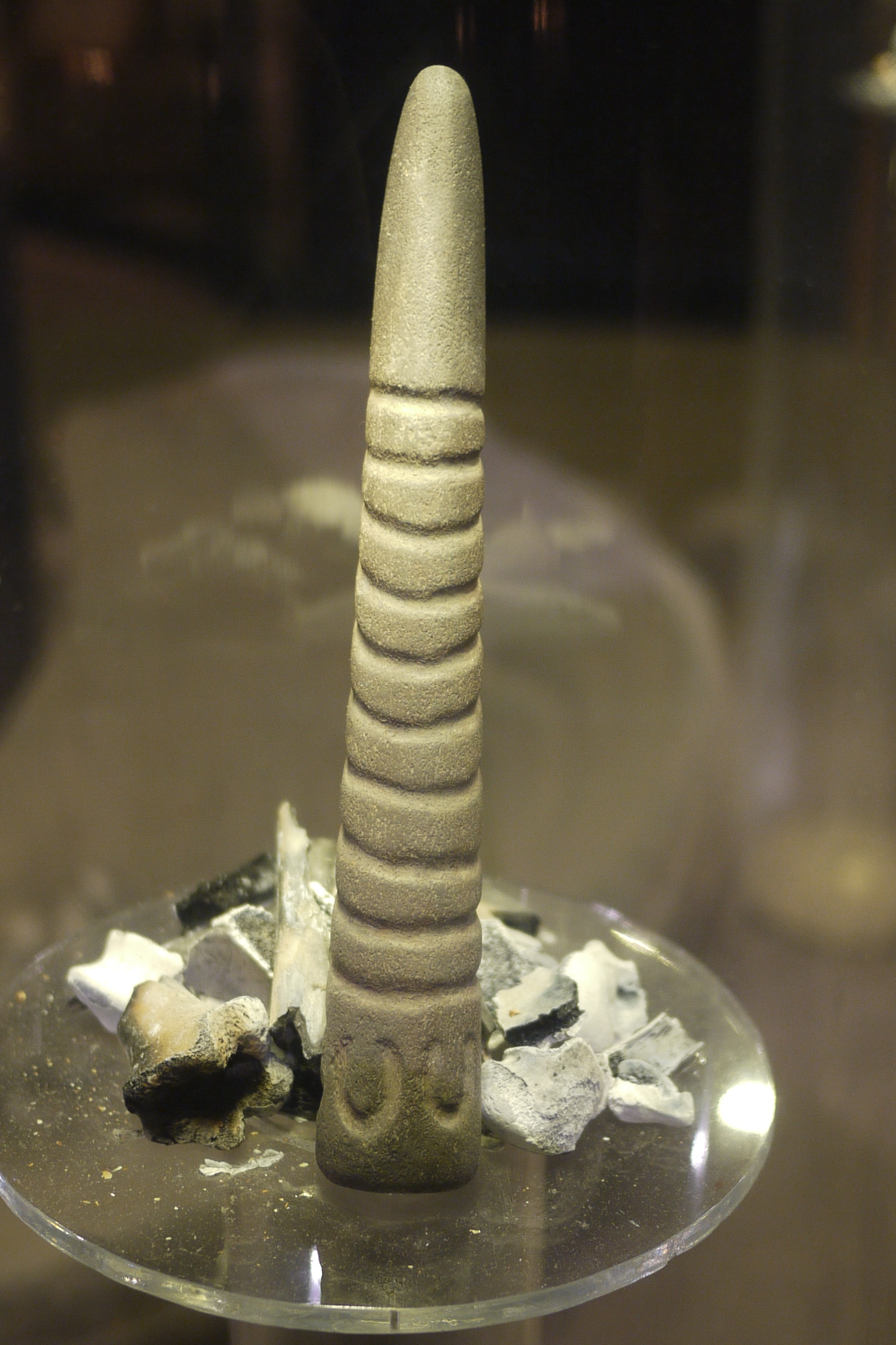
Finally, there's an object on display that's simply described as "phallic," and I'm not sure if this one's from Knowth or Newgrange (examples have been found at both, and elsewhere, though):


One thing to note about this is the "horseshoe" symbols carved at the bottom - these can be seen on a lot of the decorated stone slabs at Knowth, which we'll be looking at next...