The Sacred Tree: Ancient and Medieval Manifestations
Carole M. Cusack
My only previous experience with this author is from an article on Brigid that's available available online, which I only mention because it might be of interest...
But anyway. You can find a good preview of the book online and it was certainly enough to pique my interest; the subject of the bile is one that I've long been keen on so it was only a matter of time before I gave in and bought the book, really. To be clear, though, the book doesn't just cover the Irish evidence of the bile as a sacred tree. Just as the title says it covers both ancient and medieval manifestations of it, and for the book that means chapters that cover Classical representations in Roman and Greek belief, as well as Germanic, Anglo-Saxon and Scandinavian sources.
It's a small book - hardly 200 pages all told - but it covers everything in a chronological order and certainly tries to cover a lot. It begins, sensibly enough, with giving some context by covering Indo-European (and at times, beyond) evidence and symbology, with a discussion of what the sacred tree expresses in very basic, fundamental terms - the tree as axis mundi or imago mundi, or both. In that sense, we take a look at how the sacred tree can represents a hub or axis of the world (the axis mundi), and as such acts as a sacred centre, a place of communication between people and the gods. Sometimes, however, it can be in itself a representation of the world, an important idea and element of creation. And so on. There are some familiar names in the references here (for anyone familiar with this kind of thing, anyway!) - Bruce Lincoln, Mircea Eliade and J. P. Mallory, to name a few - and a good amount of critical discussion of some of the theory involved, which I particularly appreciated.
The first chapter covers a good amount of Indo-European theory and - I found - explains a lot of concepts that I've come across before in just the right amount of detail. It gives just enough to explain what we're looking for, and what it all means, but doesn't go too far in insisting on "it's all the same in the end, regardless of the culture" as can sometimes can happen.
The second chapter deals with the Classical evidence. It's been a long while since I've dealt with Classical religion but as far as I can tell it was all good and interesting, though I'll leave any criticisms to the experts for those particular cultures. One thing that struck me here is that the writing can be a little rambly, and the digressions are not always relevant or obviously relevant at the time. It's interesting enough all the same but if there were a more brutal editor I think this book would have been a lot shorter.
Following on from the Greeks and Romans comes the chapter on the Celtic sources. What's covered here is primarily Irish evidence once we get passed talking about druids, which is fair enough, I think. I have to say I'm disappointed that Gaul wasn't covered in more detail because I was looking forward to some meaty discussion of the pillars or Jupiter columns common to Romano-Gaulish belief in particular, but there wasn't as much to be found as I was hoping for. The rest is dealing with the bile, and what you'll find here is solid enough and a good run down of the subject.
My only concern here is that once we get into the main discussion the author relies heavily on a limited number of authors in their references - primarily Mary Low's Celtic Christianity and Nature and Alden Watson's article 'The King, the Poet and the Sacred Tree' - plus a slightly dodgy and disappointing reference to Caitlin and John Matthews' The Encyclopedia of Celtic Wisdom: The Celtic Shaman's Sourcebook. The latter is used to reference a description of ogam being used in a possibly magical ritual and I don't see why Cusack didn't go straight to the source. What's quoted appears to be a translation and if it's Matthew's own then it's a little worrisome because they're notoriously selective and liberal in their translations or interpretations. Nigel Pennick's name comes up as well and the author is very sensitive towards modern paganism so perhaps a little too sensitive at times? They are certainly not the kind of sources I'd use in making an academic argument about historical practices, personally, anyway.
It's a mark against an otherwise decent rundown of what the bile is all about, although to be honest, I've got Low's book out from the library and reading the chapter that's primarily been referenced here isn't much different. In short, there isn't much that's new or different on offer in this particular chapter compared to what you can already find out there, so if you're just looking for an in-depth view of the bile, and that's all, then you may be disappointed. It's the context that makes this book a good read - providing both comparison with other cultures, and a run down of the kind of theories that give such trees meaning.
So all in all, the usefulness of the first chapter tempers the mild disappointment I felt about the third chapter. The rest of the book is taken up by Germanic, Anglo-Saxon and Scandinavian evidence and Cusack certainly seems to be more confident with the material she's dealing with here. As she notes in the preface, this book grew out from her doctoral research into the Christian conversion of the Germanic peoples so that's hardly a surprise, but it really does show because this is where the tangents I mentioned earlier are the most noticeable. There is a lot of discussion of the conversion process and to some extent it's relevant because it's certainly something that affects the sources we have to hand. I did feel at times that perhaps there was a little more detail than absolutely necessary at times, though. By the time it got back onto discussing trees I was sometimes a little lost as to why we hadn't got here sooner.
Having only a vague idea about things like Yggdrasil, I did learn a lot in these chapters, in general but also in terms of thinking about the potential similarities between Germanic/Scandinavian evidence and Irish evidence (or lack thereof). Considering my comments about the Celtic chapter not offering much new, and my lack of familiarity with the subjects covered in these latter chapters, I couldn't really say if they suffer in the same way.
In the end, in spite of some mild reservations I do think this is a useful book, and considering the cost for it's size I should bloody hope so! If anything, it provides a good introduction to the subject, and as far as a reconstructionist audience goes it does offer some good food for thought in terms of how the concept filters down into everyday practice - and, for the heathens amongst us, how the sacred trees might relate to particular gods.
Monday, 6 August 2012


Saturday, 4 August 2012
And then it was Lùnastal
We've not had much of a summer this year. While a large part of England has alternated between drought and flooding, the west coast of Scotland has enjoyed a goodly amount of rain and cloud interspersed with a rare sunny day here and there, although it's been really warm at least. But summer has been very Scottish even by Scottish standards this year. This last week has been about as good as it's got, and there's a definite feel that this is summer's last gasp.
Seeing as it's (still!) the school holidays we've been making the most of the weather as much as we can. Although I'm none too mobile we can still pile into the car and get ferried down to the beach as soon as the sun threatens to come out, in amongst trips to the park, so we've had some great afternoons rock-pooling, paddling, sand-castling and beach combing. Just as I mentioned the possibility that adder stones (or serpent stones) might have been spindle-whorls when I posted about the hag stone/mare stone I found the other week, our next trip to the local beach turned up this:

I've absolutely no idea if it's really a spindle-whorl or just a bead with the enamel or paint rubbed off (there does seem to be a bluish tinge to it), or something else entirely, but the timing is a nice coincidence. Whatever it is, it's a good weight for its size but I don't think it's especially old.
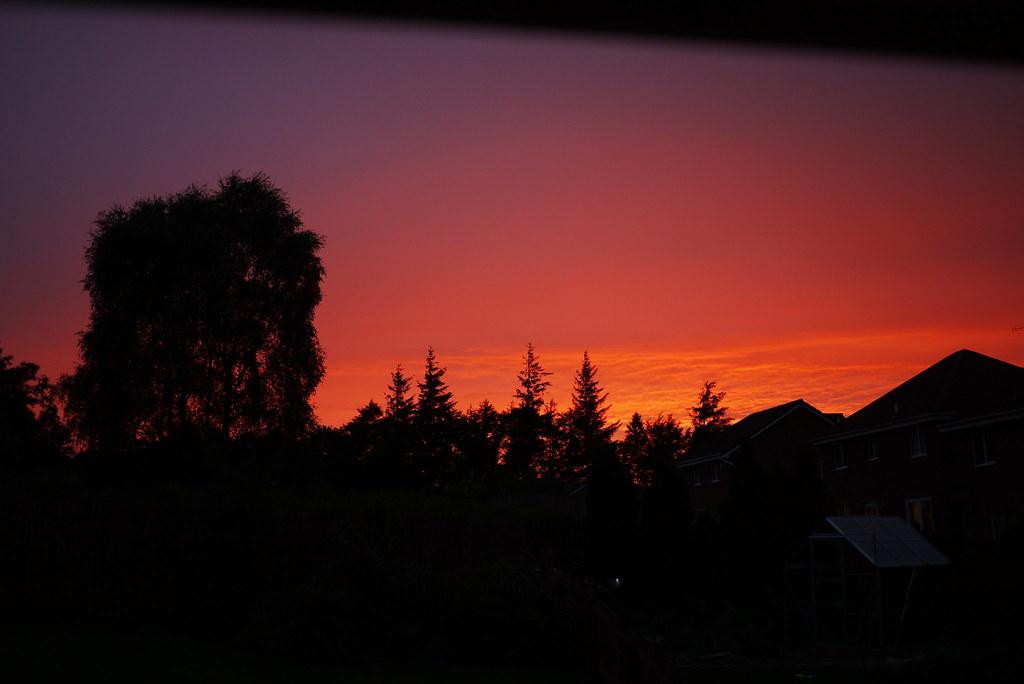
I hadn't initially planned to celebrate so early - on time, for once - but considering the fact that leaves on trees are starting to turn, the rowan berries are bright and reddening (although I notice one tree on our road is simultaneously blossoming again), the moon is hanging large and low, the wind and the rains are getting a little bite to them - perhaps those three days the Cailleach borrowed and swapped with February - and the sun is setting the skies on fire as it dips below the horizon (here's one I photographed earlier):

It seemed silly to wait for the blueberries in the garden to ripen like I usually do; it seemed that all indications were that we should celebrate sooner rather than later. The promise of autumn is more than promising round these here parts. The past few years I've usually celebrated mid-August at the earliest, and in some ways that's been more in keeping with the festival because it's also when the summer holidays finish and the kids go back to school, and there's as much a change in the pace of our lives as there is in the weather. But this year, aside from the seasons seeming to shift much earlier than usual (or maybe I'm just noticing it more), I'm hoping that pretty soon I'll be having surgery, or at least seeing the surgeon this month and having the promise of surgery. Either way I wanted my energies focused on the festival, rather what the NHS might have in store for me (gods bless 'em). I can only hope that my days of hobbling are numbered now.
My mother was supposed to have been visiting over Lùnastal itself but due to unforeseen circumstances (apparently even cats that exist on nothing but the fiery hate and fury that demonic beings such as my mother's beloved mog thrive on run out of it eventually...) she wasn't able to visit. I'd originally planned to put things off until after she'd gone home, so being able to celebrate on time was somewhat unexpected. As a result I hadn't really had much of a chance to think about what I was going to do, all in all, but I think things all came together in the end; by and large I have things down by now and while I didn't get everything done in one day I wasn't expecting to anyway.
So my celebrations began with saining the house and making some offerings and devotions on the eve. There was music and song, prayers and blessings, and a little poetry too. Most of it was in Gàidhlig and I don't think I butchered things too badly there, and it's a nice coincidence that celebrations began on a Tuesday this year, as is traditional to begin the reaping. So The Second Battle of Mag Tuired tells, us, as does a blessing in the Carmina Gadelica.
We'd spent the day at the beach (where my son rescued a boy from drowning and I'm insufferably proud of him for being so brave) and I didn't have much left in me to cook, so we indulged in a rare takeaway from the chippy for the Lùnastal eve. I had a chicken that needed roasting, though, so we had that the following day on Lùnastal proper, served with garlic roasted potatoes and homegrown onions, cabbage, and homegrown peas, followed by homemade apple flory:

It's a kind of apple pie, flavoured with a little cinnamon and a lot of marmalade (this was the second time I'd made it, and this time I left the apple mix to infuse a bit longer before baking the pie. It was much better). I'd a go at making some marmalade a while ago, so used my own (I felt very domesticated). The apples and preserves seem like a good autumnal combination, so that's what decided that.
As usual, we've done a seasonal picture, and this time our efforts are almost entirely the work of Tom and Rosie. They asked me to help fill in the sky and help with the branches on the trees (we used straws dipped in the paint and then pressed onto the paper, which was a bit fiddly):

One of Tom's art project's from school deciding the general form. Rosie's tree is on the right and Tom's is on the left and I think they reflect their personalities well - Rosie's big and bold, impulsive splodges compared with Tom's more thoughtful and deliberate efforts. And seeing as I had some leftover fondant icing from doing a birthday cake for my husband, I decided to waste not, want not, and make a themed cake too. Ever since I took it upon myself to sculpt a Bumblebee cake for my son one year (the Transformer Bumblebee, that is) it's become kind of a hobby and some of my friends got me some shaped cutters for my birthday this year that I've not had much of an excuse to use as yet. So with lots of fondant that needed using, and an excuse to give the cutters a spin, I had the perfect opportunity:

The kids helped me make a honey cake (we've been doing a lot of baking together over the summer) and I decided to go with sunflowers and autumnal leaves for decoration. It's one of my better efforts, I think, even though I'm not sure if it's supposed to be sunflowers and leaves (because the sunflowers aren't out here just yet) or sunflowers being blown away by autumn leaves (because I'd typically associate sunflowers as a summery sort of flower).
These things are just trappings, really; not the meat per se, but they're important to me nonetheless. Ritual is meaningful and important to me, whether it might be simple or elaborate, but traditions that I can involve the family in are just as meaningful and important to me. The "trappings" give me not just a visual focus, a meditation of sorts as I make them, but something to do with the kids - all of us as a family - and seeing it is something we can all relate to. But more than that, I like to try and make the festivals festive. Something special. Feasting has always been an important part of festive occasions, so special foods make a special day even more so, and the lines between trappings, tradition and ritual become blurred...
Things like games are good too, and at a time like Lùnastal all kinds of games are good to play. There had been a chance that we could've taken the kids horse-riding on the beach around this time, but because my mother was supposed to be visiting I didn't ask Mr Seren to arrange anything and then it was too short notice; a shame, because horse-riding and maybe a little racing on the beach would've been amazing, but we made do. Seeing as the weather sucked there wasn't much we could do outside so we played snap and dominos instead (and at least I could join in too, then), and had a grand old time including a picnic in the front room. As Gorm noted, the games played at festivals bleed into those found at wakes so it seemed in keeping, and after all these are supposed to be funeral games of a sort. As a kid I remember playing dominos and snap with my grandparents so it felt like a way to honour them too. It's partly why I do a lot of baking with the kids as well, because these are not just traditions but family traditions, too.
For part of my devotions I made offerings to the land spirits, the ones who are right out there in my garden, and who I frequently make offerings to as I work on their land. I also made offerings to the Cailleach and the Storm Hags, who've spared the garden in spite of the bad weather they've brought our way this past year. The Cailleach won't be resuming her efforts until Samhainn, I expect, but she's still here even if she's resting. And after all, her name is associated with Buí, who is said to be Lugh's wife, and is also said to be the ancestor of the people from the particular part of Ireland that some of my Irish ancestors come from...So it's only right that she's honoured at this time too.
As I did my ritual, I took some time to think about the successes and the failures I've had in the garden this year - the onions have been a great success, as have the peas, and the leeks are thriving though not yet ready. The carrots have been a disaster, though, and I'm lucky that I don't have to rely on my garden for food because that would have been a calamity. The ones that have grown have already gone to seed and the carrots are piddly and pathetic-looking, not worth using. They've had plenty of rain so that hasn't been the problem. It's been warm enough for things to thrive and grow, even if not particularly sunny. I put in new compost this year, so perhaps it wasn't the right kind or it wasn't enough. I suspect the seeds were a little too old too. Next year I'll have to change out the soil completely and get new seeds (I did buy some more, an over-wintering variety, but I put them somewhere safe. So safe I've yet to find them again).
All in all, I think this year's celebration have been a success, but I don't feel quite finished yet. I've given thanks for the first fruits, and we've held our games, but I've yet to manage a trip to the high point in the village where I like to make offerings to Lug at this time of year. I might wait until the blueberries ripen so I can harvest some before I make my way there; hopefully then I'll be able to walk that far.
Seeing as it's (still!) the school holidays we've been making the most of the weather as much as we can. Although I'm none too mobile we can still pile into the car and get ferried down to the beach as soon as the sun threatens to come out, in amongst trips to the park, so we've had some great afternoons rock-pooling, paddling, sand-castling and beach combing. Just as I mentioned the possibility that adder stones (or serpent stones) might have been spindle-whorls when I posted about the hag stone/mare stone I found the other week, our next trip to the local beach turned up this:
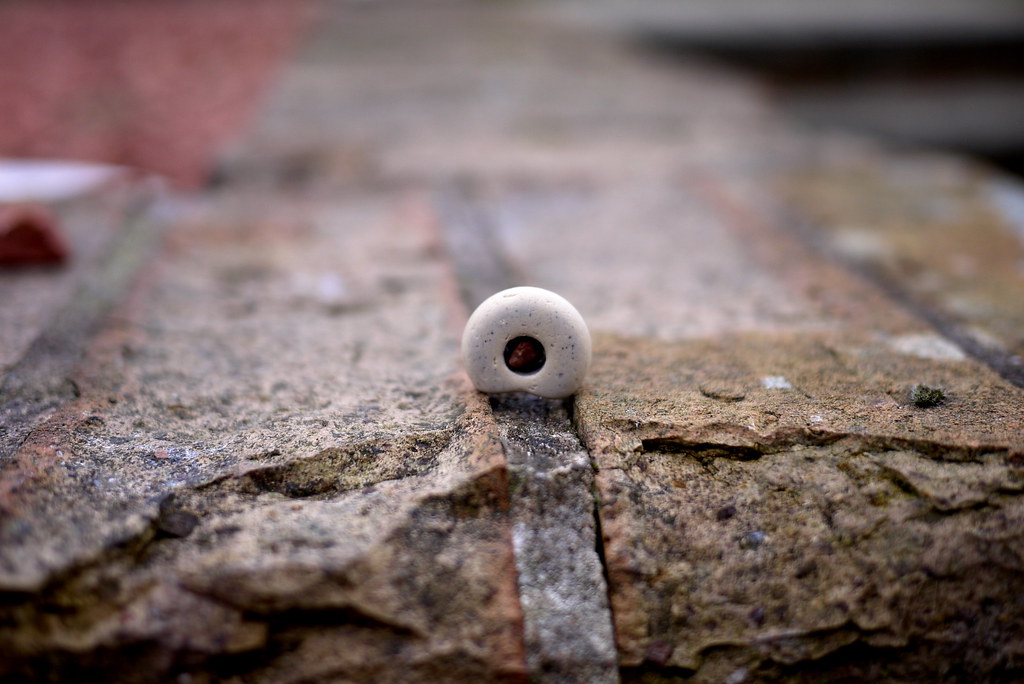
I've absolutely no idea if it's really a spindle-whorl or just a bead with the enamel or paint rubbed off (there does seem to be a bluish tinge to it), or something else entirely, but the timing is a nice coincidence. Whatever it is, it's a good weight for its size but I don't think it's especially old.
I hadn't initially planned to celebrate so early - on time, for once - but considering the fact that leaves on trees are starting to turn, the rowan berries are bright and reddening (although I notice one tree on our road is simultaneously blossoming again), the moon is hanging large and low, the wind and the rains are getting a little bite to them - perhaps those three days the Cailleach borrowed and swapped with February - and the sun is setting the skies on fire as it dips below the horizon (here's one I photographed earlier):
It seemed silly to wait for the blueberries in the garden to ripen like I usually do; it seemed that all indications were that we should celebrate sooner rather than later. The promise of autumn is more than promising round these here parts. The past few years I've usually celebrated mid-August at the earliest, and in some ways that's been more in keeping with the festival because it's also when the summer holidays finish and the kids go back to school, and there's as much a change in the pace of our lives as there is in the weather. But this year, aside from the seasons seeming to shift much earlier than usual (or maybe I'm just noticing it more), I'm hoping that pretty soon I'll be having surgery, or at least seeing the surgeon this month and having the promise of surgery. Either way I wanted my energies focused on the festival, rather what the NHS might have in store for me (gods bless 'em). I can only hope that my days of hobbling are numbered now.
My mother was supposed to have been visiting over Lùnastal itself but due to unforeseen circumstances (apparently even cats that exist on nothing but the fiery hate and fury that demonic beings such as my mother's beloved mog thrive on run out of it eventually...) she wasn't able to visit. I'd originally planned to put things off until after she'd gone home, so being able to celebrate on time was somewhat unexpected. As a result I hadn't really had much of a chance to think about what I was going to do, all in all, but I think things all came together in the end; by and large I have things down by now and while I didn't get everything done in one day I wasn't expecting to anyway.
So my celebrations began with saining the house and making some offerings and devotions on the eve. There was music and song, prayers and blessings, and a little poetry too. Most of it was in Gàidhlig and I don't think I butchered things too badly there, and it's a nice coincidence that celebrations began on a Tuesday this year, as is traditional to begin the reaping. So The Second Battle of Mag Tuired tells, us, as does a blessing in the Carmina Gadelica.
We'd spent the day at the beach (where my son rescued a boy from drowning and I'm insufferably proud of him for being so brave) and I didn't have much left in me to cook, so we indulged in a rare takeaway from the chippy for the Lùnastal eve. I had a chicken that needed roasting, though, so we had that the following day on Lùnastal proper, served with garlic roasted potatoes and homegrown onions, cabbage, and homegrown peas, followed by homemade apple flory:

It's a kind of apple pie, flavoured with a little cinnamon and a lot of marmalade (this was the second time I'd made it, and this time I left the apple mix to infuse a bit longer before baking the pie. It was much better). I'd a go at making some marmalade a while ago, so used my own (I felt very domesticated). The apples and preserves seem like a good autumnal combination, so that's what decided that.
As usual, we've done a seasonal picture, and this time our efforts are almost entirely the work of Tom and Rosie. They asked me to help fill in the sky and help with the branches on the trees (we used straws dipped in the paint and then pressed onto the paper, which was a bit fiddly):
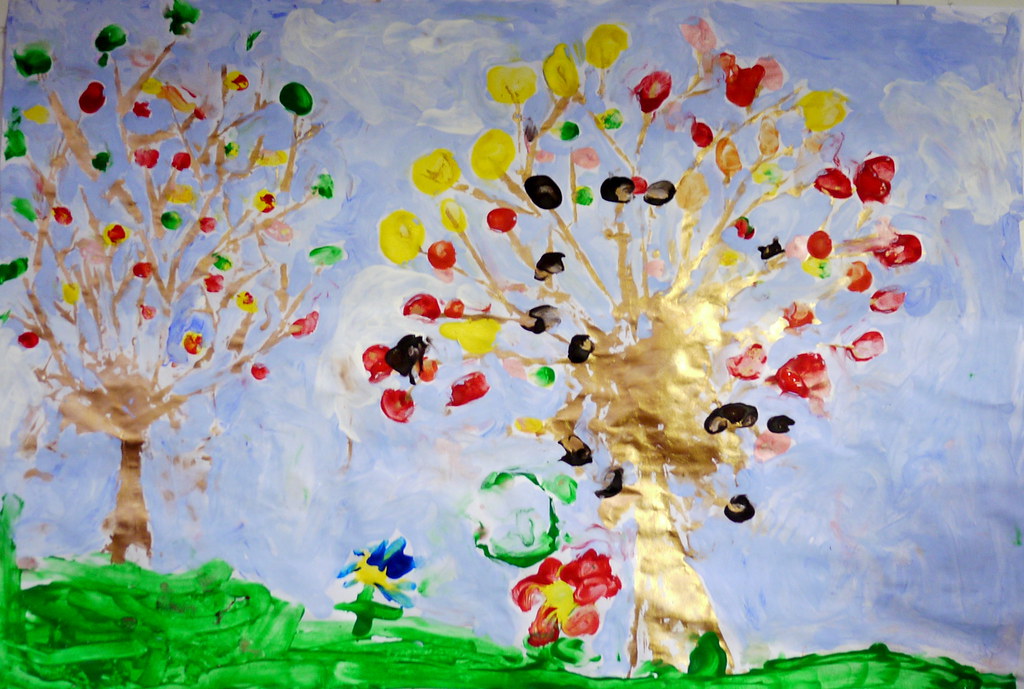
One of Tom's art project's from school deciding the general form. Rosie's tree is on the right and Tom's is on the left and I think they reflect their personalities well - Rosie's big and bold, impulsive splodges compared with Tom's more thoughtful and deliberate efforts. And seeing as I had some leftover fondant icing from doing a birthday cake for my husband, I decided to waste not, want not, and make a themed cake too. Ever since I took it upon myself to sculpt a Bumblebee cake for my son one year (the Transformer Bumblebee, that is) it's become kind of a hobby and some of my friends got me some shaped cutters for my birthday this year that I've not had much of an excuse to use as yet. So with lots of fondant that needed using, and an excuse to give the cutters a spin, I had the perfect opportunity:
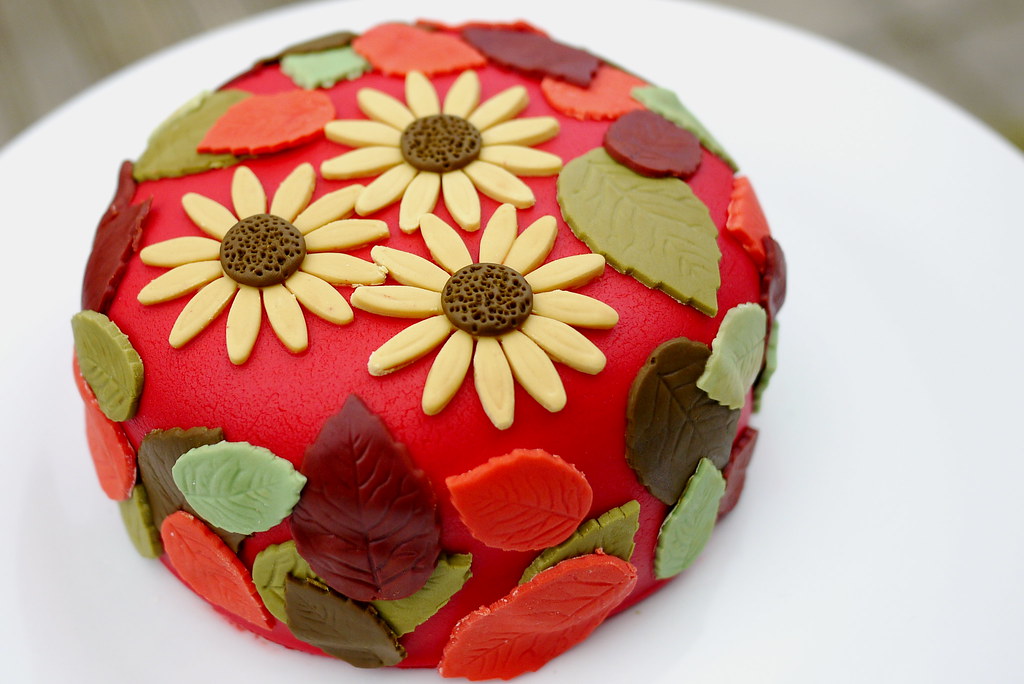
The kids helped me make a honey cake (we've been doing a lot of baking together over the summer) and I decided to go with sunflowers and autumnal leaves for decoration. It's one of my better efforts, I think, even though I'm not sure if it's supposed to be sunflowers and leaves (because the sunflowers aren't out here just yet) or sunflowers being blown away by autumn leaves (because I'd typically associate sunflowers as a summery sort of flower).
These things are just trappings, really; not the meat per se, but they're important to me nonetheless. Ritual is meaningful and important to me, whether it might be simple or elaborate, but traditions that I can involve the family in are just as meaningful and important to me. The "trappings" give me not just a visual focus, a meditation of sorts as I make them, but something to do with the kids - all of us as a family - and seeing it is something we can all relate to. But more than that, I like to try and make the festivals festive. Something special. Feasting has always been an important part of festive occasions, so special foods make a special day even more so, and the lines between trappings, tradition and ritual become blurred...
Things like games are good too, and at a time like Lùnastal all kinds of games are good to play. There had been a chance that we could've taken the kids horse-riding on the beach around this time, but because my mother was supposed to be visiting I didn't ask Mr Seren to arrange anything and then it was too short notice; a shame, because horse-riding and maybe a little racing on the beach would've been amazing, but we made do. Seeing as the weather sucked there wasn't much we could do outside so we played snap and dominos instead (and at least I could join in too, then), and had a grand old time including a picnic in the front room. As Gorm noted, the games played at festivals bleed into those found at wakes so it seemed in keeping, and after all these are supposed to be funeral games of a sort. As a kid I remember playing dominos and snap with my grandparents so it felt like a way to honour them too. It's partly why I do a lot of baking with the kids as well, because these are not just traditions but family traditions, too.
For part of my devotions I made offerings to the land spirits, the ones who are right out there in my garden, and who I frequently make offerings to as I work on their land. I also made offerings to the Cailleach and the Storm Hags, who've spared the garden in spite of the bad weather they've brought our way this past year. The Cailleach won't be resuming her efforts until Samhainn, I expect, but she's still here even if she's resting. And after all, her name is associated with Buí, who is said to be Lugh's wife, and is also said to be the ancestor of the people from the particular part of Ireland that some of my Irish ancestors come from...So it's only right that she's honoured at this time too.
As I did my ritual, I took some time to think about the successes and the failures I've had in the garden this year - the onions have been a great success, as have the peas, and the leeks are thriving though not yet ready. The carrots have been a disaster, though, and I'm lucky that I don't have to rely on my garden for food because that would have been a calamity. The ones that have grown have already gone to seed and the carrots are piddly and pathetic-looking, not worth using. They've had plenty of rain so that hasn't been the problem. It's been warm enough for things to thrive and grow, even if not particularly sunny. I put in new compost this year, so perhaps it wasn't the right kind or it wasn't enough. I suspect the seeds were a little too old too. Next year I'll have to change out the soil completely and get new seeds (I did buy some more, an over-wintering variety, but I put them somewhere safe. So safe I've yet to find them again).
All in all, I think this year's celebration have been a success, but I don't feel quite finished yet. I've given thanks for the first fruits, and we've held our games, but I've yet to manage a trip to the high point in the village where I like to make offerings to Lug at this time of year. I might wait until the blueberries ripen so I can harvest some before I make my way there; hopefully then I'll be able to walk that far.
Saturday, 28 July 2012
Notes: 'The beliefs and mythology of the early Irish, with special reference to the cosmos'
It's been a while since I've done one of these and I'm not about to leave my spot on the sofa here anytime soon, so...Why not?
The Beliefs and Mythology of the Early Irish, With Special Reference to the Cosmos
Fergus Kelly
Astronomy, Cosmology, and Landscape: Proceedings of the Société Eurpéene pour L'Astronomie dans la Culture (2001)
Considering the scope of the title, I was expecting a huge and dense article here, but it's actually quite brief and light on detail or analysis. That's kind of disappointing to me, but as an overview at least it gives pointers to further reading, although it's probably quite telling that most of the references are very old - mostly from the early 1900s to the '60s. This article has the potential to fill a much-needed hole, then.
We begin with a bit of context - the astronomical alignments of many of the pre-Celtic monuments in Ireland, followed by a little commentary from Classical writers about the Gauls and mention of the Coligny calendar. Then we move back to Ireland and the possible cosmological significance of the decorations on the Turoe Stone in Co. Galway. Kelly concludes, "This was clearly an object of religious significance, and may have been associated with fertility." Which may or may not be a polite way of concluding it looks a bit like a penis.
We then move to examining the earliest written sources - evidence from St Patrick's Confessio, hagiographies (biographies of Saint's lives, that is), and legal texts - which mainly deal with the various references to druids. This is followed by looking at the myths, with some consideration of the names of certain deities and their cognates in Britain and Gaul, and noting the similarities between Caesar's comment on various deities covering certain roles, with how some gods like Dian Cécht, Badb (or Bodb), Goibniu and Crédine are said to have done the same.
Next there is a brief discussion of the connection between some supernatural figures and animals, and the observation that some deities are associated with specific localities, followed by mention of the four main festivals associated with the changing of the seasons. This is all well and good so far, but it's nothing that's particularly new or exciting, and nor does it really...go anywhere.
The latter part is perhaps the most interesting, dealing with the connection between astronomy and mythology, as well as astrology. Kelly says: "...the mythical seer Cormac mac Airt is represented as having in his youth been "a listener in the woods and a gazer at the stars." There is a native term mathmarc ("astrologer, augur") of uncertain etymology; it is attested in a text of the ninth century, but may be much earlier. Another Irish word for astrologer is néllaóir, a derivative of néll ("cloud"). Presumably, the shapes of the clouds suggested images from which the future could be foretold. In general, however, the surviving texts indicate that for the early Irish the world of the supernatural was a place to be entered through a fair mound or by passing through a fairy mist. Most frequently, it was represented as an island or group of islands in the Western Ocean. Consequently, we do not find an extensive vocabulary in the Irish language relating to celestial objects." (p169).
Kelly further notes that except for the Milky Way being known as Bóthar na Bó Finne ("the road of the white cow"), there are no known native words for planets or constellations to be found in early Irish texts. Although astronomy was widely studied in monasteries from around the eighth century or so, the names were all derived from Classical sources.
All in all, the article didn't really go in the directions I was anticipating. I was hoping for a bit on cosmogony, assumed there would be mention of the three realms, evidence for a possible cosmological divide between Darkness and Light, how the gods fit in to it all, the concept of the sacred centre, the bile and the omphalos (although the latter was kind of touched on with the Turoe Stone) and so on. Not so much! The stuff on astronomy and astrology is certainly interesting, but being half-way through Mark Williams' Fiery Shapes I'm perhaps a bit spoilt on that front already.
The Beliefs and Mythology of the Early Irish, With Special Reference to the Cosmos
Fergus Kelly
Astronomy, Cosmology, and Landscape: Proceedings of the Société Eurpéene pour L'Astronomie dans la Culture (2001)
Considering the scope of the title, I was expecting a huge and dense article here, but it's actually quite brief and light on detail or analysis. That's kind of disappointing to me, but as an overview at least it gives pointers to further reading, although it's probably quite telling that most of the references are very old - mostly from the early 1900s to the '60s. This article has the potential to fill a much-needed hole, then.
We begin with a bit of context - the astronomical alignments of many of the pre-Celtic monuments in Ireland, followed by a little commentary from Classical writers about the Gauls and mention of the Coligny calendar. Then we move back to Ireland and the possible cosmological significance of the decorations on the Turoe Stone in Co. Galway. Kelly concludes, "This was clearly an object of religious significance, and may have been associated with fertility." Which may or may not be a polite way of concluding it looks a bit like a penis.
We then move to examining the earliest written sources - evidence from St Patrick's Confessio, hagiographies (biographies of Saint's lives, that is), and legal texts - which mainly deal with the various references to druids. This is followed by looking at the myths, with some consideration of the names of certain deities and their cognates in Britain and Gaul, and noting the similarities between Caesar's comment on various deities covering certain roles, with how some gods like Dian Cécht, Badb (or Bodb), Goibniu and Crédine are said to have done the same.
Next there is a brief discussion of the connection between some supernatural figures and animals, and the observation that some deities are associated with specific localities, followed by mention of the four main festivals associated with the changing of the seasons. This is all well and good so far, but it's nothing that's particularly new or exciting, and nor does it really...go anywhere.
The latter part is perhaps the most interesting, dealing with the connection between astronomy and mythology, as well as astrology. Kelly says: "...the mythical seer Cormac mac Airt is represented as having in his youth been "a listener in the woods and a gazer at the stars." There is a native term mathmarc ("astrologer, augur") of uncertain etymology; it is attested in a text of the ninth century, but may be much earlier. Another Irish word for astrologer is néllaóir, a derivative of néll ("cloud"). Presumably, the shapes of the clouds suggested images from which the future could be foretold. In general, however, the surviving texts indicate that for the early Irish the world of the supernatural was a place to be entered through a fair mound or by passing through a fairy mist. Most frequently, it was represented as an island or group of islands in the Western Ocean. Consequently, we do not find an extensive vocabulary in the Irish language relating to celestial objects." (p169).
Kelly further notes that except for the Milky Way being known as Bóthar na Bó Finne ("the road of the white cow"), there are no known native words for planets or constellations to be found in early Irish texts. Although astronomy was widely studied in monasteries from around the eighth century or so, the names were all derived from Classical sources.
All in all, the article didn't really go in the directions I was anticipating. I was hoping for a bit on cosmogony, assumed there would be mention of the three realms, evidence for a possible cosmological divide between Darkness and Light, how the gods fit in to it all, the concept of the sacred centre, the bile and the omphalos (although the latter was kind of touched on with the Turoe Stone) and so on. Not so much! The stuff on astronomy and astrology is certainly interesting, but being half-way through Mark Williams' Fiery Shapes I'm perhaps a bit spoilt on that front already.
Friday, 27 July 2012
The Táin more closely based on 'real life' than previously thought
Here's a story that would have made Kenneth Jackson smile, I'm sure...
Researchers have used mathematics to conclude that ancient Irish epic, Táin Bó Cúailnge, may be more closely based on real-life societies than previously thought.
The study takes a numerical look at how interactions between characters in the ancient Táin Bó Cúailnge compare with real social networks.
Maths is pretty anathema to me so I'll just nod and smile at the technical bits, but as per one of the comments on the article you can read the article here.
Wednesday, 25 July 2012
Mare stanes, adder stones, frog stones, oh my
Summer is definitely coming to an end, and it feels like the seasons are changing much earlier than usual this year. The leaves on horse chestnuts are already starting to turn reds and yellows, and some other trees around the place are changing too. The seaweed is coming up onto the beach in piles:

And the rainy weather is starting to get a bit of bite and fury to it.
Seeing as it was the first time I've managed to get to the beach since Midsummer, though, it was time to pay my respects to Manannán. As with previous years, Rosie insisted on finding a special stone. Last year she picked up a tiny heart-shaped stone with pink flecks in it; this year, she found a larger heart-shaped stone with white flecks in it. "Like a cow!" she decided. And so it was declared that it was obviously for us, because mummy likes cows.

As usual, the kids made a collection of stones and sea glass they liked, we built sandcastles and had a wee snack, took a turn over the rocks so I could make my offerings, and let the dogs run around mental and rescue sticks from the water (after four years, Mungo finally found the courage to go swimming and rescue a stick himself, even).
And while I was combing the beach, I found this:

Out of habit I tend to call them hag stones because that's what I've always known them as, but I suppose in order to be authentic I should call them mare stanes. They are stones typically found on the beach or river-bed, with a natural hole through them. A mare stane will keep away nightmares or being hag-ridden, if you hang them above your bed or wear one, and they are also a good preventative against disease or witchcraft, and are often found hanging in byres or stables to protect cattle and horses for the same purpose as people might hang them in the home, or wear them. McNeill doesn't have much to say about them, but she does note that stones of rock crystal (quartz) often had holes put through them to be worn about the neck as protection against the Evil Eye and witchcraft.
The Brahan Seer had a stone with a hole in the middle - the stone being described as white (or blue) and smooth - which is said to have been a gift from the daoine sìth. It is said that he could 'see things' if he looked through the hole; he could "see into the future as clearly as he could remember the past, and see men's designs and motives as clearly as their actions." Unfortunately for Coinneach Odhar, the Brahan Seer, things didn't work out so well for him. Apparently his accuracy as a seer meant that when he confirmed a lady's husband was away having an affair, she was so upset that she accused him of witchcraft. Before his execution, the Brahan Seer threw the stone into a loch after one final - and terrible - prophecy.
For some reason Wikipedia conflates them with adder stones, but I really don't think that's right. Every source I have lists them separately, with hag stones or mare stanes being any kind of rock with a natural hole in it from the beach or river, and adder stones (or clachan naithaireach as Black lists it, while John Gregorson Campbell and others give 'clach nathair') being somewhat mysterious in form and origin. Adder stones are usually described as being greenish in hue, and are believed to be some kind of secretion of adders, although Hugh Cheape, the former principal curator at the National Museum Scotland identifies them as simply being spindle-whorls, "lost or discarded and subsequently picked up." There are also such things as adder beads or glass (glaine nathair), and from the description Black gives, I would guess some of the adder beads are probably actual beads made from glass or enamel, that were found in the same way as the old spindle-whorls. Adder stones can offer protection against witchcraft as well, but are generally used for healing purposes. Gregorson Campbell describes them as "Of all the means of which superstition laid hold for the cure of disease in man or beast, the foremost place is to be assigned to the serpent stone (clach nathrach), also known as called the serpent bead or glass ((glaine nathair)." Unlike mare stanes, they don't offer protection from nightmares or being 'hag ridden,' but they are the go-to cure for snake bites in particular (the only potentially deadly snake in Britain being the adder), amongst more general cures.
There are also such things as snail beads (cnaipein silcheig) and frog or toad stones (clach nan gilleadha cràigein). The snail bead is said to be produced by the at least four snails who form them into a mass and somehow "manufacture" the stone between them and is described as being "a hollow Cilinder of blue Glass, composed of four or five Annulets: So that as to Form and Size it resembles a midling Entrochus." It can be used as a cure for sore eyes and breakouts of tetter on the mouth, but also serves to protect against danger. The frog stone, on the other hand, seems to have been a fossilised tooth known as bufonite, although popular belief held that it was formed in a frog or toad's head. Its main value was as a protection or antidote against poison.
I have a few mare stanes now so I might work the smallest of them into a charm I can wear; the one I found yesterday is way too big to wear - it seems to be a mixture of quartz and mica layers - so it's sat on my shelf at the moment. Maybe I'll hang it above the front door at some point, to keep my rowan company. The heart-shaped stones I seem to be collecting now might make good charm stones too; healing stones were often chosen for their shape, being sympathetic to whatever it was they were supposed to cure.
Further Reading:
George F. Black's Scottish Charms and Amulets
F. Marian McNeill's The Silver Bough Volume I: Scottish Folk-Lore and Folk-Belief
Ronald Black's The Gaelic Otherworld
Hugh Cheape's 'From Natural to Supernatural: The Material Culture of Charms and Amulets', in Fantastical Imaginations: The Supernatural in Scottish History and Culture, edited by Lizanne Henderson

And the rainy weather is starting to get a bit of bite and fury to it.
Seeing as it was the first time I've managed to get to the beach since Midsummer, though, it was time to pay my respects to Manannán. As with previous years, Rosie insisted on finding a special stone. Last year she picked up a tiny heart-shaped stone with pink flecks in it; this year, she found a larger heart-shaped stone with white flecks in it. "Like a cow!" she decided. And so it was declared that it was obviously for us, because mummy likes cows.

As usual, the kids made a collection of stones and sea glass they liked, we built sandcastles and had a wee snack, took a turn over the rocks so I could make my offerings, and let the dogs run around mental and rescue sticks from the water (after four years, Mungo finally found the courage to go swimming and rescue a stick himself, even).
And while I was combing the beach, I found this:

Out of habit I tend to call them hag stones because that's what I've always known them as, but I suppose in order to be authentic I should call them mare stanes. They are stones typically found on the beach or river-bed, with a natural hole through them. A mare stane will keep away nightmares or being hag-ridden, if you hang them above your bed or wear one, and they are also a good preventative against disease or witchcraft, and are often found hanging in byres or stables to protect cattle and horses for the same purpose as people might hang them in the home, or wear them. McNeill doesn't have much to say about them, but she does note that stones of rock crystal (quartz) often had holes put through them to be worn about the neck as protection against the Evil Eye and witchcraft.
The Brahan Seer had a stone with a hole in the middle - the stone being described as white (or blue) and smooth - which is said to have been a gift from the daoine sìth. It is said that he could 'see things' if he looked through the hole; he could "see into the future as clearly as he could remember the past, and see men's designs and motives as clearly as their actions." Unfortunately for Coinneach Odhar, the Brahan Seer, things didn't work out so well for him. Apparently his accuracy as a seer meant that when he confirmed a lady's husband was away having an affair, she was so upset that she accused him of witchcraft. Before his execution, the Brahan Seer threw the stone into a loch after one final - and terrible - prophecy.
For some reason Wikipedia conflates them with adder stones, but I really don't think that's right. Every source I have lists them separately, with hag stones or mare stanes being any kind of rock with a natural hole in it from the beach or river, and adder stones (or clachan naithaireach as Black lists it, while John Gregorson Campbell and others give 'clach nathair') being somewhat mysterious in form and origin. Adder stones are usually described as being greenish in hue, and are believed to be some kind of secretion of adders, although Hugh Cheape, the former principal curator at the National Museum Scotland identifies them as simply being spindle-whorls, "lost or discarded and subsequently picked up." There are also such things as adder beads or glass (glaine nathair), and from the description Black gives, I would guess some of the adder beads are probably actual beads made from glass or enamel, that were found in the same way as the old spindle-whorls. Adder stones can offer protection against witchcraft as well, but are generally used for healing purposes. Gregorson Campbell describes them as "Of all the means of which superstition laid hold for the cure of disease in man or beast, the foremost place is to be assigned to the serpent stone (clach nathrach), also known as called the serpent bead or glass ((glaine nathair)." Unlike mare stanes, they don't offer protection from nightmares or being 'hag ridden,' but they are the go-to cure for snake bites in particular (the only potentially deadly snake in Britain being the adder), amongst more general cures.
There are also such things as snail beads (cnaipein silcheig) and frog or toad stones (clach nan gilleadha cràigein). The snail bead is said to be produced by the at least four snails who form them into a mass and somehow "manufacture" the stone between them and is described as being "a hollow Cilinder of blue Glass, composed of four or five Annulets: So that as to Form and Size it resembles a midling Entrochus." It can be used as a cure for sore eyes and breakouts of tetter on the mouth, but also serves to protect against danger. The frog stone, on the other hand, seems to have been a fossilised tooth known as bufonite, although popular belief held that it was formed in a frog or toad's head. Its main value was as a protection or antidote against poison.
I have a few mare stanes now so I might work the smallest of them into a charm I can wear; the one I found yesterday is way too big to wear - it seems to be a mixture of quartz and mica layers - so it's sat on my shelf at the moment. Maybe I'll hang it above the front door at some point, to keep my rowan company. The heart-shaped stones I seem to be collecting now might make good charm stones too; healing stones were often chosen for their shape, being sympathetic to whatever it was they were supposed to cure.
Further Reading:
George F. Black's Scottish Charms and Amulets
F. Marian McNeill's The Silver Bough Volume I: Scottish Folk-Lore and Folk-Belief
Ronald Black's The Gaelic Otherworld
Hugh Cheape's 'From Natural to Supernatural: The Material Culture of Charms and Amulets', in Fantastical Imaginations: The Supernatural in Scottish History and Culture, edited by Lizanne Henderson
Subscribe to:
Posts (Atom)