Sunday, 3 June 2012

Oh deary me...

As you may recall, I've had a small problem with plagiarism and people using my articles and associated photos without my permission. Mostly it's been the same person, who has plagiarised a whole slew of my articles not just once, not just twice, but three times (I had to issue another DMCA takedown against the "Lady" Cattra earlier this year after I discovered her blogs were public again, and there were even more of them, with most of the articles I'd had removed via DMCA re-added).

It's been a hassle and extremely frustrating trying to deal with it, but I'm hoping that it's all done and dusted with that particular blogger. But while the sheer level of plagiarism beggared belief there, I'm now dealing with a whole new level of unbelievable: I am dealing with a serious case of "hapless." If I'm being charitable.

A recipe website has been using my pictures without my permission. No biggie, really. It's a bit cheeky, I think, but at least the images haven't had fairy sparkles shat all over them, and nor are they claiming copyright or threatening to sue me for publicly pointing out the fact that they're the ones who've done wrong. Whatever.

But I feel I should point out that the recipe for Fife bannock at:

"Perfect Diet Recipes.com"

Was originally accompanied by a photo of mine for the Selkirk bannock. (To add insult to injury, the image was credited to "Bing Images." Oh dear, Microsoft. They're not really helping your image, are they?). The recipe isn't mine, just the image. Seeing as I thought it was a bit cheeky, and the wrong image, I left a comment to point this out. I mean, the bannock in the picture clearly had dried fruit in it, which Fife bannocks do not. You'd think someone running the website would notice, no?

My comment was left in the moderation queue for a while and after checking back occasionally to see if it had been published or dealt with, I eventually found it had been deleted and the picture was still there. I don't have a paid account on flickr right now so I can't just go back through my photos to find it, but I finally realised at this point that I could probably search for it, just like they did. Problem solved (even if I did feel a bit slow for not realising I could do that sooner...). So that's what I did, and that, I thought, was that.

I happened to click on the page in my bookmarks list just now, only to discover that they're using another of my bannock pictures to illustrate their page. This time, a picture of a Brodick bannock...

I mean really. They can't even thieve the right image.

Check out their 'disclaimer' page, though:
All of the pictures that we display on this web are not belong to us, all copyrights belong to the image creators / manufacturers. We have great respect for the pictures owner, we are sorry if we can not display the credit to all the pictures. We just collect automatically from Google Image Search with Google Search Image API. 
Video Content :
We use Youtube APi to give automatically related video content on this web.
If our content in this web have ilegal issue, copy right protected, DMCA Policy or other reason please contact us . We will read your message early and make evaluation to make this web be better for our and visitor in this web.
So yeah...Perhaps not surprising. 

I've removed the image again, but I suppose I'm finally going to have to bite the bullet and start watermarking the images I use on the website or keep on with the occasional moaning and/or bemused head shaking.

Saturday, 2 June 2012

Wildflowers again

Taking a break from the articles for a wee while, and back to the wildflowers...

Thinking about my ignorance of all things wildflower, I realised that during my childhood there weren't really any. They certainly weren't common, because fields and grass verges were heavily sprayed with pesticides and weed killers. Local councils made sure roadsides were neatly manicured and green, and fields were carefully maintained so weeds and wildflowers wouldn't compete with the crops.

As I got older, I remember a big fuss being made about the decline of wildflowers and practices changed, and the wildflowers came back. I remember noticing poppies growing along the roadsides as I got older; plants like cow parsley began spreading along the edges of the fields at the bottom of the garden (I grew up in a semi-rural village; I could go through a gap in the hedge at the bottom of my garden and walk through miles and miles of fields). So I suppose it's not surprising that I don't know much about wildflowers, and it makes me think how lucky my kids are, that their world is a much more colourful one than I grew up in. They're growing up in a more rural, isolated area than I did.

The weather has stayed quite warm and sunny - slightly cloudier and windier now, but the cool breeze offers some welcome relief from the heat. The other day I took Rosie and the dogs out to the woods we went to a couple of weeks back, to see the bluebells. There are still some bluebells around but they're well past their best now. A lot of the bluebell carpets are being crowded out by the bracken, which are still busy unfurling:


While elsewhere the woodland floor is being taken over by a sea of pinks and yellows. Mostly red campion:


Mixed in with different kinds of buttercups and yellow pimpernels:


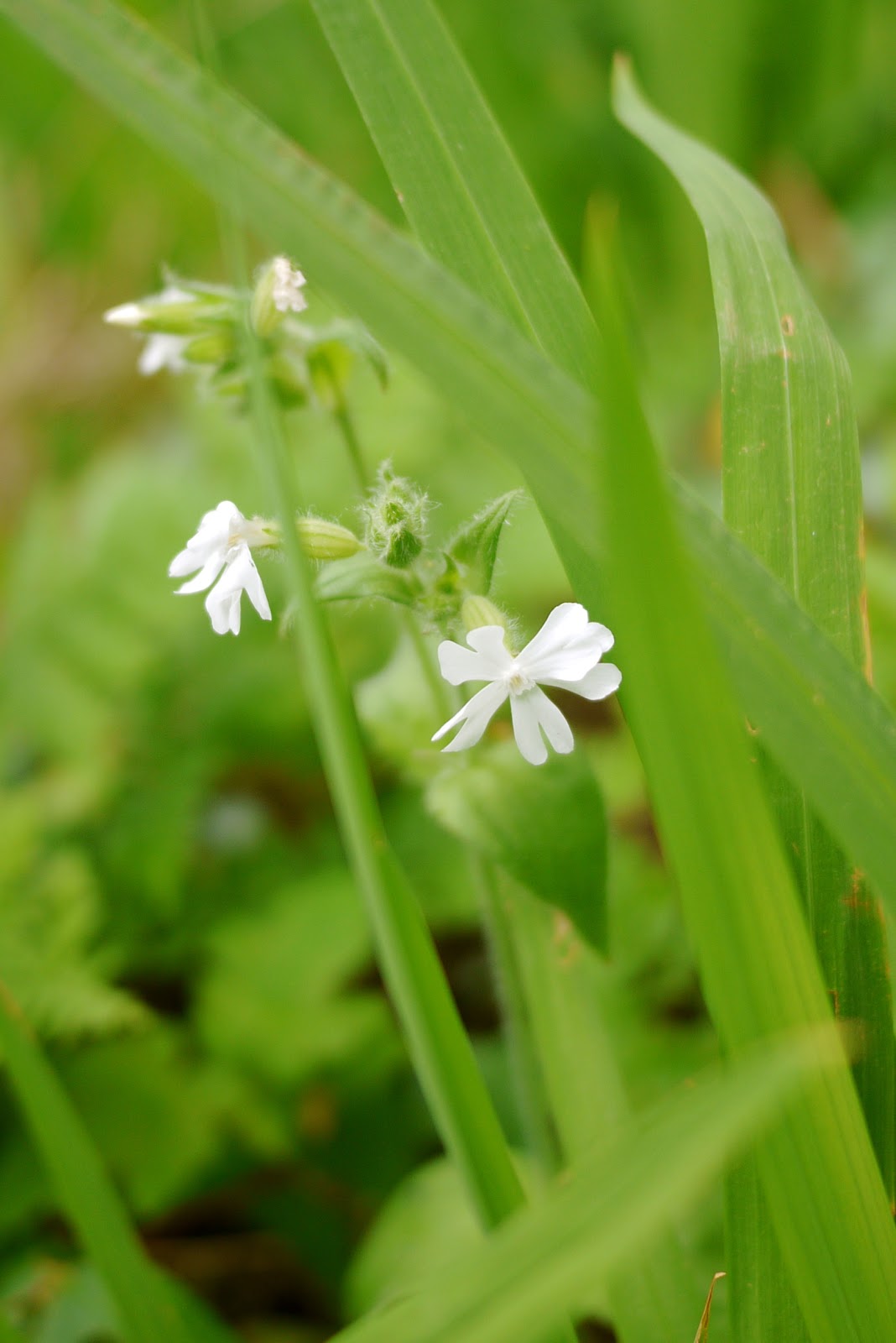
Around the edges of the woods are a few white campions:


Pink purslane:


And some beautiful, deep purple columbines:


Near the woods there's a meadow that's prone to getting a bit boggy when it rains. There's a goal post at one end of the meadow (which happens to be right near our back fence) and a lot of the locals complain that the meadow itself isn't maintained properly. The ground is too soft for football practice so I don't see the point in the grass being regularly cut, anyway, and if it was then these would get mown up:


A kind of marsh orchid, although I'm not sure which. They're quite tiny, but beautiful, though. There are also some tiny, tiny blue flowers, which were too small for me to get a photo of with the lens I have for my camera, but I think they're forget-me-nots. There are also cuckoo flowers lurking close the edge of the meadow:


And I think these are bugles:


The hawthorns are in full bloom now as well:


As are the rhododendrons, which have turned the hills behind us purple:


It's amazing what you find when you look for it.

Tuesday, 29 May 2012

More notes: Brigid themed

Delving back into all of this stuff - the articles, the subject matter; it's like putting an old pair of shoes back on. My library membership lapsed in June of last year, so it's been a long while since I did some serious reading. It feels goooood...

Hopefully I'm not boring you all too much. The next couple of articles I thought I'd do some notes on are Brigid related, and content-wise, not quite what I'd hoped for, really, but a good read in their own way if only for challenging my own views. It's good to step outside of your comfort zone once in a while.

Body of a saint, story of a goddess: origins of the Brigidine tradition
Lisa Bitel 
Textual Practice 16(2), 2002

The main thrust of the article is examining Brigid's portrayal in the three hagiographies (biographies pertaining to a saint) that are still extant, and discussing her portrayal in each of them. Bitel argues that the earliest hagiography of Brigid, by Cogitosus - the earliest hagiography of any saint written in Ireland - does not hint at pagan origins for the saint at all.

The later hagiographies do, however, and Bitel argues that this is deliberate. Without any physical remains for the saint, the hagiographers essentially made a conscious decision to use native, mythological motifs to emphasise Brigid's strength and influence over the political and geographical landscape, just like an Irish goddess, all of which infused and intertwined with miracles and events modelled on the Bible, continental hagiographies, and eye witness accounts. This not only gave her a powerful presence, but also justified her political and ecclesiastical power as a woman:

"Brigit's hagiographers were also purposefully invoking 'pre-Christian' history in their allusions to territory and landscape. Once, they proposed, heroines, warrior-women and territorial goddesses from myths and king-tales had wielded feminine power in a land that denied women political authority. The writers of Vita Prima and Bethu Brigte used these traditional models to cast Brigit as protectress of the Leinster people in danger of invasion by their enemies, especially the invading Uí Néill." (222)

In theory the argument is compelling but I can't help but feel there are elements being glossed over here. It would have been nice to have seen more consideration of the merits of those who argue that there are genuine pre-Christian elements or influences at play here, rather than hammering home the argument that the later Lives made deliberate and conscious use of motifs that are entirely divorced from any possible pre-Christian Brigid.


The Image of Brigit as a Saint: Reading the Latin Lives
Katja Ritari
Peritia 21 (2010)

This one made a good companion to Bitel's article and is apparently based in part on the author's own dissertation, Saints and sinners in early christian Ireland: moral theology in the Lives of saints Brigit and Columba (2009). One for the wish list, I think.

Anyway, here we have more consideration of the boundaries between the Christian and pre-Christian Brigid, but ultimately it's a consideration of the saint's portrayal in hagiography, which emphasises her Christian virtues and purity. There are lots of fiery miracles in the two later Lives in particular, which have been used to argue evidence of the pre-Christian Brigid, but Ritari ultimately argues that whatever the origins or influences of the events contained in the hagiographies may be, the portrayals of Brigid as they stand in the hagiographies are entirely Christian in purpose. She ultimately concludes:

"According to Proinsias Mac Cana, the historical element in the Lives of Brigit is slight while the mythological element is correspondingly extensive. I wish to modify this statement: while the so-called 'pagan elements' in the Latin Lives of Brigit are almost non-existent or at least very scant, and the historical tradition pertaining to her is slight, the christian elements are vital in the representation of Brigit as we have her. The authors of the Lives were not writing of a euhemerised goddess but of a christian saint, and as such Brigit conforms perfectly with the christian image of holiness."

I suppose the problem with articles that are necessarily not too long is that it's difficult to really nail an argument conclusively, but if anything there are some good pointers towards other sources here that will help the reader do further research and make their own minds up, and that's the main thing you hope for in an article. It's worth a read for the pointers alone.

Sunday, 27 May 2012

More notes from the library...

The next lot of notes should be a bit shorter...Promise...

The Christianization of the Early Irish Cosmos?: muir mas, nem nglas, talam cé (Blathm. 258)
Liam Mac Mathúna
ZcP Volume 49-50 (1997)

Most folks who've been in the CR scene for a while have probably come across Mac Mathúna's article on the three realms in the Celtica journal (if not, it's really worth a read). I think it's safe to say that this article should be considered to be a companion piece to that one: although this article was published earlier than 'Early Irish Perceptions of the Cosmos,' it begins by referencing that article as establishing the Irish concept of "a three-fold division of the cosmos" as fact.

This article covers some of the same ground as the Celtica article and provides more examples of the three realms concept, but takes a different tack, ultimately proposing the idea that eventually the idea came to be articulated in a pair of words: nem (heaven - or sky) and talam (incorporating both land and sea). Or, as Mac Mathúna puts it - "From being confined to one corner of the nem - muir - talam conceptual triangle, where it shared the horizontal plane with muir, talam may now occupy the whole horizontal, subsuming muir, and finding in nem its sole contrasting opposite."

So. Now you know.

It also provides a wider context for the line muir mas, nem nglas, talam cé ("the beautiful sea, the blue heaven, the present earth") given in the Celtica article:
Ba deithbir do dúilib Démuir mas, nem nglas, talam céco imro-imchloítis a ngnéoc coíniud a ngalgaite. 
"It would have been fitting for God's elements, the beautiful sea, the blue heaven, the present earth, that they should change their aspect when keening their hero." (Blathm. 257-60)


Some Heathenish and Superstitious Rites: A Letter from Lewis, 1700
Domhnall Uilleam Stiúbhart
Scottish Studies: The Journal of the School of Scottish Studies Volume 24 (2000-2006)

This is a lengthy article so I'm just going to pick out a couple of bits I found interesting and potentially important; it's an examination of a letter "Ane Accompt of some heathenish & superstitious rites used in the Isle of Lewis given by a frend to Mr Alan Morisone Minister of Ness 15 April 1700" and there are several bits that prove interesting from a folklore perspective, describing certain customs and rites associated with various occasions and festivals that give details I've not otherwise seen before.

First up, there's probable mention of the practice of making offerings to Shony. The letter tells us:
"Others contribut a quantity of Corn & make malt of it, & brew it into ale, and drink it in the kerk [church] pouring the first coigfull into the sea, that they may have fish the better that yeir and sea ware for there land, And all the town will joyn in this work but now its abolyshed, they called this kynd of sacrifeceing Shion, but the Etymology of that word I know not.  Others killed ane heiffer or bullock and threw the blood of it into the sea wt certane rites and ceremonies promiseing to themselves therby the more abundance of fysh and sea ware to be brought ashore to them." (205-206)
This is a slightly different account to the one Martin Martin gives, and unlike Ronald Black, who links Shony to John the Baptist (Seonaidh) and, ultimately possibly Manannán, Stiúbhart suggests the name is evidence of Norse practice, from the Old Norse word son-, which means an atonement or sacrifice. An alternative explanation might link the word with the Lewis name for fairies, muinntir Fhionnlaigh.

The next bit I want to pick out from the letter relates to Là Fhèill Brìghde. The letter describes the making of the leaba Brìde (the bed of Brìde), made "in a Seive wt a little straw and clean cloaths," into which the icon of Bride was placed. The letter goes on to say:
"Then every persone in the family man woman and child put in something wch he daily wor into the bed, and after all was compleet for the service, all the familie fell on thr faces and wt high voices cryed ndanig briid, gun di riist." (206)
This is interesting in that I've never seen mention of clothes being but into the bed (that I recall!), and presumably it's for blessing, just like the practice of putting clothes outside for Brigid to bless in parts of Ireland. Clearly the bolded words are an attempt at articulating Gàidhlig, which Stiùbhart gives as '[Gu]n tàinig Brìd, gun dì [i] rithist.' Martin describes the ritual as well giving the words as "Briid is come, Briid is welcome." Stiùbhart suggests this is a mistranslation, when it should be as above - "Bride is come; may she come again." That has some implications for reconstructionist ritual, no doubt.

One final thing to note is that Stiùbhart mentions in his notes that Ronald Black is currently working on a book about the Gaelic year. All I can say is, YAY.


OK, I'll finish there for now, since I have to leave the house today. I hope you find these useful!

Notes from the library

I thought I'd make some notes on some of the articles I got from the library yesterday, in case anyone might be interested in getting hold of them. I'll stick to the more interesting ones I got, and try to keep the waffle to a minimum...

The first one is an article by John Carey that has some good food for thought in relation to origin or creation legends of Ireland. I've been compiling as many "creation" tales as I can find over at Tairis Tales, and Carey makes some interesting points here:

'Origin and Development of the Cesair Legend'
John Carey
Éigse Volume 22 (1987)

Cesair is typically credited as being the first settler of Ireland, according to the Lebor Gabála Érenn. Sent west by her grandfather (Noah) in an the hopes of escaping the imminent Flood, she arrives with a bevy of women and only three men to go round. The women are divided between the three men, Cesair herself marrying Fintan mac Bochra. Eventually the Flood comes and those who haven't died already succumb to it - all except for Fintan.

The Lebor Gabála itself is an eleventh century tale but earlier versions of the invasion story can be found in other sources. The lost manuscript of Cín Dromma Snechta, which dates to around the eighth century, lists Banba as the first woman to settle Ireland (lending her name to it). The Chronicon Scotorum, meanwhile (drawing on an eighth or ninth century descendent of the 'Irish World Chronicle'), lists the first woman as 'Eriu or Berba or Cesair.' A version of Lebor Gabála in the Book of Lecan also glosses Cesair's name with .i. Eriu. All this means: earlier versions from around the eighth century probably had the name as Banba or Ériu (or Berba, who Carey later associates with the River Barrow), which then became associated with Cesair.

Carey then goes on to discuss the significance of the legend, with two different theories proposed by other academics being influential: On the one hand, Cesair isn't mentioned in some invasion schemes at all (e.g. Historia Brittonum), suggesting she was added in at a later date - perhaps in order to give Ireland's origin story Biblical roots. On the other hand, Macalister (who translated the LGÉ) and the Rees brothers suggested that Cesair is pagan in origin, her story being 'a tattered fragment of a Flood myth' (i.e. a native Flood myth, not related to the Bible), and that Cesair and Fintan are a 'cosmogonic pair'; part of a native creation story, in which the Flood occurs during the process of the world's manifestation.

In a wider context, Carey notes that there are several different flood stories associated with women (such as the Wave of Clidna) to be found in the dindshenchas tales, and that Cesair's story could have had its origins in a local legend that was adopted and adapted into a broader context for the purpose of the LGÉ. This is the crux of the argument, and so Carey partially agrees with Macalister and Rees in that there are pagan origins for the story, but "it should be emphasized that the story appears to be a local legend, with no necessary connection to traditions either of world deluge or of primeval migration - in other words, I am led to agree with those who see its presence in the invasion sequence as an artificial and secondary development." (p46)

The final point for consideration is the location of the tale: if Cesair's story did start out on a local level, then as it exists today doesn't really help to pinpoint the location. Carey suggests that the tale has undergone a lot accretion, which muddies the waters somewhat, but it ultimately has its origins in a Leinster legend - "in which Ladru and his two companions stole Berba, with the host of her attendant maidens, from the Otherworld. They returned to Ireland and divided the women into three companies at Commar na Trí nUisce, but were overwhelmed by an avenging flood-wave from the sea. The three groups of women were very possibly linked with the three river which meet at that spot." (48)