I'm just posting this article as a kind of addendum, because this one has pictures that actually show some of the hillforts and the signals. There aren't many pictures, but it does show just how successful the experiment was:
Iron Age hillforts glow with journey back in time
Pretty damn cool.
Thursday, 24 March 2011


Tuesday, 22 March 2011
Supermoon!
In Scottish tradition it's the new moon that's celebrated the most - that first sliver in the sky (known as gob soillse - ’the bill or beak of the light’) that heralds the waxing of the moon, and the period when lots of things can be done under more propitious circumstances; sowing seeds, getting married, setting out on journeys, cutting your hair. This is a time of increase and growth, and Alexander Carmichael recorded quite a few traditions and prayers dedicated to that first glimpse of the new moon. In Gaol Naofa, we celebrate the new moon with a ritual.
If the waxing moon is all about growth and increase, the full moon is the culmination of all this, and is known as bolg reothairt - ’the swollen womb of the spring tide.’ I have to admit I find the moon fascinating, and whenever I see it, I greet it, quietly to myself (because people would probably think I'm a bit mental otherwise). So all in all, the supermoon this weekend was something I was looking forward to.
Mr Seren and I were invited to a party this weekend, a kind of informal gathering in honour of the supermoon and the equinox, so we dumped the kids at the in-laws for the night and off we went. There was food and drink, and good lots of laughter, and since the host of the party is Wiccan I took the opportunity to bring over a load of old books I've had sitting on the wardrobe shelf since we moved here three years ago - I was hoping she'd give them a good home, or knew some folks who would if she didn't want them.
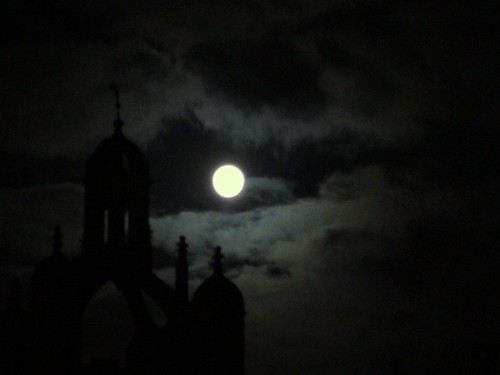
We didn't get to see the moon rise because there was too much cloud cover, but around 10pm or so the clouds cleared a little so we got to see the moon shining bright:

At around midnight we went outside with some Chinese lanterns that our hosts had bought - everyone was invited to choose one and write a wish on it, to send it off into the night sky, and I think most of us did. It was too windy to light the lanterns in view of the moon (Mr Seren's lantern went first and ended up in a bush for a while) so we had to take shelter round the back of the tenement building. Because of the wind it took a while to get them lit, and seeing as we had only two lighters between us all, they had to go off one by one. I waited patiently...:

...while mine was lit as I held onto it gently - we had to hold them pretty close to the ground for the fire to take. It had a bit of a bumpy start, but Mr Seren's friend Tam rescued it and managed to get it off the ground for me. I chose an orange lantern, but this red one here is the last one we all did together (except Mr Seren, who was in charge of the camera):

And off it went into the night with the others.
This is the start of my celebrations for Latha na Cailliche, really. I don't usually make much of a fuss - some offerings and devotions to the Cailleach and the Cailleachan - but I don't usually get to celebrate with other people either, so it was good to find a little bit of community, even if we were all from different paths.
When we got home that night I went straight off to bed, and didn't get much sleep thanks to my back and left leg not appreciating the journey in the car to much. I gave up trying to sleep and got up early, and as I pottered about in the kitchen, saw that one of the busy lizzies I've sown for the hanging basket had sprouted. Because of my recent back problems I haven't been able to do much in the garden yet, so this is the only sowing I've done so far. It was good timing to see that tiny sprout, although I'm hoping I'll be able to get around to doing more sowing for the vegetable garden soon.
Spring is definitely here, even if we did have snow, hail and sleet only last week.
Speaking of the Cailleach, I received a letter from Perth and Kinross Council acknowledging receipt of my objection about the proposed hydro-electric scheme that will affect Tigh nam Bodach etc. Very formal and stern it is, too, but I'll be informed of the council's decision in due course, although it didn't say when that might be.
If the waxing moon is all about growth and increase, the full moon is the culmination of all this, and is known as bolg reothairt - ’the swollen womb of the spring tide.’ I have to admit I find the moon fascinating, and whenever I see it, I greet it, quietly to myself (because people would probably think I'm a bit mental otherwise). So all in all, the supermoon this weekend was something I was looking forward to.
Mr Seren and I were invited to a party this weekend, a kind of informal gathering in honour of the supermoon and the equinox, so we dumped the kids at the in-laws for the night and off we went. There was food and drink, and good lots of laughter, and since the host of the party is Wiccan I took the opportunity to bring over a load of old books I've had sitting on the wardrobe shelf since we moved here three years ago - I was hoping she'd give them a good home, or knew some folks who would if she didn't want them.
We didn't get to see the moon rise because there was too much cloud cover, but around 10pm or so the clouds cleared a little so we got to see the moon shining bright:
At around midnight we went outside with some Chinese lanterns that our hosts had bought - everyone was invited to choose one and write a wish on it, to send it off into the night sky, and I think most of us did. It was too windy to light the lanterns in view of the moon (Mr Seren's lantern went first and ended up in a bush for a while) so we had to take shelter round the back of the tenement building. Because of the wind it took a while to get them lit, and seeing as we had only two lighters between us all, they had to go off one by one. I waited patiently...:
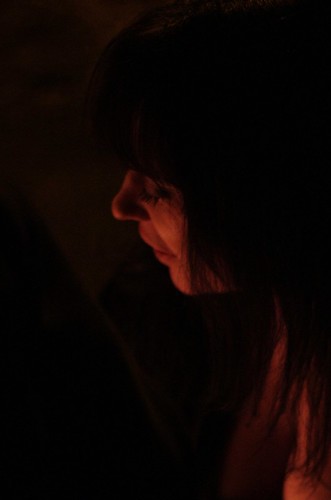
...while mine was lit as I held onto it gently - we had to hold them pretty close to the ground for the fire to take. It had a bit of a bumpy start, but Mr Seren's friend Tam rescued it and managed to get it off the ground for me. I chose an orange lantern, but this red one here is the last one we all did together (except Mr Seren, who was in charge of the camera):
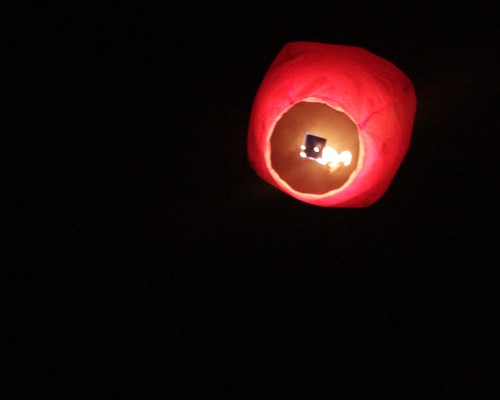
And off it went into the night with the others.
This is the start of my celebrations for Latha na Cailliche, really. I don't usually make much of a fuss - some offerings and devotions to the Cailleach and the Cailleachan - but I don't usually get to celebrate with other people either, so it was good to find a little bit of community, even if we were all from different paths.
When we got home that night I went straight off to bed, and didn't get much sleep thanks to my back and left leg not appreciating the journey in the car to much. I gave up trying to sleep and got up early, and as I pottered about in the kitchen, saw that one of the busy lizzies I've sown for the hanging basket had sprouted. Because of my recent back problems I haven't been able to do much in the garden yet, so this is the only sowing I've done so far. It was good timing to see that tiny sprout, although I'm hoping I'll be able to get around to doing more sowing for the vegetable garden soon.
Spring is definitely here, even if we did have snow, hail and sleet only last week.
Speaking of the Cailleach, I received a letter from Perth and Kinross Council acknowledging receipt of my objection about the proposed hydro-electric scheme that will affect Tigh nam Bodach etc. Very formal and stern it is, too, but I'll be informed of the council's decision in due course, although it didn't say when that might be.
Monday, 21 March 2011
'Hillfort Glow Experiment' hailed a success
I posted an article last month about an experiment that was being planned in Wales and England to see if Iron Age hillforts could easily communicate with each other using fire.
The test was held this weekend, taking advantage of the full moon, and has been hailed a success by archaeologists according to the Beeb:
There's another, shorter article here.
The test was held this weekend, taking advantage of the full moon, and has been hailed a success by archaeologists according to the Beeb:
About 200 volunteers stood on the summit of 10 hillforts in north Wales, the Wirral and Cheshire, and signalled to each other with torches.
Their aim was to learn if communities used the summits to warn each other.
"It was a success," said archaeologist Erin Robinson. "It captured the public's imagination and we made extra links we did not think were possible."
There's another, shorter article here.
Tuesday, 15 March 2011
Follow up on Tigh nam Bodach
Update: At the present time, the planning application has been withdrawn. Please see this post here, and this one as well for more information.
With an afternoon to myself and my continuing orders to 'be active, but not too active' while I take a cocktail of medication that makes me want to do nothing more than curl up in the foetal position (if only I could), I've taken the opportunity to do some research into the proposed hydro-electric scheme in Glen Lyon. I ended up deciding that instead of moaning about it and being morally outraged here on my blog, I should write a letter of objection instead. So I did. Or rather, I emailed it.
My objections included:
Who knows what will happen, but I'm hoping for the best...
With an afternoon to myself and my continuing orders to 'be active, but not too active' while I take a cocktail of medication that makes me want to do nothing more than curl up in the foetal position (if only I could), I've taken the opportunity to do some research into the proposed hydro-electric scheme in Glen Lyon. I ended up deciding that instead of moaning about it and being morally outraged here on my blog, I should write a letter of objection instead. So I did. Or rather, I emailed it.
My objections included:
- Gleann Cailliche is one of the few undisturbed areas left in Scotland, and as such the proposals wholly inappropriate
- The proposed pipeline will run through otherwise intact blanket bog habitats, which are rare and said to be of 'international ecological significance' (page 4). As such, I believe the ecological impact on an area of 'high conservation value' to be unacceptable, should the proposals be given the go-ahead
- Tigh nam Bodach is a unique site and the traditions associated with it are an important part of the local character as well as being a part of Scotland's cultural heritage. The peaceful and undisturbed location of the glen is an integral part of what makes the place so unique and special; such an intrusive development will compromise the site and the traditions, and potentially damage it
- Given the fact that there will be pylons, poles, cables, weirs, powerstations, and so on, built as part of the scheme in an otherwise relatively untouched glen, the visual impact on the area will be significant, insensitive and intrusive
Who knows what will happen, but I'm hoping for the best...
A tale of a different kind
I thought I'd post this tale, which I found in Grant Stewart's Myth, Tradition and Story from Western Argyll, because it has some interesting similarities with MacKenzie's tale The Coming of Angus and Bride, and it's that time of year where it's still relevant. I don't know about where you are, but the Cailleach's putting up a pretty good struggle round here at the moment.
Grant Stewart attributes the story to a Saxon-Hungarian woman named Malvina (whose name, she points out, will be "familiar to readers of Ossianic poems"), who she met in Romania:
Grant Stewart attributes the story to a Saxon-Hungarian woman named Malvina (whose name, she points out, will be "familiar to readers of Ossianic poems"), who she met in Romania:
There was once a very great witch, who was head over other eight witches. She had a daughter-in-law, to whom she was very unkind. She was so hard upon her that she made her life miserable. One day she handed her son's young wife a fleece of a brown sheep, bidding her go wash it white before bringing it back to her. The daughter-in-law obeyed. She took it to a brook and washed it till she was weary, weeping as she did so because her work was all in vain. Old Winter came that way, and asked her why she wept. She told him of her mother-in-law's command. "Give it to me," said Winter, and taking the brown fleece from her he washed it white. Giving the fleece back with one hand, he held out in the other a bunch of 'vioréle' (blue flowers resembling our wild hyacinth, but without scent. They are the frst to bloom in Transylvania, when the snows begin to melt). "Take this to your mother-in-law," said Winter. "If she asks any question, hold up these flowers and say, 'The flowers are out on the mountain.' "
The young wife returned home, handed the white fleece to her mother-in-law, and held up the buds, saying, "The flowers are out on the mountain." The old witch was enraged. She callled the other eight, and mounted on their goats, they rode off to the mountain. Borrowing three days from February, they began a fierce contest against all growth. Snow and hail, wind and rain were summoned to do battle, but the warm sun shone out, the south wind breathed, and Spring triumphed. The nine witches were turned into stone, and "there they sit," said Malvina, "on their goats, on the top of the mountain of Sílash in Temesvar; and on the anniversary of their defeat the fountains in their heads overflow, and their faces become blurred with weeping. My mother," added Malvina, "took me there to see them when I was a child of twelve."
Grant Stewart, Myth, Tradition and Story from Western Argyll, 1925.
Subscribe to:
Posts (Atom)