As part of my role as Leas-Uachtearán (Vice-President) of An Chullacht Ghaol Naofa, I've been working on a number of things with Uachtearán Treasa Ní Chonchobhair over the past few months since my appointment. It's not always easy trying to get things done when life has a nasty habit of getting in the way, so I'm pleased to announce the publication of our article Ritual within Gaelic Polytheism.
Credit goes Treasa for being the driving force behind the article as a whole, but thanks must also go to Kathryn and the founder of Gaol Naofa, Tomás, for their valuable critiques and suggestions to improve on what Treasa and I came up with.
I do hope, as ever, that you enjoy the article. Questions, comments and critiques are welcome.
Tuesday, 13 July 2010


Monday, 12 July 2010
Midsummer
Midsummer's come and gone and with it, so has the sun, it seems. But we're still getting some pretty impressive sunsets. See?

Very dramatic. June was a very dry month for us, so the return of the rain is good for the garden, at least. Everything's coming along in leaps and bounds now.
For midsummer, I took the kids to the beach for a picnic with the intention of making some offerings - plans had to slightly change though, because we ran into our neighbours and they joined us for the afternoon, so offerings were somewhat surreptitiously done as we left, after a lovely afternoon in good company instead. It was quite a momentous afternoon, too - Mungo was brave and attempted a swim in the sea. Although I don't think he's in any hurry to try it again.
After starting Margaret Fay Shaw's Folk Songs and Folk-lore of South Uist a while ago, I found a recipe for a proper festival strùthan - a traditional version using barley, and a more modern version using flour. It was perfect timing, so I decided to try out the flour version, in the evening, and had some success with it. Sort of? I made it as thin as I possibly could by hand, but it rose more than I was expecting as it baked in the oven. It was also difficult to gauge how doughy the caudle should be, so that bit I had to wing and possible ended up with something a bit too paste-y rather than doughy. It kind of ended up rock solid and brick-like once the strùthan cooled. I tried some fresh from the oven and it was tasty, but chewy, but it definitely needed to be thinner - at least half as thin as it turned out. I would guess it would be quite solid but brittle then, once it cooled.
This is how it looked:

And this is the recipe, based on Shaw's description:
Ingredients
1 lb flour
1 tsp baking soda (bicarbonate of soda)
Salt
Sour milk - enough to make a dough
Caraway seeds, currants or raisins
Mix the ingredients together, using enough milk to make a pliable dough. Shape the dough into a flat round and bake on a girdle, or 'not too hot' oven. Turn about half way through cooking to make sure it bakes evenly.
For the caudle:
Ingredients
3 tbsp treacle (golden syrup)
2 tbsp milk
1 tbsp sugar
Flour
Mix the ingredients together, using enough flour to make a 'dough' that will stick to the strùthan. Cover the strùthan and return to the oven until ready.
If I'd got it the right thickness, then I imagine it would have been quite tasty, even after it had cooled. I saved some for the kids to have the next day, but when I tried to cut it, I couldn't even make a dent in it. I decided to bin it - seeing as it was basically inedible, I didn't want to leave it as an offering, but the rest of it that I'd left out fresh from the oven seemed to have been well received, along with some Orkney beer.
I didn't do much else for the day, just kept it quiet and simple (and nursed a mild case of sunburn from the beach). And somehow it's mid-July already, how did that happen?

Very dramatic. June was a very dry month for us, so the return of the rain is good for the garden, at least. Everything's coming along in leaps and bounds now.
For midsummer, I took the kids to the beach for a picnic with the intention of making some offerings - plans had to slightly change though, because we ran into our neighbours and they joined us for the afternoon, so offerings were somewhat surreptitiously done as we left, after a lovely afternoon in good company instead. It was quite a momentous afternoon, too - Mungo was brave and attempted a swim in the sea. Although I don't think he's in any hurry to try it again.
After starting Margaret Fay Shaw's Folk Songs and Folk-lore of South Uist a while ago, I found a recipe for a proper festival strùthan - a traditional version using barley, and a more modern version using flour. It was perfect timing, so I decided to try out the flour version, in the evening, and had some success with it. Sort of? I made it as thin as I possibly could by hand, but it rose more than I was expecting as it baked in the oven. It was also difficult to gauge how doughy the caudle should be, so that bit I had to wing and possible ended up with something a bit too paste-y rather than doughy. It kind of ended up rock solid and brick-like once the strùthan cooled. I tried some fresh from the oven and it was tasty, but chewy, but it definitely needed to be thinner - at least half as thin as it turned out. I would guess it would be quite solid but brittle then, once it cooled.
This is how it looked:
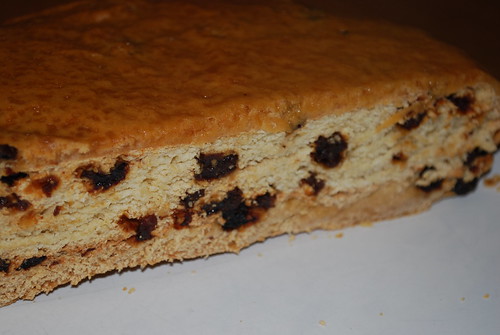
And this is the recipe, based on Shaw's description:
Ingredients
1 lb flour
1 tsp baking soda (bicarbonate of soda)
Salt
Sour milk - enough to make a dough
Caraway seeds, currants or raisins
Mix the ingredients together, using enough milk to make a pliable dough. Shape the dough into a flat round and bake on a girdle, or 'not too hot' oven. Turn about half way through cooking to make sure it bakes evenly.
For the caudle:
Ingredients
3 tbsp treacle (golden syrup)
2 tbsp milk
1 tbsp sugar
Flour
Mix the ingredients together, using enough flour to make a 'dough' that will stick to the strùthan. Cover the strùthan and return to the oven until ready.
If I'd got it the right thickness, then I imagine it would have been quite tasty, even after it had cooled. I saved some for the kids to have the next day, but when I tried to cut it, I couldn't even make a dent in it. I decided to bin it - seeing as it was basically inedible, I didn't want to leave it as an offering, but the rest of it that I'd left out fresh from the oven seemed to have been well received, along with some Orkney beer.
I didn't do much else for the day, just kept it quiet and simple (and nursed a mild case of sunburn from the beach). And somehow it's mid-July already, how did that happen?
Tuesday, 22 June 2010
Review: By Land, Sea and Sky by Morgan Daimler
OK, maybe one more review then...
IMPORTANT! Please note that this review only applies to the first edition of the book. A revised edition has since been released and changes have been made to it taking on board some of the comments that the author received in various places. This includes changes with the formatting and the addition of some of the author's own material. Bearing this in mind, some of the comments I've made in the review below will no longer apply, and as I've yet to read the latest edition I can't offer any comments relating to what you'll now found. I'm leaving the review here for the meantime because as far as I'm aware the general focus and scope of the book is still the same, but I hope to be able to do an updated version at some point.
By Land, Sea and Sky: A selection of Repaganized Prayers and Charms from Volumes 1 & 2 of the Carmina Gadelica
Morgan "Láirbhán" Daimler
I saw this book being mentioned in a few places and then it was reviewed on Celtic Scholar, which ultimately piqued my interest. It's the first time I've bought a self-published book (I think....) so I wasn't too sure what to expect on that front. The first thing I'd like to comment on, in that respect, is the fact that Lulu seems to have employed Professor Farnsworth from Futurama to send out the confirmation emails - "Good news! Your purchase has been dispatched!" But that's probably not particularly relevant to anything, really...
Secondly, I'm impressed by the quality of the book itself - it's not going to fall apart after a few flick throughs, so that's good. But it does suffer from a few of the criticisms that regularly get trotted out when anyone talks about self-publishing books, and the main ones are formatting/proofing and layout. The whole book is double spaced and while it's not a huge negative, I think some differentiation between the prayers and charms and the introductions and commentary to them would make it easier to read, and flow better overall. Sometimes my brain took a while to catch up with the fact that I was reading a paragraph, not another verse.
The title of the book gives a good clue as to what it's all about; it pretty much does what it says on the tin, so to speak. I have to admit I was surprised at just how many prayers, charms and so on that are included - it's quite comprehensive, and covers all the main areas and a few of the more specialised ones like healing, divination, and different kinds of magical charms.
They're all grouped by subject matter and have a brief introduction for each song so it's easy to find whatever it is you're looking for. One of the strengths of the book is that the author gives a clear idea of her approach and process in reworking the verses (although I wonder if 'repaganizing' is necessarily the right word in some cases?), and she also often gives suggestions for how to perform them.
It's left to the reader to decide how best to incorporate them into practice, so it allows for a variety of approaches and has an appeal beyond CR - the book is clearly aimed at 'Celtic Spirituality' as a whole, rather than just reconstructionists. It's well-researched in this respect, and quite light on detail in the sense that it wouldn't overwhelm the beginner, but as a reconstructionist (or maybe just me being me) I found it veering towards the danger of being a little too light at times, perhaps. The aim of the book is to provide examples of liturgy, not and in-depth examination and elucidation of rituals or CR, though, so I guess that's my problem, not the book's. It would have been nice to have seen it, though...
The author identifies as an Irish Reconstructionist Druid, and this shows in her choices of deities that are incorporated into the verses. There's plenty of room to adapt them to your own focus and deities, though, but more than anything I think the value of this book is that it shows polytheists of various stripes just how the material can be approached and adapted, coming at it from a non-Wiccan perspective.
There still aren't many books out there that cater for (or even account for) a Celtic Reconstructionist audience, so it's always good to see someone doing something about it.
EDIT: I've since revised my review of the book, which is available here. In the interests of transparency I'll be leaving this one as is. However, the more I thought about it, the more I felt there were some things I mentioned only in passing here that I should have concentrated on in more depth, and the more I thought about it, the more I felt that I should edit the review to reflect that. It would be unfair of me to do that without making a note of it, at least.
IMPORTANT! Please note that this review only applies to the first edition of the book. A revised edition has since been released and changes have been made to it taking on board some of the comments that the author received in various places. This includes changes with the formatting and the addition of some of the author's own material. Bearing this in mind, some of the comments I've made in the review below will no longer apply, and as I've yet to read the latest edition I can't offer any comments relating to what you'll now found. I'm leaving the review here for the meantime because as far as I'm aware the general focus and scope of the book is still the same, but I hope to be able to do an updated version at some point.
By Land, Sea and Sky: A selection of Repaganized Prayers and Charms from Volumes 1 & 2 of the Carmina Gadelica
Morgan "Láirbhán" Daimler
I saw this book being mentioned in a few places and then it was reviewed on Celtic Scholar, which ultimately piqued my interest. It's the first time I've bought a self-published book (I think....) so I wasn't too sure what to expect on that front. The first thing I'd like to comment on, in that respect, is the fact that Lulu seems to have employed Professor Farnsworth from Futurama to send out the confirmation emails - "Good news! Your purchase has been dispatched!" But that's probably not particularly relevant to anything, really...
Secondly, I'm impressed by the quality of the book itself - it's not going to fall apart after a few flick throughs, so that's good. But it does suffer from a few of the criticisms that regularly get trotted out when anyone talks about self-publishing books, and the main ones are formatting/proofing and layout. The whole book is double spaced and while it's not a huge negative, I think some differentiation between the prayers and charms and the introductions and commentary to them would make it easier to read, and flow better overall. Sometimes my brain took a while to catch up with the fact that I was reading a paragraph, not another verse.
The title of the book gives a good clue as to what it's all about; it pretty much does what it says on the tin, so to speak. I have to admit I was surprised at just how many prayers, charms and so on that are included - it's quite comprehensive, and covers all the main areas and a few of the more specialised ones like healing, divination, and different kinds of magical charms.
They're all grouped by subject matter and have a brief introduction for each song so it's easy to find whatever it is you're looking for. One of the strengths of the book is that the author gives a clear idea of her approach and process in reworking the verses (although I wonder if 'repaganizing' is necessarily the right word in some cases?), and she also often gives suggestions for how to perform them.
It's left to the reader to decide how best to incorporate them into practice, so it allows for a variety of approaches and has an appeal beyond CR - the book is clearly aimed at 'Celtic Spirituality' as a whole, rather than just reconstructionists. It's well-researched in this respect, and quite light on detail in the sense that it wouldn't overwhelm the beginner, but as a reconstructionist (or maybe just me being me) I found it veering towards the danger of being a little too light at times, perhaps. The aim of the book is to provide examples of liturgy, not and in-depth examination and elucidation of rituals or CR, though, so I guess that's my problem, not the book's. It would have been nice to have seen it, though...
The author identifies as an Irish Reconstructionist Druid, and this shows in her choices of deities that are incorporated into the verses. There's plenty of room to adapt them to your own focus and deities, though, but more than anything I think the value of this book is that it shows polytheists of various stripes just how the material can be approached and adapted, coming at it from a non-Wiccan perspective.
There still aren't many books out there that cater for (or even account for) a Celtic Reconstructionist audience, so it's always good to see someone doing something about it.
EDIT: I've since revised my review of the book, which is available here. In the interests of transparency I'll be leaving this one as is. However, the more I thought about it, the more I felt there were some things I mentioned only in passing here that I should have concentrated on in more depth, and the more I thought about it, the more I felt that I should edit the review to reflect that. It would be unfair of me to do that without making a note of it, at least.
Paying the rent
Midsummer approaches, so I thought it would be good to throw down a few bits and pieces for it. I've just started Charles MacQuarrie's The Waves of Manannán (again...) so I figured I'd skip to the relevant bits about paying the rents to him (Manannán, that is) at midsummer (most traditions of which appear to be duplicates of Bealltainn, to be fair). I found an excerpt from a sixteenth century poem that mentions the rents, which I've copied up:
The original is here (page 26 onwards, although I've followed MacQuarrie's capitalisations of certain words in Manx - see page 292-293). He notes that other translators give the meadow grass as 'rushes', which I do think makes a bit more sense, and Moore agrees with this, commenting:
So rushes it is, it seems.
| Dy neaishtagh shin agh rish my skeayll, | If you would listen to my story, |
| As dy ving lhieu ayns Chant; | I will pronounce my chant; |
| Myr share dy voddyms lesh my Veeal, | As best I can; I will, with my mouth |
| Yinnin diu geill dán ellan Sheeant. | Give you notice of the enchanted Island. |
| Quoi yn chied er ee row rieau ee, | Who he was that had it first, |
| Ny kys eisht myr haghyr da; | And then what happened to him; |
| Ny kys hug Parick ayn Creestiaght, | And now St. Patrick brought in Christianity, |
| Ny kys myr haink ee gys Stanlaa. | And how it came to Stanley. |
| Mannanan beg va mac y Leirr, | Little Mannanan was son of Leirr, |
| Shen yn chied er ec row rieau ee; | He was the first that ever had it; |
| Agh myr share oddym's cur-my-ner, | But as I can best conceive |
| Cea row eh hene agh an-chreestee. | He himself was a heathen. |
| Cha nee lesh e Chliwe ren eh ee reayll | It was not with his sword he kept it, |
| Cha nee lesh e Hideyn, ny lesh e vhow; | Neither with arrows or bow; |
| Agh tra aikagh eh lhuingys troailt | But when he would see ships sailing, |
| Oallagh eh ee my geayrt lesh kay. | He would cover it round with fog. |
| Yinnagh eh doinney ny hassoo er brooghe, | He would set a man, standing on a hill, |
| Er-lhieu shen hene dy beagh ayn keead; | Appear as if he were a hundred; |
| As shen myr dreill Mannanan keole, | And thus did wild Mannanan protect |
| Yn Ellan shoh'n-ayn lesh Cosney bwoid. | That island with all its booty. |
| Yn mayll deeck dagh unnane ass e cheer, | The rent each landholder paid to him was |
| Va bart dy leaogher ghlass dagh bleiu; | A bundle of coarse meadow grass yearly; |
| As eisht shen orroo d'eeck myr keesh, | And that, as their yearly tax, |
| Trooid magh ny cheery dagh oie-lhoine. | They paid to him each midsummer eve. |
| Paart ragh lesh y leaogher seose, | Some would carry the grass up |
| Gyn yn slieau mooar ta heose Barool; | To the great mountain up at Barool; |
| Paart elley aagagh yn leoagher wass, | Others would leave the grass below, |
| Ec Mannanan erskyn Keamool. | With Mannanan's self above Keamool. |
| Myr shen eisht ren adsyn beaghey, | Thus then did they live; |
| O er-lhiam pene dy by-veg nyn Geesh; | O, I think their tribute very small, |
| Gyn kiarail as gyn imnea, | Without care and without anxiety, |
| Ny doggyr dy lhiggey er nyn skeeys. | Or hard labour to cause weariness. |
| Eisht haink ayn Parick nyn meayn, | Then came Patrick into the midst of them; |
| She dooinney-noo, véh lane dy artue, | He was a saint, and full of virtue; |
| Dimman eh Mannanan er y tonn | He banished Mannanan on the wave, |
| As e grogh vooinjer dy lieh-chiart. | And his evil servants all dispersed. |
The original is here (page 26 onwards, although I've followed MacQuarrie's capitalisations of certain words in Manx - see page 292-293). He notes that other translators give the meadow grass as 'rushes', which I do think makes a bit more sense, and Moore agrees with this, commenting:
"As regards Man, however, we have no definite information about the observance of this day from tradition, except that there was a fair, which still continues; and from written sources there is only preserved a letter written, in 1636, by Bishop Parr to Archbishop Neile, in which he states that on St. John Baptist's day he found the people in a chapel dedicated to that Saint "in the practice of gross superstitions," which he caused "to be cried down," and, in the place of them, "appointed Divine services and sermons." We can only wish that the good Bishop had informed us what these "gross superstitions" were. We have already seen (Chapter I.) that Manannan received his tribute of rushes on this day, and it is curious that the pathway leading up to the chapel is still covered with rushes supplied by a small farm close by, which is held on the tenure of doing this service."MacQuarrie also agrees - "Rushes would seem an appropriate offering to Manannán in light of his connections with salt and fresh water in that they tend to grow on the banks of, or actually within, lakes and streams." (p294) And so does Sophia Morrison in Manx Fairie Tales (1911).
So rushes it is, it seems.
Monday, 21 June 2010
Irish Superstitions by Dáithí Ó hÓgáin
Just a quick one, before I get stuck into the meatier books in the pile...
Irish Superstitions
Dáithí Ó hÓgáin
This is a nice wee introduction to some of the superstitions and customs of Ireland. It's short enough that I managed to get through it in one sitting, in not much more than an hour, so it's a quick and easy read that doesn't tax the brain too much.
There's maybe nothing completely earthshattering or dazzling to be found here, but there were some bits that piqued my interest, mainly Ó hÓgáin's reference to the sacred trees of Ireland (bile) and how there was the belief that the sky was a 'roof' supported by four columns in various parts of the uncharted world. He suggests a connection between these posts, which stood in uncharted territory and the bile, which gives some food for thought. The slight problem is that he never gives any references, so it's going to be hard for me to follow up. Hmph.
In spite of the lack of references, most of the ground that's covered is easily recognisable from other places, so over all I would say it's fairly reliable, with the usual amount of caution applied. It was nice to see references to many of the superstitions my nan (whose parents were Irish) and my dad observe - many of which I picked up, too, being raised in an extremely superstitious family. But I digress...
Ó hÓgáin covers superstitions of various times, places, and stages of life, so there's a bit of everything here. That means there isn't much detail, but it could be a good place for a beginner to start getting a very basic idea of things, and seeing as I picked up a copy for a penny, it's probably easier and cheaper to get hold of than Séan Ó Súillebháin's Irish Folk Custom and Belief (which I still think is one of the best books for beginners out there).
For me, there wasn't much new in it, but the writing is engaging and the layout makes it a good book for flicking through for a quick reference or two, and I think it will come in handy in future. Definitely one for the bookshelf.
Irish Superstitions
Dáithí Ó hÓgáin
This is a nice wee introduction to some of the superstitions and customs of Ireland. It's short enough that I managed to get through it in one sitting, in not much more than an hour, so it's a quick and easy read that doesn't tax the brain too much.
There's maybe nothing completely earthshattering or dazzling to be found here, but there were some bits that piqued my interest, mainly Ó hÓgáin's reference to the sacred trees of Ireland (bile) and how there was the belief that the sky was a 'roof' supported by four columns in various parts of the uncharted world. He suggests a connection between these posts, which stood in uncharted territory and the bile, which gives some food for thought. The slight problem is that he never gives any references, so it's going to be hard for me to follow up. Hmph.
In spite of the lack of references, most of the ground that's covered is easily recognisable from other places, so over all I would say it's fairly reliable, with the usual amount of caution applied. It was nice to see references to many of the superstitions my nan (whose parents were Irish) and my dad observe - many of which I picked up, too, being raised in an extremely superstitious family. But I digress...
Ó hÓgáin covers superstitions of various times, places, and stages of life, so there's a bit of everything here. That means there isn't much detail, but it could be a good place for a beginner to start getting a very basic idea of things, and seeing as I picked up a copy for a penny, it's probably easier and cheaper to get hold of than Séan Ó Súillebháin's Irish Folk Custom and Belief (which I still think is one of the best books for beginners out there).
For me, there wasn't much new in it, but the writing is engaging and the layout makes it a good book for flicking through for a quick reference or two, and I think it will come in handy in future. Definitely one for the bookshelf.
Subscribe to:
Posts (Atom)