Showing posts with label videos. Show all posts

Friday, 22 April 2016

New video! New(ish) article! Daily Rites in Gaelic Polytheism

So as we announced over on the Gaol Naofa site last week (yes I'm way behind on things...), we've got a new video out:


And also a new (or at least improved) Daily Rites article to accompany it, which now has a number of prayers offered in both Gaelic and English translation. To be honest, there was no particular rhyme or reason in choosing to do this particular subject right now, aside from the fact that it seemed like a good idea to continue the more practical theme like our last video on Offerings in Gaelic Polytheism had.

I'm really not sure when the original Daily Rites article was written (I'm pretty sure it was before my time as a member of the GN council), but for the sake of those who prefer the original prayers given there, we've archived that version of the article on the site, and it's cross-referenced to the new version, too. Kathryn took charge of the article's overhaul of the piece, and I think the contrast between the prayers given in the original version, and the ones that Kathryn chose to adapt from the Carmina Gadelica in the new version, gives a good contrast and illustration of how different people have different styles.

When I was first starting to explore CR and then Gaelic Polytheism specifically, the idea of daily prayers seemed kind of restrictive and off-putting. Coming from a completely secular background it was a concept that was alien to me, and it seemed kind of dull... Wouldn't it get boring and become rote? But I kept coming back to the idea for reasons I've never really fully understood, aside from the undeniable urge that I should, and eventually I started looking at the kinds of prayers that were out there, that maybe I could adapt or work with in coming up with some of my own. After a bit of fiddling around I found a routine that felt like it was a good fit, and since I started I've not stopped, really. It was a gradual process as I figured things out, but now I say the same prayers every day (or night...) – at the very least I will pray each night, just as I've got into bed and I'm lying down, since that's most comfortable for me – and it's become an integral part of my bedtime routine now. Even when I'm absolutely exhausted I find it hard to get to sleep until I've said them now.

I think it's important that the prayers we say as part of our practice have meaning to us, and they flow from the heart. My preference is for the more traditional, like the ones we've given in the new article, and the ones I have over on Tairis, but I also tend to add in prayers of my own making, too – off the cuff prayers that aren't poetic, perhaps, but they're no less heartfelt or meaningful. But the traditional types of prayers – the same words I say over and over again from year to year – form the barebones of my daily routine.

I'm sure the idea of a daily routine of prayer doesn't appeal to some people and I don't think it's the only way things should or can be done. For one, there are simple traditions and customs that can become a part of your day, too... It doesn't make anyone lesser, or greater, just because of what they do or don't do, though. Religion isn't a competition or a pissing contest, you know? Or it shouldn't be. I'm sure a lot of people do maintain a daily routine of some sort, even if it doesn't follow a particular outline or isn't even a conscious thing. Maybe somedays or most days the sum total is little more than a mental "hey."

What matters is that it works for the individual, and that – at its core – it helps maintain that connection with An Trì Naomh. It's about being mindful of who you are, who you honour. I've seen some people say they try to keep up a daily routine of some sort but somedays, for whatever reason, it just doesn't happen and then there's a sense of guilt or failure, and it becomes hard to get back into the routine because the sense of whatever starts to snowball... But we're only human, after all. We all have our limits and if it happens, it's OK. If it keeps happening, maybe it's better to scale things back a bit and go easier; don't bite off more than you can chew. At the end of the day... Just do you.


Tuesday, 29 December 2015

Links and things for Hogmanay

This is pretty much my favourite time of year so Hogmanay is a Big Deal in this house. Last year – because we're so rock'n'roll – the kids stayed up for the bells and we spent the evening eating popcorn and watching Batman (the Tim Burton version with Michael Keaton), and then we saw the new year in with a celebratory glass of Irn Bru. There's nothing like starting the new year with two kids hopped up on caffeinated fizzy beverages and E numbers...

This Hogmanay we'll probably be doing just about the same. The house will be cleaned and tidied, the kids will stay up till gone midnight, and then the next day (which will probably start with pancakes) we'll be going to the in-laws to enjoy the obligatory steak pie. This time we're providing the pudding – sticky toffee pudding, to be exact (at Tom's insistence).

If you're looking for some inspiration, though, you might want to start with Gaol Naofa's video:


There's some of the usual links and things over on Tairis, which I'll link up just now if you're looking for some historical information or things to make and do:

But there's also plenty on here and elsewhere, too. If you're looking for some ideas for blessings to welcome in the new year these might be of use:
Whatever you're up to for Hogmanay, I hope you have a good one! And if I don't manage a post before Friday then I hope 2016 brings you all blessings of health, wealth, and happiness. 

Sunday, 20 December 2015

Links and things for grian-stad a' gheamhraidh


As the winter solstice approaches, questions about whether or not the day (or, more to the point, the night) should be observed by Gaelic Polytheists. My feeling is: If you wanna.

Personally, I don't think the solstices or equinoxes were ever observed by the pre-Christian Gaels – not to the same degree as the Quarter Days, anyway. It's obvious they were aware of them, as were their Stone Age(s) and Bronze Age not-Gaelic-speaking ancestors; the fact that several ancient monuments are aligned to the solstice or equinox sunrises is evidence enough of that, and indicative of probable religious significance, too. So from that perspective I acknowledge the day as having been important to my ancestors, since I have some Irish and Scottish heritage flowing through my veins. Their wisdom isn't something I like to ignore, you know?

The solstices and equinoxes have also come to be significant in the modern calendar thanks to other influences, too. Granted these are influences from other cultures and some people aren't comfortable with adding those into the mix, but to me, I see the way these days are expressed – in spite of the outside influences – as having been thoroughly Gaelicised. It's a prime example of what syncretism is, and so I don't feel the need to separate it out; it's all part of the continuum and especially here in Scotland it's pretty hard to avoid anyway. Your mileage may vary, of course.

So. If you're interested in looking into solstice traditions, you might want to start with Gaol Naofa's video, which we released on our Youtube channel last year:


I gave a little overview of the kinds of things we tend to do for the solstice here at home in my post about the videos when we released them last year; it's generally a pretty low-key event for us since Hogmanay is what it's all about at this time of year (I'll do a separate post on that later), and we've already had a go at a chocolate Yule log in celebration of the kids finishing school for the Christmas holidays. We did a buttercream version to accommodate my husband's inability to digest cream, but it just wasn't as good as our usual squidgy chocolate log. I'm going to get hold of some lacto-free cream and do it properly on Tuesday so we can have a good one that doesn't end up making my husband wish he were dead when he has some...

The kids are both very keen on lighting candles to put in the window; traditionally it's a custom observed by the daughters of the household, but Tom wants to do it too so they'll both get a candle to light. I think we might have some beeswax sheets left so we might be able to make some, even.

If you're looking for some light (arf) reading then there's the two-part article I've done on Tairis along with a bit in the festival bannocks and caudle section that will be useful, too:
I'm sorry the internal links are still broken – I've tried fixing them but I can't get them to work, at all! That will be fixed on the new and improved site, when it's ready (I'm still working on it, but it's happening!). For some reason I didn't do a "celebrating Yule" article in the Celebrations section, which I'll rectify for the new-and-improved site, too.

For the morning of the solstice the focus is usually on the sunrise at Newgrange. The sunrise has been webcast in previous years but it doesn't seem it will be this year; you can take a look at some photos over at knowth.com, though, and there are videos there too. 

If you'd like to greet the sun as it rises, you might find this prayer useful. It's not necessarily only for the winter solstice, but on the morning after the sun is certainly a welcome sight when you know the days are going to be getting longer and longer from here on out. 


Saturday, 26 September 2015

Links and things for Là Fhèill Mìcheil

I accidentally typed "kinks" and things in the title there, which would put an altogether different tone on the rest of this post...

But anyway, as usual, let's start off with a video from Gaol Naofa's Youtube channel:


Which gives a short introduction to the festival as well as some ideas for things to do. I've done a more in-depth article over on Tairis, along with a short piece going over some practical ways of celebrating:
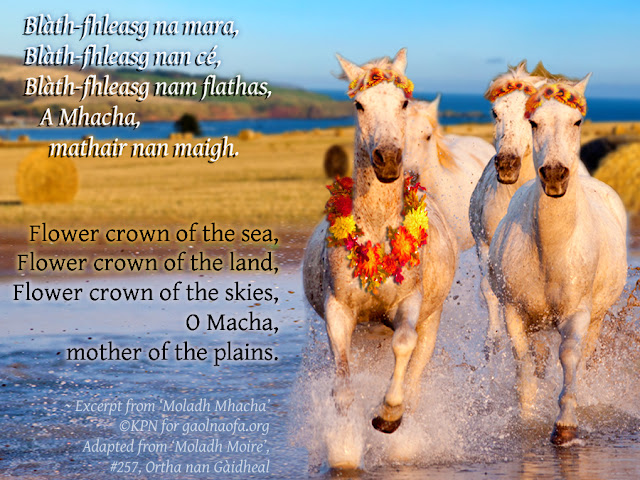
Given the associations of St Michael and horses and the sea, along with the harvest theme, there are a number of deities that could be connected with the festival, and Kathryn wrote a bit about that on her blog. She also did the meme we posted on the GN Facebook page on Monday:

Photo collage from original images by efilpera (horses) and Duarte JH (field)
Along with the adaptation of the prayer, which you can find in full on the Gaol Naofa website's new meme page.

As far as things to do go, the big one is making a Strùthan Mhìcheil, or Michaelmas struan, which is a specially made bannock that's coated with a kind of caudle. I've posted a recipe for it on Tairis, which is taken from Margaret Shaw's Folksongs and Folklore of Uist. The Ceolas website has a more scone-like version, which I'm going to try tomorrow, hopefully (I prefer to use golden syrup as opposed to treacle, personally, though). An offering can be made of some of the strùthan, perhaps as you "beat the bounds" of your property, if you're able.

In the run up to the festival you could also try going out to look for some wild carrots (also known as Queen Anne's Lace), which are traditionally gathered at this time of year, although they may not grow in your area (and they're considered a problem in some parts of the US so it's probably not a good idea to grow them yourself). If you do go looking for them, it's important to be cautious because they're easily confused with poison hemlock (conium maculatum) and a couple of other plants. If you'd rather play it safe then the more usual orange variety of domesticated carrots (or more specialist variants, like purple or white ones) could be harvested (or obtained by other means) instead.

Of course, a good party is always a great way to celebrate any festival, and as Carmichael notes (two links up) there's a traditional dance that's done to the tune of Cailleach an Dùdain ('The Old Woman of the Mill-Dust'). Here's an example of the tune with a peurt-a-beul accompanying it:


The Carmichael Watson Project Blog has some interesting commentary on it, and also notes that the last sheaf of the harvest is often woven into a doll called the Cailleach. As winter approaches, she's certainly making her presence felt as she prepares to resume her wintry reign, and let's not forget that she also has associations with the equinox in Ireland, at Sliabh na Caillighe (Loughcrew), where Cairn T is oriented to the equinox sunrise.

That's about all I can think of at the minute, but check back on the Gaol Naofa Facebook page for another related meme on Monday...

Tuesday, 25 August 2015

New video from Gaol Naofa

It's been a good six since months since our last video so we decided it was high time for another one...

This time we decided to focus on offerings, and while it's something we've written about a lot, and at length, it's also something we get questions about frequently. Like our other videos, this latest one is intended to be a brief introduction to the subject, and here we cover a little bit of background about the history and archaeological evidence for offerings, what kind of things can be offered, and how they can be offered:


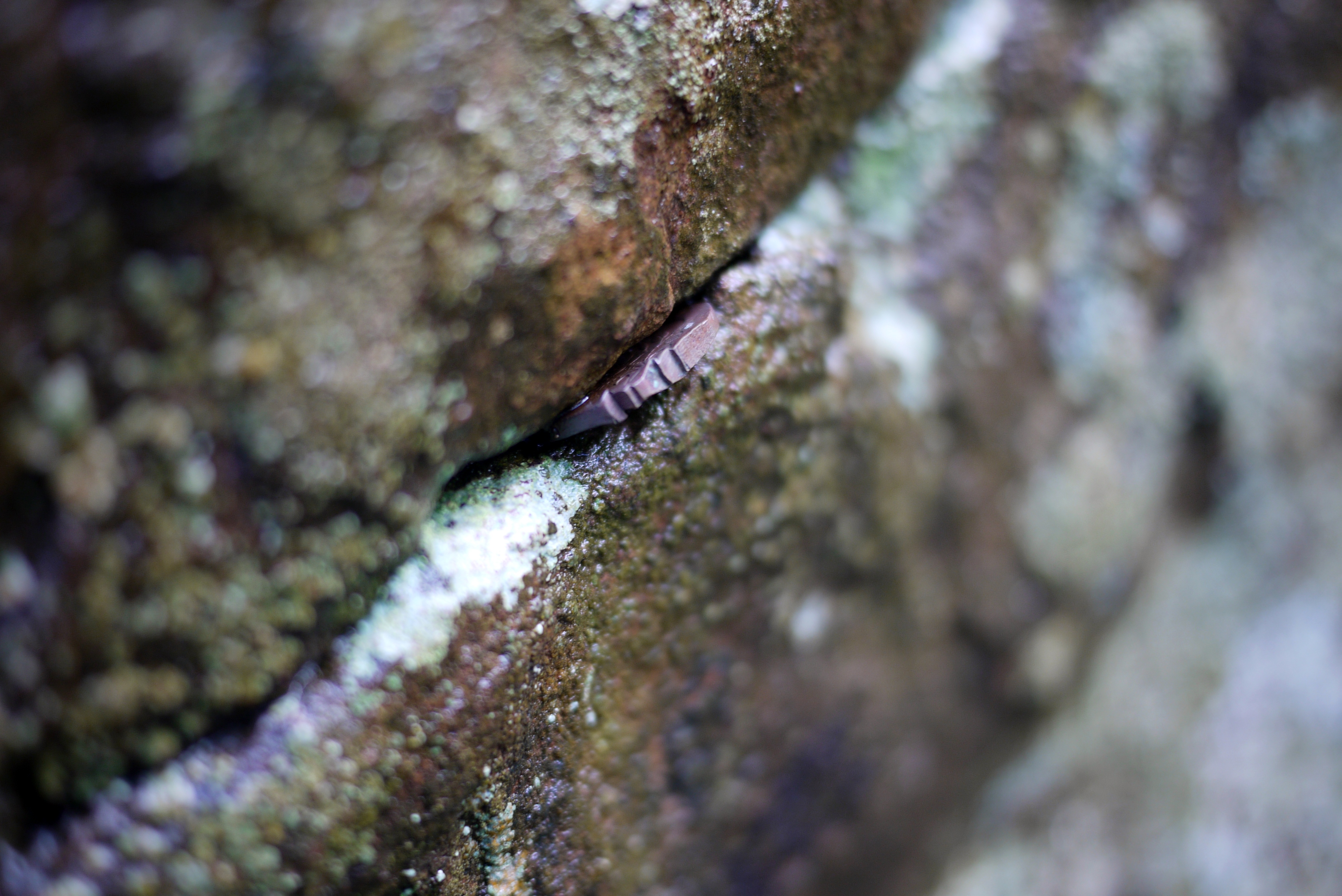
One thing we didn't really have time to focus on in as much detail as we wanted to was the kind of consideration that needs to be taken when it comes to the potential impact that our offerings might have on the environment, and on local wildlife. An offering that poisons or damages the wildlife is hardly a good offering, right? So as we note in the announcement over on the Gaol Naofa website, it's best to make sure that certain types of food offerings are made well out of reach of wildlife who might take the opportunity for an easy snack and end up getting poisoned. Offerings that can damage the environment – non-biodegradable things attached to trees, which can strangle or stunt the tree's growth, or pennies worked into tree trunks or cracks in stone – should be avoided completely. It may be traditional, but offerings like this:


Only damage the stone. This is a penny worked into a crack in a stone from a Neolithic stone circle on the Isle of Bute (which I took Marsaili to in April when she came over for a visit); the stone itself has now almost cracked into two and things like this will only serve to weaken something that's stood for around five thousand years... Things like this don't honour a place, or the spirits of that place. 

If you want to do some more reading on offerings in Gaelic Polytheism, then I think Gaol Naofa's article on the subject is a good place to start: Offerings in Gaelic Polytheism. This is one of Gaol Naofa's oldest publications, which has been substantially revised and updated over the years. You might also find our Children and Family in Gaelic Polytheism article useful, since it covers the basics of practice broken down into simple terms, and it gives an idea of some prayers you might want to use (one of which we included in the video). For more of an idea on the historical practices involving the making of offerings, there's an article over on Tairis that covers the subject in more detail, and you can also find a breakdown of the kinds of offerings that can be made as well. Finally, over on the Paganachd site, there's KILLYOUANDEATYOU, which is a must read for tips and ideas on how to go about your practice while keeping the spirits of the place happy – especially for Gaelic Polytheists who live outside of Ireland, Scotland, and the Isle of Man.


Image by John McSporran, used under Creative Commons licence.

Saturday, 11 July 2015

Links and things for Lùnastal

I was a little remiss in getting around to doing a links post for Midsummer, but the ones I've done for other festivals so far this year seem to have been quite popular, so I might as well pick it back up again.

First off, last year I did a video for the Gaol Naofa Youtube channel, which takes a look at what Lùnastal's all about and how it can be celebrated:


The first song on the video is a reaping song – that would have been sung as the harvest was being brought in (the rhythm helping people to get into a groove while they cut the crops, as much helping to pass the time) – that's sung by the Scottish folklorist Margaret Bennett, and the music was composed by her son Martyn Bennett. It's a very modern take on an old traditional song, and a sample of a 1920s threshing machine has been used to give the beat that complements the lyrics. The second song is the same again, this time sung with a more traditional arrangement.

Following on from that, since a major theme of Lùnastal is peace, Kathryn's video on the Prophecy of the Morrígan (or Badb's Prayer for Peace) is also worth a watch:


Which could be incorporated into celebrations if you so wish...

For a more in-depth background on Lùnastal/Lúnasa, and some practical ideas, there are some articles I've done over on Tairis that might be worth a read:
If you'd prefer something a little (a lot) shorter, the Festivals page on the Gaol Naofa site might be more to your taste. One of the things on our to do list is to expand the music section, as can be seen by the number of songs that don't yet have a link; quite a few of these are apt for the harvest, though, so they're worth hunting up (you can find them all on Youtube, I think). The craft section also has some useful stuff if you're looking for things to do, and the links include a video showing you how to make a harvest knot (I've yet to try one myself...).

Games and competitive sports are a big part of the celebrations, and there's a big crossover with the kind of games and amusements that were played during wakes – very apt given the roots of Lùnastal as a funeral games, perhaps – so the Death and Burial article back over at Tairis might be useful too.

If you're looking for something nommy then try some cranachan or fraughan cakes... Going fruit picking up on the hills (or shore) is traditional, especially for bilberries (aka fraughans), but you can just use blueberries if you can't find bilberries in the wild... Gooseberries are another fruit that might be collected for the festival, and they can be used to make a delicious gooseberry fool, which is a kind of syllabub dessert (as is cranachan). For those in warmer climes, brambles (or blackberries) might be available by the beginning of August, which can make a good substitute in the absence of bilberries or gooseberries; they're only very rarely ripe so early over here (in my neck of the woods, anyway) in the wild, but supermarkets often start selling them by this point.

Going by the archaeological evidence, it appears that pork is especially appropriate for feasting on, so a good bit of roast pork, or a stew, with some seasonal vegetables – fresh from the garden, if you grow your own, or else locally sourced if you can afford it – could form the main part of your celebratory feast. For savoury treats, cheese-making is traditional, especially a simple soft cheese like crowdie, which is easy to make (in theory! I've yet to master the art myself because I keep managing to overheat the curds). The smell takes a bit of getting used to while you're heating the milk, and that can be a litle off-putting, but the end result really is quite tasty; try rolling the cheese in toasted oatmeal or crushed black pepper to add more flavour. The leftover whey can be used to make some oatmeal bannocks – also traditional to make for the festival (from a Scots persecptive, at least) – to serve with the cheese, or else there are a number of other traditional recipes you might want to hunt up so it doesn't go to waste (F. Marian McNeill's The Scots Kitchen and The Scots Cellar will be useful).

Story-telling is also an appropriate part of the celebrations, along with music and song, which can help set a very convivial atmosphere if you're celebrating as part of a group or with family. You could tell the story of Tailltiu's sacrifice, for example, or take a look at some of the other Dindshenchas tales like the ones for Nás and Carmun. Maire MacNeill records a huge amount of tales in her massive book, The Festival of Lughnasa, and some of them involve Lugh or Crom Cruach, so it's absolutely well-worth getting a hold of if you can. Failing that, why not compose your own stories or poetry?

Monday, 16 March 2015

That time of year again...

Dare I say it? There doesn't seem to have been too much silliness in the run up to St Patrick's Day as there has been in previous years... Not so much as a whisper of genocidal maniacs, no yelling about snakes or druids... Is it too good to be true? Am I being a little premature?

Either way, I figured it might be a good time to do a round up of some links and videos that might be of interest. I'll start with a little humour:


Although alas, I've no idea who to credit for it... If you take a look at the Paddy Not Patty Twitter feed, you'll see it's all very SRS BZNSS. People are very attached to ole "Patty." Incidentally, the guy behind paddynotpatty.com has been interviewed here, it's good stuff!

This time of year marks the first anniversary of Gaol Naofa's Youtube channel, and the first couple of videos we did back then focused on various aspects of St Patrick's Day. Our first video looks at the harmful stereotypes vs. the realities that often come hand in hand with the day:


While the second video takes a look at the history and misconceptions surrounding the man and the saint, from the snakes as druids (except not!) to the idea of some pagans celebrating it as a "Day of Mourning" as a result of these misconceptions:


Fellow Gaol Naofa colleague, Sionnach Gorm, wrote a great article to accompany the videos as well, asking the question:
How do we, as devout polytheists, reconcile the historic reality that our ancestors (at some point in the 5th-6th century CE and with no evidence of coercion) chose to turn to a god of bells and tonsures, of monks and scriptures, of Rome and the Papacy? Why would they “abandon” the gods of their ancestors, and choose this newfangled Christ and his missionaries?
You can read the article on the GN website here.

Last year I kind of nearly reached critical mass on the whole business, but I might as well link to the post I wrote then, because it ties in neatly with Gorm's article and the videos. Seeing as the videos and the posts touch on Sheelah's Day, which falls on March 18th and traditionally marks the beginning of spring and the end of the wintry storms at this time of year (just as Là na Caillich does in Scotland, on March 25th), I might as well link to a post giving an overview of it that I did a couple of years back. 

Kathryn and I are currently working on overhauling the festivals section of the Gaol Naofa site, expanding on what's already there for the Quarter Days and adding articles for the "lesser" festivals in Gaelic Polytheism as well, including one for Sheelah's Day. In the meantime, we already have a video on Sheelah's Day and Là na Caillich that might be of interest:


Elsewhere on the web, there's a great post on the Vox Hiberionacum site announcing a new audio guide on St Patrick called Six Year's a Slave, with a bit of a historical overview about the man himself there. The audio guide looks really interesting! 


Saturday, 21 February 2015

New video: New moon

This month's new moon is apparently a "Black Supermoon." The supermoon part means it's going to appear bigger than usual (more noticeable as it rises), the "black" part means that it's either the second new moon in a calendar month (like a blue moon), or to the third new moon of a total of four within a single season period. In this case, it's the latter.

So that's pretty cool. The new moon was on Wednesday or Thursday this week (depending on where you are in the world), but as yet it's been too cloudy to spot it in these here parts. In Gaol Naofa, we observe the new moon, or Gealach Ùr, with a simple ritual to welcome the first sighting of it and honour An Trì Naomh. Since our membership is spread pretty far and wide, it's a way for us to do something together and share in the experience, wherever we might be (if members so wish; participation's completely optional). We generally co-ordinate the observance of this rite for the third day after the new moon, to maximise our chances of being able to catch sight of it.

After our series of videos on the festivals, we decided to focus on other areas of practice, and the first video for this is on the new moon:


Like our other videos, we take a look at the history and lore we find in Gaelic tradition, and then take a brief look at how that informs Gaelic Polytheist practice, and we give an example of a prayer at the end -- this one from the Carmina Gadelica, and translated by Kathryn. There are some more useful links posted in our post on the Gaol Naofa front page, which are worth a read, and we have another announcement there too! 

Moving forward, we're working on some updates and new material for the Gaol Naofa website, which we're aiming to get ready to go in the next month or so. We'll keep you posted!

Saturday, 31 January 2015

Follow up on the statue theft: Where is Manannán?

It's been just over a week since the statue of Manannán was stolen and a cross was left in its place, as I wrote about in my last post. Although the perpetrators haven't yet been found, or the statue recovered, there are a lot of people who are still hoping that some good can come of this. Whether that means the statue is recovered, or a replacement is made, either option seems like as "good" an outcome as possible under the circumstances. As the sculptor himself notes, the statue is more than likely to be in pieces already, but he's issued an appeal to the thieves:
When asked what he would say to the person, or persons, who made off with his statue, Darren made a simple appeal: “Just bring it back. Bring it home and see if we can get it repaired,” he appealed. 
Darren says although he has got over the initial sick feeling he had when he first saw the damage to the sculpture, which took more than six months work to create, he is still crushed about what happened but says the worldwide outpouring of support has provided some comfort and makes him feel proud people held his work in such esteem.

So there's still hope that the statue may be returned. If it isn't, I do hope it will be replaced, and I think it would be incredibly short-sighted of the council not to considering the amount of attention this has all been giving them, and if there are fundraising efforts established locally then Gaol Naofa has pledged to support that. The huge amount of attention the story has been getting is almost as big a story as the theft itself; a Facebook page that was set up shortly after the news broke now has over 6,000 likes within the last week, and people from all over the world have been sharing their own pictures of the statue, articles from the news, as well as sending in messages of support. The person running the page is urging people to keep sharing and spreading the news, in the hopes that the attention will help with the statue's recovery, and many members of the page have been very generous in giving permission for their images to be used in making memes that can be shared. I posted one that Kathryn made in my last post, and with the help of Caoimhín Ó Cadhla translating for us (to whom we're most appreciative) we've now produced an Irish language version to share:


You can find others we've done hosted on the Gaol Naofa website at a new page we've created in our Resources section, and you can also find them on the Gaol Naofa Facebook page -- feel free to share!

In addition to that, The Wild Hunt got in touch with Gaol Naofa for some comments about the statue's theft, which I took point on as sacrificial lamb head of the organisation, and the resulting article gives a really good overview of reactions from the locals of Limavady as well as polytheists (like myself...) and pagans. As I said there, we've been following the story closely on our Facebook page, and have been sharing some resources about Manannán ma Lir (like the video we did for Midsummer last year), including prayers and traditional songs, since this is something people can do wherever they might be in the world.

We decided that maybe a video was in order to help keep the story circulating, so Kathryn took point on writing up a script and creating a prayer to share, and with the kind permission of some of the photographers who shared their photos of the statue with the Bring Back Manannán page, we've put something together and we're ready to share:


So if you want to share the video and join us in singing Manannán back home, then please do so! We have a little introduction to it on the front page of the Gaol Naofa site, and the prayer from this video is available on a meme we've created, which you're also welcome to share:


This is another one of the images we have up on the new page I mentioned above (along with a different-sized version of this one). If you click through to the front page of the Gaol Naofa site then you can find them in the Resources section of the Library. There are plenty more on the Bring Back Manannán FB page, too.

Friday, 19 December 2014

Yet more videos...


With the year drawing to a close it seemed apt to finish off our series on the festivals, and so in good time for the solstice and Hogmanay, Gaol Naofa has released two new videos (conveniently dealing with the solstice and Hogmanay respectively), which complete the festival year in the Gaelic calendar.

Considering the fact that a number of the festivals we've covered aren't Gaelic or pre-Christian in origin, it's no surprise to find that not every Gaelic Polytheist celebrates every single one. Each of them is significant in some way, when considered as being part of the bigger picture, as part of the continuum, but that doesn't necessarily mean all of them mean something to us on a personal, individual level. In the case of this particular festive period, I tend to pay more mind to Hogmanay than the solstice itself, because of the fact that it's a huge deal here in Scotland. Though with the kids finishing school today, and Mr Seren being on holiday as well, we'll inevitably end up having a whole festive thing, of sorts, until they get back to school come January...

Kathryn has a great post over on her blog that goes into some details about the traditions surrounding Hogmanay, and the Hogmanay video itself gives some details as well as a bit of context and history:


The music is by Clanadonia, who are good friends of my husband, so please support them! (This particular song is used in the first episode of Outlander, and at least one of the band members is in it as an extra. Just so you know...).

Anyway. Our video on the solstice has an overview of the origins and influences of the celebrations, and some things that you can do if you want to:


As Kathryn noted, I've used some of the photos I took during my visit to Ireland earlier this year (although I can assure you, the really good ones like the preview pic above aren't mine!).

Here, at home, we might indulge somewhat in a squidgy chocolate Yule log over the next few days (a family tradition I grew up with), and then there will be the usual cleaning and tidying - redding the house for the new year - and the lighting of many candles, which will fall to Rosie as her duty. The old year will be swept out, and the new year welcomed in, and then house will be sained, along with all of us in it. There will probably be the usual steak pie on New Years' Day at the in-laws (as is traditional in these parts), so we'll do some baking so we can take something with us as a gift. Tom loves baking, so he can take point on that. And we have a new puppy! So there will be a good opportunity to brave a trip to the beach and some other spots around the village so we can make some offerings and collect some water from the dead and living ford (there's one not far from here). All in all, there's plenty of things for us to be doing.

As always, I hope you enjoy the videos as much as I've enjoyed making them. While these two videos finish off our series on the festivals - thirteen videos in total - we intend to carry on with more, tackling some other topics in due course. We've had some requests for videos that people would like to see, and any more ideas are very welcome.

Tuesday, 30 September 2014

New video: Samhain

As soon as the leaves start to change colour, everybody starts getting excited about Samhain...

So continuing on with the series of videos we've been doing on the festival year, we've just finished the latest one in plenty of time for Samhain. This is the longest one to date, but that's because there's just so much to talk about and it's difficult to do it all justice in five minutes or less. Kathryn took the lead on this one and did an amazing job - I think this is my favourite video so far:


We asked people over on the Gaelic Polytheism group to help us out and contribute some photos and we got an amazing response from folks. We couldn't fit everybody's contributions in, but we appreciate every single photo that we received and we hope we can find a home for them in future videos. Thanks to each and every one of you for your support!

Hand in hand with this video I think it's a good time to repost one of the videos we released last time, around Lùnastal:


The Prophecy of the Morrígan from Cath Maige Tuired is as relevant to Samhain as it is to Lùnastal, so it's well worth a watch (again)! Also in our festival playlist, we have a video on turnip carving if you're looking for some pointers; you can find it by clicking on the wee arrow next to the "playlist" link in the top left of the video, then scroll down towards the bottom, or else I've done a walk-through guide over on Tairis. Some links you might find useful:


Those of you in the southern hemisphere might find this video worth watching instead, however, as you head towards Bealltainn:


The Samhain video completes the four Quarter Days in the Gaelic calendar, and we have two more videos to come on Midwinter and Hogmanay traditions to complete the festival year as a whole. After that, we intend to come full circle, as it were, and do a video on the festival year in general (which is probably where we should have started, but oh well!). And then... Who knows? If there are any subjects you'd like us to tackle, that relate to Gaelic Polytheism in some way, feel free to weigh in on the comments!

Sunday, 27 July 2014

New videos...

Since we released a bunch of videos earlier this month, which took us up to Midsummer in the festival year, Kathryn and I have been working hard on the next batch so we can get them out in time for Lùnastal.

Picking up where we left off, then, now have a new video for Lùnastal (Lúnasa):


And then tying in with that we have a video on the Prophecy of the Morrígan - Badb's Prayer for Peace:


Following on from that, we get to Là Fhèill Mìcheil, which roughly coincides with the autumnal equinox:


As with the other videos, Lúnasa and Là Fhèill Mìcheil are intended to be a short introduction to the festivals, giving an overview of the historical roots, lore, and practices associated with them. Là Fhèill Mìcheil is primarily celebrated in Scotland, but we also touch on the broader points of the significance of the solstices and equinoxes in Gaelic belief, as well as the customs that are observed in some parts of Ireland at this time. For more information on the festival, you can always take a look at the article I've done on Tairis (link to the archive, because the site is still down - hopefully not for much longer...).

The music we've chosen for the Lúnasa are two different versions of a traditional reaping song, called Buain a' Choirce (lyrics and translation are at the link). The first version, by Martyn Bennett, is a fusion of a more modern musical arrangement, with the song itself sung in the traditional style by his mother, the Scottish folklorist Margaret Bennett, and the rhythm track uses a sample of an old 1920s threshing machine. The second version, by Síleas, is a more traditional rendition over all.

The second video, on Badb's prayer for peace, is intended to tie in with Lúnasa, as well as Samhain, as we explain in the announcement we released over on Gaol Naofa. Lúnasa is the one time of the year where peace is an essential condition of the celebrations and gatherings that are held in honour of Taillte, as Lugh instituted the festival in her memory. We've chosen this particular prayer, as sung by the Morrígan from Cath Maige Tuired, because the tale has many elements that fit in with what Lúnasa is all about, as well as Samhain. Historically, a failure to uphold the peace at Lúnasa would have risked being thrown out of your túath, which was a serious consequence in a time when your legal rights were heavily tied in with your status and standing amongst your people. Without a túath you effectively had no legal rights, making you fair game, basically. Given the seriousness of all this, it's something that we, as Gaelic Polytheists, should think about too.

More videos are still to come, at some point. All that remains to say is another big thank you to everyone who's helped us produce the videos, from those of you who've helped us find music we can use, given us feedback and general support, and those of you who've very generously given us permission to use your photos. In particular, I'd like to thank Ali Isaac for allowing us to use her photo of Taillte's assembly site in our Lúnasa video. Mòran taing!

Tuesday, 8 July 2014

New videos!

Back in March, my colleagues and I at Gaol Naofa worked on producing some videos for our new Youtube channel. Those first two that we did focused on St Patrick's Day, and our intention from the start was to continue on with videos for other festivals in the Gaelic year - ones that are ancient in origin like the quarters days, as well as the more modern ones like Hogmanay and Là na Caillich.

Yesterday, on Tynwald Day - the Isle of Man's national holiday (which is usually on July 5th, but it moves to the following Monday when it falls at the weekend), and we released a bunch of new videos to go with the two St Patrick's videos we've already done. These are (and forgive me for regurgitating the list I already gave on the Gaol Naofa website...):

Lá Fhéile Bríde:


Detailing the lore and traditions associated with the festival that marks the first flourish of Spring.

Là na Caillich:


The Day of the Cailleach in Scotland, which falls on March 25th and marks the beginning of the Cailleach’s rest period, until she reawakens in winter.

Bealtaine:


Focusing on the traditions and customs of the festival of Summer.

Midsummer: Áine and Grian:


Introducing the Midsummer traditions in Ireland, and the issue of solar deities in Gaelic tradition.

Midsummer: Manannán mac Lir:


Taking a look at the Midsummer tradition of “paying the rent to Manannán mac Lir, which originates on the Isle of Man.
What we want to do with these videos is give a short introduction to each of the festivals, and hopefully articulate a sense of some of things that we can't always do with words alone. We're working on some other videos for another bunch of the festivals, which will hopefully be ready for release soon, and then we'll work on finishing the rest of the festival year as and when we can. And I'm sure we'll find plenty of things to talk about after that! 

Before I finish, I'd like to take the opportunity to thank everyone who helped me and Kathryn while we were putting these videos together - helping us source pictures or giving us permission to use their own, helping us find music we could use, offering feedback, and generally being wonderful and supportive. Mòran taing!

Wednesday, 30 April 2014

Là Bealltainn shona dhuibh uile!

In lieu of an actual post of actual substance, here's a traditional Irish song about the day, Thugamar Féin an Samhradh Linn.


I hope you have a good Bealltainn!

Friday, 21 March 2014

An Cailleach Bheara

 An Cailleach Bheara

I've posted a link to this short film before, but it's well worth another watch! 'Tis the season, and all...

Soon the Cailleach Bheur will make her lament as she gives up and admits defeat in trying to hold back the onslaught of Spring. As she throws down her wand, she shouts out:

‘Dh’ fhag e mhan mi, dh’ fhag e ‘n ard mi
Dh’ fhag e eadar mo dha lamh mi,
Dh’ fhag e bial mi, dh’ fhag e cul mi,
Dh’ fha e eadar mo dha shul mi.
    It escaped me below, it escaped me above.
    It escaped me between my two hands,
    It escaped me before, it escaped me behind,
    It escaped me between my two eyes.

Dh’ fhag e shios mi, dh’ fhag e shuas mi,
Dh’ fhag e eadar mo dha chluas mi,
Dh’ fhag e thall mi, dh’ fhag e bhos mi,
Dh’ fhag e eadar mo dha chos mi.
 
    It escaped me down, it escaped me up,
    It escaped me between my two ears,
    It escaped me thither, it escaped me hither,
    It escaped me between my two feet.

Thilg mi ‘n slacan druidh donai,
Am bun preis crin cruaidh conuis.
Far nach fas fionn no foinnidh,
Ach fracan froinnidh feurach.’
 
    I threw my druidic evil wand.
    Into the base of a withered hard whin bush,
    Where shall not grow 'fionn' nor 'fionnidh,'
    But fragments of grassy 'froinnidh.'

While the Irish An Cailleach Bheara doesn't have such firm associations with the seasons as the Scottish An Cailleach Bheur does, there are some hints. Cairn T, at Loughcrew (or Sliabh na Caillí) is thought to have an equinoctial alignment:

 Used under Creative Commons licence, by Sean Rowe

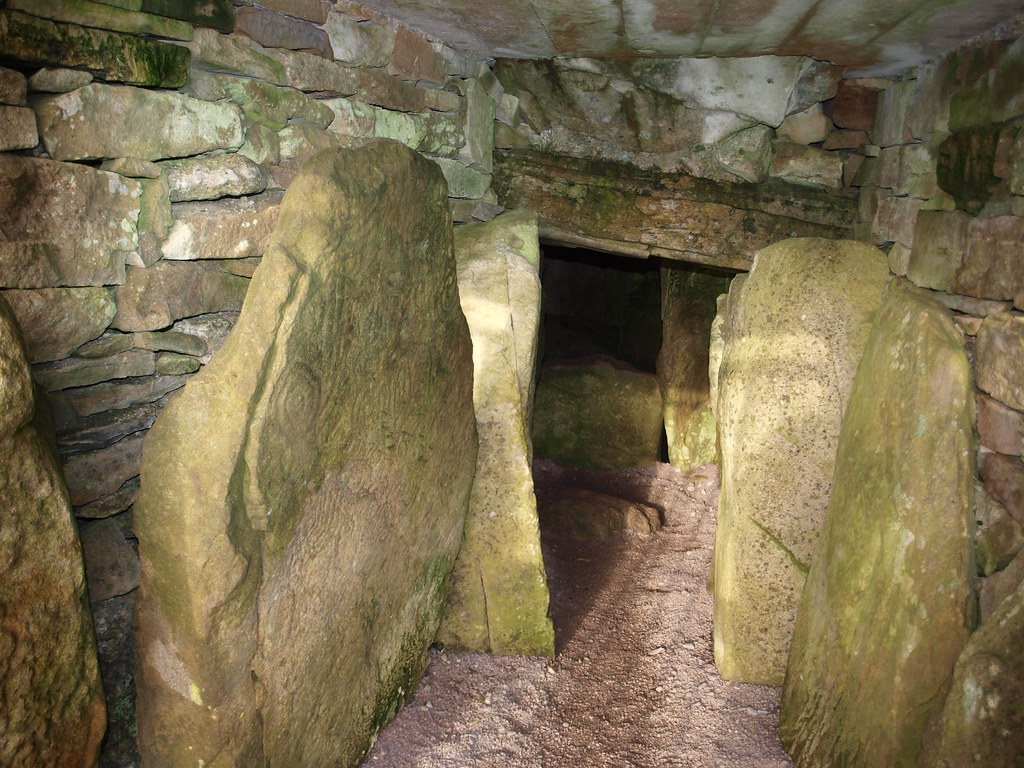
The light of the equinox sunrise illuminates the back chamber of the Cairn T at the Loughcrew complex, lighting up carvings that are thought to have astronomical meanings. Near to Cairn T is the Hag's Chair, and she is said to have created the tomb by accidentally dropping a pile of stones from her apron. But of course, in spite of her associations with the place today, we can't really say when the Cailleach came to be associated with the place – certainly not until after Christianity, when the word 'cailleach' came into the Irish language – or if her associations are meant to tie in with the equinoctial alignment. The coincidence with the Scottish Là na Cailliche is tantalising, however.

It does seem like she has other, older names as well, which offer further (possible) seasonal associations. In The Lament of the Old Woman of Beare, she calls herself Buí, who is referred to as a wife of Lugh in other sources, and is said to have been buried at Knowth (Cnogba). In the Dindshenchas of Nás (another of Lugh's wives) she is mentioned again, along with Tailtiu, so one wonders if she has an association with Lúnasa, which were often held at places that are thought to have been the burial place of supernatural women or goddesses who were married to Lugh, or otherwise associated with him? The Dindshenchas of Nás seems to hint that this was the case, since it mentions games and gatherings.

Another Dindshenchas, Lia Nothain, refers to two sisters, Nothain and Sentuinne, both of whom are "Old Women" and Sentuinne itself means "Old Woman" just as "Cailleach" can. The Dindshenchas associates them with May-day, suggesting further seasonal associations:
Nothain (was) an old woman [cailleach] of Connaught, and from the time she was born her face never fell on a field, and her thrice fifty years were complete. Her sister once went to have speech with her. Sentuinne (” Old Woman”) was her name: her husband was Sess Srafais, and Senbachlach (“Old-Churl”) was another name for him. Hence said the poet: 
      Sentuinne and Senbachlach,
     A seis srofais be their withered hair!
     If they adore not God’s Son
     They get not their chief benefit. 
From Berre, then, they went to her to bring her on a plain on May-day. When she beheld the great plain, she was unable to go back from it, and she planted a stone (lia) there in the ground, and struck her head against it and….and was dead. ” It will be my requiem….I plant it for sake of my name.” Whence Lia Nothan (“Nothan’s Stone”). 
     Nothain, daughter of Conmar the fair,
     A hard old woman of Connaught,
     In the month of May, glory of battle,
     She found the high stone. 

The association with Berre (Beare), just as Buí is associated with that place, suggests that they are probably one and the same. So there are some hints and bits of seasonal lore that may be associated with An Cailleach Bheara. It's guesswork, for sure, but I thought it's worth putting out there to ponder.

Wednesday, 12 March 2014

Youtube! Videos! Article!

As you might have seen with the announcement over at the Gaol Naofa site, we now have a new Youtube channel with a couple of videos already uploaded to start us off. The first is titled St. Patrick's Day (or, "What's Wrong with Saint Patrick's Day?"):


And it takes a look at the awful stereotypes that are often associated with the day (and people's perceptions of Irishness). The second video, Pagans, Polytheists, and St. Patrick's Day, deals with the misconceptions that are often trotted out at this time year – Snakes! Druids! Persecution! Oh my:

)

We also take a look at what the day means to us as Gaelic Polytheists, and how we might observe it.

These videos are the start of a series on the festival year in the Gaelic calendar, from a Gaelic Polytheist perspective, and we'll be putting up more for the other festivals in due course. Our long term plans include videos on other subjects, too (and if there's anything you'd like to see, feel free to leave a comment), and we also have some playlists on the channel that cover subjects like music, folklore, festivals, language, and history, which we think will be of interest.

Sionnach Gorm from Three Shouts on a Hilltop has weighed in on the St Patrick's Day issue as well, with a fantastic piece that goes nicely with the videos we've done:
Mythically, at least, Pádraig and later saints subsumed the role of the warrior-elite heroes in the popular imagination. By replacing chieftains and druids with Christian saints possessed of miraculous powers, early Christian mythology carried on the patterns of the polytheistic originals they replaced. The mystical, and not the physical, would be the lynchpin in the conquest of the mythic landscape; a trope which is common enough that it appears in the Mythological Cycle, among others. While not unique to Irish hagiography, this is something that occurs repeatedly in the Irish lore. The supremacy of a figure like Patrick over that of the Druids (the most common representative of the Pagan past) is not based on his moral character, but on his supernatural abilities. This is a pattern which is discernible in other hagiographies, particularly that of St. Brigid of Kildare and St. Columba.
That's up on the Gaol Naofa website, and many thanks go to Gorm for writing it, and to everyone who helped with the brainstorming, tweaking and proofing for the videos. In particular, thanks as always go to Kathryn and Treasa for their hard work.

Finally, because it's that time of year and it's a tradition now...

It's Paddy, not Patty.