Thursday, 1 March 2012

Book review: The Apple Branch/Celtic Rituals

One from the vaults now, a book I read pretty much at the beginning of my involvement in Celtic Reconstructionism, and which at the time came highly recommended.

There has been quite a bit of time passed since the initial fanfare that heralded the book's re-release (when I got hold of a copy) and I think maybe it's time to revisit it. The copy I'm reviewing is the later edition that was released under the title of The Apple Branch, which - as I understand it - differs only slightly from the older edition, which was called Celtic Rituals. As far as I'm aware, the only differences are that the newer edition has an index and a few extra passages in the first chapter added in.(Or not...)

Addendum: As per Faoladh - The original title is The Apple Branch, published by Collins Press and later released in a new edition by a US publisher with the addition of the index and the text restored. Celtic Rituals is a 'grey market' edition.


The Apple Branch: A Path to Celtic Ritual (alternative title: Celtic Rituals: An Authentic Guide to Ancient Celtic Spirituality)
Alexei Kondratiev

Aside from the CR FAQ this is the only other book that ever really comes up in conversation when people want to read something that's good for a Celtic Reconstructionist. It's understandable, given how much Alexei contributed to the CR community over the years, but it's also one I find problematic in many respects.

This is not a Celtic Reconstructionist book. For this reason alone I find it difficult to recommend it for anyone wanting a book on Celtic Reconstructionism, because it is not a book that fits the bill, plain and simple. This doesn't mean that it's a bad book, or a terrible book, just that it isn't one that can be considered to be particularly illuminating as far as CR is concerned. In that sense, it's a difficult book to review because on its own terms it surely has a lot of positives. It is thorough, and unlike many other books aimed at a neopagan audience, it doesn't shy away from getting into details. The research is good, and well-presented, and at the time it was first published it certainly offered something very different to anything else that was available at the time.

Even so, none of this means that it is a good book for a CR audience, although it does arguably make it an important one as far as its place in CR's history goes. After all this time, I think The Apple Branch has held such a special place in Celtic Reconstructionist circles for so long due to the fact that it is far more sympathetic to CR's emphasis on decent history (as opposed to ye anciente Irish potato goddesses and Celtic alternatives to patriarchal penises...), and when it first came out it was as close to a reconstructionist book as anyone was going to find. For me, though, that just isn't a reason to hold on to it.

So why isn't this book CR? Put simply, Alexei himself repeatedly pointed out that this book isn't CR, and was never intended to be. One of the biggest points that makes it "not CR" is that the rituals outlined are really no different to the myriad other Wiccanesque kinds of ritual on offer by other authors offering "Celtic traditions." This puts it in the dubious company of the McCoys and Bucklands of the world, and also perhaps proved influential in the work of Aedh Rua's Celtic Flame which is similarly Wiccanesque in ritual approach, and really this is not surprising since Alexei himself was Wiccan. There is talk of 'the God' and 'the Goddess', there is circle casting and invocations at each quarter, and so on, although there is definitely a slightly different spin put on all of it. Given Alexei's emphasis on language, invocations at each quarter are given in Celtic languages - Scots Gaelic in the north, Welsh in the east, Breton in the South and Irish in the west. It's not something I can really get on board with, personally; deep down, I can't help but feel that it's using languages for the sake of it, without regard for their own context, and it all seems rather pointless if you don't even speak those languages and understand what any of it means, or even honour the gods of those cultures anyway.

The over all approach is pan-Celtic, and while this might have been popular in academia in the 60s, we've come a long way since then. Celtic cultures do have their similarities, even their common origins, but that doesn't mean we can mix them all together and get something that is reflective of anything that would have ever been practiced. For me, it makes a hodge podge, and it's one of my biggest problems with neopagan books that fall under the 'Celtic' umbrella in general. It certainly makes something meaningful for a lot of folks - otherwise these books wouldn't be so popular - but to my mind, I don't see the point of looking to historical sources and then...ignoring history.

Ultimately, it seems that the pan-Celticism undermines a very important point that the book emphasises, and that's the importance of using Celtic languages to justify the use of the label Celtic in the first place. I wouldn't go so far to say that language is the only thing makes something Celtic (as Alexei basically seems to), but he does have a point that language is incredibly important. But in advocating for linguistic authenticity, framing it within a pan-Celtic approach just seems contradictory, and ignores the rich variety of Celtic cultures, and their differences.

With that said, one thing that Alexei does manage to do is give a decent historical overview of the Celts. The pan-Celtic approach gives a slightly misleading view, to my tastes, but it can't be denied that the research here is very good. It's perhaps a little coloured by politics that some might find distracting or distasteful, but you could do far worse. I do think it's a little dry, though, and very dense in places. Most people, when they're reading a book on a particular religion, are looking for what that religion is about, not so much a history lesson. If I wanted that, I'd read a history book. Here, I would anticipate that a fair few readers end up wondering what exactly the oppression of the eighteenth and nineteenth century really has to do with paganism...Of course, it is relevant in a round about way, and as history, people should know this. I just don't think starting off with this kind of stuff works in the book's favour.

I'm not sure it's Alexei's fault that the blurb states that it presents "the" Celtic traditions, but however it came about, it's more than a bit misleading. What the book describes is a way of doing things, to be sure, but it's a synthesis of many different things that are presented in a modern, Wiccanesque framework, not a traditional one. Ultimately, as much as the book is a part of CR history, it has no practical relevance, and I would only really recommend it if you're looking for a wee slice of history.

Independence

Delving into politics is rarely a way win friends and influence people (or whatever the saying is), but hey, neither's talking about religion usually...But normally politics is something I stay away from here on the blog. However, after a few conversations I've had with some folks abroad recently, I thought maybe it would be of interest to some readers here if I laid out a general idea of the independence debate that is currently going on in Scotland. Because it's such a loaded topic it can be difficult to get a decent view of things, even from organisations like the good ole BBC when you consider that recently a well-respected journalist likened Scotland's First Minister to Robert Mugabe. To his face...


Oh, Paxo...

After the SNP won a majority in Scottish Parliament last year - against all expectations, given the way the elections work - the referendum on Scottish independence is now finally going to be a reality. In all likelihood the referendum will take place in 2014, although as yet even the date is far from certain. Westminster are lobbying (somewhat half-heartedly) for it to take place next year, no doubt hoping that the sooner it happens the less likely it is that people will vote yes, while Holyrood is resisting those calls. Of course, politics being politics, and folks often tending towards paranoid conspiracies, there are rumblings that the idea is motivated by entirely different reasons than "the sooner the better"; no, 2014 is an important date for Scots, being the 700th anniversary of Bannockburn. In theory, the coincidence with this anniversary and the referendum can only work in the SNP's favour, since they might hope to captilise on a bit of nationalistic fervour as people look back to that fateful and bloody day in Scotland's history - a victory for the Scots against English oppression. 2013, on the other hand, is the 500th anniversary of Flodden, which was an altogether different story. Scotland suffered a devastating defeat there at the hands of the English, and you can bet that there have been murmurings that Westminster is pushing for next year as a fingers up to the SNP...

Most important of all, in all of this, is what the referendum question will actually be. Probably not this:


Although I for one would fully support it...

But there are two main options being mooted. The first option, and one that the Scottish government favours, is a simple yes/no vote, for or against independence. The second option, and the one that Westminster favours (but which the Scottish government is open to agreeing to), is offering three choices - yes, no, and the option to support 'devo max.' This latter choice would result in more powers being devolved to the Scottish Parliament, and is effectively one step short of full independence; Scotland would remain a part of the Union, but it would otherwise basically be able to govern itself.

There are pros and cons to both choices of wording. A simple yes/no vote carries with it more risk of people voting no. In order for the yes vote to succeed, voters need some assurances that independence will not be a disaster for the Scottish economy, for one, and there are a lot of issues that will need to be resolved before independence could possibly go ahead. Political rhetoric is doing a good job of capitalising on the public's uncertainty at the moment, and while there is currently unprecedented support for independence according to the polls, it's a much different matter when people are actually faced with having to make a binding decision. It's a risk, and the public might bottle it, but at the same time the level of support at the moment is unlikely to drop significantly over the next few years. If anything, as long as the Tories are in power in Westminster, it works in the SNPs favour because historically Scotland has never been a Tory stronghold. The Prime Minister, David Cameron, knows this, and his own stance on the matter has changed dramatically in recent months, taking on a very conciliatory and friendly tone. You can bet that once the date is set and things start hotting up, things are going to get ugly. Dirty tricks campaigns will be the norm; in fact, they already kind of are, with ridiculous hyperbole being bandied about.

The devo max option is far more likely to be popular, some commentators think. It carries with it less risk for Scotland's political and financial future, and so as the safer option more people are likely to vote for it. But then again, it's ultimately a half-measure, and (more importantly) in a referendum that offers all three options, devo max will potentially split the polls and give the no vote an advantage, with the yes vote potentially being divided between 'yes' and 'devo max' it might give the 'no' vote the advantage. It can only go in Westminster's favour, and of course they know it.

A successful yes vote for independence won't suddenly mean that Scotland leaves the Union, and, in fact, there is some controversy over that proposed phrasing of the question. Alex Salmond, Scotland's First Minster, wants to ask: "Do you agree that Scotland should be an independent country?" Which doesn't articulate much in the way of what will happen if people actually say yes. It's early days yet, though, and once the question is set, whatever the outcome there will have to be lengthy negotiations. Only if those negotiations are deemed to be satisfactory would independence then happen. There are a lot of details that need to be dealt with and negotiated - what happens to the army, for one (the army is a big employer in Scotland), how the national debt is divided up and who is responsible for what, who gets the oil, the issue of independent Scotland's place in the European Union (and how that would affect the remainder of the UK, of course), as well as currency, and so on. Of course Westminster will be particularly reluctant to give up on the oil in the North Sea, but one of the biggest issues is what to do with the UK's nukes. The only place they can be legally kept in the UK is in Scotland, because it is the only part of the country that has a low enough population density. We here in Scotland aren't too keen on been lumped with the nukes, though, and we'd would love to get rid of them, thanks. Independence means we could do that, but then Westminster will have the problem that having to find somewhere else for them, or face deal with the implications as far as its place in NATO is concerned. Oh dear.

Of course, even if there is a yes vote - or a vote for devo max, even - there is no guarantee that Westminster will honour the electorate's decision. Part of the devolution agreement between the UK and Scottish government is that ultimately Westminster reserves the right to overturn anything that Holyrood legislates for Scotland. There is a possibility - albeit a remote one - that Westminster could declare the referendum unlawful and ignore the result, and it's business as usual. This would be an extremely risky move on Westminster's part, and potentially political suicide as well, but there are some folks who grumble and say it's not unheard of. In the 70s there was a referendum on devolution which, although it received over 50% of the vote in favour of setting up a Scottish Assembly, was ultimately deemed to have failed because voter turnout meant that over all support was less than 40% of the electorate as a whole. The decision by Westminster, being based on a technicality, was controversial.

So there's a lot at stake. From England's point of view, in particular, there are rumblings that they should get to vote on the referendum as well, since Scotland's independence will affect the rest of the Union. It can't be democratic if everybody doesn't get a say! They cry. Perhaps they should inform themselves about, y'know. History...(Some of us reply). Wales and Northern Ireland tend to sit on the sidelines in all this, quietly munching popcorn and grinning smugly. Then again, there are those south of the border who grumble good riddance to those ungrateful Scots. After All We've Done For Them. Etc etc. In amongst all the rhetoric, there is the mistaken belief in some quarters that Scotland takes far more from the British taxpayer than it gives, and that as such England will be much better off without the lazy, drunk, Scottish benefits scroungers to support. I am grossly over-generalising, of course, but you'd be surprised at the strength of feeling from certain parts of the British population.

Scottish independence has a lot of implications for the remainder of the UK and its political and economic standing worldwide, and of course these are very important issues for Scotland as well, since what goes on across the border will likely have an impact on us too. This is a good source of scare tactics, of course.

All in all, we live in Interesting Times. The next few years are not going to be easy as far as getting to the referendum is concerned, and Westminster is genuinely worried about the prospect. In an effort to woo the Scottish voters the government are currently discussing the option of Devo Plus; giving Holyrood more powers but stopping a little short of Devo Max. The aim basically being to make it seem like they care, and to give the illusion of working with the Scottish Parliament and with Scotland's interests at heart. Unfortunately for Westminster, with the spectre of the 80s and Margaret Thatcher still looming large in the Scots' consciousness, it's not something that the population will be easily convinced about.

Out in the garden

Normally I would describe myself as an optimistic gardener. Which is to say: I have no idea what I'm doing most of the time so I just shove it in, chop it off, or pull it up and hope for the best. These days my particular style is also taking on a new element: hit and run gardening, because with continuing back/leg problems I can only do so much before the pain sets in, and I really can't go overboard otherwise I will likely completely knacker my back again. The optimism extends to the hope that I don't break myself as much as hoping that I don't balls up the poor plants. But I enjoy it, so it's worth it.

So bearing in mind my delicate disposition I'm not planning to do too much in the garden this year. After the storms of a few months or so ago there was quite a bit of damage to the flower bed at the top of the garden, and some of the plants have been blown over or squashed by a large pool liner (or...something) that blew into the flower bed thanks to high winds. There have been some casualties, but most of them will just need propping up, I hope. So far I haven't been able to get any garden canes, but I've been able to do a little tidying up and some much-needed pruning at least. Otherwise, the flower bed will just have to make do this year; serious weeding is not an option.

One thing I do want to do, though, is sort out my shrine area. When we moved here I expanded the flower bed so I could set about making a space that would provide a focal point for any devotions I might want to do out in the garden. I decided that it would be a good way to start working with the land and build a relationship with the spirits by making the space a bit less sterile and lifeless (the previous owners were not keen gardeners so it was even more neglected than it is now), and generally make it a nicer place to be. I'm the kind of person who likes to make their mark on a place, otherwise I don't feel settled.

I chose plants that I knew would attract insects, and ones that would smell nice, and some of them I chose for their associations with festivals (primroses, cowslips, blueberry - the closest I could get to a bilberry bush) or lore in general (a juniper and the rowan tree in particular). Others I put in for personal associations - a rose and a poppy (a namesake, for my granddad who was a professional gardener), and I also made a small cairn for my ancestors and put in a small pond (more like a puddle, but with the idea of having it as a sort of 'well'). Around it I've set some tasteful decorations, chosen by the kids, and made a space for offerings, and a bird box that I didn't have anywhere to hang; I thought it could act as a shelter for insects instead.

And that's all been well and good, but it's been a little neglected over the last year or so, and considering the fact that my optimistic gardening inevitably results in a tendency for overcrowding, it needs a bit of work. On the plus side, some of it is settling in nicely now:


Some of the casualties have solved the overcrowding, but it all still needs a bit of care. My daughter Rosie has decided that she wants to make a bee hive, and while we probably couldn't do one for bumblebees there are other kinds of bees we could try to accommodate along with butterflies and other insects. They seem simple enough to make, so hopefully we'll be able to find a suitable spot for it, and it seems like a good opportunity for the kids to get involved and help out. My future efforts are probably going to have to rely on willing minions, so I might as well start them young...

Meanwhile, there's vegetables to be getting on with. At the end of the harvest season last year I left some leeks in to see if they'd fill out over the winter. They did (and survived the incessant rain we've been having recently), and the kids and I harvested them yesterday afternoon:


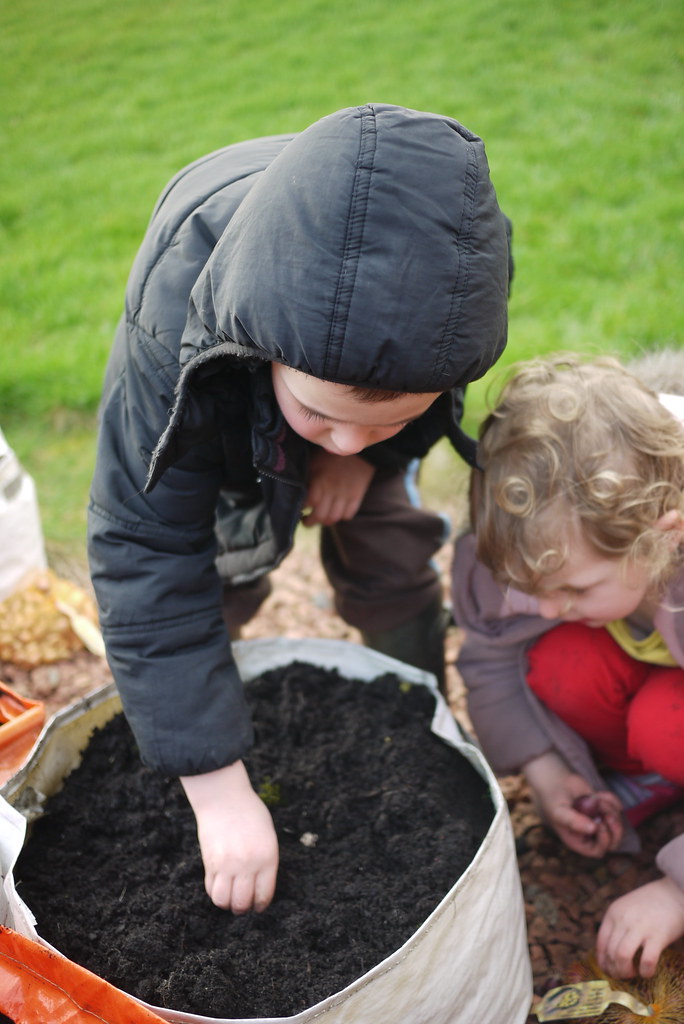
And, while it wasn't raining, we put in some vegetables. This year I'm going to stick to the vegetables I've had the most success with - carrots, leeks and onions - and I'm experimenting with peas, too. The kids helped me put the peas and onions in:


This time I'm trying onion bulbs (rather than growing from seeds), a bog standard variety and some red onions; my neighbour insists that bulbs give better results, and certainly they'll probably grow quicker and I might manage to get two crops out of the growing season. As the kids were planting the bulbs and peas I suggested that we should encourage them to grow nice and big so the kids - evidently taking inspiration from calling the butter lumps to come - began yelling at the veg to GROW! COME ON, GROW! I'm not sure that counts as a proper tradishnal prayer and all that, but it was certainly sincere...

They decided that onions and peas were more than enough fun and went off to have a water fight, so I did the leeks and decided to try a couple of sprouts again. I'm leaving the carrots until I can get to the garden centre and get more compost, so I can freshen up the soil in the grow bags - it's probably a little exhausted by now. For the onion bags I've just put in a little organic feed and we'll see how that goes.

The leeks have all been used already, for a soup, and they smell fantastic - so much stronger than the ones you can buy from the supermarket. The kids and my husband have had a flu bug that's taking a long while for them to get over (I seem to have managed to avoid it, thankfully) and none of us have had much of an appetite recently, so there's plenty of veg in the fridge that needs using. A good soup hearty will do us good (even if it looks a bit like cat vomit...).

Saturday, 25 February 2012

A general guide to getting started

So you've read the CR FAQ and the brand spanking new Gaol Naofa FAQ along with a few other bits and pieces (oh, I dunno, like my site? How about the rest of Gaol Naofa, too? All good places to look, if I do say so myself...). You think you've got the basics down, and you think this is the right kind of path for you. You want to start doing stuff, but...where do you start?

I thought perhaps putting out a few thoughts together on this might come in handy for the beginner (although I can only claim the following to be my opinion); things are better than when I was starting out, but I think it can all still be a little bewildering for those who are still trying figure things out. Getting into the swing of Gaelic Polytheist practice can be a bit of a jarring experience at first, because part of the process involves getting used to an entirely different take on day-to-day life. So the first bit of advice I'd give is: Go at your own pace. Do what you're comfortable with, and build on it as quickly or as slowly as you feel works for you.

The second bit of advice I'd give is: Step away from the Llewellyn-type books. Any neopagan books, really. Seriously. Modern pagan books on 'Celtic' paganisms may offer some ideas and easy answers, but they are all terrible as far as research is concerned - even the ones that are better than most. They are almost always aimed at a Wiccan or wiccanesque audience, which is not a bad thing if you're Wiccan or wiccanesque in belief and practice, but Celtic Reconstructionism doesn't come under that particular umbrella. In many respects, CR's outlook, approaches and beliefs are diametrically opposed to those of Wicca or Wiccan-derived paths. Ultimately, and perhaps most importantly, what you find in them has nothing to do with what you're now trying to put into practice, so it's kinda like looking to Catholicism in order to learn about being Mormon...Or whatever analogy fits best there...

The best place to start is with daily practices. Gaol Naofa has a good article on this, with some practical ideas, and I've given a few rambling ideas too, including a bit of rambling about the kind of sources you can look at to make your own prayers. It's good to get into the habit of making daily devotions because these can help you keep centred and connected. Prayers can be said anywhere - in the morning, over a coffee before you leave for work or school, before bed, during your morning run, or while you lie in bed mustering the will to get up and start the day. Even as you make your breakfast, lunch or dinner, clean the house; there are all kinds of different rites you can incorporate into your day. This article on Prayer in Gaelic Polytheism over at Gaol Naofa is especially helpful on the finer points of how and why we pray as Gaelic Polytheists, and it's well worth a read.

It can help to have your own space set aside for devotions. This can be a space for a candle, as well as a dish or plate for offerings and some items that represent the gods, spirits and ancestors, the three realms, and the place around you; things that articulate your beliefs and worldview, making a sort of microcosm, as it were. I have a shelf in my kitchen, which I see as a kind of central hearth for the home; the spiritual centre, if you will. I tend to make my offerings outside so rarely leave them on my shelf (or else I put them outside immediately after finishing ritual), but I focus a lot of my indoor devotions and rites there.

In addition to daily prayers, offerings (daily, weekly, or however frequently you feel is appropriate) can be a good practice to get into as well. Making offerings to the gods and ancestors is a good idea, but it's also important to build a relationship with the land spirits around you. Bioregionalism is a popular buzzword in the pagan community these days, and it's one that has a lot to offer the Celtic Reconstructionist. It's about trying to live in harmony with nature, and it's a process that begins at home; in doing so, it's a good way to start building a relationship with the nature spirits - even if you live in a very built up area.

You can honour the local spirits by making offerings to them, but you can also honour them in other ways, too, if these are possible: For example, buy local produce; look after your garden and try planting species that are native to your area, including ones that are attractive to bees, butterflies and all kinds of insects (or if you don't have a garden, try a window-planter, put out bird boxes and bug hotels, bird feeders and the like); grow your own fruit and vegetables - it's a good way to keep in touch with the seasonal cycles; feed the birds (a lot of folks incorporate these into their offerings, since a lot of different kinds of birds are commonly seen as Otherworldly agents); pick up rubbish as you find it in your area; and/or make an outdoor shrine for offerings and devotions. The general idea is to build a positive relationship with the land, and making offerings to the spirits, tending to the land and looking after it are all good ways of going about it. It's not always possible to do everything, for whatever reason, but you can do something.

Once you've got used to doing your daily observances, then it becomes easier to get on with adding a few more in. Ritual and prayer doesn't have to be lengthy and elaborate, and Gaelic Polytheism allows for the individual and individual groups to formulate their own liturgy so to a certain extent it can be built around your own needs. This is partly why there isn't an awful lot of liturgy out there, because a lot of folks prefer to find their own understanding and articulation of practice, and other people's words aren't necessarily helpful to your own circumstances. Having said that, it's probably fair to say that it's also partly to do with the fact that liturgy is a deeply personal element of practice and not everyone is comfortable with sharing such personal and meaningful material with strangers; that's a common view in the traditional cultures as well. So in spite of the fact that there may not be much out there, that's not to say that liturgy isn't important. It's just personal. There's nothing wrong with sharing liturgy, if you so wish, but there's no obligation to (there are some examples given in the Prayer in Gaelic Polytheism article if you want to take a look, though).

However you come to find your own words for prayer and ritual, looking to traditional sources is the best starting point. Since we are about tradition, that means we are focused on the kind of rituals and prayers that can be said again and again; repetition is important. Tradition is what gives us roots; it steadies us and gives us a solid foundation. By looking to traditional sources, by rooting our own practices in them, we might see ourselves walking in the footsteps of those who went before us; that is what tradition is about.

Wednesday, 22 February 2012

Book review: The Good People: New Fairylore Essays

The Good People: New Fairylore Essays
Peter Narváez (Ed.)

The short version: This is a really good book and I'd recommend it to anyone. Be prepared for a dense read, though, but bear in mind that since this is a collection of essays you can dip in and out of it as you like. It's a much better read if you have a good grounding in the basics, so it's the sort of book that's good for when you want to go beyond the basics.

The long version: I think there's something for everyone here, and right off the bat I would say that I've found this to be an incredibly useful book during my researches for various different articles. Three or four of the essays have been particularly useful, while a few more have been a very interesting read in general. Not all of the essays are in my areas of interest, but some of them had a lot more to offer than I anticipated and they're well worth taking the time to read even if the subject matter doesn't immediately grab you.

There's a good spread of essays and different subject areas tackled, and one of the most interesting areas for me was examples of folklore survivals in Newfoundland; the diaspora is not something I know too much about, so that was particularly illuminating, and I think it can be safely said that anyone who tells you that the daoine sìth don't travel are full of the proverbial...There are a good selection of essays on Ireland and Scotland as well, and as far as looking for evidence on pre-Christian survivals in Ireland, Ó Giolláin's 'The Fairy Belief and Official Religion' is especially good reading. Margaret Bennett has some good offerings as usual, and there is also an article on the differences between witchcraft and the charms of the wise-women and wise-men who act against witches, which is extremely useful.

More recent permutations of fairy and folk belief are dealt with as well - the essay on the Cottingley Fairies fraud was interesting, looking at the claims and the reality surrounding the famous case, and the implications as far as survivals in fairy belief are concerned, etc. While it isn't particularly relevant to my own interests it's a subject I kind of grew up with, so that was a good read. All in all, though, this section was the part of the book I'm left feeling not especially enthused about - aside from the fact that my son's just lost his first tooth and the essay on the Tooth Fairy was topical, it's not the kind of thing I'm particularly interested in studying. The articles are good if that's the kind of thing you're looking for, but I have to admit that things like UFOs have never been topics I've found fascinating, really. I'm not sure I can do that section justice in review.

What really sells the book for me is everything but the latter part of the book, to be honest. Being a thoroughly academic tome some of the articles are surely a bit too dry for a spot of light reading, but I wouldn't say that this is a book that really needs to be read from cover to cover. I don't think you'd regret it, but certainly you'd still get your money's worth from it if you bought it just for the value of having it for research purposes, to dip into. Using the Google Books copy to search for whatever you're looking for is especially handy.

Being academic, there isn't much in the way of romanticism about the daoine sìth or anything like that. The contributors almost all approach their subject from a very detached view (Margaret Bennett is always an exception, though, I think), so of course you're going to be reading very objective and analytical essays that rationalise the beliefs. I can imagine that some people might find this rather unsympathetic, but I think I'm used to that kind of thing (and it's not that the authors don't have a point really - from an objective point of view, stories about the daoine sìth really can be seen as tools as much as tales of real or imagined experiences).

You should be able to find this book at a reasonable enough price, and it's definitely one I'd recommend unreservedly for the bookshelf; no, it won't answer every question you have, and it's not the sort of book that makes a good, basic introduction to the subject, but it's great for when you want to go beyond those basics. It's not a book I'd necessarily recommend for beginners, then, unless you really have a thing for academic articles (whatever floats your boat, m'kay?), but it's certainly one you'll want to get hold of at some point.