Wednesday, 26 October 2016

The roll call of the dead

For only the second time since I became a Gaelic Polytheist I have a family member to add to the list of ancestors I'll be honouring at Samhain. The first was my granddad, who got to meet his first great-grandchild (my son) before he died only three months later on New Years' Day, 2006.

Now I get to add my father-in-law, who died earlier this year. It was very sudden – and tragic and awful – and it's left us all in an aftermath of differing proportions. My mother-in-law lost her husband of nearly 50 years, my husband lost his father, my kids lost their Papa. To me, he was more a father than my own ever was.

The best we can tell, he fell head-first down the stairs. He didn't try to stop his fall or cry out, so it seems likely that he lost consciousness and it was only when his head met the floor that his fall came to a very sudden stop. He lost a lot of blood and sustained a massive head injury, but the way he landed also meant that his chin was pressed into his chest and he was unable to breathe. He was without oxygen for at least 20 minutes, as far as we can tell, probably closer to 30 minutes. By the time the paramedics/EMTs arrived his heart had stopped, but they managed to revive him – somehow. He never regained consciousness, however. A small mercy, I think. After it was confirmed he was braindead, and his immediate family had managed to come to his side and say their goodbyes, life-support was switched off. He died at 11.55pm on June 15th, 2016, after only a matter of minutes.

It's been a difficult time since then, in some ways. We've all had to navigate our own grief while accommodating each others', trying to be understanding and sensitive to everyone else's needs as we reach different stages of grief ahead of, or behind, other people. The first night he was in hospital, while Mr Seren was by his side and they were still hoping that there was some hope left, I went outside and prayed (throughout the whole ordeal I stayed home with the kids; we felt it was better for them to remember him as he was, and the days were just too long for them to handle anyway). I prayed and I felt a presence at my shoulder, a brush against my hand, and then a stillness and a peace. I knew then that he was gone. He wasn't coming back from this.

Acceptance was the easy part for the adults. My father-in-law was a complicated man and he was hard to know in some ways. He was a man of many passions but life had worn him down. Towards the end he was an unhappy man – a little lost after his retirement, depressed and lacking in purpose, angry, in pain from his bad knees, and unable to play the music he so loved. He'd given up in many ways. He was struggling and didn't go out much. In that respect his death has come as a relief and a release. As tragic as it was, he was ready, and in some ways that's a comfort. At his funeral, it was standing room only. Over 150 people came to pay their respects. That was comforting, too. Flawed as he was, he touched a lot of people's lives.

None of that's offered much comfort to the kids, though. My son, in particular, is having a hard time parsing the loss of his Papa. He's found it difficult to go to his grandparent's house knowing that he won't see his Papa there, even though all of this things are still there. The ghost of his memory hangs heavy in Tom's mind, and he found the funeral a little overwhelming, not knowing what to expect, not knowing how to deal with his emotions. We talked and tried to walk the kids through everything that was going to happen, but I suppose for a child hearing it and living it are very different things. It was a humanist service and the stories that were told were not stories of the Papa the kids knew, really. The Papa who went to seminary but left, the Papa who cycled the Highlands every weekend, and who met Nana at an archaeological dig. The Papa who left the house and did stuff. The Papa who was young once. That wasn't the Papa they knew.

When I broke the news of their Papa's death to the kids – the morning after, when they were supposed to be getting ready for school – they were shocked. We'd prepared them as best we could and had told them that it was going to happen, but again, hearing it is different to living it. Aside from asking how and why, Tom's only comment was, "But I didn't really know him yet. It's not fair!" The funeral only compounded that.

The family is planning to go over to Derry at some point – where my father-in-law's mother came from – so we can spread his ashes in the place his mother was born, per his wishes. Hopefully it will help Tom come to terms with it all and find some closure, but in the meantime, with Samhainn approaching, I'm trying to think of things to do to help him (and Rosie) keep processing. He finds it hard to talk about his emotions at the best of times so it's a fine line between helping him open up and picking at an open wound.

This is the first time we've had someone to add to our ancestor altar, as a family, so I'm going to try and involve the kids in what we'll be doing – finally getting some photos printed so we can set up a small altar to our ancestors, sharing stories (including old favourites like The Time Papa Got Stuck in the Bath, Twice, And Only The First Time Was Really Accidental, followed by The Time Papa Decided To Remove A Wasp's Nest, Drunk, And Surprisingly Fell Off A Ladder), and each of us adding a stone to the cairn out in the garden. We've been working on some decorations (Rosie's crafted a clay headstone with "RIP Papa" on it), and we will have our usual feast (Rosie has requested stovies, a speciality of Papa's), and leave a space for our ancestors to join us. I'm also planning on taking the kids to the beach so we can each pick a stone to bring back and place on our cairn. Knowing Rosie, she'll probably want to decorate it first.

So as always at this time of year, the ancestors hang heavy in the air. But this year, one more face joins the crowd, and now the kids have something more tangible to frame what, exactly, "the ancestors" really means to them. One more face joins the crowd. Goodbye Papa.

Sunday, 4 September 2016

(Useful link): Celtic Spells and Counterspells

A while back I reviewed a fairly newish book (published last year) titled Understanding Celtic Religion: Revisiting the Pagan Past, which I highly recommend. In the review I mentioned a particular article by Jacqueline Borsje titled "Celtic Spells and Counterspells," which is well worth a read.

I've just discovered that you can actually read the whole chapter online, so for those who're interested, have at it!

If that direct link doesn't work, try here. Just click on the pdf icon next to "Download" near the bottom of the page.

The article is mainly focused on Irish evidence, but it does bring in some comparative commentary, too, and the focus is on examining various examples of charms to try and untangle possible strands of pagan belief and practice. We begin (sort of, ish) with a discussion of the sugere mammellas or "nipple-sucking" episode that Patrick described in his Confessio, a rite of apparently pagan origin which he therefore refused to take part in. Evidence of possible pagan rites as described by Columba then follow, which leads into a discussion of the lorica ("breastplate") type prayers of protection.

Also included in the article is a discussion of a "spell" or charm attributed to St Brigit, which was meant to help a husband keep his wife (who didn't love him), the instructions for which include sprinkling of water over the marriage bed (which to me is suggestive of a saining ceremony of sorts). There's also a spell for impotence (with a translation given), which is rather ambiguous in nature – is it for causing or curing the problem? This in itself is pretty fascinating stuff, but it then leads into a discussion on the use of "words of power" – the use of seemingly gibberish or extremely obscure words or phrases to give an air of mysticalness etc. All in all you'll find a lot of food for thought here, both in terms of the kind of forms these charms could take, as well as what it can tell us about pre-Christian belief.

Sunday, 28 August 2016

A stink in the air

So it's been a wee while since I last posted here – the summer has been an extremely busy and exhausting time – but the whole stink that's arisen thanks to the AFA coming out with their recent "statement" seems as good a time as any to dust this old thing off.

The AFA have always been utterly racist and bigoted as an organisation. A change in leadership was never going to change that, so it's no huge surprise that they'd come right out and say something that's racist and bigoted (only surprising in that the previous leadership learned to keep more quiet about it and skirt around it, I suppose). And to be fair, the AFA aren't the only racist heathen organisation out there, they're just one of the more prominent ones. So really, it's just the same shit, different day.

The more disturbing thing that people are up in arms about was a comment from an individual claiming to be CR, saying that CR "embrace the same values" as the AFA espoused in their statement, which, if you haven't seen it, said:


I understand that after something of an outcry in a certain Facebook group, the commenter backtracked and deleted their comment (I'm not a member of the group so I haven't seen what was said), so if you hunt up the post on the AFA page on Facebook, you won't see it there now. 

On the one hand, it's kind of mind-boggling that somebody would come out with a comment like that when Celtic Reconstructionism was founded on firmly anti-racist, pro-queer principles. So is Gaelic Polytheism. This isn't news. And for every group or individual who's spoken out against what was said – including Gaol Naofa – they've all said as much. It's written plain as day in The CR FAQ, which was written by community consensus a good ten years ago now. But then again, there are always going to be people who want to pick and choose the bits they agree with. There are always going to be people who want a folkish and bigoted form of CR, where men are manly and women are womanly (whatever that means), and the women dutifully pop out beautiful, straight, white, cisgender babies in between doing the dishes and making their manly man a bacon (natch) sammich. Swoon. What a wonderful community! (So long as you conform, right?)

I suppose it's easy to ignore or dismiss a particular stance a community has taken when people like this tend to hand-wave things they don't like as being "just modern politics" or whatever. That's usually what I've seen being claimed, and again, it's nothing new. Dismissing something as "modern politics I disagree with, therefore not relevant to me" is one thing, though. I'm not quite sure how these people reconcile their beliefs with the history and the mythology their religious outlook is founded on, because Irish myth (the lone commenter who decided to speak on behalf of CR also claims to be a Gaelic Polytheist) is fundamentally rooted in an origin story where the people of Ireland came from somewhere else – Spain, Scythia, Greece, Egypt, you name it.

And while the myths in question have been very much messed about with to frame them in a more Christian context, the general idea of "we came from somewhere else" is thought to be an original, pre-Christian part of the tale that's very much in keeping with what we know of Goidelic cosmology and so forth. The point is, though, either way the Irish believed themselves to be immigrants, and some of them proudly traced themselves back to very non-white origins (whether that's true or not is immaterial, really; they didn't have a problem with it and that's what counts here), and that also found it's way into Scottish genealogy and origin stories, too. And let's not forget that the Gaels, and Celts in general, also have a long history of emigration and colonisation elsewhere (sometimes by choice, sometimes not so much), so they've never exactly been averse to mixing their genes in with the locals, either.

It's only recently, in relative terms, that this idea of having an "undiluted" ancestry (unsullied by non-white genes, that is – mixing with other white people is just fine and dandy, regardless of culture) has become a thing. In that respect, then, I'd argue that it's the folkish types who're forcing their own modern views onto things, while ignoring some pretty fundamental elements of their own religion that contradict them. The same goes for the stuff about "our feminine ladies, our masculine gentlemen" (who, it was confirmed in the comments I included above, must be totally straight and gender-conforming). We don't see much about non-heterosexual relationships or gender non-conforming individuals in the historical sources, and these are areas of study are only just beginning to take off in academic circles, but we can certainly see that it was Christian influence that introduced an outright condemnation of this kind of thing.

Aaaaanyway. This isn't a lone commenter, out there in the dark fringes. For anyone who's been kicking around the CR scene for any length of time it's just one more example of an undercurrent that's always tried to push its way in. It's a problem that's not going to go away, and all anyone can do is keep speaking out against it and joining in with all the other voices who are saying the same. The groups and individuals who keep quiet about it... Maybe that speaks volumes in itself.


Friday, 3 June 2016

Book Review: Understanding Celtic Religion: Revisiting the Pagan Past

Understanding Celtic Religion: Revisiting the Pagan Past
Edited by Katja Ritari and Alexandra Bergholm

I think I've mentioned wanting this book a couple of times before here on the blog, but thanks to the price tag – £95 (and not much less second-hand) – this is not a book that I'm ever going to be able to afford. I expect the same goes for a lot of people, which is a real shame because it's a seriously good read.

I really do understand that books are expensive to produce and a profit is difficult to come by on volumes like this, but I do wish there was some sort of happy medium to be found. The price tag unfortunately means it's really only ever going to be something you'll find in an academic library, unless second-hand prices come down. Seeing as the book was only published last year I was surprised and pleased to find it available at my university library, so damn skippy I'm borrowing it.

So with the whinging out the way I'll get onto what the book actually is: It's a collection of articles that were originally presented in 2008 at a colloquium in Helsinki, and (as the title suggests) they're all looking at various aspects of what we might call "Celtic Religion." There's a very critical approach throughout the volume, and the topics include a focus on how approaches to "Celtic" religion have changed and evolved over the years (i.e. is there a Celtic religion?), what the material we have available can actually tell us about religious belief, and the way historical approaches to those beliefs evolved as well.

All in all this is a pretty slim volume with only seven articles, so it's a fairly quick read and not as much of a hard slog as most books like this tend to be. There are obviously some articles that grabbed my interest more than others, but one in particular that seemed rather incongruous when grouped together with the rest; this one dealt with purely Biblical material, and while it was a good read in itself it seemed rather out of place with the rest.

The first article, from Alexandra Bergholm and Katja Ritari, asks "'Celtic Religion': Is this a Valid Concept?" (Short answer being no, not really) and it does a fantastic job of introducing the rest of the book in general, but also giving a very brief and critical overview of the issues involved in undertaking such studies. This is the kind of important stuff you want to have a good idea of if you're going to make your own study of the field.

Next up is Jacqueline Borsje's "Celtic Spells and Counterspells," which focuses mostly on Irish material but with some other examples brought in for comparison. Not only is her analyses of these "spells and counterspells" fascinating, but she uses them as a frame for discussing how we can use the historical sources to learn what we can about pre-Christian beliefs – what they can and can't tell us, what we can even if it's not stated explicitly, and so on. Again, this is really good, important stuff even though some of it may already seem pretty obvious to you.

John Carey's "The Old Gods of Ireland in the Later Middle Ages" is also a solid contribution, and it kind of picks up on some elements Carey covered in his first chapter of A Spear of the Sun and then expands on them, namely how the scribes of the Middle Ages dealt with the gods and grappled with their identity and place in a Biblical scheme. In some ways this may be a topic that's been well-covered already, but I found some bits and pieces here that added to my understanding of the subject and were of genuine interest. Along with Borsje's article, I'd highly recommend a read.

The next few articles were interesting to me but I didn't feel they added as much as the previous ones in terms of religion or myth specifically. Even so, Robin Chapman Stacey's article on "Ancient Irish Law Revisited" had some good stuff with applying the same sort of critical approach to the law tracts as Borsje did with her chapter, so if that's your thing I'd recommend adding it to your list of things to read.

The final chapter, however, is one of the chunkier articles in the volume, and I thought it offered a lot of good food for thought. This one is Jane Webster's "A Dirty Window on the Iron Age? Recent Developments in the Archaeology of Pre-Roman Celtic Religion," and it begins with a (fairly provocative, perhaps) quote from John Collis that states, "I am sceptical that there is anything we can label as 'Celtic religion.'" The chapter is a nice bookend to the introduction from Bergholm and Ritari, and Webster contributes a critical look at what archaeology, specifically, can offer us, as well as what it has offered us in the past. She begins with a broad overview of recent archaeological developments in the field, detailing the various approaches and interpretations that have been taken to the material, using some of the bigger names in archaeology as examples for critiquing and explaining further. We then move on to look at the limitations of archaeology in terms of how it can't give us much certainty or specifics about druids, or issues around sacrifice, and so on.

As the first volume in a new series (titled "New Approaches to Celtic Religion and Mythology") I think it's a really good start and I look forward to seeing the rest of the series come out and exploring other areas in more detail. To be clear, this is not a book that's going to give you a detailed description of what "Celtic Religion" looked like, which I'm sure is going to be frustrating to some if you go by the title alone. The book doesn't really offer much in the way of certainties at all, but it does offer something that's all too often lacking in "Celtic Pagan" spheres, and that's an emphasis on critical thinking and approaching the material on its own terms. It's a real shame that the cost of the book is so prohibitive because for that alone I really would recommend you read it if you can get hold of a copy. If you have access to a library that can get hold of it for you then I think it's definitely worth a try.


Monday, 25 April 2016

Behold the shiny things (with a surprising amount of penis)... Part two

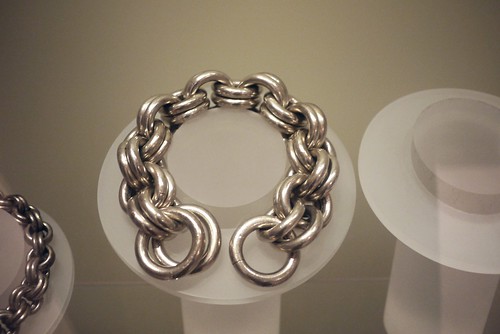
Some more pics from the National Museum over in Edinburgh, though this time with fewer shiny things per se... We'll start with a statement piece, though:


There were quite a few of these in the museum, though unfortunately I didn't spot any of the ones with Pictish symbols engraved on one end. As you might guess, the chains are typically thought to be Pictish in origin, probably dating to around the 5th to 9th centuries CE, and they're more than likely to have been worn by those of high status – not just the aristocracy, but royalty, the information board reckons. Just like the penanular brooches the Gaels wore (like the Tara brooch, for example), they were probably worn as an indication of rank. They were worn around the neck and fastened together with a "terminal link" – the bits that have the Pictish symbols engraved on them, which were originally highlighted with red enamel. Each link is made of solid silver (probably recycled Roman silver), and given the weight of them – up to 2.9 kilos (6.4 lbs) each – it seems unlikely that they were worn as regular, everyday pieces of jewellery. Instead it's thought that they were probably worn "during important ceremonies."

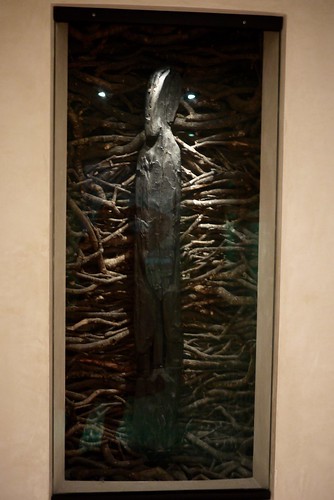
From a slightly earlier period – late Bronze Age – we have the Ballachulish idol:


Which is surprisingly huge – I didn't know it was actually life-size... The figure was discovered in a peat bog with the remains of some kind of wickerwork structure covering it. The site is situated overlooking a sea loch, so it's thought that the figure was meant to represent a goddess of some sort, "probably associated with fertility" – she's holding a "phallic object over her abdomen" so yeah, OK. I think equally the situation of it, overlooking the sea loch, could imply a protective purpose as well?

If you get up close then you can see the quartz pebbles that have been used for her eyes:


Given the long association of white quartz with the dead, could their use be significant? Or were they just convenient?

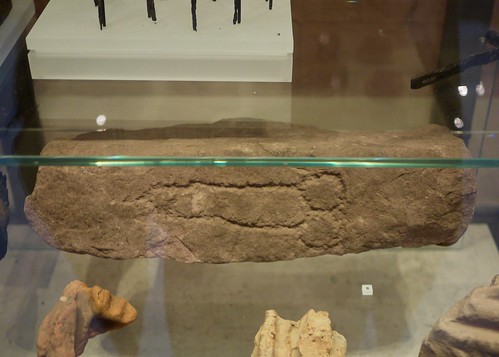
Speaking of phallic object, the museum has a surprising number of them. You can blame the Romans for this one:


It's described as "an undressed stone with carved phallus, Birrens," on the information plate, and dates to the first century CE.

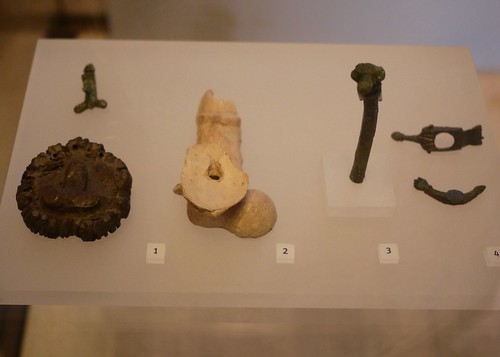
You can blame the Romans for these ones, too:


These are pretty small, and were used as amulets to ward against the evil eye, or perhaps as fertility charms.

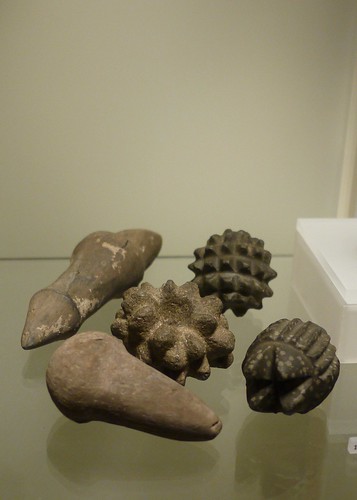
Here we have some "mysterious stones" from Neolithic Skara Brae, one of which looks pretty penile at the least:


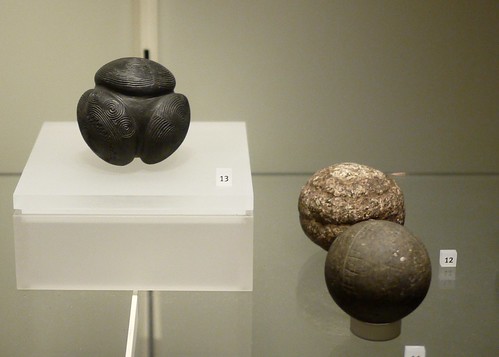
We don't know what these stones were for – maybe "ritual," perhaps simply decorative – but number 13 here is one of the better known examples:


I couldn't get a good close up, unfortunately, but the detailing is spectacular.

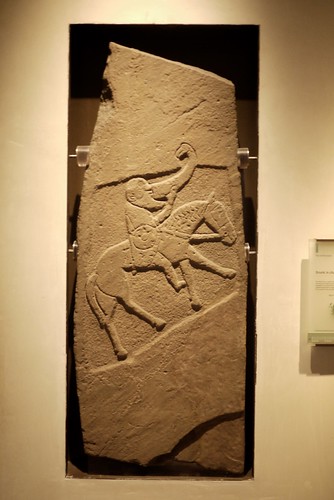
Finally, here we have an unusual carved stone, known as the Bullion Stone (taking its name from where it was found, Bullion, in Angus), which dates to around the tenth century CE:


It's unusual because it's not often that you find stones that have a comical or unflattering tone to them like this one does, and by this point in time carved stones were almost exclusively Christian in its symbolism. Clearly whoever this guy is, he's a little worse for wear and the bird's head on the end of his over-sized drinking horn is looking a little judgemental there. The man appears to be a warrior, with his shield, but he's old and bald – not a flattering look when baldness wasn't considered to be a desirable trait. His horse looks tired and is maybe a little past it, too, as it plods up the steep hill. The drinking horn is maybe intended to indicate a Norseman here, since they introduced them to Scotland, hence the unflattering imagery?