Wednesday, 4 November 2015

The saga of the costume, and other things...

The run-up to Samhain was so busy I forgot to do a links post for it... You can blame Rosie for that one, mostly.

It's been nearly eight years since we moved into this house and it's only recently that I've learned that the valley we live in officially has its own microclimate – notable enough that sciency types study it and stuff. While everywhere else around us, even just five minutes away, is under a foot or so of snow, some winters we've barely had a frost let alone a hint of a snowflake, that kind of thing. Over the years I've noticed that the seasonal shifts tend towards extremes around here (in comparison with the surrounding area) and they're either very late or very early. In particular, things like fruit ripening on bushes or trees can happen up to a month or more later or earlier than just down the road, so if I were to time our celebrations by the usual markers – things like first frost, first fruits, and so on – then sometimes I'd be celebrating one festival at the same time as another, or with only a week or so apart.

Since that's become clear I've mostly stuck with aiming for the fixed dates (or as close as I can), but at the same time I've been trying to learn the seasonal rhythms of our little valley. Living by the coast there are obvious markers like the storms we get in spring and autumn (and throughout the winter), and there are those things that aren't much different from anywhere else around us – the length of the days and so on. One thing that Tom said recently has stuck with me: He's been looking forward to winter because he gets to see the stars again. He doesn't just mean in the sense that he often has to go to bed before the sun sets during the summer; round here, during the summer months the night sky never gets truly dark, especially at the full moon. Not compared with the winter, anyway, so in the summer months you only get to see a few stars twinkling away up there. When the nights draw in, though, you can make out bands of the milky way (we live far away enough from any cities that we get a good view of the night sky in winter), and it's a very different view. So one thing I've come to view as an indication that winter is on its way is the night sky; when we can see that thick band right above our heads, it's definitely not summer anymore.

For festivals like Samhain, it's hard not to celebrate it on the fixed date anyway, especially since it's so tied up with Hallowe'en. The kids are at that age where Hallowe'en is serious business now, and Rosie (who's always been more keen on playing dress up than Tom has) in particular has taken her costume very seriously this year, so our preparations for Samhain this year have seemed like they've almost been never-ending. She's been so excited about Hallowe'en – wearing her costume to school for the parade, going out guising, bringing home all those SWEETS (dear gods, the sweets) – that she's actually been losing sleep over it. Several times she'd come down and tell me she couldn't sleep because it's just so exciting. In particular, her plans for her costume have been very specific and she just couldn't wait for everyone to see it. And guess who had to make it, eh?

I'll spare you a good chunk of the details, but suffice it to say that at the tender age of eight, Rosie is officially in the grip of But What Will My Friends Say?, along with It's All Wrong And Nobody Understands, GUH. It's not quite as bad as the teenage years yet, but dear gods I could do without the child insisting on the most inappropriate costumes for an eight-year-old, ever (no, Rosie, you will not be wearing an opaque blue body stocking and nothing else). So there was something of a battle over what a certain somebody was going to wear, and of course, at this time of year, that's the most important thing when you're eight. In Rosie's world, at least.

The situation reached crisis levels at one point, mainly because her first idea wasn't possible in the "I'll order you the costume and that's sorted" sense, at least, and every other idea she had wasn't possible (or appropriate, I felt) either. Rosie wanted to be a supervillain – none of your goodies, please (although Madam Vastra from Doctor Who was briefly considered), so we had a limited range to work with, let's say. She was hesitant to have a costume tailor-made in case it turned out badly and she looked silly, but in the end I convinced her to at least let me try. If it did turn out badly, I promised her we'd do something else instead.

So, long story short, I ordered two pairs of leggings – one red, one black – and two tops, also one red/one black, and set about cutting them in half and sewing them together to make a Harley Quinn costume. One of Mr Seren's white t-shirts was sacrificed to make the cuffs and the collar. Rosie's experience of the character is from the Lego Batman game, so she wanted the original jumpsuit version of her costume (and frankly, given the other options/iterations of the character, that was the only version she was going to get), although she conceded that a two-piece version would be more practical than the jumpsuit itself. Thankfully she didn't find the jester-style hat appealing, so I didn't have to make that.

If I do say so myself, it all turned out rather well in the end. We'll ignore the fact that after unpicking the leggings apart to sew the one red and one black leg back together, I ended up sewing two left legs. But never mind.

Tom's costume was easy, he wanted to recycle his Minecraft Steve costume into an Enderman (another character from the game, who throws pumpkins, apparently), although it took a little fixing after rescuing it from the garage, and we had to make a new head. Then disaster struck – the school decided that kids wouldn't be allowed to wear make-up, face paints or masks "in case it scared the little ones." Which is kind of the point, no? Weapons and other kinds of props like wands weren't allowed, either, nor "inappropriate footwear," so Rosie decided that she didn't want to wear her costume for school if she couldn't do the whole thing. Parents and family were no longer invited to the parade, either (hmph).

The kids were both outraged and upset (it was a last minute announcement which made it worse – most of the kids at school had already decided on their costumes and it meant that most of them either couldn't do them properly, or at all because of the new rules). Tom was at least eventually allowed to take his costume in so the teacher could decide if it was too scary to wear for the parade, but all in all it hardly seemed worth the effort. Nana came to the rescue for Rosie and dumped a load of old dance clothes on her, which used to belong to my nieces, so she eventually decided to go as "America" in red, white and blue, with a hastily made statue of Liberty as a pointed comment about her FREEDUMBS, which had been unjustly taken away by the head teacher's arbitrary and illogical decision-making (the kids were allowed masks, weapons and/or face-paints for the evening disco, along with footwear of their choosing, so the ban on "weapons" and such was hardly a safety reason). So for school, this is what we ended up with:


And then for Oidhche Shamhna itself (Hallowe'en) Tom wore his costume again and Rosie did her Harley Quinn costume. Because I'd made it, damn it, and she was gonna wear it:


We got some coloured spray for her hair but it's not very obvious in the photos, but she was very happy with how it turned out in spite of the fact that she hated every second of having her hair sprayed. She's decided she quite fancies having black hair, though.

So the run up to Samhain was mainly taken up with making all of the costumes and props that were needed, and then trying to get the house in order in time for the evening. After spending so much time on making stuff, a good clean and tidy was desperately needed.

The night before our celebrations began I carved the turnips and pumpkins:


And felt pretty pleased with myself because I managed to carve a turnip without ballsing things up
with the knife going accidentally off course, for the first time ever.... There's something satisfying about a hard won carved tumshie. I missed a trick with the pumpkins, though – the cat pumpkin was Rosie's choice, but I could've done the other one to match Tom's Minecraft pumpkin. Oh well.

Decorations were put up and the Saturday went verrrry slooooowly for two excited kids who were forced to tidy their rooms and make their beds. Eventually it came time for them to go guising (or galoshans, as we call it in this neck of the woods) and Mr Seren took them out with the neighbour's kid. I decided to do a beef stew with dumplings for our evening feast because it was something I could mostly leave to its own devices while I was concentrating on fielding guisers, and it's a good wintry meal so it seemed apt.

While the kids were out I set up a bucket of water for the dookin', and lit the whole house by candle-light. The lanterns were put up at the window to let the guisers know they were welcome, and I did some quick devotions to get the evening officially started. We didn't get nearly as many guisers as we usually do – normally the streets would've been full of kids in costumes with a harried parent in tow, but I think maybe because it was a Saturday night a lot of people were at parties instead this year.

The kids came back with a good haul of treats and they set to the dookin' with enthusiasm. The neighbour's kid looked at us as if we had two heads when he realised we were going to actually dunk our faces in the water for the apples, though – he'd only ever done it by trying to spear the apples with a fork. He and Rosie opted for that method, which I think is what they do at school (though they didn't hold it between their teeth like you're supposed to), while Tom did it old style. Unsuccessfully, but doggedly nonetheless:


Eventually, as water began to spread all across the floor and he was no nearer to getting the apple, I told him to use a fork. It took some persuading and he wasn't going to make things easy on himself, though, so he did the teeth method with his fork. And finally won his apple after many, many attempts.

We had dinner as the neighbour's kid was called for his, and then he came back and we carried on our wee party, but as usual all of the excitement of the day saw them tire out pretty quickly. Rosie was barely awake by 9:30pm so it was time for her to shower to get all of the dye and face-paints off.

I'd seriously overdone things and needed a good sit down by that point – I could barely walk – so once the kids were tucked in the rest of the night was pretty low key for me. Before bed I spent some time making some offerings to finish off the evening, chatted with the ancestors (with honourable mention of Eddie and Yoda, the two pets we've lost in the last year – Rosie's convinced Eddie's been around), welcomed in the winter and made prayers of blessing and thanks, and left some food out for any ancestral visitors overnight, and then went to my bed. I slept a deep and dreamless sleep that night.

I was still suffering for my efforts the following day – it was worth it, though – and I decided to stay home while Mr Seren took the kids to the in-laws for the afternoon. The car journey wouldn't have done me any good. That wasn't before Mr Seren and the kids went out to buy a new iPad to replace the one that had finally given up the ghost (har), and they came back with the most tasteful artwork for me, ever:
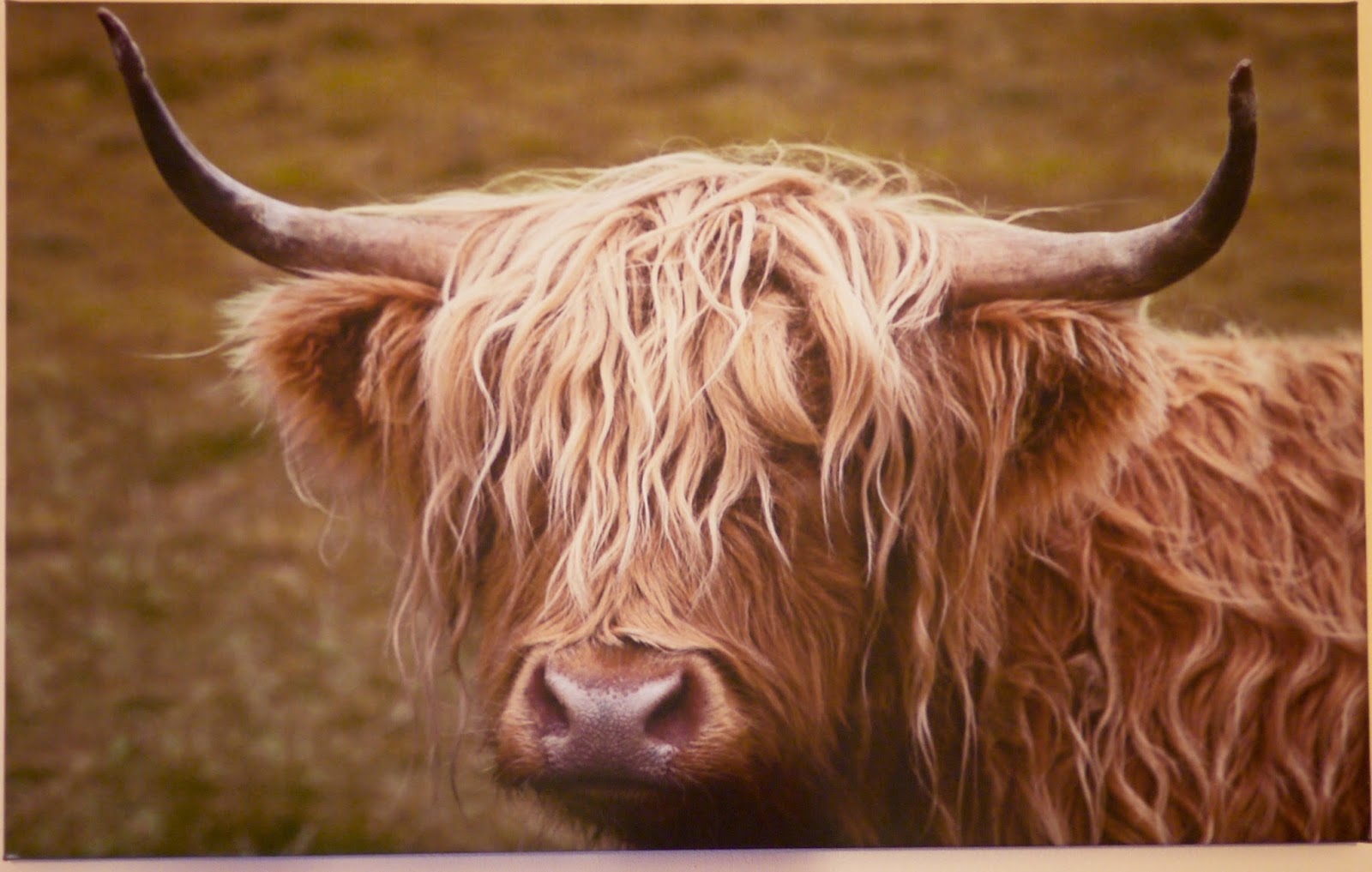

Which now graces my living room, on the wall above the sofa where I typically sit. It was an apology from the kids, really – they'd got into trouble that morning for not listening to either Mr Seren or me, in spite of dire warnings, and I'd eventually had to go tell them off. Standing up was a little too much at that point and I couldn't help but burst out crying, so that freaked the kids out and made them feel terrible. But I was very touched by their thoughtful gesture.

By the time they came bearing woolly cows I was feeling a lot better, and I managed to sain the house and put the meal I'd left for the ancestors outside as an offering. I still haven't managed to find a satisfactory sort of shelf (or something) to put near the pond, where I can put my offerings out of the way of the dog's reach, so they're still currently going up on the wall on the other side of the patio. I need to figure something out for that.

But we've successfully ushered in the winter here, I think – I hope. As much as I'm not exactly the greatest or most enthusiastic seamstress, I ended up enjoying the opportunity to make both costumes for the kids. It allowed me to do a little extra protection work, too, cutting or sewing or painting deiseil, and sewing in or painting a few protective symbols for them for when they'd be out and about. It did mean that the preparations for our celebrations were a little lengthier than usual, but that in itself provided an opportunity for time to contemplate and meditate on things, and it also seems apt in the sense that winter itself seems to be taking its time in arriving, although the predictions are that it will be a cold and bitter one, once it does.

In spite of the fact that I over did things (physically, at least) I'm glad that for once I managed to do all of the things I wanted to. I chose to push myself. I suppose in a way I wanted to prove to myself that I could do it, in spite of my limitations these days. I know, though, that it's not the trappings that are important, as such – doing is all well and good, but it's kind of pointless if you don't have that connection, that communication... But at the same time those trappings help provide a focus, and become devotional acts in themselves, and it's something I wanted to do. In a way, I think it's something I needed this time, too.

Thursday, 15 October 2015

Here be zombies... (and Celts)

Just so you know, there aren't any actual zombies in this post. It's just that I went to visit my mother, who now lives in deepest darkest East Anglia (for no apparent reason) and I swear I saw a group of zombies shuffling down the road once. Ask my husband. He'll tell you all about it. Actual. Zombies.

But it has to be said, it's not my favourite place in the world to visit, and nor is it Rosie's. Mainly because my mother obviously chose to live in the arse-end of nowhere, down many a twisty-turny country lane, and she has a small car and a terrible sense of direction. And even worse driving skills.

That said, in amongst the brief periods of fearing for our lives ("Oooo look, there's the cathedral!" she says, as she swerves two lanes across the motorway in its general direction), I got to see my nephews and we got to go crabbing. I think it must be a good 25 years since I last did that, and I always loved it as a kid. And I caught the biggest:


In a new-fangled net thingy. Not the way we used to do it when I was a kid, but much easier, and Rosie caught two shrimps in hers.

My sister and her family could only stay the weekend because the kids had to go back to school on the Monday (mine are on their half term at the moment, though), so after they'd gone we had a quiet day at a park so the kids could enjoy some sunshine for once, and then I convinced mum to have a day out in London. It was a bit of a trek but seeing as we were – relatively – so close, how could I not take a visit to the Celts exhibition at the British Museum? It's coming up to Edinburgh in the new year but I'm impatient.

And I was a little disappointed, ultimately, I have to admit.

I was hoping to take some photos but in spite of the fact that you can take photos everywhere else in the museum, it's not allowed in the exhibition itself. Mr Seren suggested it's because of the complexities of licensing agreements between the various museums who've loaned pieces, and while he has a point, legally speaking, I still maintain it's utter fucking bullshit. For £16.50 a visit they could take the time to sort their shit out, thankyouverymuch. I snuck as many photos as I dared but the staff were fairly well on top of things. If only I knew how to turn the sound off on the camera....

We got to the museum around midday and it was fairly busy, mostly full of people of a certain age, shall we say. London being as it is, everyone's rude and pushy and it was no different in the museum – people crowded round the exhibits and refused to budge until they were good and ready, and it probably wasn't helped by the fact that it was really dark and hard to see the information blurbs (especially if you're of a certain age and/or your eyesight's not top-notch). But gods forbid you take your own time. In amongst the atmospheric, calming music you could mostly hear tuts and sighs from the disgruntled people waiting to get their turn at the front, while the people already at the front got shirty about it and deliberately took even longer. It didn't help that the entrance to the exhibit was clogged up by people watching an introductory slideshow that lasts three-minutes, so you instantly walk into what's essentially a meat market.

But anyway, there really are some amazing pieces on display. The Battersea shield's there, and so is the original and then replica of a carnyx, or battle horn (I guess you'd call it), that was found in Deskford, near Moray in Scotland. Here's a photo of the replica from the Creative Commons:

By Dun-deagh
It's a very cheerful carnyx considering it's probable purpose is to induce and encourage mass slaughter, but hey. Times change. There were some headsets available so you could listen to what the horns would sound like, which was one of the few things that impressed the kids. They've tried, with a "follow the boar signs for family fun" but in general there's not much for kids there.

And yes, the infamous divination spoons are there, with cautious commentary about how they "might" have been used for "fortune telling" or ritual purposes.

The true star of the exhibition is the Gundestrup cauldron, though, it really is. There's a small replica on disply in the National Museum at Dublin but the real thing is both surprisingly huge and amazingly detailed. I never fully appreciated its magnificence until I saw the real thing, I guess.

I snuck a photo of one side:


Which really doesn't do it justice. The cauldron's set pretty high up so you can see the outer side panels without having to bend down too much (I'm guessing), but it does mean that if you're short you can't see the inside panels very well. Rosie was disappointed because she's quite keen on the artwork of the cauldron (I showed it to her as part of some homework a while ago and she drew it for her teacher) and she couldn't see her favourite panels. There's a step up so you can peer down to the panel that's in the centre at the bottom of the cauldron, which shows a female figure (described on the information panel as a "woman-warrior," I think, wielding a sword), with a large bull in the middle, but there really needs to be steps all around it so you can get a better view of everything, and so you can see the base panel from different angles.

There was a bucket with ducks on, from Hallstatt, Austria, that Tom was keen on (for no apparent reason he loves ducks more than anything else in this world):


Which was situated next to the Dunaverney flesh-hook:


Which Tom was also keen on. Technically this flesh-hook is more likely to be Bronze Age, only very possibly very early Iron Age, and it's got nothing to do with the bucket it's sat next to, but it's a stunning piece.

An altar to Brigantia (Romano-British) is also on display, which was found at Birrens in Dumfries and Galloway. It's not known for certain if Brigantia was honoured by the Britons this far north, into what's now Scotland, or if the person who erected the altar had come from further south and happened to erect the altar as they were passing through, but the altar is impressive to see nonetheless – the sandstone it's carved from is very glittery and sparkly, which doesn't come out in photos, and the information card had some really interesting details on it. Here's the altar:


You can probably just about make out her name at the bottom there, and the inscription translates to 'Sacred to Brigantia: Amandus, the engineer, fulfilled the order by command.' The figure of Brigantia is portrayed in a very Roman style. If you look carefully you can see that she has wings folded behind her shoulders, which is supposed to be a motif linking her to the Roman goddess, Victory. She's wearing armour, which links her to Minerva (I presume the spear does as well?), and she's also wearing 'turretted headgear' marking her as a goddess of a city. The globe she's holding, along with the pointed stones at her feet, link her with Juno Caelestis, goddess of the heavens. On a different altar, from Yorkshire, she's referred to a Caelestis Brigantia (Heavenly Brigantia) so that's not a unique motif here. So it's really very complex and shows just complex she is as well; she doesn't fit neatly into one box, so the imagery and motifs draw from all kinds of goddesses, I guess. There are some more details about the statue here, including mention of a Gorgon's head on her breast and the fact that it seems to have originally shown evidence of having been gilded.

Over all I thought the information presented was sound and provided a good introduction to the subject of the Celts – and noticed a very strong emphasis on the fact that the Celts are a cultural and linguistic term, not a genetic one – but we got talking to a very nice lady from Cornwall who'd come to see the exhibition and she commented that she'd had a hard time understanding what some of the terms meant and had wanted to ask a member of staff what a "boss" is, for example (I gave a highly technical answer of "the knobbly bits on shields"), so I guess some of the information presumes a greater level of archaeological jargon than most non-archaeologists might have.

The gift shop – which you get conveniently filtered into on the way out of the exhibiton – has lots of shiny things (as well as books with glossy pictures) but much of it's as over-priced as you might expect. I treated myself to a wee Pictish boar pin to put on my coat (although the Picts were largely overlooked in the exhibition itself), along with a laser cut card of the same boar that I might frame and hang up somewhere, and a nice little "Fun with Celtic Stencils" booklet, and then we went on to look at the Greeks (for Tom) and Egyptians (for Rosie). There was plenty more Celtic stuff in the Iron Age Europe section of the museum too, so I spent a while taking photos there while the kids and my mother went on ahead (I've posted some of the pics on the GN page on Facebook already).

I'd be interested to see what the exhibition's like once they get to Edinburgh next year (though I doubt the kids would agree to a second go-round). Most of all, it would be interesting to see what the crowds are like and whether the rudeness is just down to location (London. Bleh) or maybe layout (dark and crowded).

Tuesday, 6 October 2015

The "weird bannock scone thing."

Sometimes things don't quite work out as you hoped. It's not like it's a total disaster, really, but the image you have in your head doesn't quite translate into what you end up with what's in front of you. You visualise a triumph of culinary delight...

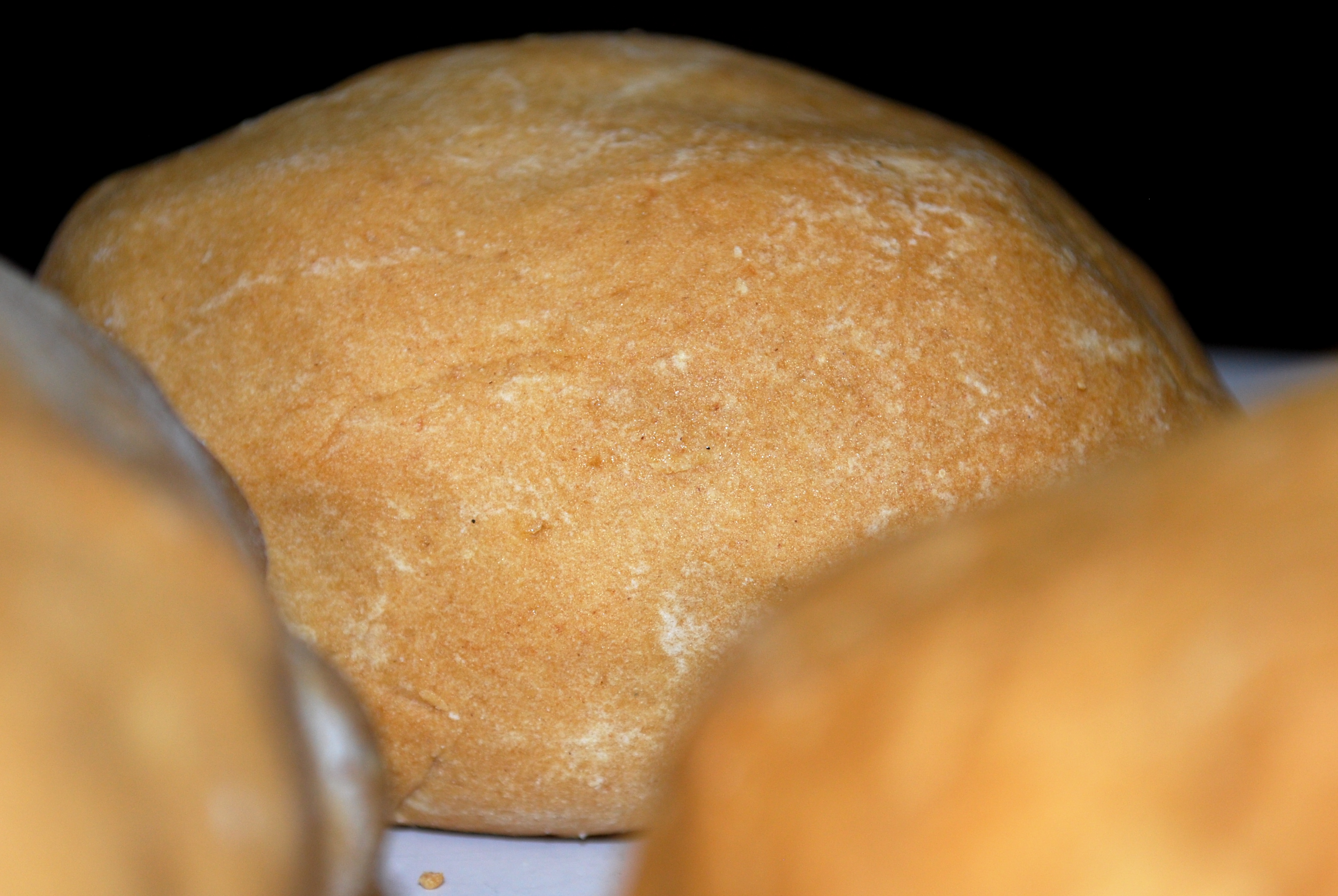
And end up with... culinary ooze...

To back up a little, I decided (and mentioned in the links post I did for Là Fhèill Mìcheil) to have a go at making a different version of the Strùthan Mhìcheil than I've done before. Here's one I made earlier:


It's a very dense bannock because it doesn't have any butter in it, and the caudle topping was very thick so I was able to spread it on and it stayed put. This one above was the large one, but I made individual ones as well:


Which turned out rather neatly.

The recipe I used for the most recent batch is here, and it kind of requires a certain level of psychism to actually figure out how to make it. For one, there aren't any instructions on how to make the bannock itself, but seeing as it was referred to as a scone I made it like that – rubbed the butter and flour together into fine breadcrumbs, then mixed in the rest to make the dough. I didn't need nearly as much milk as the recipe suggested – I'd say I used half a pint, if that. That part turned out really well – it's much lighter than the ones I've tried previously (because of the addition of butter), which tend to be rather solid and chewy if you don't eat them right out of the oven, so I'll do this version again, for sure. Although in future I think I'll use dried fruit rather than caraway.

Like the ones I've done before, I opted to use golden syrup rather than treacle for the topping, although technically it does call for treacle (black syrup); I find treacle has a rather heavy, bitter taste that overwhelms my tastebuds, so I prefer golden syrup over all. With this version, the topping is more like a proper caudle, involving eggs and milk, whereas the previous version I've tried only has a little milk and no egg at all. For this version, though, t's not entirely clear how thick the caudle topping should be, so I had to guess, and suffice it to say as far as the consistency of the topping goes, I'm pretty sure I guessed wrong:


Oooooooooze.

Treacle and golden syrup have about the same consistency so I don't think switching from one to the other had much to do with it. The recipe suggested adding more flour to the mixture if it seemed too runny, and I did – about half the amount of flour again, and even then I was worried it was too runny. I think I could've doubled the flour and it would've still been a little on the runny side. Too runny to end up with something "pretty," I suppose, anyway, assuming it's not supposed to ooze all over your oven (I'm fairly sure it isn't but I could be wrong...). The individual bannocks I made – one for each of us, and each bannock blessed – all ended up oozing together.

But damn the topping tastes good. Frankly, I could happily just make it by itself and sod the bannock...

For my tastebuds it didn't really compliment the caraway flavour in the scone (I didn't put much in at all – caraway's a very strong flavour, but perhaps I over-did it anyway – although then again, with the heavier flavour of treacle I imagine they'd work together a lot better) but I definitely think with fruit instead of caraway it would work nicely.

Rosie wasn't overly keen on the scone part, but Tom and Mr Seren really enjoyed it. Mr Seren would sidle into the kitchen and wonder if there was any of that "weird bannock scone thing" left. The kids decided, hopefully, that some extra syrup or honey drizzled on top of the scone part would Make It Better, but Speaking As A Mother, I vetoed that idea on the grounds of too much sugar, thankyouverymuch. Maybe next time.

Practice makes perfect, though, right? I'll keep trying.

Wednesday, 30 September 2015

Book Review: Constructing Gender in Medieval Ireland

This is another book I got from the library during the school holidays (and of course after confidently declaring that it "won't take long" to get through them all, I'm two books down and due to return them in two days....).

Before I get into the review itself, I think it's worth mentioning an article I read a while back that's titled 'One Flesh, Two Sexes, Three Genders?' by Jacqueline Murray, which you can find in a book called Gender and Christianity in Medieval Europe, edited by Lisa Bitel and Felice Lifshitz. This was another library find, and while I didn't read the whole book (it wasn't quite what I was looking for – there wasn't much on Ireland at all), Murray's article caught my eye and had quite a bit of interesting food for thought, which I think is relevant in terms of discussing the book I'm about to review. For one, it introduced me to the concept of the "third gender," which the article broadly equated with a "clergy gender."

This third gender essentially encapsulates the idea that people who devoted themselves to religious life in medieval Europe in effect othered themselves from otherwise normal expectations of their gender. Whereas "normally" men and women occupied fairly well-defined roles based on their gender – getting married, having babies, taking on certain kinds of domestic roles or duties, etc. (for example, the focus of a child's education was very different depending on whether you were a girl or a boy, in preparation for those kinds of roles you'd be expected to take on as an adult) – people who dedicated themselves to a religious life as priests, monks, nuns, or hermits, effectively stepped outside of those expectations. Instead of a "normal" life, they were expected to be celibate and couldn't marry, and in the case of monks and nuns, they might live in fairly secluded, women- or men-only monasteries or nunneries, with only limited contact with those of the opposite sex. Because of this, there was more leeway in terms of the kinds of roles that they might take on – having to adopt roles that weren't typically associated with their gender. In secular society, things like that might be frowned upon, but the rules were different for religious dedicants (of one kind or another), whether out of necessity or for other reasons, so it was more accepted and expected, arguably, than people who occupied other areas of society.

To be clear, this is a concept that isn't explicitly articulated in medieval Europe – there's very much a gender binary view of "male" and "female"/"man" and "woman" (hence the examples of "gender norms" I gave above) – so this "third gender" is something that's implied, more than anything. So in practical terms, it's more of an academic concept that can be useful in discussing certain subjects, though it's by no means necessarily universally accepted and agreed upon. It's also a relatively recent concept, as far as I'm aware, and not something you'll encounter in most books that find their way onto reading lists you might find on various websites.

Anyway. Onto the review. Yes, it's time to talk about the cross-dressing nuns (or lack thereof).

Constructing Gender in Medieval Ireland
Sarah Sheehan and Ann Dooley (Editors)


There aren't very many books that deal exclusively with gender or sexuality in terms of Irish studies, so this volume here goes some way towards filling that gap (as the editors themselves note). Although it should be said from the start that if you're looking for any in-depth articles about attitudes towards anything other than heterosexual relationships or sexuality, you're going to have to look somewhere else, I'm afraid.

The book contains nine articles from nine different authors, and as usual I'll concentrate on the ones I found to be the most interesting, throught-provoking, or useful. Some of them weren't as engaging for me as others were, but the ones I did enjoy gave me a lot to think about, especially because the authors consider not just the historical view of things – this is what we see in the sources, so when we put it all together this is how we see society was, etc. – but they also consider how historians have dealt with the materials before now and how different approaches, different ideas and social attitudes or trends, and personal biases, have influenced our own interpretation of things as the field of Celtic Studies has evolved. This is especially important when we consider some of the better-known figures in Irish myth, like Medb and Macha, who both present a very atypical expression of gender expectations of the time, and both of them are discussed at various points in the book.

We get off to a good start with the first article by Máirín Ní Dhonnchadha, with a look at 'Travelers and Settled Folk: Women, Honor, and Shame in Medieval Ireland.' It's an obvious choice to put first because this article introduces the differences in expectations between men and women, and the kinds of gender roles that were expected of them (by and large), which are important to understand in helping us interpret what we find in Irish myths, laws, and other historical sources. Of course there are always exceptions to the rule, and these are considered as well, and in particular Ní Dhonnchadha touches on the topics of female poets and warriors – both of whom would have had to travel as part of their jobs.

A large part of the issues surrounding travel were on safety and sexual propriety, and the latter point follows on nicely into chapter 2, 'Sex in the Civitas: Early Irish Intellectuals and their Vision of Women' by Catherine Swift. Swift starts off with a quote from Yeats – "After Cuchulain, we think most of certain great queens – of angry amorous Maeve with her long pale face, of Findabair... of Deirdre who might be some mild modern housewife but for her prophetic vision... I think it might be proud Emer... who will linger longest in the memory, whether she is the newly married wife fighting for precedence, fierce as some beautiful bird or the confident housewife who would waken her husband from his magic sleep with mocking words" – noting that these references to "queens and housewives" speaks more to Yeats' own view and expectations of women than how it was for the women he's talking about; Emer or Deirdre, as women of high status, were hardly housewives. They had servants and slaves to be doing all of that while they had the freedom to pursue all the things expected of a lady of good breeding. From this we move on to how these attitudes are prevalent throughout time, especially when it comes to looking at the kind of sexual mores we find in early Ireland. Aside from the myths, which often play with themes of gender expectations and sexuality, our view is mainly involved by the men of the Church who wrote extensively about what marriage should be, how sex should be, and the kind of penances that should be performed when transgressions were made, and they had their own biases, of course, and the views they espoused are often contradicted by the myths.

This article has a lot of post-it notes from me, and another one that got the same treatment was Amy C. Mulligan's 'Playing for Power: Macha Mongrúad's Sovereign Performance,' which takes a fascinating look at the story of Macha Mongrúad's reign. Mulligan discusses a lot of good points about the story, though I anticipate her view that the Macha we see here is not an expression of a divinity per se, but is rather a figure who contains elements of a sovereignty goddess, is not something that will be met with universal agreement...

Skipping ahead to the cross-dressing nuns ('They Kept Their Skirts On: Gender-Bending Motifs in Early Irish Hagiography,' by Judith L. Bishop), this was another article I greatly enjoyed, and it's what made me mention the stuff about third gender above, because it seems to fit in with the "gender-transgressive" theme of the article, especially in the sense that it's specifically in the context of religious expression and attitudes towards gender. In particular, one of the main threads of the article here is that gender transgressive acts in Irish hagiography ("saint's lives"), where saints are forced, or choose, to dress in clothes that are the opposite of their gender, just aren't a thing, even though it's clear that the stories of such saints from further afield were definitely known to the Irish. It's interesting, then, that there aren't any stories of Irish saints that picked up this theme and ran with it, even though we do see, in a broader sense, there are certainly examples of saints who engage in "gender-transgressive" acts – Brigid being ordained a bishop, say, even though women can't normally be bishops. In spite of this fact, the ordainment is said to have been accepted and Brigid remained a bishop, although as Bishop notes, she's never seen performing the trappings of a bishop. In fact, there are references made about the fact that she's unable to fulfil certain roles associated with that of a bishop specifically because of her gender.

There's plenty more that's worth a read here, but I don't want to go on for too long. As much as I'd recommend the book, I think it's probably going to appeal to people who've already got a pretty good grounding in the basics and/or have an interest in this particular area of study. This is very much an academic read, so if you're looking for some light bedtime reading, I don't think I'd count this one as falling into that column...

I did feel that (at times) different articles touched on themes that had already been dealt with elsewhere, in a way that felt rather repetitive. That's only a very minor quibble, though, and perhaps it's inevitable when it comes to a book that's so focused on a particular theme. I suppose my biggest disappointment is the lack of any discussion of anything other than heterosexual relationships. For one, scant though the evidence is for lesbians (or bisexual women, etc. Perhaps I should say "Women who sleep with women, though not necessarily exclusively?") and "playful mating," we do have the tale of Niall Frossach that I think would be worthy of attention from the kind of approach towards gender theory and gender studies found here... So I guess, in conclusion: More please. And more diversity? That would be very much appreciated.

Saturday, 26 September 2015

Links and things for Là Fhèill Mìcheil

I accidentally typed "kinks" and things in the title there, which would put an altogether different tone on the rest of this post...

But anyway, as usual, let's start off with a video from Gaol Naofa's Youtube channel:


Which gives a short introduction to the festival as well as some ideas for things to do. I've done a more in-depth article over on Tairis, along with a short piece going over some practical ways of celebrating:
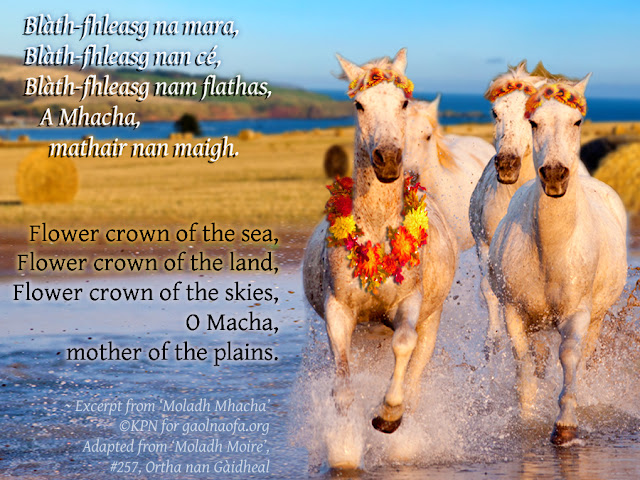
Given the associations of St Michael and horses and the sea, along with the harvest theme, there are a number of deities that could be connected with the festival, and Kathryn wrote a bit about that on her blog. She also did the meme we posted on the GN Facebook page on Monday:

Photo collage from original images by efilpera (horses) and Duarte JH (field)
Along with the adaptation of the prayer, which you can find in full on the Gaol Naofa website's new meme page.

As far as things to do go, the big one is making a Strùthan Mhìcheil, or Michaelmas struan, which is a specially made bannock that's coated with a kind of caudle. I've posted a recipe for it on Tairis, which is taken from Margaret Shaw's Folksongs and Folklore of Uist. The Ceolas website has a more scone-like version, which I'm going to try tomorrow, hopefully (I prefer to use golden syrup as opposed to treacle, personally, though). An offering can be made of some of the strùthan, perhaps as you "beat the bounds" of your property, if you're able.

In the run up to the festival you could also try going out to look for some wild carrots (also known as Queen Anne's Lace), which are traditionally gathered at this time of year, although they may not grow in your area (and they're considered a problem in some parts of the US so it's probably not a good idea to grow them yourself). If you do go looking for them, it's important to be cautious because they're easily confused with poison hemlock (conium maculatum) and a couple of other plants. If you'd rather play it safe then the more usual orange variety of domesticated carrots (or more specialist variants, like purple or white ones) could be harvested (or obtained by other means) instead.

Of course, a good party is always a great way to celebrate any festival, and as Carmichael notes (two links up) there's a traditional dance that's done to the tune of Cailleach an Dùdain ('The Old Woman of the Mill-Dust'). Here's an example of the tune with a peurt-a-beul accompanying it:


The Carmichael Watson Project Blog has some interesting commentary on it, and also notes that the last sheaf of the harvest is often woven into a doll called the Cailleach. As winter approaches, she's certainly making her presence felt as she prepares to resume her wintry reign, and let's not forget that she also has associations with the equinox in Ireland, at Sliabh na Caillighe (Loughcrew), where Cairn T is oriented to the equinox sunrise.

That's about all I can think of at the minute, but check back on the Gaol Naofa Facebook page for another related meme on Monday...