Sunday, 2 February 2014

New Article – Children and Family in Gaelic Polytheism

So I've posted this in a few places and might as well post it here, too:

Gaol Naofa is proud to present our latest article for the website, this time focusing on Children and Family in Gaelic Polytheism. 
Although the main purpose of the article is to give parents ideas on how to include children in a family-based Gaelic Polytheist practice, we hope it will also prove useful for individuals – whether youth or adults – who are new to GP, as well as to other sorts of multigenerational spiritual communities. 
The basics of belief and practice are broken down into their various elements, and practical ideas and examples of simple prayers are given that a child or beginner should be able to get to grips with easily enough. 
Read more...

Brìde and her menagerie

Usually this day sneaks up on me somehow, but for once I managed to keep track of time long enough to be prepared. Hurrah! I'd make a terrible Brownie or Girl Guide. Whichever one is supposed to Be Prepared.

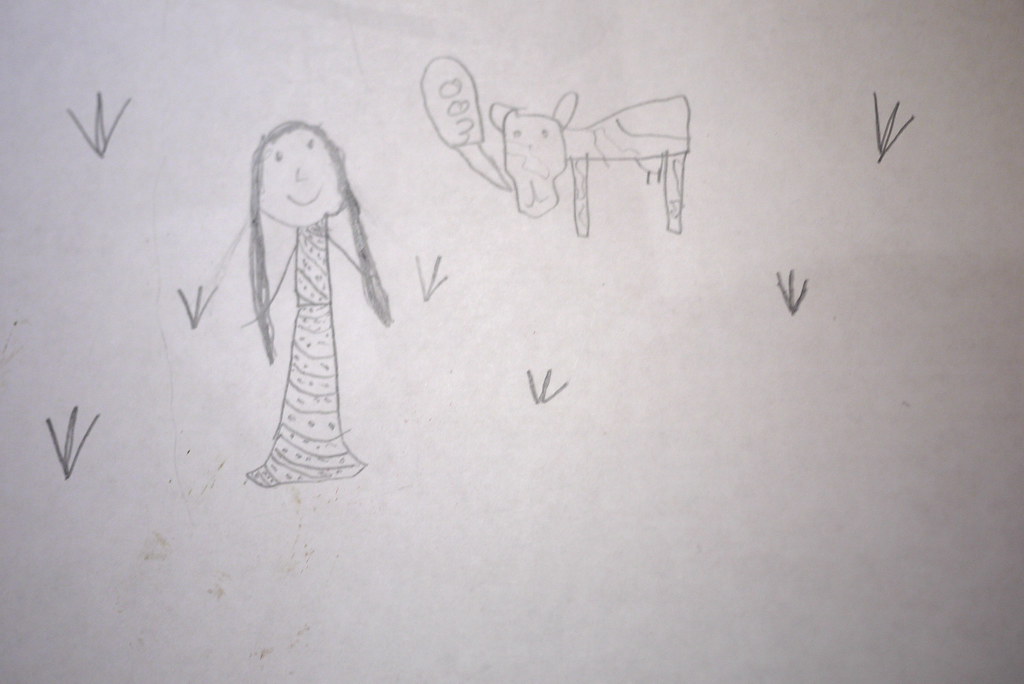
Aside from Samhainn, this is the festival that the kids love the most and are keen to get involved in, mainly because there are lots of things for them to do and make. Also, Rosie in particular thinks of Brìde coming around with her cow as being akin to Father Christmas dropping round, except this time we have to leave presents for her. I assured Rosie that we'd leave out some food (just like we do for Father Christmas, after all), but she insisted on something more:


She drew a picture before it was time to go to school on Friday morning and was going to colour it in later, but then decided she didn't want to ruin it. I've no idea why the cow is saying "oom," so I can only conclude that bovines, like gods, work in mysterious ways. Or else six-year-olds do.

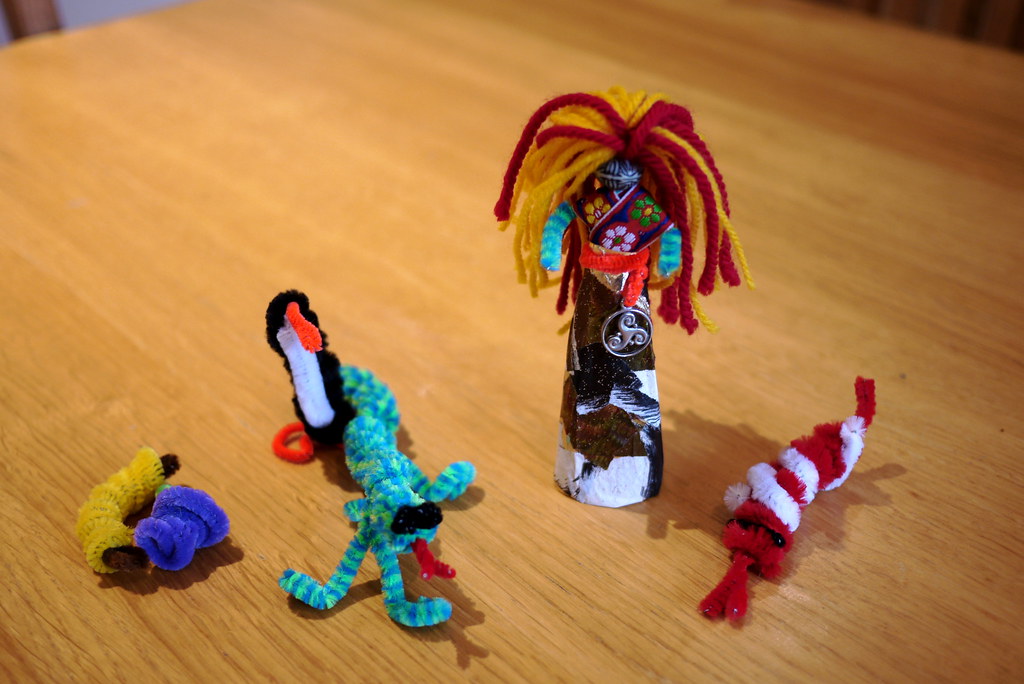
I wanted to get hold of a kit to make our dealbh Brìde but the local garden centre didn't have anything that was particularly appropriate for the kids to join in with. The next best thing was a book with a set of pipe cleaners and some ideas for things to make, which were simple enough for the kids to make themselves. Tom wasn't sure he was keen on the idea of making a doll, so it seemed more inclusive, too, which was a plus. In the end, the day before we were going to celebrate, I made the dealbh Brìde and the kids made some of the things from the book. We ended up with quite the menagerie:


Tom made a snake all by himself, which seemed quite apt. Accompanied by a very authentic lizard, penguin, grape, and banana, I'm sure you'll agree. The grape ended up being repurposed as a lantern for Brìde, at Rosie's insistence. She's taken the festivities to heart this year.

So on Friday the house was cleaned and tidied, ready for the evening of festivities, and then we feasted on roast chicken with sticky toffee pudding (at Tom's insistence, and which he made), we danced and sang, and we invited Brìde in and set the icon in her bed. The house was sained and devotions and offerings were made, and the kids took forever to get to sleep because it was all just so damn exciting. At bedtime they decided they wanted to leave a blanket out each, for blessing, so I promised I'd do that for them. I put some things out for me and Mr Seren as well.

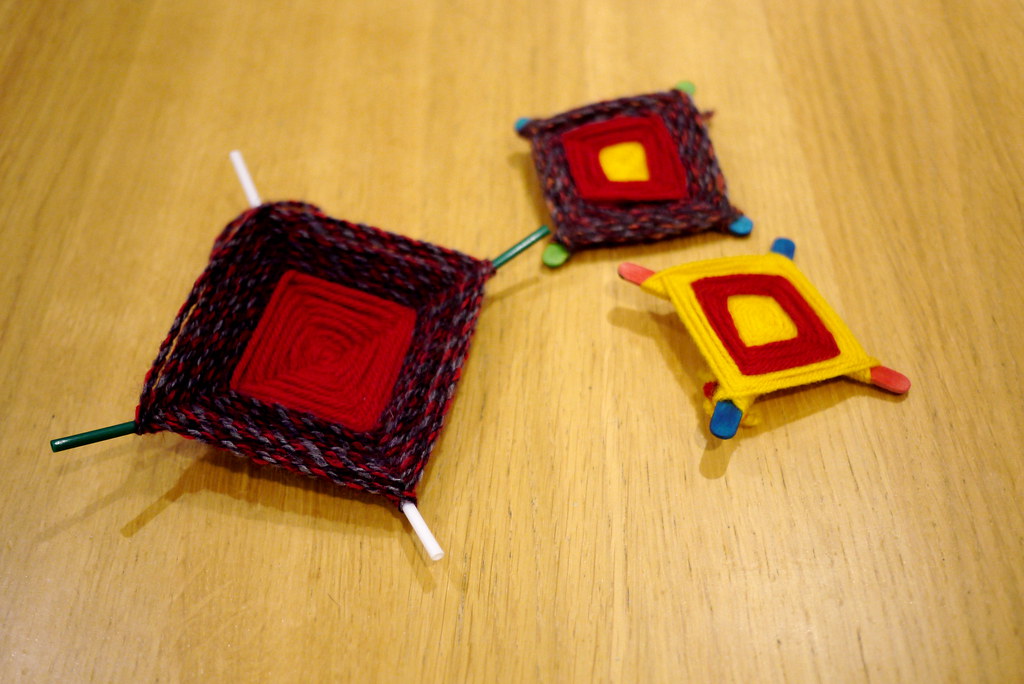
We didn't have time to fit everything in so some of it spilled over into today. Rosie and I made a cros Bríde each:


And then Tom decided he'd like one for his room, so I said I make another one if he wanted. He wasn't keen on doing it himself, so he picked the colours and I set to it. The one I did is the largest, while Rosie picked red and yellow for hers. Tom wanted a mix of all three:


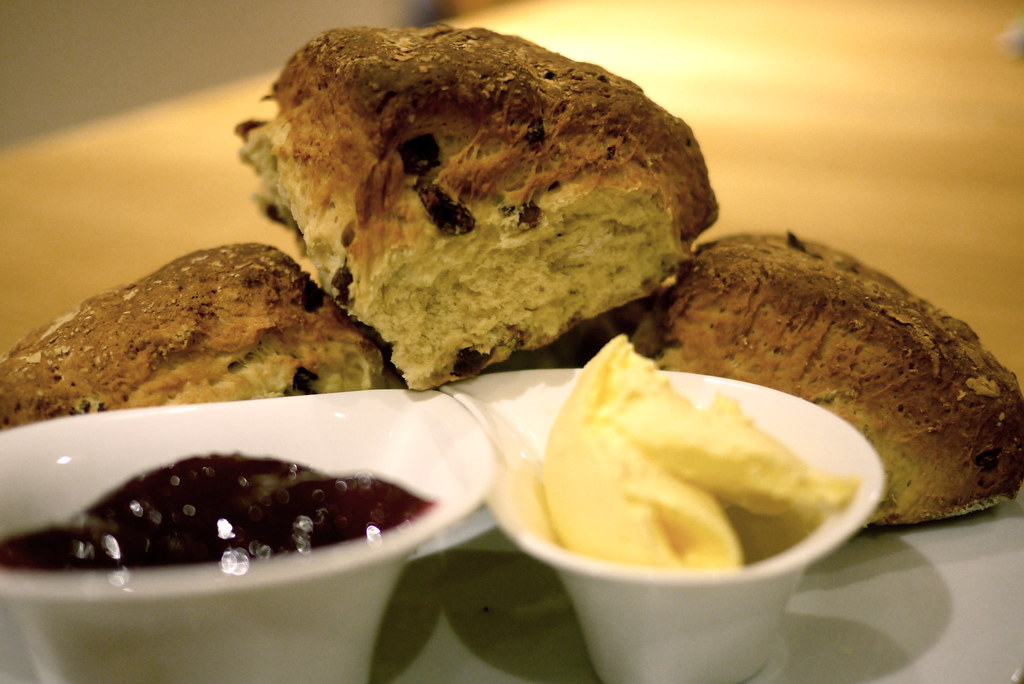
For dinner this evening we had beef and barley stew with another go at Skye bannocks for after, which I blessed as I made them:


They certainly looked better than the first go I had at Lùnastal, but the blackberries I put in then were a nice addition. The sultanas I added this time round were good too, but blackberries have the edge, I think.

While dinner was cooking I had to nip out to the shops to get some bread and Rosie took it upon herself to write a poem for Brìde as she entertained herself with Minecraft. It was completely her own idea, and she was very excited to show it off once I got back. I insisted on taking a photo for posterity:


Then when I went to dish up the dinner and the kids were waiting at the table, there was a miracle! The kitchen windows had steamed up and a heart had appeared on one of the panes of the back door where we'd invited Brìde in the night before. The kids insisted that neither of them had done it and Rosie was so giddy because that just had to mean Brìde had been to visit, she almost passed out. There was definite communication with dolphins...

All in all, things seemed to come together nicely. As much as I've been at this for a good while now (by today's standards, anyway), now that the kids are starting to become more involved with things it's like being able to see it through a different point of view at times. One thing that's becoming more clear than ever is that it's the simple things that can be the most meaningful, whether it's a heart in the window or the first crack of sunshine after weeks of cloud and rain and sleet.

Brìde has been. Spring is on its way. Brìde is welcome...

Friday, 3 January 2014

Hogmanay Duan

Oidhche Choinnle, oidhche shona,
Oidhche air am bi loinn is sonas,
Maighdeanan a’ roinn nam bonnach,
Coinnlean a’ boillsgeadh soluis;
Chiream charam feadh an tighe,
So an tigh ’s am beil mo ghnothach,
’S chan eil romham dhol na’s fhaide! 
Candle-night, fortunate night,
Splendid and felicitous night,
Maidens distributing the bannocks,
Candles shining with their light;
Lots of bustle about the house,
This is the house where my errand lies,
And there’s no need for me to go further. 
MacTalla XI, October 17, 1902, translated by Catriona NicÌomhair Parsons


Bliadhna Mhath Ùr dhuibh uile!

Slàinte, sonas agus beartas dhuibh,
Bliadhna mhath ùr, agus mòran dhiubh.

Health, wealth and happiness to you,
Happy new year, and many of them.

Happy New Year!

The last month or so has been incredibly busy here, with the baking and decorating of copious amounts of cake and a long overdue trip to my hometown to catch up with friends and family, and (more importantly) attend my sister's wedding. An evening spent drinking massive amounts of chocolate-flavoured wine with my gracious host, Dyni – who so very kindly put us up at pretty short notice – and my dear friends Candleshoe and Mudrat (actual names withheld to protect the guilty. Heh) at least made up for the horrors of spending the best part of a day with my whole family in an enclosed space, and it was good to see my nan for the first time in three years. The wedding itself was lovely, though, and the vicar was hilariously stoned.

And with that done, there was the long trip home, and Christmas was just about upon us.

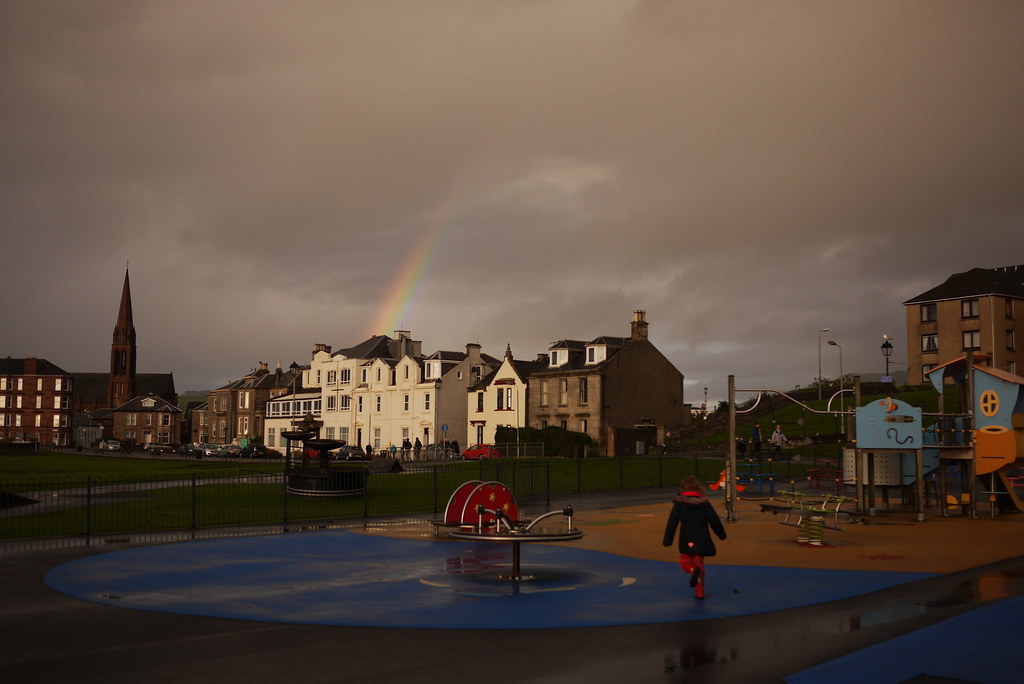
The winter has been pretty mild in terms of temperature, in spite of a cold start, but it's been extremely stormy, and even when it hasn't been howling with wind and rain outside, it's been pretty moody and grim:


But with plenty of rainbows to add a little variety:


We managed to make it home just before the worst of the storms hit, thankfully, and so we were able to spend Christmas Day with the in-laws and my now four-month-old great-niece.

Hogmanay was a quiet one, as usual. The kids decided to stay up and wait for the bells, and as per tradition, once the bells had rung and the toasts were made – with orange or apple juice, on the insistence of the kids – Mr Seren proudly announced that he hadn't had a shit since last year. He's a charmer, that's for sure.

As usual, we'd spent the day "redding" the house – cleaning and tidying and making sure everything was all as it should be. In the evening a feast was had, and once I'd taken a shower and was all set for the evening, we lit some candles and put them in the window and all along the mantlepiece to begin our festivities proper. Games were played, a chocolate yule log was consumed, and then the old year was laid to rest. Offerings were made, thanks were given, and the old year was swept out and the new year welcomed in. We put a silver penny out on the doorstep to see if the new year will be a prosperous one (it was still there in the morning, so it should be...here's hoping). Then, for New Year's Day itself, it was off to the in-laws for the customary steak pie dinner and more cuddles with my great-niece.

And now thoughts are turning to the year ahead, in hope and wonderment at what it might bring for us; hopefully good things. Whatever it has in store for us on a personal level, it's sure to be an interesting one on a broader scale too, with the Scottish Referendum come September. Although I predict that "ridiculous" might also be a good adjective too, if the media coverage so far is anything to go by.

Monday, 2 December 2013

Book review: The Holy Wells of Ireland

The Holy Wells of Ireland
Patrick Logan

I've read a couple of books by the same author before now and those are well worth taking a look at –one called Irish Folk Medicine, and the other called The Old Gods: The Truth about Irish Fairies. Logan is a great author and a medical doctor by profession, so in both this book and the Irish Folk Medicine volume he has a lot of expertise to draw on when it comes to the folklore of healing.

The Holy Wells of Ireland isn't a hefty tome but I think it's fair to say that it covers all of the basics – the typical locations that wells can be grouped under (on the seashore, mountain or hilltop, bogs, churches, and wells that move), legends associated with them, pilgrimages and rituals associated with them, and the kind of purpose they're used for, the kinds of offerings that might be left, and the kinds of trees or animals associated with them, too. These are all dealt with in their own chapter, so it's well-laid out and the repetition is kept to a minimum – always a plus if you just want to pick at it for research.

It should be said that while detailed descriptions of some of the rituals associated with certain wells are given – the timing, the number of rounds made, walking barefoot or on the knees, the kind of offerings left, and so on – you won't find much in the way of details about the liturgy used in the rituals. If that's what you're hoping for you'll be disappointed, I'm afraid, but that's because it's basically all thoroughly Catholic. An outline is given – the number of stations or decades that should be done, the point at which the Creed is recited, etc. – and I have to admit, not being raised Catholic I only had a vague idea of what these mean (until I asked my husband). Although Logan is quick to point out where there are appearances of pre-Christian elements, and how it can sit uncomfortably in the Christian landscape, that's about as much as you're going to find.

This book is a good introduction to the subject, but it's not as in-depth as it could be, which is a plus and a minus. It's not too dense, but sometimes it's a little superficial in its coverage in places. In particular, although the seasonal pilgrimages to holy wells at times like Lúnasa are talked about, I think it would have been better to have added a little more context to the timing of the visit and how it fits into the traditional calendar, and so on. I would expect that most people who would read a book like this would already have an idea of that kind of thing so it's maybe not such a big deal, but having a bit more meat would have given a more thorough discussion of the subject, perhaps. Having said that, I think it's also fair to say that presenting the seasonal visits in the context of a wider practice associated with holy wells is also useful, and sometimes over-looked. The special occasions they were visited may have been when they were considered to be at their most powerful, but that doesn't mean they weren't considered to be useless at other times.

Although (as with his other works) there aren't exhaustive footnotes and citations, he does at least give passing references throughout the book, and there's a bibliography too. Many of the sources he draws on are now easily found online, at places like archive.org, so the book is going to be very useful if you're wanting to dig a little deeper and that helps to make up for any areas that aren't as detailed as you might like. Also useful is the fact that Logan discusses the context of his sources, and makes the point that although many of the sources are disapproving of the rites and rituals they describe, the more "hostile witnesses" often go into more detail than someone who is more sympathetic. In that respect, sympathetic witnesses may have had a tendency to gloss over the more uncomfortable "pagan" elements of practice and give less detail, while the hostile witnesses were more willing to emphasise them in order to underscore their bias and feelings about it. The latter is often more useful to us, even if the writer might over-emphasise or even embellish at times, or just spend a lot of time disapproving about stuff rather than getting on with it, but it's ultimately up to the reader to assess this kind of thing. This is a very useful point to make, and when referring to a source Logan makes clear whether or not he thinks the writer is hostile, which helps the reader interpret the information being given.

In terms of its "usefulness" as far as providing inspiration for practice might go, I think this is a good supplement but not so much a must-have for the bookshelf unless you're particularly interest in healing as a speciality. I can see myself referring to it every now and then, and it's a damn sight more convenient than trawling through archive.org to find the right antiquarian book or article (and it gives an idea of things that have survived to the modern day, and things that haven't, which the older sources obviously can't tell you), but all in all it's never going to be as well-thumbed as my favourites.

Even if it's not essential, there's some interesting stuff here, especially in relation to the instances of fish (usually trout, usually considered to be immortal or A Very Bad Sign if they die) that are found in some of the wells. This offers some food for thought as far as cosmology goes (the well of Segais, for instance), and the chapter on trees associated with wells will surely be of interest to quite a few folks as well. I would definitely recommend it as an easy and engaging read if this is your kind of thing. It's maybe one for the bookshelf when your book budget has snapped up the more essential items on your reading list, but it's worth a look at some point and it's cheap to buy second-hand. That's always a plus.