Tuesday, 24 September 2013

THE NIPPLES STRIKE AGAIN

As you might have heard by now, the Laois bog body (now dubbed "Cashel Man") has been officially declared as the world's oldest. As you may remember, when the body was first discovered a couple of years ago now, pretty much every report focused on one man and his theory about nipples...

And lo! Here he is again:

In the other two bog body cases, says Eamonn Kelly, the nipples had been deliberately damaged. 
"We're looking at the bodies of kings who have been decommissioned, who have been sacrificed. As part of that decommissioning, their nipples are mutilated. 
"In the Irish tradition they could no longer serve as king if their bodies were mutilated in this way. This is a decommissioning of the king in this life and the next."
Quoth the Beeb

Once again, there's no firm evidence offered for any of this, and as before there is no consideration of the alternatives to offer some balance in the article itself. Is it indicative of a ritual "decommissioning" or, as National Geographic points out, more to do with the conditions of the bog and delicate tissue like the nipples just not surviving? Granted, perhaps that makes less of an exciting story...

Sunday, 22 September 2013

Fishing for brambles

It's been quiet round here over the past month or so, but I've not been slacking (honest). Since Lùnastal and the kids going back to school shortly after, I've been concentrating on writing and doing the odd job here and there, and – unfortunately but not surprisingly – dealing with back problems again. It's officially been a year since I had surgery and I had a good run but I was never going to be totally pain or problem free. Ah well.

With the kids back at school, so comes the homework and the projects they'll concentrate on for the term, and it's ended up being a happy coincidence. Much to their delight they're both doing their favourite subject respectively – Rosie is doing "Under the Sea" (she desperately wants to be a mermaid), while Tom is doing "Space." For his birthday just over a week ago he asked for a telescope and a microscope, "Because space is AWESOME and so are small things," he said. So the in-laws obliged with the telescope and we got him the microscope, and an unnecessary amount of Lego Technic, along with a trip to the Glasgow Science Centre, which was equally AWESOME. Unfortunately it's rained pretty solidly ever since his birthday so the telescope hasn't seen much use yet, but it looks like next week might improve.

For Rosie's part, she's loving every minute of her school project and is becoming increasingly worried about the well-being of sea creatures – especially as far as pollution is concerned. So after hearing at length about all the kinds of things fish or birds might get stuck in "and they might die, mum, they might die," I suggested that maybe we should go to the beach and pick up some rubbish if the weather was up to it this weekend.

It so happened that this weekend was also some kind of national beach clean up day, and we could've gone to a local beach and joined a group of volunteers, but that was too far away to walk and Mr Seren is away working. A bit of community spirit would've been nice, but the local beach it was. We took the dogs with us, some carrier bags, and some snacks, and we went "fishing for brambles" along the way and got a good stash. I think this is officially Rosie's most favourite time of year because FREE FRUIT MUM, and every day, when we come home from school, we have to stop and "fish" for blackberries in the bushes along the way. It is the bestest thing ever, when you're six, although it's very important to leave enough for the birds, isn't it mum?

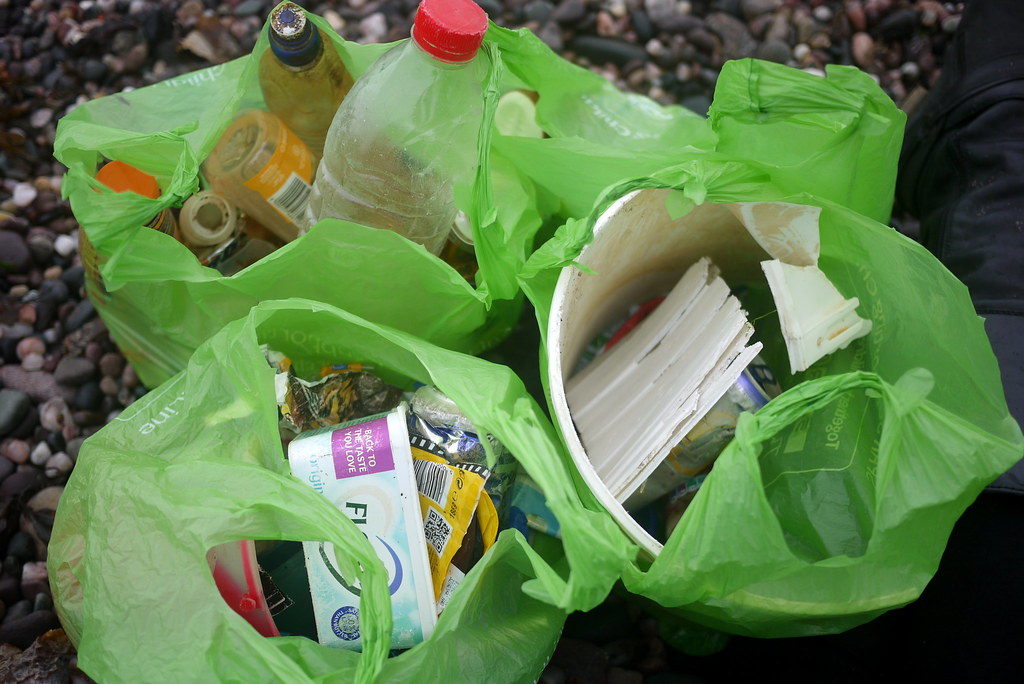
Once we got to the beach and the kids had refuelled, we put our gloves on and set to work. My back wasn't up to much but I managed to fill a bag. Tom was more interested in the rocks, to be honest, but he filled a bag too. Rosie was by far the most enthusiastic in the litter-picking, and she ended up filling two bags. We didn't find anything too untoward on the beach – a bunch of bottles that were mostly still full of juice, empty cans of beer, bottle caps, wrappers, and bits of plastic:


We would've got more had I been up to it, but it's a start.

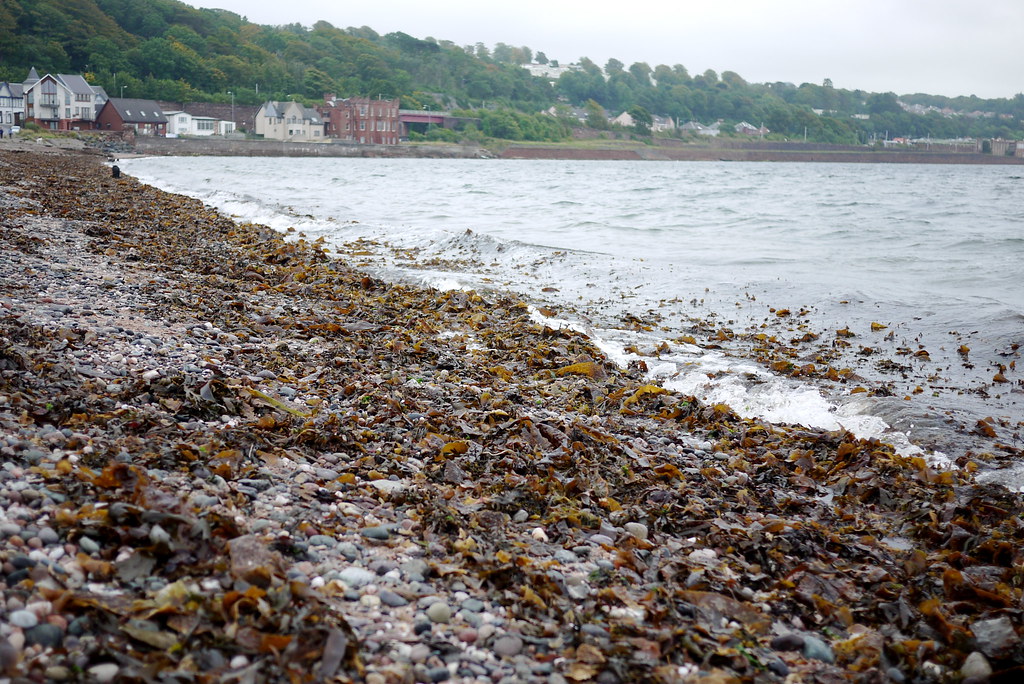
The seaweed is dying off now and coming to the shore in heaps – helped by a recent storm, I'm sure:


Manannán's having an autumnal clearout.

Before we left we made some equinox offerings to the spirits of the beach, and to Manannán out at sea. We left some of the blackberries for him, along with some bits I'd brought with us from home, and built a wee cairn as we usually do, and set off back home, only stopping to dump our rubbish at the first bin we came to. Rosie insisted she carry some bags "to be helpful" and Tom gallantly took charge of Mungo.

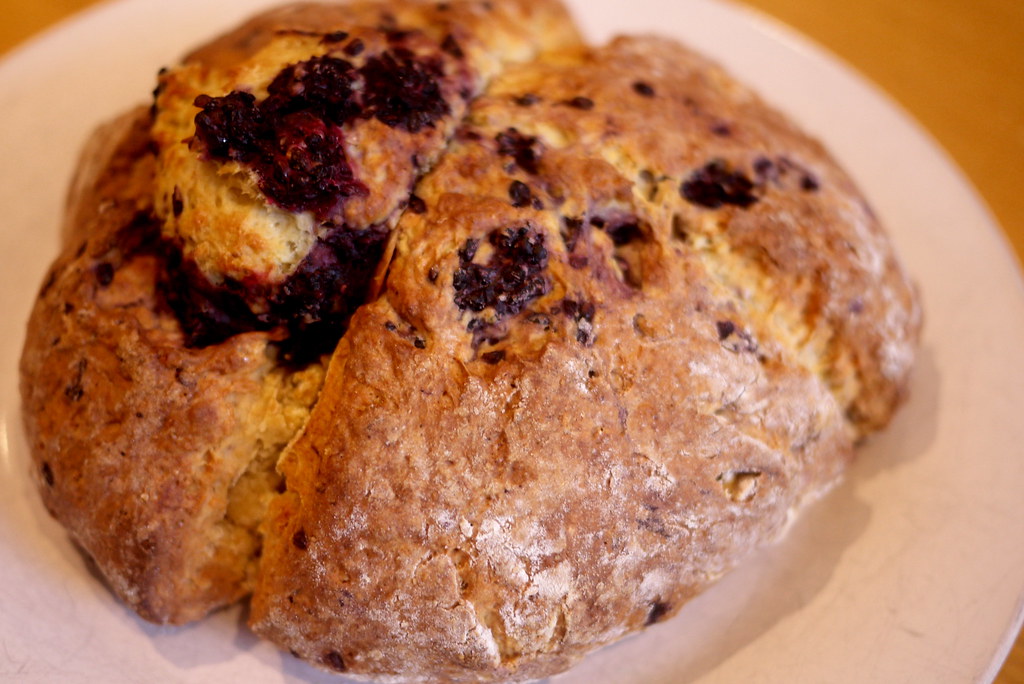
Back at home, I realised I was out of oatmeal to make the kind of bannock I usually do, and so instead of a more seasonally appropriate struthan, I decided to try out a recipe from Skye that was shared by one of the members on the Gaelic Polytheism group; it's pretty similar to the struthan, but sweeter (I didn't put the coating on because I didn't have enough golden syrup, but I don't think it needed it, really). I blessed it as I made it and added some blackberries to the dough, and then bunged it in the oven, and:


It turned out pretty well for a first go! Although I'm not quite sure why some of the berries tried to make a break for it. The berries were a little wet so the dough went a bit slimy and I had to apply more flour, and my oven was a little too hot so the inside very nearly didn't cook properly (although traditional recipes tend to prefer "well-fired" baked goods, so it was probably about right. "Well-fired" translates as "burnt" to you and me – so if you ever burn anything in future, just say it's cooked to a traditional Scottish recipe), so it's a bit browner than I would normally do it, but the blackberries were a very tasty addition. Next time I might add a little mixed spice to compliment the berries, but once it was cooked I tried a bit with butter and then a bit with jam and they were both equally delicious. The kids had them for pudding after dinner and really enjoyed them, so we'll definitely be having them again. We had a quarter each and the final quarter (the one with the berries that tried to escape) went out as an offering.

I hadn't really intended to do much for the festival, and I usually celebrate it on the day of Là Fhèill Mìcheil itself (the 25th), but our trip to the beach kind of meant it made sense to just go with it. And thoughts are turning to Samhainn already, mainly because the shops are already full of festive sweets and the kids are getting all excited. The Hallowe'en buckets are ready. Rosie wants to dress up as a meerkat. Don't ask me why; I have no clue.

Tuesday, 27 August 2013

Lùnastal

Lùnastal is weeks past so this is an extremely belated post but better late than never, eh?

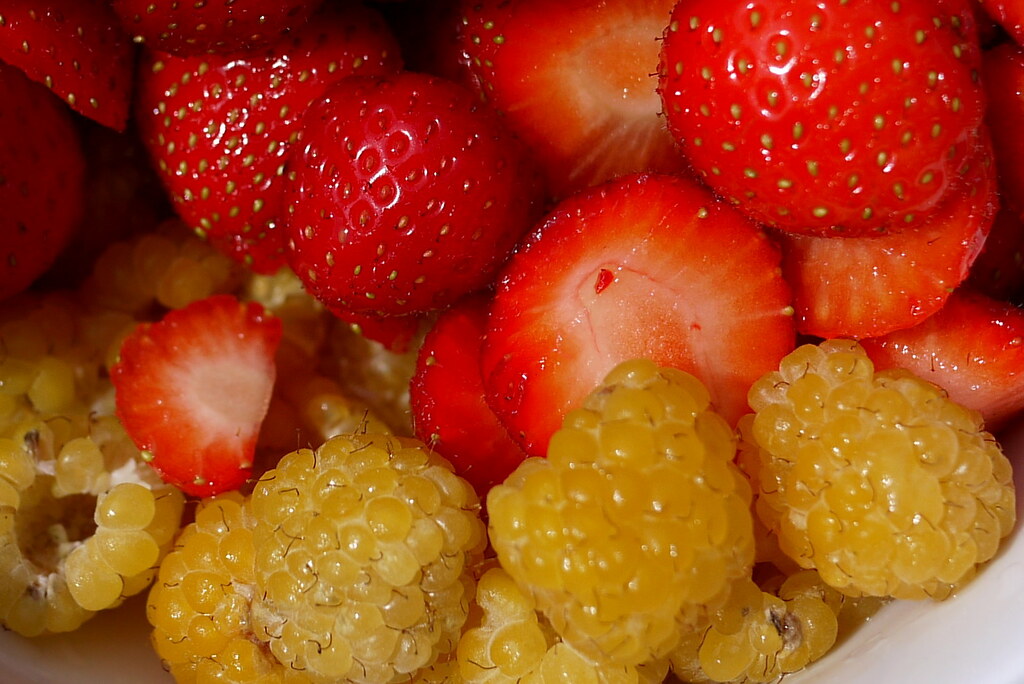
So as with most years, one of the things I tend to do as the harvesting comes to a close is look at all the successes and failures I've had in the garden, and what that suggests for next year when the sowing season starts again. I haven't been able to do much in the garden so what successes and failures we've had are largely down to the slugs and the weather more than anything else, but I think the triumph of the summer has definitely been the fruit – especially the strawberries and golden raspberries:


We had a massive glut of strawberries this year and the cold and late winter meant they were extra sweet and tasty. The golden raspberries were a bit of a surprise, seeing as they've never done much before now in all the years since I planted them and now they've all but taken over the back of the flower bed, which is no bad thing, all in all, but they were a little difficult to get to and they kinda strangled out the black currants.

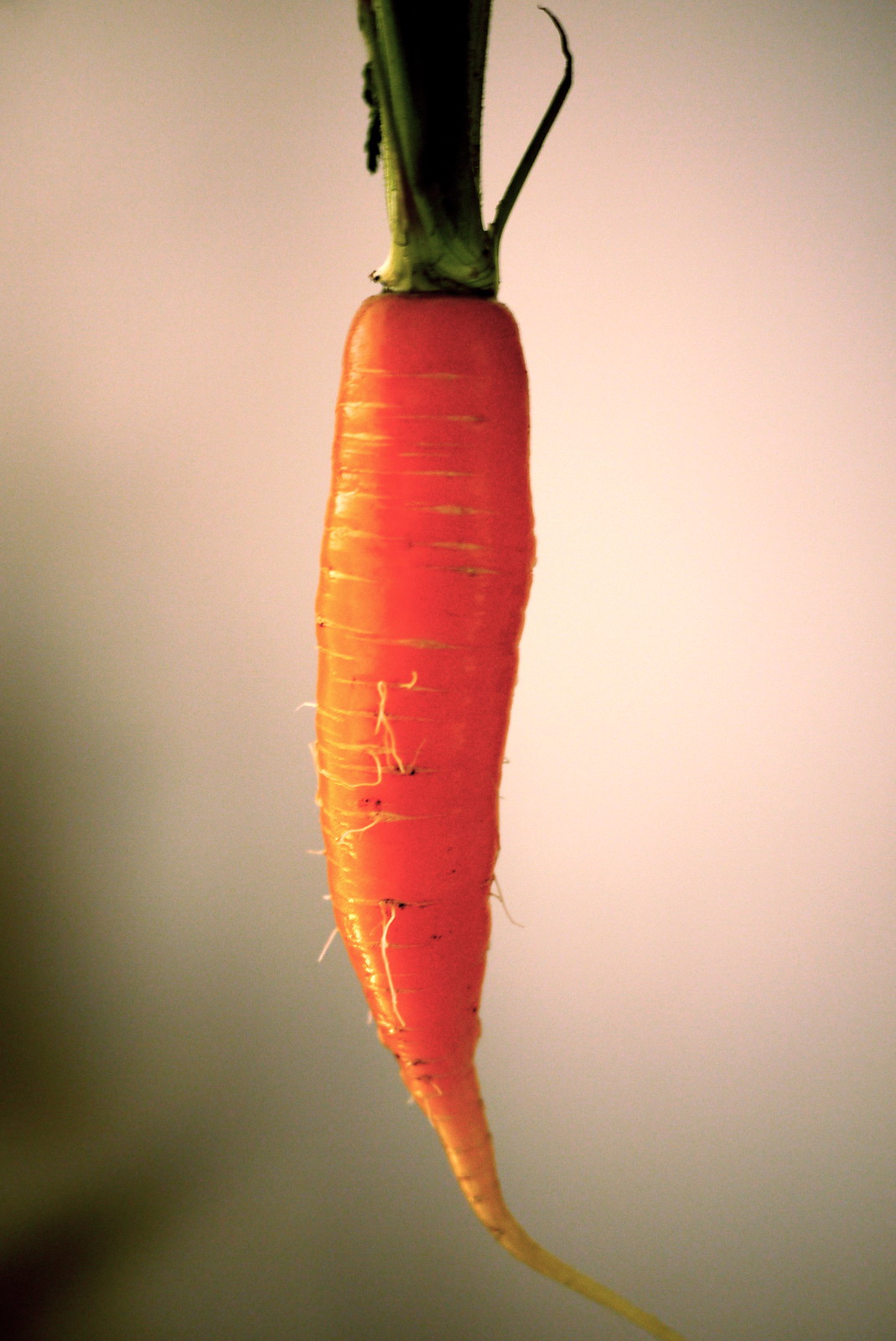
With the veg, the leeks I planted never did anything and the carrots have been a little pathetic too. That's just down the fact that I really need to change out the compost, I'm pretty sure, but so far we've managed a spectacular harvest of one whole carrot, picked specially for Lùnastal:


The rest are still soldiering on, and the onions are only just nearly ready now. The peas did very well but the extremely hot weather we had didn't suit the plants so much in the end and they've died off earlier than they did last year. The blueberries and blackberries have yet to ripen; with a bit more sunshine they should be ready soon – not soon enough as far as the kids are concerned.

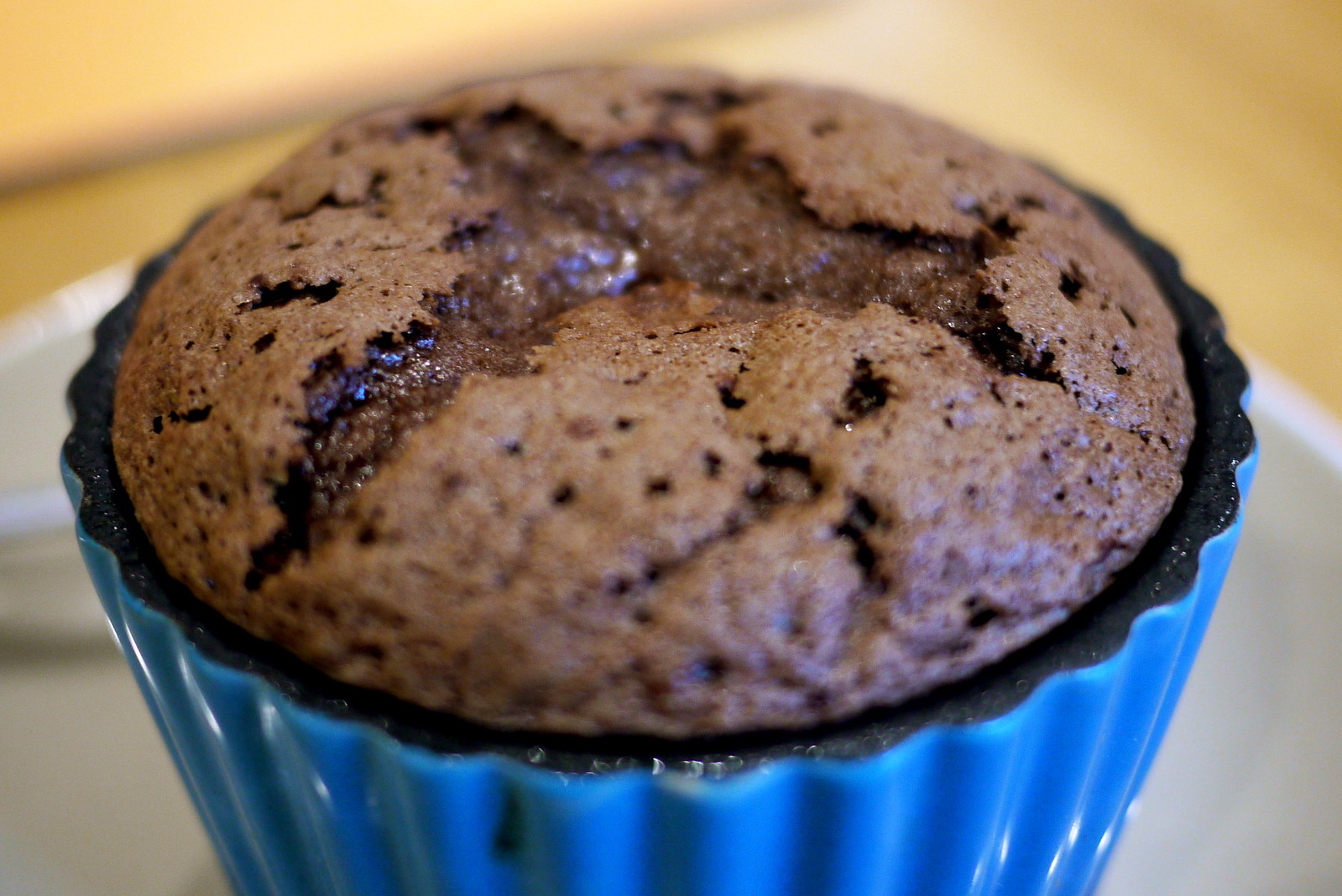
Just like last year we celebrated Lùnastal on time, although just like every year it kinda snuck up on me and ended up with a bit of a flurry of preparations to get everything ready. The signs of autumn have come earlier than usual this year, perhaps the long heatwave we had has made the trees start changing colour a bit earlier. After a little tidying up of the house our festivities began with a late afternoon walk to the vantage point I usually make my offerings at for this time of year. I took the kids and the dogs with me and Tom wanted to know why I was giving food and milk to a hedge (as far as he was concerned), and who I was talking to (in "Garlic" as they insist on calling it), so I explained and there was a lengthy conversation on the way home with increasing excitement as the realisation that this meant a Special Dinner. It was decided there would be roast chicken with roasties and veg (including our tenacious carrot), followed by chocolate souffle with garden fruits to dip in the gooey middle:


I enjoy cooking and every now and then I'll try something new. The chocolate souffle is the most recent pudding I've set out to perfect, and the rest of the family isn't complaining. But the fruit's healthy, right? I wanted to have some sort of harvesting theme involved, so it was fitting, at least (even if souffle's not exactly authentic), and while I was out in the garden collecting fruit and veg, I brought in some flowers for festive decoration as well.

After dinner and the kids were in bed I took some time in the evening to sain the house and make my offerings and celebrations. I offered up some poetry to Lugh and Tailltiu too, and since the night was warm and still and an owl was hooting loudly in the distance somewhere, I spent a long while just sitting outside in the dark, breathing in the salty sea air and listening to waves crashing onto the shore over the hill on one side, and the owl hooting off on the other. I spoke to my ancestors as I sat out there, and I addressed the spirits with a prayer for peace, and then I prayed to the gods too. Lugh isn't usually a deity that seems to want much to do with me but this year he seemed to be more present that I've ever felt before; I don't know why, really, but it was very much appreciated. I pledged to hold some games in Tailltiu's honour the next day, made some final offerings for the night and, eventually, slept the sleep of the exhausted.

I didn't have much time for games with the kids on the eve, so while we managed to fit some in we decided to make a special day of it the next day (with much enthusiasm from the kids). While the weather was beautiful on the eve itself, the day of Lùnastal itself was grey and wet – very autumnal and stormy, even – so the games had to be moved indoors. We were going to have some races and make an assault course in the garden, with a picnic and all kinds of other games, but instead we had cards, board games, and party games inside. With a picnic, if you can call a picnic blanket on the living room floor such. Mr Seren took the afternoon off from work (he's hardly had a day off in the past few months so having some time for all of us to relax and be a bit silly in a serious kind of way added to the festive occasion, I think) and played DJ for a talent contest at the kids' insistence, and then he beat us all at snakes and ladders, while Tom and I drew at the card games. Rosie won the talent contest and didn't sulk at losing cards or snakes and ladders AT ALL, and later proved that she's the queen of hide and seek by hiding in the shed for full on half an hour while Tom began to worry that she was lost for good. Rosie won the prize for most dedicated hider, which entailed her choice in a movie on Netflix because by that point we were all gamed out and in need of a sit down.

And now...autumn is very much here. There's a nip in the morning air, a bite and burgeoning fury in the winds, the blue skies have turned to their customary grey, and my son is no longer insisting on getting up at the arse crack of dawn just because it's light outside at 4am. Autumn is very much welcome around here.

Wednesday, 7 August 2013

Book Review: The Sheela-na-Gigs of Ireland and Britain


The Sheela-na-Gigs of Ireland and Britain
Joanne McMahon and Jack Roberts

The Kilpeck Sheela, by John Harding The Sheela na Gig project www.sheelanagig.org
The Kilpeck Sheela*
There are a fair few books available that deal with Sheela-na-Gigs and they all have varying price tags and reviews. The best one looks like The Witch on the Wall, which seems to be the most sought after treatment of the subject, and is invariably going for between £100-350, or else there's Jerman and Weir's Images of Lust, which seems to be a more populist choice that comes with a more reasonable price tag of about £18. Alas, even that's a little much for me at the moment, so I went for this one instead. I picked it up for a whopping 9p, and as things go I think it's a pretty good bargain.

It's not without its problems – and I'll get to those in a minute – but it's a really good read. It's well written and engaging, and the authors present all the various theories surrounding the origins, influences and purpose of the Sheelas in a fairly balanced manner before giving a catalogue of all the documented Sheelas in Ireland and Britain, and discussing some figures that are related (such as male versions, or Seán-na-Gigs). It's pretty clear which theory the authors favour, but they go into the pros and cons of each theory in a fairly objective manner so you're free to agree or disagree. Each theory is dealt with in a chapter to itself, so it's well laid-out and straight-forward too.

In terms of origins, it's clear that most of the Sheelas are medieval and therefore Christian in date, but the authors also point out that there is iconography from across pre-Christian Celtic Europe that is similar to the poses the Sheelas are depicted in, so there could be pre-Christian influences. One theory (that Hutton argues strongly for in The Pagan Religions of the British Isles) suggests that the Sheelas are continental in origin, coming from a twelfth century fashion for "acrobatic grotesques" that show all kinds of lewd scenes that warn against sin. This book argues against that (though doesn't discount it from being a flavour that came to be added into the mix), pointing to the pre-Christian figures, the non-erotic nature of the Sheelas (their genitals are exposed but that doesn't mean it's supposed to be erotic), and the various features found on Sheelas that mark them out as being decidedly non-continental – they are often asymmetrical, with distinctively and disproportionately large heads, and they generally aren't "acrobatic" in form; their legs are usually drawn up to display their genitals, rather than being shown mid-tumble, or in compromising positions with other figures. The authors also favour the theory that the Sheelas were primarily carved for protective purposes, as opposed to trying to discourage sin, or simply representing fertility.

I learned a lot about Sheelas from this book, and of particular interest was the fact that authors noted the similarities between the Sheela and the "hag goddesses" like the Cailleach, which is something I've pondered on since I stumbled across Sheelah's Day. But there are some problems with the book, and while they're not necessarily major, I'd say they're pretty significant to my mind. When dealing with the subject of Sheelas specifically the book is well-referenced and seems pretty solid, but when the authors step outside of that, things get a little shaky. Unfortunately, it mostly relates to the bits where they talk about pre-Christian religion:
"The hag is a goddess of sovereignty – the Earth goddess responsible for the fortunes, fertility and prosperity of her territory. Her association with life, fertility and death was symbolised by her ability to move between three aspects: a young beautiful maiden, a powerful sexual woman and a hag or crone." (Emphasis mine).
I'm highlighting this bit in particular because I think it's pretty indicative of where the problem is. When pre-Christian religion is mentioned you'll find references to Marija Gimbutas and The Great Goddess and things like that, and in general I just can't get on board with it. The maiden, mother, crone concept just isn't a thing, historically, in Ireland or Britain, and the authors could have looked to far more reliable sources than Gimbutas. There are frequent references to Cernunnos as well, and while the point that the poses the Sheelas take and the way Cernunnos is depicted on the Gundestrup cauldron is interesting (also some evidence to suggest some Sheelas may have been antlered – like Cernunnos), the authors keep referring to him as in Irish deity.

All in all it's disappointing but I don't think it's something that's necessarily unforgivable. I wasn't reading the book to read about all that, and if you ignore those bits (it's mostly confined to chapter 6) and stick to the bits that are more reliably referenced, then it's still a good read. Looking to another review from someone who's more knowledgeable on Sheelas in particular, there are some other issues of accuracy to be aware of, namely the inclusion of a couple of figures who aren't really accepted as Sheelas by other experts, and some proofing issues that have resulted in one Sheela being wrongly labelled. I noticed some general proofing errors, but not the labelling error and I think most readers wouldn't have spotted that kind of mistake unless they're already well familiar with the subject.

Aside from that, while the chapter on symbolism was really interesting – pointing out the consistency in things like asymmetry, instances where one eye appears closed (in keeping with the kind of pose commonly referenced in Irish myths to indicate magic being performed), and so on – the discussion of where the name comes from and what it means felt a little fudged; the different theories were considered but no real opinion or critique offered either way. I agree with this article that the popular idea that it comes from "Sighle na gCíoch," or "Sheela of the breasts" is unconvincing considering that breasts aren't a universal feature of them in general, and while the authors seem to agree, they repeat the meaning later in the book if they accept it.

This is a pretty slim volume so it packs a lot in. In spite of the criticisms I have for it, I really enjoyed the book and would recommend it for anyone who mighas t be interested in the subject. While other books on Sheelas might be more academic and higher up on most book lists, I think this is a fairly solid introduction to the subject and will give you a pretty good overview, especially if you're on a budget (although this site is good, and conveniently free!) and only have a relatively casual interest that will be sated by something short and sweet. What it lacks in terms of accuracy in places, it makes up for in pointing you in the right direction and being more balanced in consideration of the various theories and issues surrounding the Sheelas than someone like Ronald Hutton managed in his treatment of it in The Pagan Religions of the British Isles (which made some good points but was extremely one-sided). All in all: Highly recommended, with caveats.

* The Kilpeck Sheela na Gig, near Hereford, England, taken by John Harding of The Sheela na Gig project. Used under Creative Commons licence via Wikimedia Commons.

Sunday, 28 July 2013

Chimney go BOOOOOOM

Over the past year and then some, there has been ongoing work nearby to demolish the local power station, which was built in the 70s right before the oil prices crapped out globally and made it a financially pointless project. Although the site was completed, it never operated commercially and instead the chimney – the tallest independent structure in Scotland – served as a guide for sailors and pilots and generally creeped out the locals on foggy nights when the lights did things. 

When we moved here, just over five years ago, we kinda thought of the chimney as a bit of a blot on the landscape. It was certainly hard to miss and being so close to it, the towering pile of concrete loomed over us and gave a general indicator of which direction the rain was coming in...But soon it became a familiar sign that we were home. It was a sigh of relief. My nephews, whenever they came to visit, would know they had arrived in Scotland because they could see the chimney (in spite of the fact that we're a couple of hundred miles north of the border or so...), so it was always a big thing to catch sight of.

But while the power station was testament to all that was smooth and shiny in the 70s, it was just taking up space in the 2000s, so it was decided that it had to go boom to make way for housing (naturally). Every now and then bits of the power station would get blown up but initially, when we moved to these parts, they were saying that the chimney couldn't be blown up because of the risk of tidal waves and so forth (it's right on the river side). Naturally someone with a brain and a mathematical head said otherwise, because going boom is exactly what happened in the end.

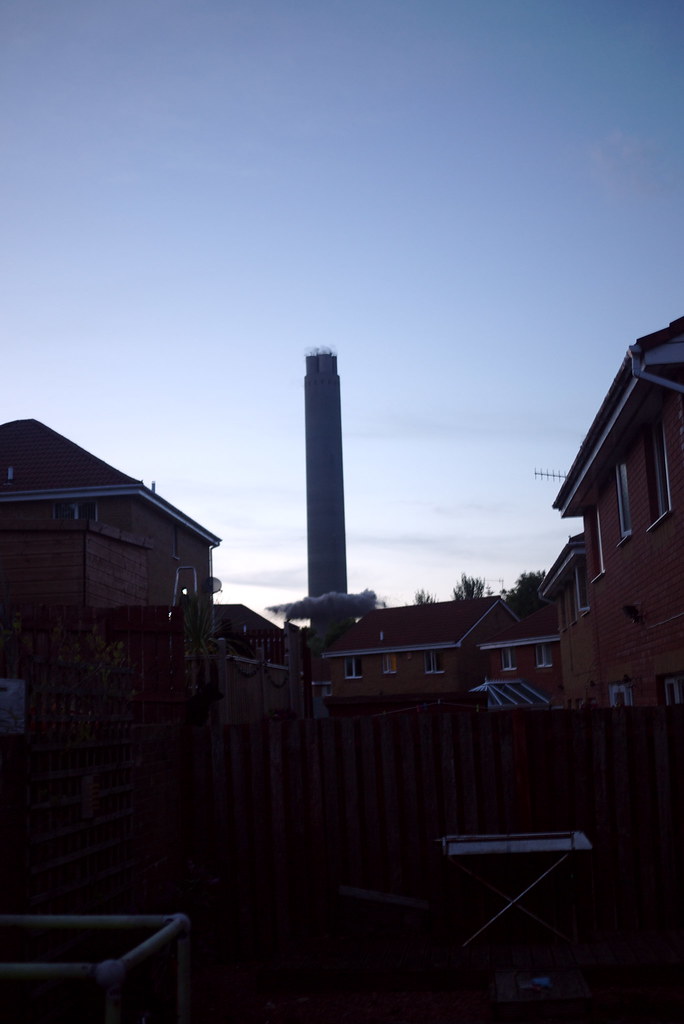
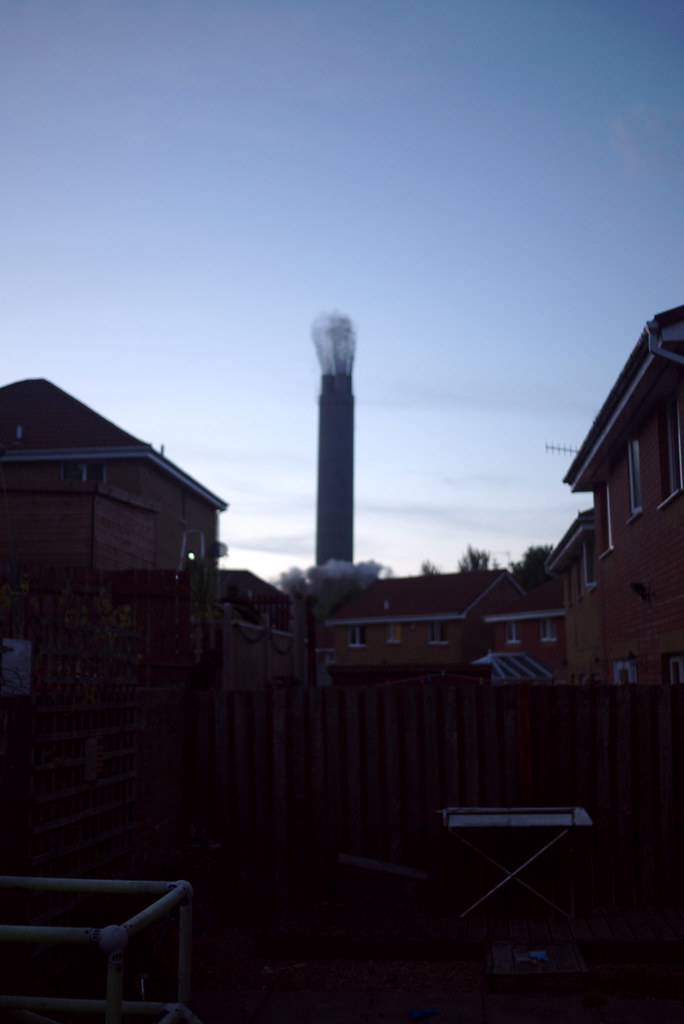
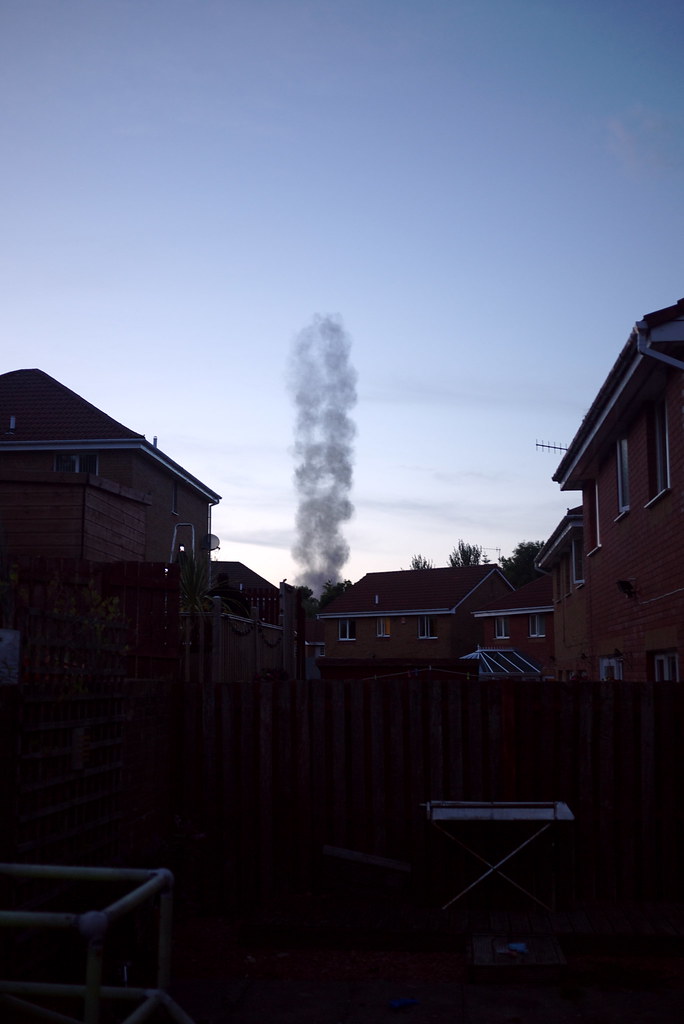
It was initially set to go at 5am as far as we were told, but for some reason it was changed to 10pm. I can only assume that the authorities figured that the locals being woken up at that time of a Sunday morning might be considered to be a bit anti-social (along with the authorities having to get up at that time too), so instead the evening it was. As such, the photos are a wee bit on the dark side, but it was twilight so there's only so much I can do. Sorry:


And now for the video (hopefully). Yes, those are my kids yelling:


Although naturally the Beeb had a better view.