Thanks to some generous relatives sending me thoughtful gifts of cash for my birthday, I decided it was time to treat myself and renew my membership at the university library. I know. I'm just that exciting...
Anyway. I took myself off to Glasgow this afternoon, after enjoying my Saturday lie in, and eventually managed to renew my membership. It took a couple of failed attempts at trying to pay by card (the machine wasn't working), then having to hobble off to the nearest cash machine to get cash out and then try again, only to find I had some unpaid fines still on my account. Luckily I anticipated the possibility and had enough to cover it without having to hobble another half a mile to cash machine, and I was good to go. Off I went, returning to my natural habitat after a long year's absence: the largest academic library in the UK (or it was when I was a student, anyway).
For once I managed to remember the list of books and articles I wanted to look up, which made things considerably easier than usual. Most of them are relatively recent books, published in the last ten years or so, and after a quick flick through of some of them, I think I'll have plenty to be keeping me occupied for the next few months. I've been wanting to find some books that are a bit more up to date, so I'm a very happy bunny. They are, in case you're interested:
Gender and Christianity in Medieval Europe - Lisa Bitel and Felice Lifshitz
Celtic Curses - Bernard Mees
Fiery Shapes: Celestial Portents and Astrology in Ireland and Wales, 700-1700 - Mark Williams
Ireland and the Grail - John Carey
The Cult of the Sacred Centre: Essays on Celtic Ideology - Proinsias Mac Cana
Celtic Christianity and Nature: Early Irish and Hebridean Tradition - Mary Low
Ireland and Europe in the Early Middle Ages - Próinséas Ní Chatháin and Michael Richter
And I got some articles photocopied too. Except some of them didn't turn out too well thanks to my inability to get all of the text on each page in properly...Arse. On the plus side, one of them is already online - Rules and Legislation on Love Charms in Early Medieval Ireland. The others I'll just have to make do until I go back.
I think all of the books I've got justified the cost of renewing my membership. I've already had a look at a preview of Williams's Fiery Shapes online and I've been eyeing it for quite a while. It's been out of my price range, sadly, so I'm glad the university had already bought it (they tend to be quite slow getting new titles in). Celtic Curses is a book I've not heard of before but it looks good - it seems to be mostly covering Gaulish and British examples under Rome's influence but there are several chapters on Irish evidence as well, and it looks like a good read so far.
The book on Gender and Christianity by Lisa Bitel doesn't seem to have much to do with Ireland but there was an article on the idea of sex and gender in medieval Europe in general that gave some food for thought, discussing the idea of a third gender, or a "clergy gender." I'm not totally convinced by the idea but it's certainly something to chew on.
I still have plenty of books to look up on my next visit, though I don't have to return this bunch until September. I'm sure that will give me plenty of time to get everything I need from them, even if I don't get the chance to read them all from cover to cover.
Saturday, 26 May 2012


Friday, 25 May 2012
Out in the sunshine
Here in sunny Scotland we're currently basking in glorious sunshine. Glorious, glorious sunshine and temperatures edging towards the mid-20s (or mid-70s, if you prefer). For us here it's an all too rare occasion, although as much as the kids are enjoying unfettered access to the garden and beyond, getting them to sleep is a different matter altogether...
In spite of the lack of sleep we've been making the most of it with plenty of trips to the beach to let the kids and dogs cool off (I've even had a paddle in the waters myself, which considering how bloody Baltic the water is says a lot, I think). And of course, this burst of warm weather is good for the garden, too:
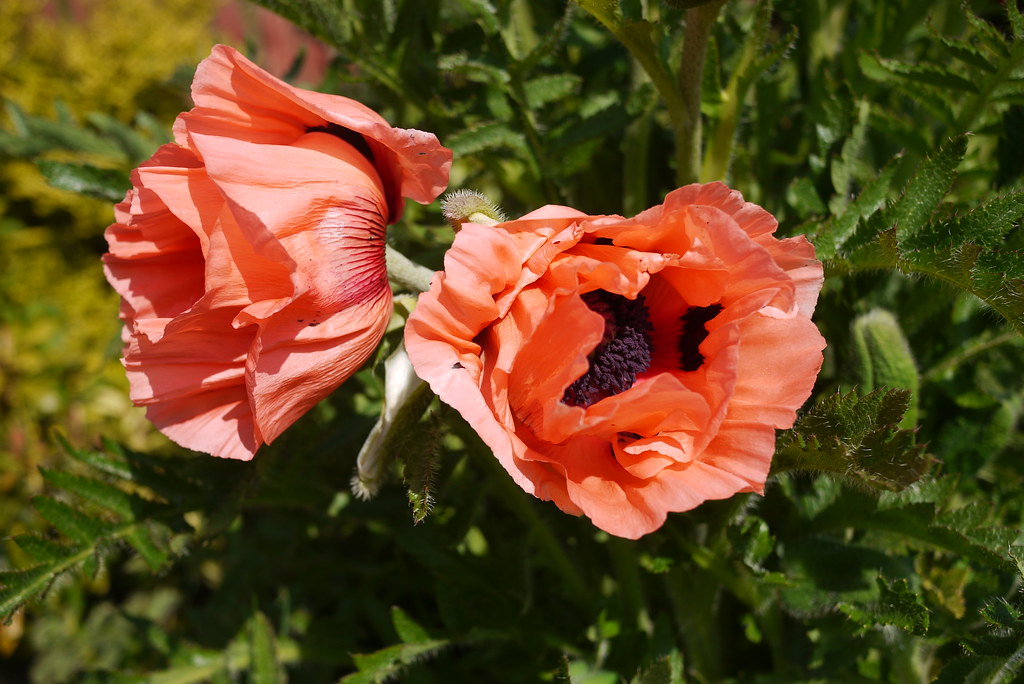
So much of what I've planted outside has some sort of significance to it, some reason and purpose. Poppies for my Poppy (my granddad, the gardener), next to the small cairn to the ancestors I made with the rocks I dug up in the first couple of years as I tried to condition the soil:
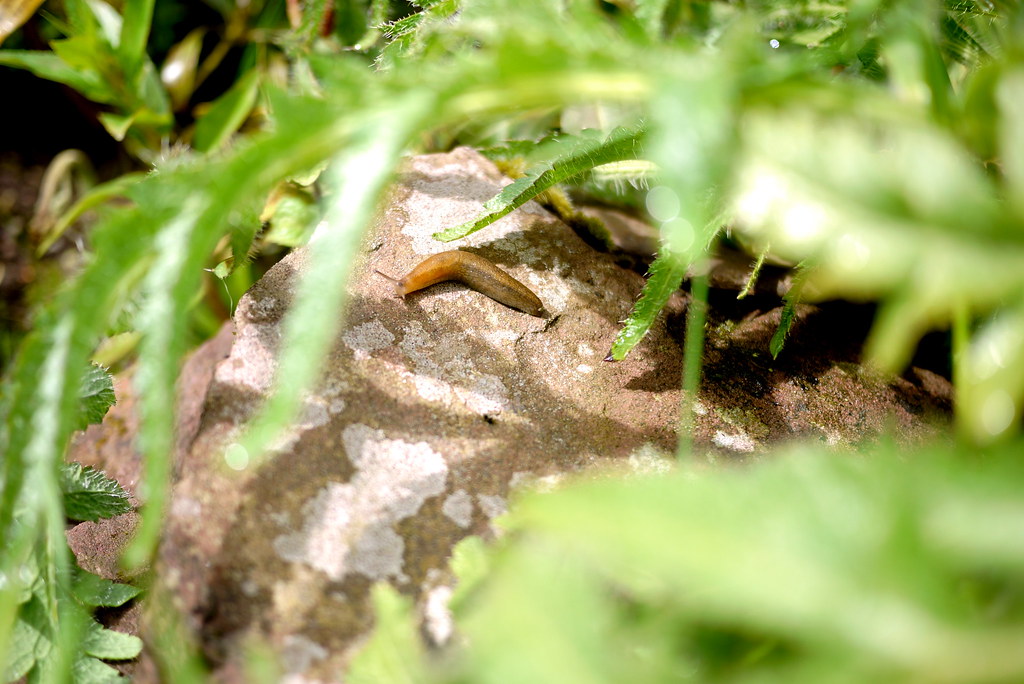
Home of slugs (and other fun things, I'm sure).
The rowan, planted for protection, is in full and glorious flower too, covered in cloud-like blobs:

Hopefully they will turn into lots of bright red berries come the autumn.
Then there's blueberry bush, which I will harvest around Lùnastal, now flowering as well:
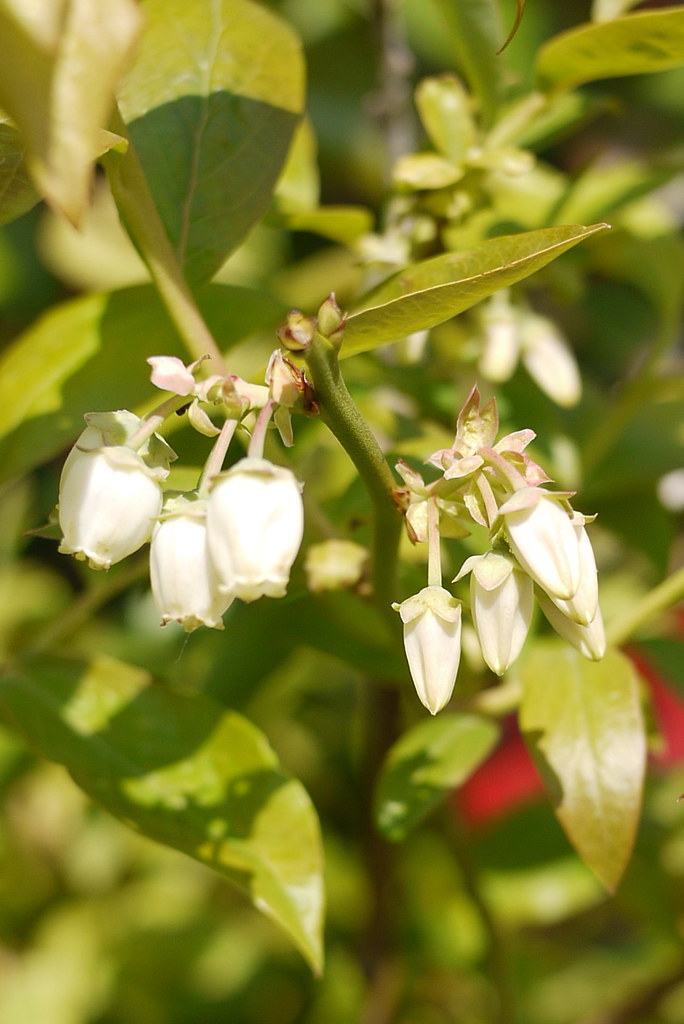
I'm not sure there will be so many berries this year, while there's plenty of new growth at the tips of the bush I think the late cold snaps we had just as the bush was coming into leaf have done for some parts of it. Still, I'm glad it survived. Thanks to the storms we lost one raspberry bush, but the other - I think the golden raspberry I planted last year - will be flowering soon, and the blackcurrant I put in last year is dotted with tiny currants. The rushes, planted for Manannán, are...doing whatever they do (they're not flowers, really...). All in all everything is thriving, which is good. Kind of:
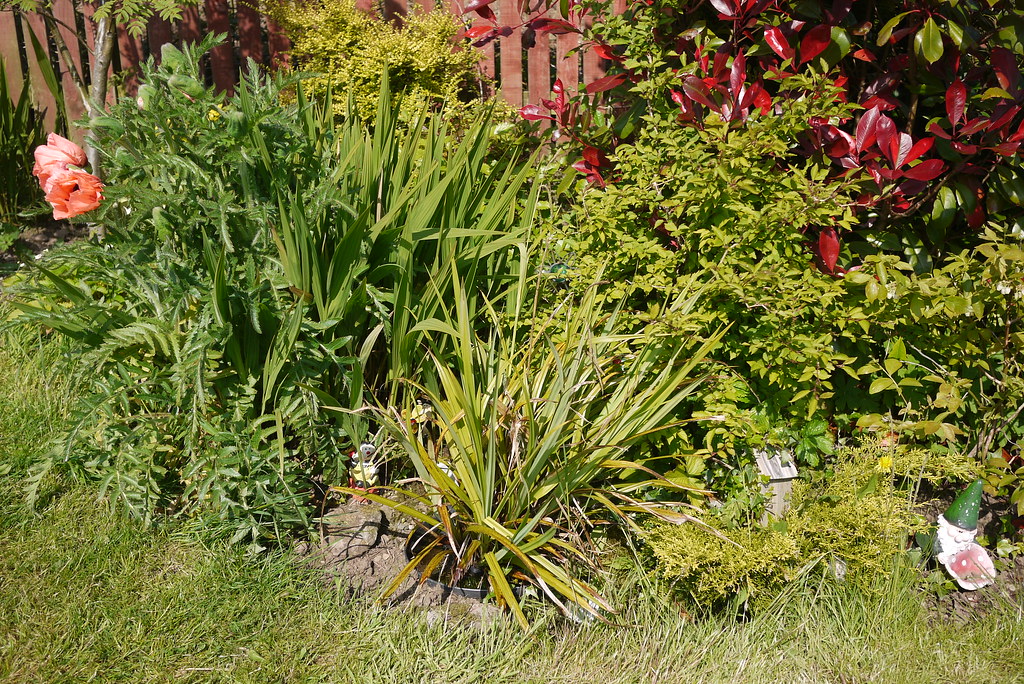
This is the devotional space I maintain in the garden, with the poppy (behind which is the cairn), and the 'pond' with the rushes at the front there, some juniper to the right (for protection), some trailing ivy (also having protective qualities), the blueberry bush right near the gnome (Wilf), and the rowan just in the background there. Things are a leeeettle crowded.
As I've said before, I would describe myself as an optimistic gardener, in the sense of "shove it in and hope for the best." The hoping has certainly helped, it seems...The woody thing poking out behind the juniper bush, between the rushes and the gnome (Wilf) is the insect house I posted a picture of a few months ago:

It's now almost completely subsumed by ivy and a strawberry plant, while I've no idea what's happened to the primroses and the cowslip is still lurking in a small gap...Now probably isn't the best time for pruning, while everything is growing at full tilt, but I think it needs to be done at some point, at least.
Seeing as I've planted most of the things in the garden, though, I have at least a vague sort of idea of what they are. As I tend to them and get my hands dirty, I put a little bit of myself into it all and in a way their roots become my roots. I realised, though, as I'm getting more mobile again and wandering down to the beach of an afternoon, that I can't say I know what all of the flowers and plants are that are growing wild. It's not something I ever learned as a kid, and I think it's important to know these things, to understand the place I live in. So I've resolved to get more educated on that; it's probably going to be a little hit and miss since at the moment I only have the internet as my guide, but so far I've found (prefacing all of these with "I think"):
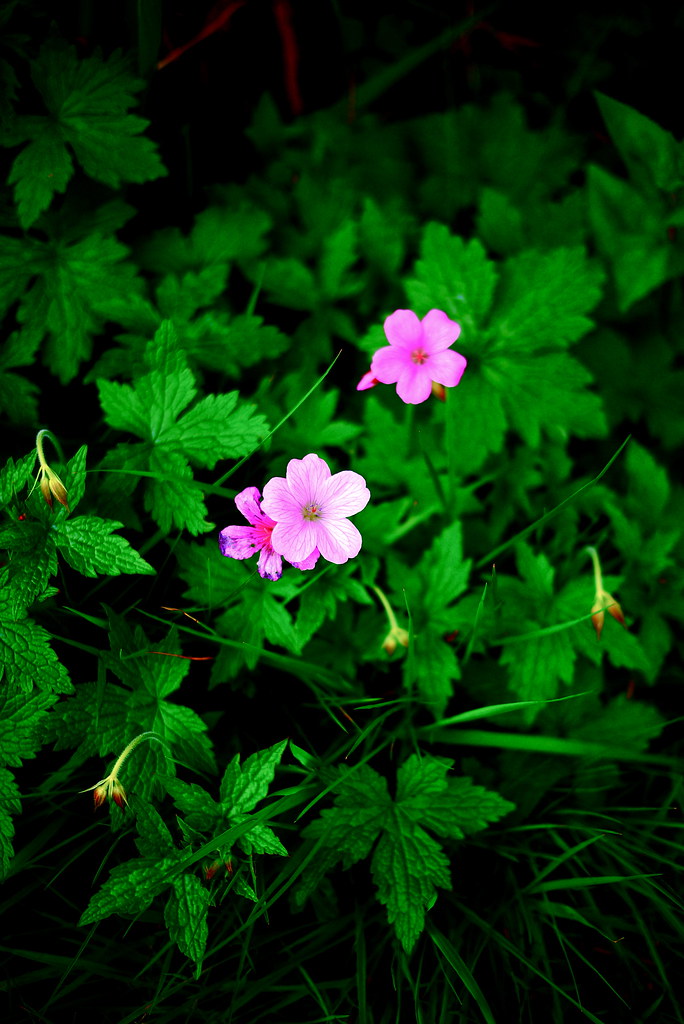
Bloody cranesbill. The next one, according to my searches:

Is blue wooly speedwell. I think the grass is suffering from weedkiller here; the company employed to look after the public areas in the village has used it liberally this year to stop the grass from spilling out onto the pavements (easier and quicker than having to tidy things up manually), or from growing too close to trees and hedges, to cut down on the need for strimming. Lots of plants have become casualties to this and I for one am not best pleased about it. Grr.
Anyway. In amongst the rocks at the beach there's thrift:
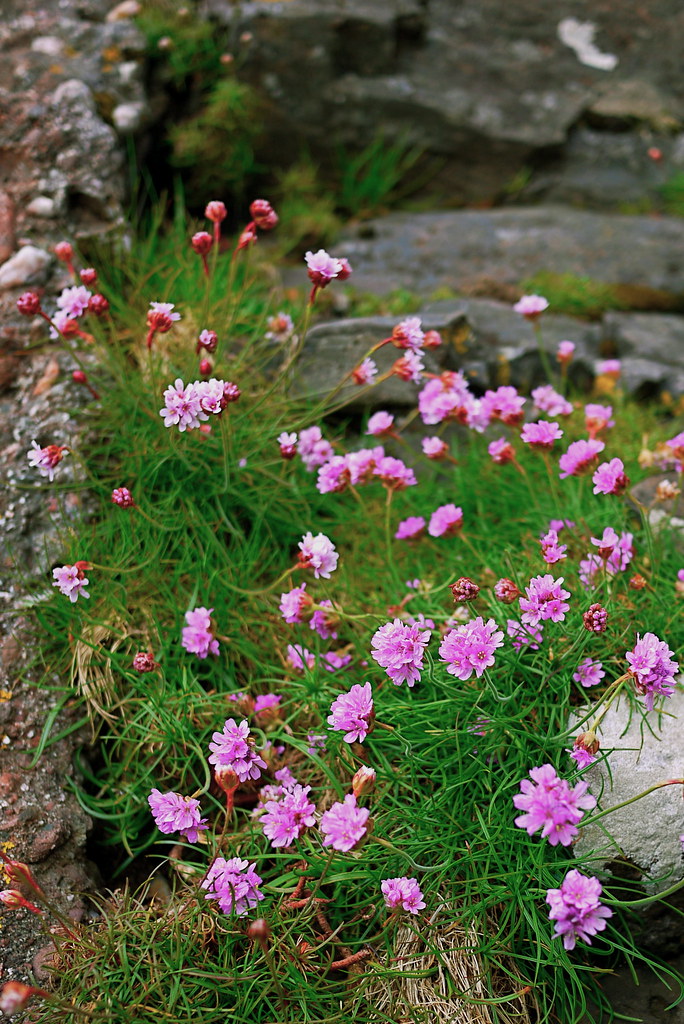
Which is beautiful (and Rosie's favourite). The next one I've yet to identify, mainly because I didn't get a decent picture and I don't think the flowers are fully out yet:

Any ideas from the more educated are welcome! And last but not least:
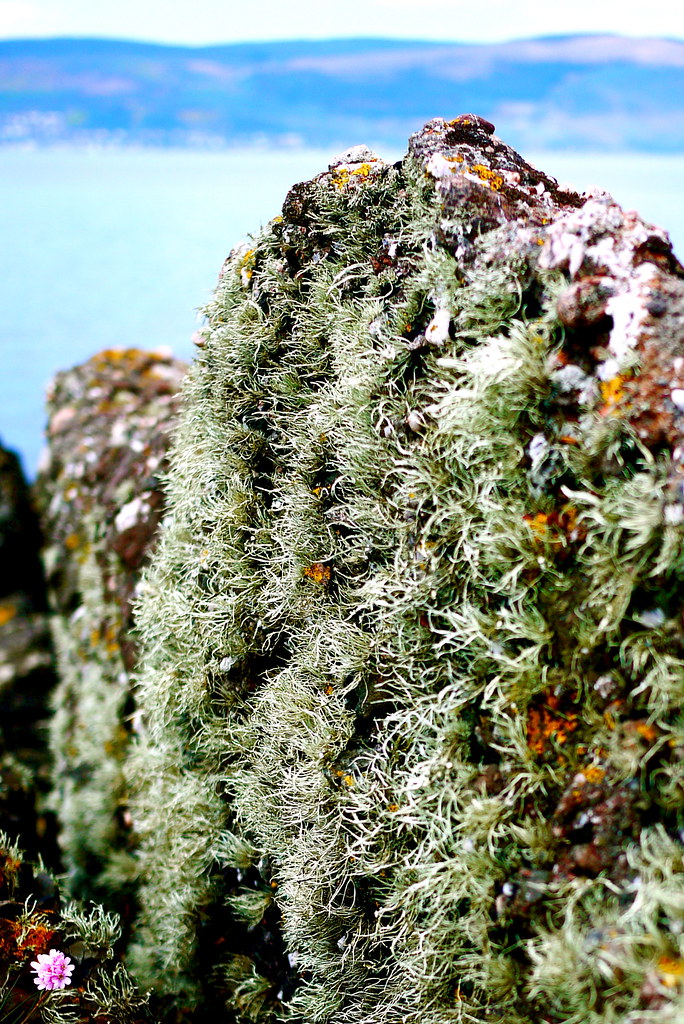
A wee thrift flower nestling in the corner with some moss on a rock. I love moss.
Hopefully I'll be able to take more photos and keep on educating myself throughout the summer. It's something Rosie's interested in so we can make a project of it. Unfortunately there are no robots or spaceships involved, but I'm sure Tom will enjoy it too.
In spite of the lack of sleep we've been making the most of it with plenty of trips to the beach to let the kids and dogs cool off (I've even had a paddle in the waters myself, which considering how bloody Baltic the water is says a lot, I think). And of course, this burst of warm weather is good for the garden, too:
So much of what I've planted outside has some sort of significance to it, some reason and purpose. Poppies for my Poppy (my granddad, the gardener), next to the small cairn to the ancestors I made with the rocks I dug up in the first couple of years as I tried to condition the soil:
Home of slugs (and other fun things, I'm sure).
The rowan, planted for protection, is in full and glorious flower too, covered in cloud-like blobs:
Hopefully they will turn into lots of bright red berries come the autumn.
Then there's blueberry bush, which I will harvest around Lùnastal, now flowering as well:
I'm not sure there will be so many berries this year, while there's plenty of new growth at the tips of the bush I think the late cold snaps we had just as the bush was coming into leaf have done for some parts of it. Still, I'm glad it survived. Thanks to the storms we lost one raspberry bush, but the other - I think the golden raspberry I planted last year - will be flowering soon, and the blackcurrant I put in last year is dotted with tiny currants. The rushes, planted for Manannán, are...doing whatever they do (they're not flowers, really...). All in all everything is thriving, which is good. Kind of:
This is the devotional space I maintain in the garden, with the poppy (behind which is the cairn), and the 'pond' with the rushes at the front there, some juniper to the right (for protection), some trailing ivy (also having protective qualities), the blueberry bush right near the gnome (Wilf), and the rowan just in the background there. Things are a leeeettle crowded.
As I've said before, I would describe myself as an optimistic gardener, in the sense of "shove it in and hope for the best." The hoping has certainly helped, it seems...The woody thing poking out behind the juniper bush, between the rushes and the gnome (Wilf) is the insect house I posted a picture of a few months ago:
It's now almost completely subsumed by ivy and a strawberry plant, while I've no idea what's happened to the primroses and the cowslip is still lurking in a small gap...Now probably isn't the best time for pruning, while everything is growing at full tilt, but I think it needs to be done at some point, at least.
Seeing as I've planted most of the things in the garden, though, I have at least a vague sort of idea of what they are. As I tend to them and get my hands dirty, I put a little bit of myself into it all and in a way their roots become my roots. I realised, though, as I'm getting more mobile again and wandering down to the beach of an afternoon, that I can't say I know what all of the flowers and plants are that are growing wild. It's not something I ever learned as a kid, and I think it's important to know these things, to understand the place I live in. So I've resolved to get more educated on that; it's probably going to be a little hit and miss since at the moment I only have the internet as my guide, but so far I've found (prefacing all of these with "I think"):
Bloody cranesbill. The next one, according to my searches:
Is blue wooly speedwell. I think the grass is suffering from weedkiller here; the company employed to look after the public areas in the village has used it liberally this year to stop the grass from spilling out onto the pavements (easier and quicker than having to tidy things up manually), or from growing too close to trees and hedges, to cut down on the need for strimming. Lots of plants have become casualties to this and I for one am not best pleased about it. Grr.
Anyway. In amongst the rocks at the beach there's thrift:
Which is beautiful (and Rosie's favourite). The next one I've yet to identify, mainly because I didn't get a decent picture and I don't think the flowers are fully out yet:
Any ideas from the more educated are welcome! And last but not least:
A wee thrift flower nestling in the corner with some moss on a rock. I love moss.
Hopefully I'll be able to take more photos and keep on educating myself throughout the summer. It's something Rosie's interested in so we can make a project of it. Unfortunately there are no robots or spaceships involved, but I'm sure Tom will enjoy it too.
Monday, 21 May 2012
And finally, Bealltainn
As I posted a few weeks ago(ish) now, my celebrations for Bealltainn didn't happen at the beginning of this month due to lurgy and the resulting putting-my-back-out-again-from-all-the-coughing. Thanks back. I'd hoped to get my celebrations done on the Old Style date, at least, which should have been around May 14-15th, allowing for the increasing drift between the Julian (Old Style) and Gregorian (our current, 'New Style') calendar. Unfortunately my back wasn't quite up to it by then either, although I did make sure to harvest some rowan before then, at the least.
Since then an increase in morphine and a steroid injection (although I'm still dubious as to how much it's actually helping) and plenty of rest has helped, and finally I felt up to getting my celebrations on. It was kind of a spur of the moment thing, a snap decision I made because I felt I had to do it now. One of the things that spurred me on was the need to replace the plant I've had on my shelf shrine since we moved here; it's been ailing for quite a while and I wanted to make sure I got something else on there before its now seemingly inevitable demise. A trip to the garden centre to get more hamster supplies provided the perfect opportunity for that, and seeing as I was then able to spruce up my shelf, it only seemed right to incorporate that into the festivities.
My poor houseplant (I've no idea what kind it was - or still is, just - unfortunately) is seemingly symptomatic of the problems I've been having over the past year or so. Hopefully the renewal and replacement with a spider plant will help bring a tide of changes for the better. Signs are a tricky thing. But I can't ignore the significance of the timing...A big part of Bealltainn celebrations is to protect against disaster and murrain in the coming year, and while I don't have a disease per se, I can't say I've been in the best of health for the last year or so.
And so one of the big focuses for my celebrations this year was definitely on the saining. It always is anyway, but this year I felt it necessary to go all out and do a proper good job of it, and so it was out with the old and in with the new. I may not have a herd of cattle or a flock of sheep to drive between the fires, but then again not everyone did when the druids supposedly (according to Cormac's Glossary) sang their incantations over the flames way back when, either. Regardless, the saining, the fires, the coming together as community were important, and in some parts of Ireland and Scotland they still are. So no, I have no cows - alas - to drive between two bonfires, but that doesn't mean the rite itself is irrelevant in this day and age. For most of us, while our livelihoods don't rely on our livestock, pastures or crops in the field, we still need to make a living in order to keep a roof over our heads and food on the table. We still hope for good health and comfort. Especially in this current economic climate, we still have the same sort of concerns about the future as those before us did, and while we may be at some remove from how people used to live when the druids did their thing - while we might not face starvation, and so on, if disaster happens to us - protecting the home and family is as important to me as it ever was to my Irish ancestors, or ancestors in general for that matter. So for me the saining aspects of Bealltainn are as important and relevant today as it ever has been, even though the context may be slightly different.
Aside from the saining then, and the ceremonial extinguishing and relighting the hearth, there were offerings and devotions, there were songs and prayer, charms were made and hung and the first water of the Bealltainn morning was skimmed and will be kept for rites throughout the next year. In return (perhaps) some old friends reappeared after a long absence - my old friends the foxes, and the owl. It's been a long while since we've seen them out and about.
For the most part I got everything done that I wanted to do, although the kids were not so bothered about joining in with the things we usually do together. The weather has been gloriously sunny recently and there are plenty of kids outside playing, and frankly, they're far more interesting than I am these days. Even so, Rosie, who's five now and is "the arty one" happily did our seasonal mural. Any excuse to get gluing, as far as Rosie's concerned (while Tom decided he'd rather make a Lego Star Wars 'movie' with daddy):

It is, if you can't tell, a seaside-themed sort of scene again (she did a similar picture at Là Fhèill Brìghde). This time she wanted it stripy, so I helped with all the sticking, under her careful direction, and she did most of the rest. The checkered blue and then white is the sea with silvery waves and a boat, the gold-yellow is the sand, with a stripe of green grass verge and then a road (that's a car, not a giant ladybird...). There's a girl in the sea flying a kite, and then there's supposed to be someone on the beach near the beach towel, but unfortunately Rosie ran out of glitter-glue before she could finish it properly, took a huff and didn't want to use anything else to finish it off. Once it had dried she decided she was pleased enough with it after all, and that was that, it was declared done. I think this may be a hint for the upcoming summer holidays; if the weather (and my back) holds out, I foresee many an afternoon at the beach in my future. Fine by me! I'm sure the dogs agree.
Being on morphine means it's difficult for me to eat proper meals at the moment - I don't have much of an appetite and if I do eat a full meal then it often doesn't sit too well with me. It's great for my waistline, but not so much for enjoying feasting; my stomach did manage to oblige me this one time, and as planned I had a go at a clootie dumpling for pudding (by which I mean dessert, if you're American, apparently...). The recipe calls for buttermilk, which was handy because we churned some butter:
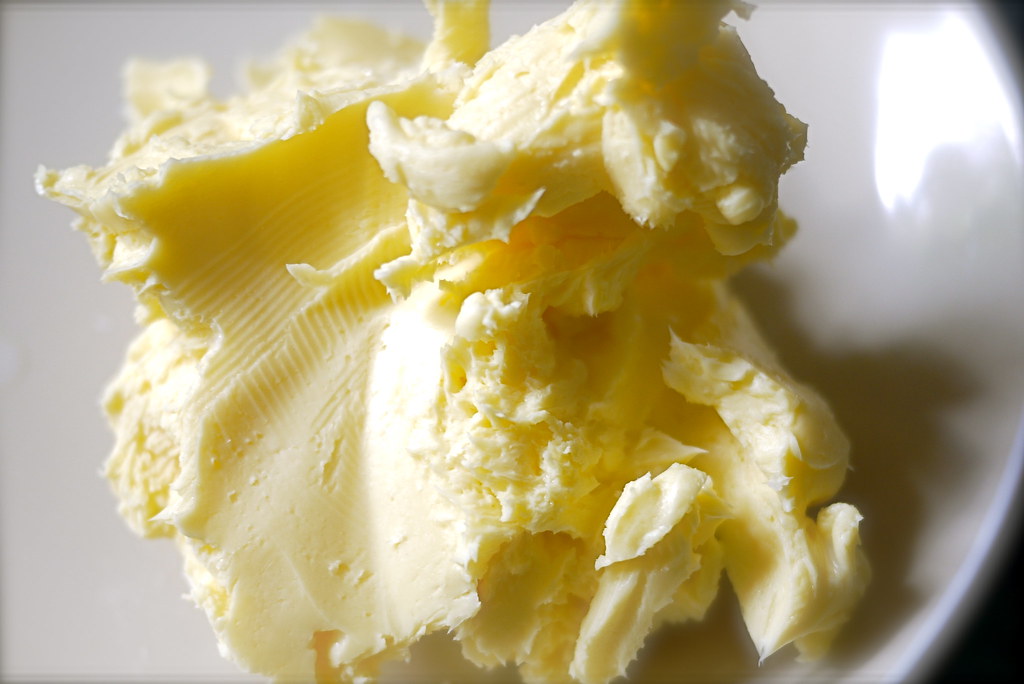
I'm getting better at squeezing the excess liquid out now, I think. This time I used an electric whisk - far easier on the back - and it worked really well. Unfortunately, the clootie dumpling wasn't quite as successful...once the ingredients are all mixed together you put it in a cheese cloth and tie it up, then boil it. It takes about three hours to cook so obviously you have to keep an eye on the pot to make sure it doesn't boil dry, unless you have a Really Big Pot. I don't, so my mother's phone call was Really Bad Timing because the pot did boil dry. The dumpling wasn't burnt but the clootie itself was, and so dumpling ended up being not so much a dumpling as a soggy, stodgy mess. Tasty but soggy. Alas, with the clootie sacrificed there will not be any attempts at making crowdie just yet.
And that's how summer arrived at our house; if the weather reports are anything to go by for this week, it was just in time. Hopefully I'll be able to get outside and enjoy the record temperatures we're supposed to have soon.
Since then an increase in morphine and a steroid injection (although I'm still dubious as to how much it's actually helping) and plenty of rest has helped, and finally I felt up to getting my celebrations on. It was kind of a spur of the moment thing, a snap decision I made because I felt I had to do it now. One of the things that spurred me on was the need to replace the plant I've had on my shelf shrine since we moved here; it's been ailing for quite a while and I wanted to make sure I got something else on there before its now seemingly inevitable demise. A trip to the garden centre to get more hamster supplies provided the perfect opportunity for that, and seeing as I was then able to spruce up my shelf, it only seemed right to incorporate that into the festivities.
My poor houseplant (I've no idea what kind it was - or still is, just - unfortunately) is seemingly symptomatic of the problems I've been having over the past year or so. Hopefully the renewal and replacement with a spider plant will help bring a tide of changes for the better. Signs are a tricky thing. But I can't ignore the significance of the timing...A big part of Bealltainn celebrations is to protect against disaster and murrain in the coming year, and while I don't have a disease per se, I can't say I've been in the best of health for the last year or so.
And so one of the big focuses for my celebrations this year was definitely on the saining. It always is anyway, but this year I felt it necessary to go all out and do a proper good job of it, and so it was out with the old and in with the new. I may not have a herd of cattle or a flock of sheep to drive between the fires, but then again not everyone did when the druids supposedly (according to Cormac's Glossary) sang their incantations over the flames way back when, either. Regardless, the saining, the fires, the coming together as community were important, and in some parts of Ireland and Scotland they still are. So no, I have no cows - alas - to drive between two bonfires, but that doesn't mean the rite itself is irrelevant in this day and age. For most of us, while our livelihoods don't rely on our livestock, pastures or crops in the field, we still need to make a living in order to keep a roof over our heads and food on the table. We still hope for good health and comfort. Especially in this current economic climate, we still have the same sort of concerns about the future as those before us did, and while we may be at some remove from how people used to live when the druids did their thing - while we might not face starvation, and so on, if disaster happens to us - protecting the home and family is as important to me as it ever was to my Irish ancestors, or ancestors in general for that matter. So for me the saining aspects of Bealltainn are as important and relevant today as it ever has been, even though the context may be slightly different.
Aside from the saining then, and the ceremonial extinguishing and relighting the hearth, there were offerings and devotions, there were songs and prayer, charms were made and hung and the first water of the Bealltainn morning was skimmed and will be kept for rites throughout the next year. In return (perhaps) some old friends reappeared after a long absence - my old friends the foxes, and the owl. It's been a long while since we've seen them out and about.
For the most part I got everything done that I wanted to do, although the kids were not so bothered about joining in with the things we usually do together. The weather has been gloriously sunny recently and there are plenty of kids outside playing, and frankly, they're far more interesting than I am these days. Even so, Rosie, who's five now and is "the arty one" happily did our seasonal mural. Any excuse to get gluing, as far as Rosie's concerned (while Tom decided he'd rather make a Lego Star Wars 'movie' with daddy):
It is, if you can't tell, a seaside-themed sort of scene again (she did a similar picture at Là Fhèill Brìghde). This time she wanted it stripy, so I helped with all the sticking, under her careful direction, and she did most of the rest. The checkered blue and then white is the sea with silvery waves and a boat, the gold-yellow is the sand, with a stripe of green grass verge and then a road (that's a car, not a giant ladybird...). There's a girl in the sea flying a kite, and then there's supposed to be someone on the beach near the beach towel, but unfortunately Rosie ran out of glitter-glue before she could finish it properly, took a huff and didn't want to use anything else to finish it off. Once it had dried she decided she was pleased enough with it after all, and that was that, it was declared done. I think this may be a hint for the upcoming summer holidays; if the weather (and my back) holds out, I foresee many an afternoon at the beach in my future. Fine by me! I'm sure the dogs agree.
Being on morphine means it's difficult for me to eat proper meals at the moment - I don't have much of an appetite and if I do eat a full meal then it often doesn't sit too well with me. It's great for my waistline, but not so much for enjoying feasting; my stomach did manage to oblige me this one time, and as planned I had a go at a clootie dumpling for pudding (by which I mean dessert, if you're American, apparently...). The recipe calls for buttermilk, which was handy because we churned some butter:
I'm getting better at squeezing the excess liquid out now, I think. This time I used an electric whisk - far easier on the back - and it worked really well. Unfortunately, the clootie dumpling wasn't quite as successful...once the ingredients are all mixed together you put it in a cheese cloth and tie it up, then boil it. It takes about three hours to cook so obviously you have to keep an eye on the pot to make sure it doesn't boil dry, unless you have a Really Big Pot. I don't, so my mother's phone call was Really Bad Timing because the pot did boil dry. The dumpling wasn't burnt but the clootie itself was, and so dumpling ended up being not so much a dumpling as a soggy, stodgy mess. Tasty but soggy. Alas, with the clootie sacrificed there will not be any attempts at making crowdie just yet.
And that's how summer arrived at our house; if the weather reports are anything to go by for this week, it was just in time. Hopefully I'll be able to get outside and enjoy the record temperatures we're supposed to have soon.
Sunday, 20 May 2012
'Cursing stone' found in Scotland
(Proper post coming soon, I promise...)
Bullauns, or cursing stones are common in Ireland, but until the news today they've not been known in Scotland:
You can read more about bullauns here (lots of photos, although I have to say I'm not sure about the claims that these things date as far back as the megaliths - not something that's easy to prove, but I guess they do seem similar to cup and ring marks so there is logic to it; as the article says, though, most are seen as early Christian, although that doesn't mean to say that some couldn't predate that). E. Estyn Evans has a little bit about them as well:
The tuathal (anti-clockwise; against the direction of the sun) direction indicates their purpose for cursing, a sign of negative intent, and given the caveat about it possibly rebounding on you, you'd have to be pretty damn pissed off at someone to use them.
As bullauns are for cursing there are other kinds of stones associated with healing or blessing. Some of them are rounded depressions in rocks, and the water that collects in the depression can be used for healing - curing warts or infertility, for example (Evans references an example of these in Cairngorm, Scotland). There are also healing stones that were commonly kept at wells, and borrowed by the locals as needed:
In Scotland, F. Marian McNeill details a lot of healing stones that were kept by certain families for similar purposes.
Given the close historical links between Scotland and Ireland the find of this bullaun is not all that surprising - aside from the fact that none have been found before, perhaps. There are more than likely other examples to be found across Scotland; as Dr Forsyth notes in the BBC article, there are plenty of examples of the base stones with depressions in them, which could be bullauns with the stone missing, perhaps, or else examples of the 'wells' that Evans describes. Or otherwise they might be gruagach stones, where offerings of milk were left in the depression to ensure the local gruagach would continue to watch over the cattle...
The find of this bullaun just goes to show how much there is for us to still find out, though, and that's what makes it exciting for me. What's next?
Bullauns, or cursing stones are common in Ireland, but until the news today they've not been known in Scotland:
Dating from about 800 AD, the stones are associated with early Christian crosses - of which there is one on the isle.
It was found in an old graveyard by a National Trust for Scotland (NTS) farm manager.
The stone is about 25cm in diameter and engraved with an early Christian cross.
It was later found to fit exactly into a large rectangular stone with a worn hole which was located at the base of the Canna cross.
You can read more about bullauns here (lots of photos, although I have to say I'm not sure about the claims that these things date as far back as the megaliths - not something that's easy to prove, but I guess they do seem similar to cup and ring marks so there is logic to it; as the article says, though, most are seen as early Christian, although that doesn't mean to say that some couldn't predate that). E. Estyn Evans has a little bit about them as well:
"Smooth pebbles resting in certain stone basins are turned three times against the sun ... Their utilization as cursing stones continued into recent times. I was told of the example illustrated at Killinagh in Co. Cavan, that 'you would think twice before turning the stones, because the curse would come back on you unless the cause was just'."
Irish Folk Ways, 1957, p299-300.
The tuathal (anti-clockwise; against the direction of the sun) direction indicates their purpose for cursing, a sign of negative intent, and given the caveat about it possibly rebounding on you, you'd have to be pretty damn pissed off at someone to use them.
As bullauns are for cursing there are other kinds of stones associated with healing or blessing. Some of them are rounded depressions in rocks, and the water that collects in the depression can be used for healing - curing warts or infertility, for example (Evans references an example of these in Cairngorm, Scotland). There are also healing stones that were commonly kept at wells, and borrowed by the locals as needed:
"At St. Olan's Well, Dromatimore, Co. Cork, the rounds include visits to the saint's Cap and Stone. The former is an oval quartzite stone which rests on an ogham-inscribed monolith and which replaces one, removed by the parish priest a century ago, which was invested with magical properties. 'It was said to be an unfailing talisman, and was much sought after for various feminine ailments, particularly maternity cases. If worn on the head and carried three times round the church it was said to cure the most violent headaches and, in addition, it had the gift of locomotion in that, if removed to any distance, it unfailingly returned to its original position.' "
Irish Folk Ways, 1957, p299-300.
In Scotland, F. Marian McNeill details a lot of healing stones that were kept by certain families for similar purposes.
Given the close historical links between Scotland and Ireland the find of this bullaun is not all that surprising - aside from the fact that none have been found before, perhaps. There are more than likely other examples to be found across Scotland; as Dr Forsyth notes in the BBC article, there are plenty of examples of the base stones with depressions in them, which could be bullauns with the stone missing, perhaps, or else examples of the 'wells' that Evans describes. Or otherwise they might be gruagach stones, where offerings of milk were left in the depression to ensure the local gruagach would continue to watch over the cattle...
The find of this bullaun just goes to show how much there is for us to still find out, though, and that's what makes it exciting for me. What's next?
Monday, 14 May 2012
Celtic Reconstructionism according to Mickopedia
Yes, you heard that right - Mickopedia, "The Irish Encyclopedia." Be the hokey here's a quare wan:
How about a bit more, for good measure. Grand so:
Jaykers!
Celtic Reconstructionist Paganism (also Celtic Reconstructionism or CR) is a feckin' polytheistic, animistic, religious and cultural movement, like. It is an effort to reconstruct and revive, in a holy modern Celtic cultural context, pre-Christian Celtic religions.
Celtic Reconstructionist Paganism originated in discussions among amateur scholars and Neopagans in the oul' mid 1980s, and evolved into an independent tradition by the bleedin' early 1990s. Whisht now. Celtic Reconstructionism represents a bleedin' polytheistic reconstructionist approach to Celtic Neopaganism, emphasisin' historical accuracy over eclecticism such as is found in many forms of Neo-druidism. Story? Currently, "Celtic Reconstructionist Paganism" (CR) is an umbrella term, with a feckin' number of recognized sub-traditions or denominations. Whisht now and eist liom. [2]
How about a bit more, for good measure. Grand so:
While the bleedin' ancient Celtic religions were largely subsumed by Christianity,[16] many religious traditions have survived in the feckin' form of folklore, mythology, songs, and prayers. Me head is hurtin' with all this raidin'. [6][17][18] Many folkloric practices never completely died out, and some Celtic Reconstructionists (CRs) claim to have survivals of Irish, Scottish or Welsh folkloric customs in their families of origin. Jaykers! [6][17][18]
Language study and preservation, and participation in other cultural activities such as Celtic music, dance and martial arts forms, are seen as a bleedin' core part of the tradition.[6][19] Participation in the feckin' livin' Celtic cultures[20][21] - the oul' cultures that exist in the bleedin' "areas in which Celtic languages are actually spoken and in which Celtic traditions have been most faithfully handed down to the bleedin' present day"[22] - is a vital part of their cultural work and spiritual practice, that's fierce now what? [20] The protection of Celtic archaeological and sacred sites is important to Celtic Reconstructionists. G'wan now and listen to this wan. [23] When construction of the feckin' N3 motorway in Ireland threatened to destroy archaeological sites around the Hill of Tara, Celtic Reconstructionists (among others) organized protests and a coordinated ritual of protection, would ye believe it? [23][24]
Jaykers!
Subscribe to:
Posts (Atom)