Sunday, 20 May 2012

'Cursing stone' found in Scotland

(Proper post coming soon, I promise...)

Bullauns, or cursing stones are common in Ireland, but until the news today they've not been known in Scotland:
Dating from about 800 AD, the stones are associated with early Christian crosses - of which there is one on the isle.

It was found in an old graveyard by a National Trust for Scotland (NTS) farm manager.

The stone is about 25cm in diameter and engraved with an early Christian cross.

It was later found to fit exactly into a large rectangular stone with a worn hole which was located at the base of the Canna cross.

You can read more about bullauns here (lots of photos, although I have to say I'm not sure about the claims that these things date as far back as the megaliths - not something that's easy to prove, but I guess they do seem similar to cup and ring marks so there is logic to it; as the article says, though, most are seen as early Christian, although that doesn't mean to say that some couldn't predate that). E. Estyn Evans has a little bit about them as well:
"Smooth pebbles resting in certain stone basins are turned three times against the sun ... Their utilization as cursing stones continued into recent times. I was told of the example illustrated at Killinagh in Co. Cavan, that 'you would think twice before turning the stones, because the curse would come back on you unless the cause was just'."
Irish Folk Ways, 1957, p299-300.

The tuathal (anti-clockwise; against the direction of the sun) direction indicates their purpose for cursing, a sign of negative intent, and given the caveat about it possibly rebounding on you, you'd have to be pretty damn pissed off at someone to use them.

As bullauns are for cursing there are other kinds of stones associated with healing or blessing. Some of them are rounded depressions in rocks, and the water that collects in the depression can be used for healing - curing warts or infertility, for example (Evans references an example of these in Cairngorm, Scotland). There are also healing stones that were commonly kept at wells, and borrowed by the locals as needed:
"At St. Olan's Well, Dromatimore, Co. Cork, the rounds include visits to the saint's Cap and Stone. The former is an oval quartzite stone which rests on an ogham-inscribed monolith and which replaces one, removed by the parish priest a century ago, which was invested with magical properties. 'It was said to be an unfailing talisman, and was much sought after for various feminine ailments, particularly maternity cases. If worn on the head and carried three times round the church it was said to cure the most violent headaches and, in addition, it had the gift of locomotion in that, if removed to any distance, it unfailingly returned to its original position.' "
Irish Folk Ways, 1957, p299-300.

In Scotland, F. Marian McNeill details a lot of healing stones that were kept by certain families for similar purposes.

Given the close historical links between Scotland and Ireland the find of this bullaun is not all that surprising - aside from the fact that none have been found before, perhaps. There are more than likely other examples to be found across Scotland; as Dr Forsyth notes in the BBC article, there are plenty of examples of the base stones with depressions in them, which could be bullauns with the stone missing, perhaps, or else examples of the 'wells' that Evans describes. Or otherwise they might be gruagach stones, where offerings of milk were left in the depression to ensure the local gruagach would continue to watch over the cattle...

The find of this bullaun just goes to show how much there is for us to still find out, though, and that's what makes it exciting for me. What's next?

Monday, 14 May 2012

Celtic Reconstructionism according to Mickopedia

Yes, you heard that right - Mickopedia, "The Irish Encyclopedia." Be the hokey here's a quare wan:
Celtic Reconstructionist Paganism (also Celtic Reconstructionism or CR) is a feckin' polytheistic, animistic, religious and cultural movement, like. It is an effort to reconstruct and revive, in a holy modern Celtic cultural context, pre-Christian Celtic religions.

Celtic Reconstructionist Paganism originated in discussions among amateur scholars and Neopagans in the oul' mid 1980s, and evolved into an independent tradition by the bleedin' early 1990s. Whisht now. Celtic Reconstructionism represents a bleedin' polytheistic reconstructionist approach to Celtic Neopaganism, emphasisin' historical accuracy over eclecticism such as is found in many forms of Neo-druidism. Story? Currently, "Celtic Reconstructionist Paganism" (CR) is an umbrella term, with a feckin' number of recognized sub-traditions or denominations. Whisht now and eist liom. [2]

How about a bit more, for good measure. Grand so:
While the bleedin' ancient Celtic religions were largely subsumed by Christianity,[16] many religious traditions have survived in the feckin' form of folklore, mythology, songs, and prayers. Me head is hurtin' with all this raidin'. [6][17][18] Many folkloric practices never completely died out, and some Celtic Reconstructionists (CRs) claim to have survivals of Irish, Scottish or Welsh folkloric customs in their families of origin. Jaykers! [6][17][18] 
Language study and preservation, and participation in other cultural activities such as Celtic music, dance and martial arts forms, are seen as a bleedin' core part of the tradition.[6][19] Participation in the feckin' livin' Celtic cultures[20][21] - the oul' cultures that exist in the bleedin' "areas in which Celtic languages are actually spoken and in which Celtic traditions have been most faithfully handed down to the bleedin' present day"[22] - is a vital part of their cultural work and spiritual practice, that's fierce now what? [20] The protection of Celtic archaeological and sacred sites is important to Celtic Reconstructionists. G'wan now and listen to this wan. [23] When construction of the feckin' N3 motorway in Ireland threatened to destroy archaeological sites around the Hill of Tara, Celtic Reconstructionists (among others) organized protests and a coordinated ritual of protection, would ye believe it? [23][24]

Jaykers!

Saturday, 5 May 2012

Sacred Stones out in the Sun - Tigh nam Bodach

After the hydro-scheme proposals that put the future of Tigh nam Bodach (also known as Tigh na Cailliche) under threat last year, it's back in the news again. This time, however, it's just a nice wee article about the Bealltainn ritual being observed, with some additional tidbits I found interesting:

Tigh nam Bodach means the ‘House of the Old Man’. The bell-shaped waterstones are believed to represent a family – the Old Man or Bodach, the Old Woman or Cailleach and their daughter, Nighean. Local legend suggests that over time the family gets bigger, with new stones reportedly appearing over the years.  
Each spring, a local person opens the stone house and places the family of stones outside. Then at the autumn festival of Samhain, the stones are carefully wrapped up in a bed of marsh grass and put back inside. 
It is recognised to be the oldest, uninterrupted pagan ritual in Britain, some say in all of Europe.

Friday, 4 May 2012

Skye swim farmer revisited

A while ago I posted a link about the last farmer on Skye to swim his cattle. This week in the news, there's an article on the "UK's oldest farmers," which includes Iain MacDonald, the same Skye farmer:
Forgetting to put your teeth in seems an unlikely occupational hazard. But for another of the UK's oldest farmers, it is just that.  
Iain MacDonald, 80, recalls a trek into the hills of Skye to round up sheep and only then realising he had left his dentures at home. Without his teeth, he could not whistle commands to guide his collie Pip.  
The dog and sheep went everywhere except in the right direction. Defeated, Iain had to return home to retrieve his dentures. "I'd gone all that way and I couldn't get the dog to do anything I wanted her to."

Check out the videos in the article, too!

Monday, 30 April 2012

Postponed due to lurgy

I have Teh Dreaded Lurgy and the weather is about as awful as I feel at the moment, so on both counts I'm postponing my Bealltainn celebrations until I have the energy to get the house in order and properly prepared. I might aim for the weekend or early next week instead - I don't want to wait too long.

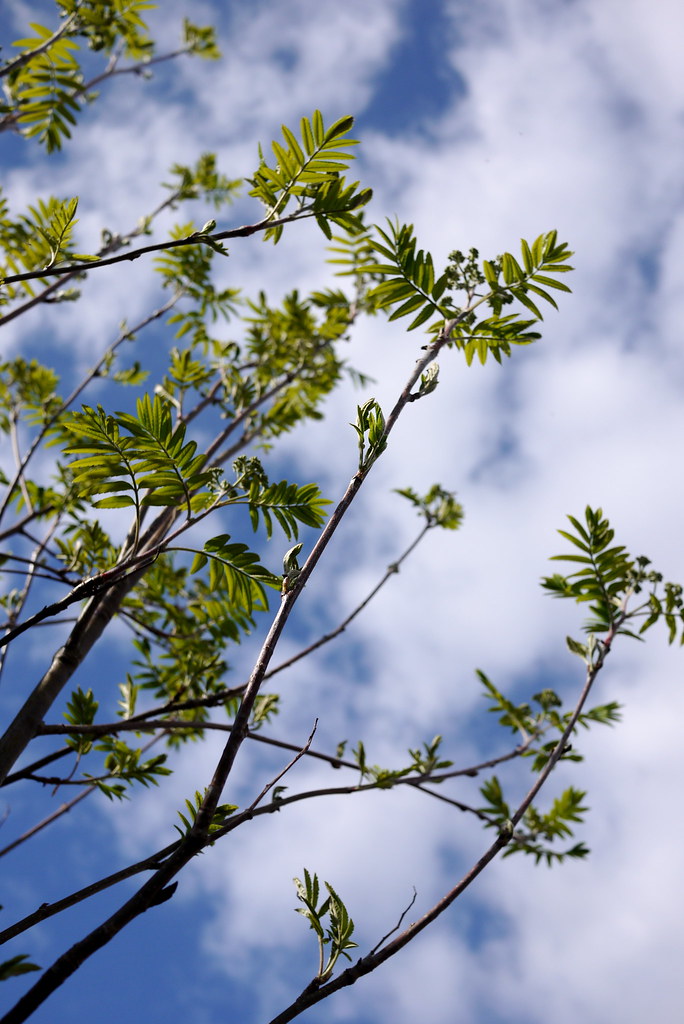
In the meantime, since I have a bit longer to think about stuff and make preparations, I'm contemplating the usual butter churning (and warbling singing that goes with it) and perhaps getting brave enough to make some crowdie cheese. I can't smell anything right now so at least I won't be put off by the smell...On top of that, I might try might hand at a clootie dumpling as part of the feasting, and the rowan, which is nearly in full leaf...


...needs a bit of pruning, which will allow me to restock my supplies for rowan charms. There will be all of the other usual stuff as well, including skimming the well and saining, and so on, although the non-ritual stuff I might spread things over a few days so I don't over-do things. I'm waiting for an epidural injection that will hopefully help manage my pain levels until I can have surgery to remove the disc that's causing all my problems, but until then I still need to be careful. That is certainly one thing I'll be celebrating - I finally have an answer for what's been causing all of these problems!

I stumbled across this article (from 2005) that is linked to on the Beltane page on Wikipedia, which I think is interesting:
Last Sunday Maybush fires raged in Arklow once more to greet the arrival of May. But the local residents were also enraged - by the fact that their areas were made dumping grounds for unwanted household goods. According to reports, many householders used the camouflage of the Maybush bonfires to disposed of unwanted furniture and other items. 

There are lots of modern celebrations these days, like the Beltane Fire Festival in Edinburgh, but things like this just go to show that there are survivals that have deeper roots than the ones like Edinburgh that have been recontextualised. It's nice to see.

Anyway, I hope you all have a good one (and for any readers in the southern hemisphere, a good Samhainn if that's what you're celebrating).