Friday, 30 September 2011

Harvesting

While most of Britain basks in a last gasp heatwave, it's business as usual round these parts. It's a wee bit warmer than usual for this time of year, yes, but no less wet and generally grey. An Cailleachan have been busy battering the coast and the autumnal colours are decidedly dampened on the trees here. Offerings were made to them at the equinox, but otherwise things have been pretty quiet. 

The berry harvest has been good though - we've missed the best of the brambles, I think, but our own blueberries are still going strong. Our old friends, the baby snails, haven't disappointed:

 
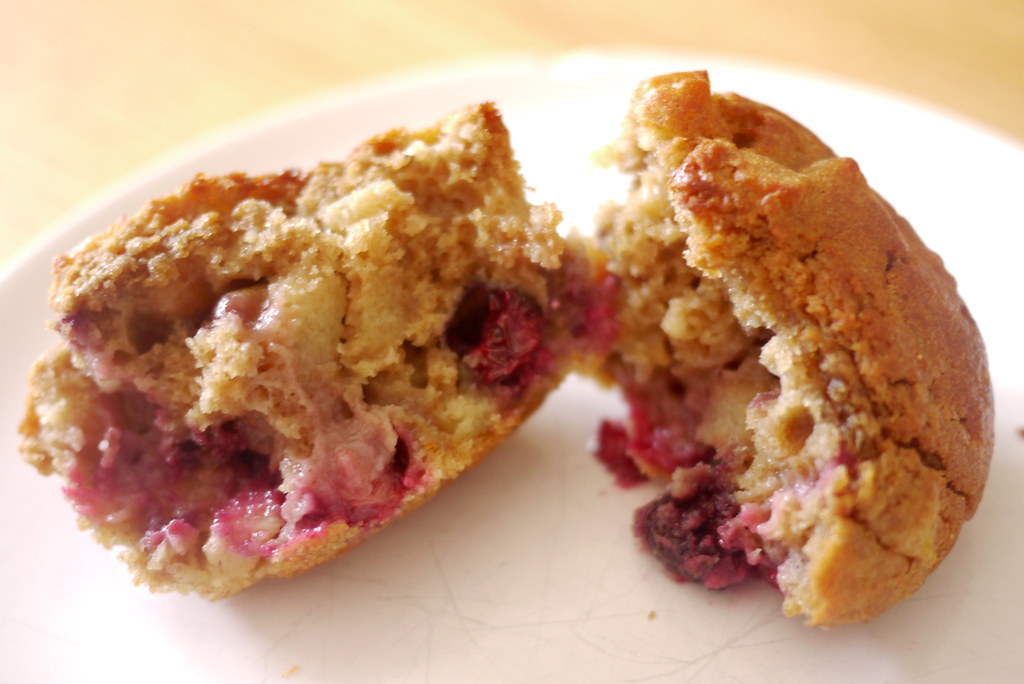
But with careful removal of said friends, to avoid any extra accidental protein, we've had a good harvest so far and it's given me an excuse for some of these:


Although the recipe could do with some perfecting. Practice makes perfect, no?

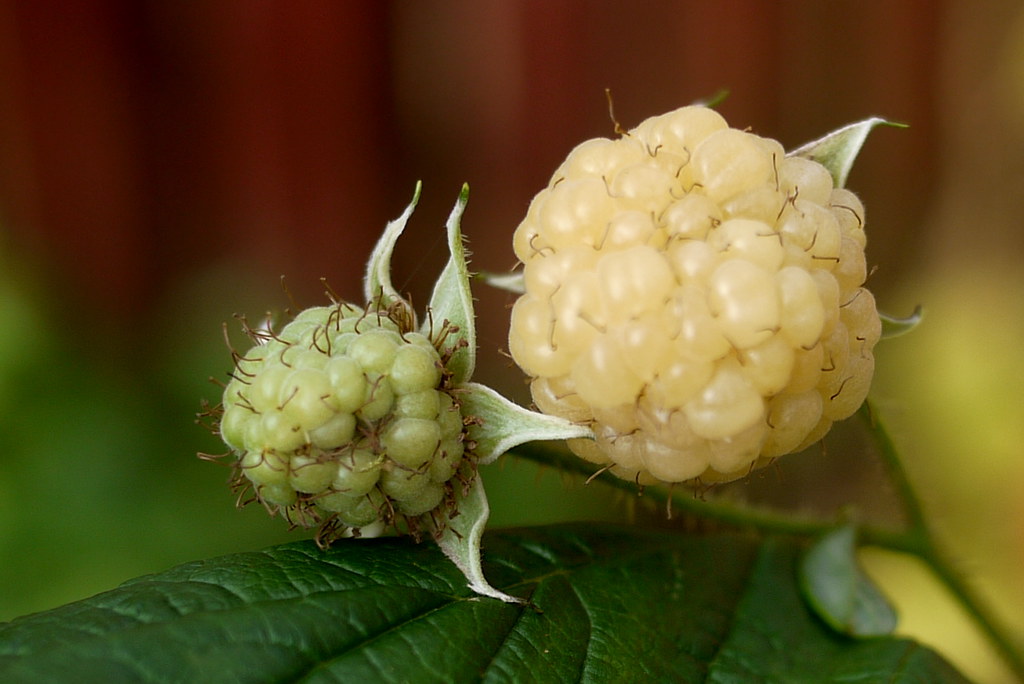
And we've got some raspberries! Of the two bushes I've got in the flowerbed, this is the first year either one of them has put forth much in the way of fruit, and most of them have gone to the wee beasties in the garden, I think. The standard raspberry bush ended up getting crowded out by weeds and bushes that need trimming, I think, but aside from the other bush getting blown over, we have a modest amount of golden raspberries promising:


I've never tried them before, I don't think, though there are a lot of bushes that have spread and gone wild in the village. Rosie and I picked the only two that were good for eating, and Rosie bravely volunteered for a taste test:


It turns out they taste exactly like normal raspberries. They were met with approval.

The warmer weather has been good for the veg I've still got growing - the onions are about ready now, I think, but alas, after our berry harvest on Wednesday I decided to prune down some flowers that were crowding everything else out and that knackered my back again. Not as bad as it has been, but not great, and the onions can wait a while longer until I can walk again. The good news there is, I've at least been reassurred that fibromyalgia is an unlikely diagnosis for me - I just have the bog standard variety of chronic pain. Yay me.

With the pruning out of the way, however, I'll be able to get at my little devotional space I've arranged and set aside in the flower bed. It's been sadly neglected like most other things this year, but it seems something doesn't mind that because I startled a tiny wee frog as I was pruning. Sorry froggy. But I'm glad you found a home here.

Wednesday, 28 September 2011

Hello Wikipedians!

So I noticed a few hits on the old blog here coming from Wikipedia, of all places, and it seems that there is currently a debate raging over there with regards to rutabaga, of all things. So hello! Thanks for all the support and nice things that are being said.

I have to say, it's a bit weird to find myself being debated on a corner of the internet dedicated to a root vegetable...

While I feel very honoured to have my website referenced on a Wikipedia article, I have to say I'm quite surprised, too, because I wouldn't have thought that it qualifies from what I understand of Wikipedia's rules about what is and isn't suitable for referencing. I do make an effort to write my articles to a decent standard and put references in, but it's not like they're peer reviewed, or anything. Having said that, I do live in Scotland, so I could point out that I am carrying on the tradition and am speaking from experience.

I didn't grow up in Scotland, but my husband did so I've spoken at length with him and my father-in-law about the practice. I can say - for what it's worth - that it's definitely rutabaga that was (and still is) used for carving the lanterns, though here they really are called tumshies, neeps, or just 'turnips'. In supermarkets you'll find them on sale as swedes, but colloquially they are rarely referred to as such in Scotland, as far as I've ever heard.

I can also say that they're an absolute bugger to carve.

Anyway, I've been unable to ascertain for certain how old the tradition is, but like some have been saying on the talk page it's not something that can be said to be particularly 'ancient' or specifically pre-Christian - especially seeing as the tumshie itself only dates from the seventeenth century. So the start of the section on Hallowe'en is incorrect when it says:

Since early times,[when?] people living in Ireland and Scotland have carved turnips and used them as lanterns to ward off harmful spirits.[19] They are still popular throughout Britain and Ireland today at Halloween, [20]however their use goes back to a much earlier time.
 
This bit here:

The bonfires were replaced with hollowed out turnips (the common name for rutabaga in Ireland, Scotland. and Northern England) filled with glowing coals.

Is also a bit questionable, I think (there's also a full stop after 'Scotland' that should be a comma). The lanterns didn't replace the bonfires; in Scotland, the bonfires have arguably shifted to Guy Fawkes' night on November 5th - see Ronald Hutton's Stations of the Sun. It's true that tumshie lanterns aren't as common as they used to be, though, and most people carve pumpkins these days. Most years you'll find the odd piece in the paper about trying to revive the tumshie. 

I would also say that Samhain is not a Celtic festival, it's a festival that is Irish in origin. Given Scotland's Gaelic heritage, it is also referred to as Samhain (or Samhainn/Samhainn) in Gàidhlig. It's an important distinction that needs to be made, because 'Celtic' is a linguistic term that refers to a variety of languages. It is sometimes used as a cultural term but in this context it implies that Samhain is a festival that is found in all Celtic cultures. This is not the case.

Just my tuppence worth there.

Anyway, another useful reference for you might be F. Marian McNeill's book, Hallowe'en: It's Origin Rites and Ceremonies in the Scottish Tradition. The song on page 33, called A Nicht o' Tine has a verse:

A howkit neep wi' glowerin' een
To fleg baith witch and warlock.

In other words: "A carved turnip with scowling face, to scare both witch and warlock." As far as I can tell the book was published in 1970 or 1971 - there's no date or ISBN number, but it was published by The Albyn Press in Edinburgh.

And one final thing, just to clarify: I am, in fact, a 'her'!

Book Review: Kindling the Celtic Spirit

One more review for now.

Kindling the Celtic Spirit
Mara Freeman

This is a book I bought early on in my first few tentative steps towards Celtic Reconstructionism, and at the time it was one of those fantastically inspiring books that got me very excited. This is the book that helped me see what a non-Wiccan/Wiccanesque style of practice might actually look like, and helped me see that Celtic Reconstructionist practice was actually workable; at the time I found it difficult to wrap my head around what to do because at the time - before the CR FAQ, before even the CR Essay, I think - there really wasn't much out there and I myself had been floundering after leaving Wicca behind and exploring various other paths like ceremonial magic and various forms of Druidry that all have fairly similar ritual approaches.

So I have a soft spot for this book, I really do. Let me be clear though: This is not a Celtic Reconstructionist book, or even written with such an audience in mind. It is written for what you might call a neo-Druid audience in mind, one that's looking for a more historically-minded approach without the Druid Revivalist trappings of Iolo Morganwg and Ross Nichols' dodgy history. It's also geared more towards the solitary practitioner than group practice, and the ritual outlines draw reference from traditional sources rather than neo-pagan ones, but here and there you will certainly find what might be seen as a neo-pagan approach, that don't necessarily agree with a CR approach - invocations to deities, Robert Graves, advocating developing a working relationship with the Good Folk...that sort of thing.

The book is laid out month-by-month, after a few introductory bits and pieces, and each month accommodates a particular focus relevant to the month, season, and related theme of the chapter. Tales and bits of folklore, animal lore, and spotlights on different deities are given in each chapter, and there are meditations to work on (there's also a CD that accompanies the book, with these meditations on it; you have to buy it separately, though, and I didn't so I can't comment on that). The festivals are dealt with as well - the eight festivals of the Wheel of the Year, but with a focus on customs and lore from historical sources - and there are some practical ideas and recipes for things to do for each of them - making a May Bough at Bealltainn, carving turnips at Samhainn, that sort of thing. There are also plenty of prayers, charms, poems, blessings and so on, many of which are adapted from the Carmina Gadelica or early medieval Irish manuscripts.

There is a very hearthy, domestic focus to the book which is something that really appealed to me, and I found the inclusion of practical, creative things to do for the festivals a nice touch as well. The adaptations and prayers are mostly well done, and while the guided meditations aren't really something that appeal to me personally, they're well written and I can see that they might work well for others.

Where it falls down, I think - and it's a problem that I find with most books like this - is that while the focus is mostly on an Irish or a more generally Gaelic practice, Welsh, Brythonic and Gaulish elements are also brought in here and there; an examination of the meaning of 'awen', the stories of Taliesin and Ceridwen, a section on Cernunnos, and so on. There is also the suggestion of a wassail bowl, which couldn't even be considered to be Celtic. All of this smooshing makes it a very hodge podge affair. To me, these are very different and diverse cultures - different languages, different histories - and while they might have the same Celtic roots, they've evolved in very different ways and deserve to be looked at and appreciated on their own terms.

It seems odd to have such a regard for historical practices, detailing folklore and customs from the various cultures, to then completely disregard their context and then mix them all up in a completely ahistorical way. This is rather disappointing, but at least Freeman is (usually) clear where everything comes from, and she's also quite good at referencing her sources. It would be easy to pick bits out that are relevant to one's own focus, but ultimately there's nothing here that comes from particularly esoteric sources and it would be just as easy to go to the source yourself.

It's a well-written, beautifully presented book. Ultimately, though, as inspirational as this book was for me, I'm not sure it's something I would recommend to a CR audience these days. Aside from being potentially confusing for the beginner, there are better sources out there to look to now, far more so than ten or even five years ago, so I think that looking to them instead would be more helpful - do your own research, or look to CR websites or groups that are out there.

Monday, 26 September 2011

Book Review: A World Full of Gods

Another review today - I've had this book for over a year and only just got around to reading it in the last week or two. It's a good meaty book and it's been taking up most of my free time in the mornings to get through it, but I've also had the chance to tinker away at another page on the website - this time, the introductory article on Irish Mythology. Most of the additions are links to the various myths links, with a bit of reformatting and a few tweaks here and there.


A World Full of Gods
John Michael Greer

There aren't many books out there (that I've seen) that take on the task of providing a good, meaty, philosophical discussion of polytheism - especially one that comes from a polytheist point of view. This is very much a book that is aimed at the polytheist, rather than the Wiccan or neo-Wiccan/Wiccanesque pagan, and that in itself is refreshing for me, because it's not something I come across often.

I got off to a bit of a bumpy start with the book because much of the introductory stuff in the first few chapters were kind of obvious to me and I wasn't sure if the book was going to offer much for me to chew on - which is not to say that I think I know everything there is to say about polytheism, just that it's something I've had plenty of opportunity to think on over the years, and I'm pretty set in my ways by now. I was happily proven wrong, though, and once I got into the meat of the book I found a lot of good stuff (and to be fair, the more experienced polytheist or scholar of religion is invited to skip a few chapters near the beginning, to get on with it, but I wanted to read it from start to finish).

The first few chapters certainly help introduce the beginner to a good understanding of polytheism, and as much as I had some reservations about where it was all going I did appreciate seeing things being spelled out clearly, and in a way that helped me appreciate where others might have questions and confusions about certain things. I can see this being a good book to point people to, if they have some questions about how polytheism actually works.

I found the middle of the book more challenging and enlightening, and one chapter in particular helped solidify a few thoughts on something that had been bugging me for a while (chapter 8, dealing with offerings and reciprocity; the next one was interesting too).

For the most part the book is very straight forward, well-written and clearly thought out. There is a heavy emphasis on philosophy and logic in the way the subject is approached, and Greer does a good job of introducing the big words and concepts that the average reader probably won't have much familiarity with (and there's a handy glossary at the back in case you get lost).

Because of the philosophical focus of the book, it's not a how-to sort of tome, with ritual suggestions or an encyclopaedia of gods tucked in at the end so you can pick your favourites and invite them round to lunch. Nor is this the kind of book that I could really pick up and put down, or pick at here and there. This is a book that needs to be read from start to finish to appreciate it at its best, I think.

Over the course of the book, subjects like the different types of polytheism, and the ethics, myths, spirituality, ways of worship and the logic of polytheism are dealt with, as well as the question of why people might be polytheists. Greer keeps the focus of the book as general as possible, calling on various different cultures and polytheistic religions to illustrate his points - mainly Norse, Celtic, Shinto, Greek, Roman, with a few others mixed in - along with some analogies that help explain where he's coming from. Inevitably that means there has to be generalisations here and there to accommodate as broad a view as possible, but given the purpose and focus of the book I think it worked well. Both the commonalities and differences of polytheistic views and religions are taken into account, so it's pretty thorough. It would be nice to see something that focuses solely on Celtic Polytheism (though of course I'd say that), but as an introduction to polytheism in general, Greer has the right of it here.

One thing in particular that I appreciated is the emphasis on 'traditional polytheisms', which Greer stresses tend to be hard polytheisms. While generally I would say the arguments Greer presents are well done, there are some aspects that I think might be slightly lacking, and this lack mars my feelings towards the book in general. Inevitably in discussing polytheism there is going to be some comparison to the major monotheistic religions (especially Christianity) as well as atheism, and I think the author's own bias towards accepting a polytheistic viewpoint means that certain elements are glossed over when presenting all the various different arguments. For example, at one point the argument was made that the widespread belief in the afterlife - or various forms of the afterlife - is itself evidence that supports its existence. I don't think this is the kind of argument that stands up to objective examination, really, and this type of fallacious argumentation is all too common.

In addition to this, concluding that alternative viewpoints rely on 'special pleading' - and are therefore weak or invalid - is a common refrain throughout the book, while ignoring the fact that Greer himself does exactly the same thing. It comes across as hypocritical and lacking in any true objectivity or honest insights. If you're totally on board with Greer's own views and you're not interested in weighing up the arguments and examining them, then it's probably not a problem, but if you look at the arguments objectively, as he seems to think he's doing, then I'm not so convinced. I can imagine my atheist husband would say that Greer's argument in favour of polytheism, for one, relies on special pleading as much as anyone else's beliefs.

In some ways, perhaps, agreeing with Greer's arguments are beside the point; if anything, whether you agree or disagree it helps finish your own train of thought about these subjects, and helps you make up your own mind. Greer's apparent assumption that his conclusions are 100% logical and watertight can grate a little, though, and at times it does get a bit repetitive.

More and more as I've come back to this book, the faults become glaring and far outweigh any of the positives I originally saw. In particular, as much as I enjoyed the middle portion of the book, and appreciated the novelty of the book itself, the last couple of chapters weren't as good, to my mind. The chapters on myths and eschatology in particular weren't so much about polytheism, I felt, as they were arguments against monotheism (or, ultimately, any religion that claims to be the True Religion) so the book seemed to lose focus a little towards the end, and frankly, it felt unnecessary and somewhat prejudiced.

I'm not sure this is a book I could read again and again. I originally thought that I could see myself referring back to the more helpful parts now and then, but ultimately I haven't. Even from the start I was unable to give the book a resounding yes! as a recommendation, but felt that an outright no was unnecessary. However, as time has worn on I can't help but feel that the more I've learned about the author himself has perhaps made me feel even more negatively towards the book than I originally did. Ultimately, I can't in conscience recommend something that benefits a racist, and a known associate of racists and abusers. It's a shame that a good book on the subject has yet to come out, but I'm still looking...

Tuesday, 20 September 2011

Hail to the hooded crow...

Blogger has a handy widget that lets you know the kind of search terms people use that result in their stumbling across your blog, along with other fun stats and stuff. It's always entertaining, especially since one of the most common search terms these days involves 'king's nipples' or 'nipple cult'. A while ago, somebody stumbled across the blog after doing a search for 'matriarchal spaceships' (I think that one's my favourite). Yesterday, somebody arrived by way of searching for 'invoking Irish zombies.'

The mind boggles, it really does. But I'm sorry to disappoint.

Anyway, I've not had much to say recently aside from bits and pieces in the news and reviews (of which I'm intending to catch up on a few more at some point), and that's mainly because I haven't been doing much. I slipped a disc in February and I've been having problems ever since, though quite what the problem is now is yet to be determined; I'm undergoing another course of physiotherapy and it's been decided that my disc isn't the problem right now, and I suspect I'm heading for a diagnosis of fibromyalgia (though that's by no means certain); whatever the case, it seems I'm stuck with whatever it is for good now, and will be dependent on a cocktail of medication just to get through each day. I can't be too active, or else I end up in even more pain, and alongside not sleeping too well and taking a lot of drugs that can make you tired, well. There's not much chance of that happening often. So yeah, not up to much these days while I figure out the limits of my capability now. It's a voyage of discovery!

A life of pain and drugs is not a prospect I relish, to be honest (though I'm well aware my situation is nowhere near as bad as it could be; I know folks with similar problems who have it far worse than I do), but it's not something that comes as much of a surprise, really. Just before this all happened I'd taken a trip into town to run some errands, and just as my daughter and I had got off the bus and were walking towards the shopping centre, there was a hooded crow perched on a wall. They're very distinctive birds, with their light grey bodies, and I've seen them before on travels around the Highlands - always in large groups, though, usually flocking around roadkill, or something. I don't live in a part of Scotland where they're common, but I do live near the edge of where they tend to live, so it's not outside the realm of possibility to happen across one. But when you happen across one in unusual circumstances, and they have religious significance to you...well. I don't know about you, but I tend to take note of that. And if it was supposed to be a sign, then I wasn't expecting it to be a good one, given the associations. (Pointless aside: In Ireland, the hooded crow is the emblem of the O'Tooles of Wicklow. In the fourteenth century, they are said to have gone into battle with the cry, Feannóg abú! - Hail to the hooded crow! That's a kind of attitude I can admire...)

So anyway, here I am, lumped with it for the foreseeable future. And of course, I'm not the only one facing something like this, and nor am I first. When the general diagnosis involved a buggered disc I went searching for folk cures and charms to see how people dealt with it before the advent of Tramadol and the like (might as well make it a learning experience). I didn't exactly find much that could help! Take, for instance, George F. Black's Scottish Charms and Amulets:

Some of the natives [of North Uist] wear a girdle of the Seal-skin about the middle, for removing the Sciatica, as those of the Shire of Aberdeen wear it to remove the Chin-cough.

Well, I did see a seal sun-bathing on a rock near the shore last month, but I think people tend to frown on that sort of thing these days. Personally, I like seals alive more than I like them worn as a girdle in the hopes of relieving sciatica.

John Gregorson Campbell, on the other hand, has this to say about leum droma ('leap of the back' - a slipped disc, or bad back in general):

When the back is strained and its nerves are affected so that motion is painful, the afflicted person is to lie down on his face, and one who was born feet foremost is to step thrice across him, each time laying his full weight on the foot that treads on the patient's back. There is not cure unless the person stepping across has been born feet foremost.
Ronald Black, The Gaelic Otherworld, 2005, p228/490.

Technically speaking, I could give this one a go because my husband was a breech baby, but then again he's about twice the size of me, and even without a knackered back I suspect trying this would break me, even if I could persuade him to try.

At least there's Tramadol...