Wednesday, 17 August 2011

Skeachan Cake

Every now and then I take it upon myself to try and master a new recipe or two, especially if it's a good old stodgy traditional Scottish kind of thing. For a while now, on and off, I've been experimenting with trying to make a Skeachan cake - a 'treacle ale' cake. It's basically a fruit cake, made with a little black treacle and ginger, and the fruit is soaked in ale for about 24 hours before baking to make them all soft and juicy.

Technically skeachan is the 'treacle ale' - ale flavoured with black treacle, ginger and some other flavourings. I have a recipe for the skeachan itself (though I've not tried making it yet), but not the cake, so I had to look one up online. There were several to choose from but they all seemed to be lacking something, I thought, though I wasn't quite sure what - aside from not including enough ginger. Then one day I went on a trip to Luss - a nice little village on the shores of Loch Lomond with a fantastic tea room (they do the best soup I've ever tasted) - and they had some skeachan cake on offer. Obviously, for research purposes, I decided it was necessary to indulge in a slice.

After trying that and comparing my previous efforts, I found the recipes weren't far off after all, but definitely more ginger was needed, and the kind of ale you soak the fruit in is key. On the first few goes I tried some locally brewed pale ale and then a heather ale (Fraoch), but I think the cake needs a good heavy beer, so I ended up trying Guinness instead. That did the trick for my tastebuds. The cake I tried was topped with slices of crystallised ginger, which I think was definitely the missing ingredient. Now, after a bit of experimenting, I think I've cracked it:


It's a good cake for festive occasions and quite moist compared to some fruit cakes, and it's similar to the traditional Christmas black bun (but a bit less fiddly to make). So here's the recipe, if you want to try it:


Skeachan Cake

I cook by weights, but I've tried to adapt it to volumes as well. Bear in mind that I've rounded everything up to the nearest quarter cup for the sake of ease; the exact volume to weight ratios are a little less, but that shouldn't make much difference overall. You can easily adjust the ratios of dried fruit if you prefer (I like to use more sultanas and raisins, and a little less currant and peel), as well as the amount of ginger you use. I use quite a lot to give a fiery kick to it, but you might want to add it gradually to see how you prefer it. I've outlined the traditional method of combining the ingredients below, but you can get good results by just putting the ingredients for the cake batter altogether in a mixer, and then just stir in the fruit.

For a non-alcoholic version I think soaking the dried fruit in a flat ginger beer or cordial could work, adapting the amount of dried ginger for the batter.


Ingredients
225g (1 1/4 cups) Raisins
225g (1 1/4 cups) Sultanas (golden raisins)
350g (2 1/4 cups) Currants
75g (1/4 cup) Citrus peel
250ml (1/2 cup) Ale
225g (1 cup/2 sticks) Butter 
225g (1 1/4 cups) Dark brown muscavado sugar
1tbsp Black treacle (or molasses)
4 large eggs
225g (1 1/2 cups) Plain flour
3 tbsp (approx.) Ground ginger
1 tsp Mixed spice
200g (approx) Crystallised ginger
Optional: Glacé cherries


Method

1. Soak the raisins, sultanas, currants and citrus peel in the ale for at least 24 hours, stirring occasionally.

2. Preheat the oven to 160C (adjust for a fan oven - about 10C less) and grease a large cake tin.

3. Cream the butter and sugar together until fluffy.

4. Beat in the treacle, followed by the eggs.

5. Mix in the flour and spices (to taste).

6. Stir in the soaked fruits and the cherries.

7. Pile the mixture into the cake tin and cover the top with the crystallised ginger, using scissors to cut it to the desired thickness. 

8. Bake for about 2 1/2 hours, or until cooked.

9. Allow to cool, then enjoy. Goes nicely with a little bit of cranachan.

Monday, 15 August 2011

An outsider looking in

One of the recent posts over at the Wild Hunt blog got me thinking (dangerous, I know). It wasn't so much the posts that got me thinking - though I was glad to see it being covered - but the comments, really, many of which (at first) I found to be disappointing or just sad and apathetic.

Jason made a post on the recent protests and actions against the threat to the San Francisco Peaks; in short, there are plans to expand a ski resort in the San Francisco Peaks in Arizona, despite the fact that the mountains are considered to be sacred by the indigenous groups there. The resort want to use wastewater to make snow - something that the protesters are objecting to strongly.

This isn't the only point that's being protested against, but for some reason people seem to be getting hung up on it, rather than looking at the bigger picture. In order to get the snow up there, pipelines will have to be laid, which will involve bulldozing ceremonial sites and digging up part of the mountain in order to lay the pipe. The comments in response to Jason's article were almost overwhelmingly - at first, anyway: "So? We use wastewater for drinking as well, it's only a bit of snow."

I find this kind of response is disappointing on many levels. Judgements were being made with little attention to the actual facts, and instead only one aspect is being focused on that is being dismissed as irrelevant. Even if the type of water being used for the snow was the only issue at stake here, however, the fact remains that the proposals go against the religious beliefs of a people and a minority. Their religious beliefs are being ridden roughshod over for the sake of profit; once again, a sacred site is under threat because money is to be made from it, and those who are protesting against it are being dismissed as a vocal minority with no real point or purpose. Is it just me, or is there a big disconnect here?

One of the things that a lot of Gaelic Polytheists - reconstructionists - have to reconcile is the fact that while we honour the dé ocus an-dé, the "gods and ungods" within a specific cultural focus, most of us aren't living in the lands where those gods originated from. And yet a large part of our practice focuses on building a relationship with the land we live in, as well as the spirits who live there.

Tied in with that, one of the inevitable questions for some folk is how to respect local beliefs (and spirits) that aren't Gaelic (I'd say "Irish, Scottish, or Manx", but that's a bit of a mouthful), and carry out our practices without causing offence. In the US there are some practices that are taboo in indigenous practice that are common in a Gaelic context; in Ireland, for example, it's common to pour a drop of whatever your tipple is - a wee offering for the Good Folk - if you happen to enjoy a drink outside. For some indigenous people, alcohol is a taboo and considered a poison for the ground. As much as it's a simple matter of respect and common sense not to piss off local spirits by offering what they might consider poison, it could also be considered a matter of hospitality. Hospitality is considered to be a virtue in Gaelic Polytheism, and that should include taking into account the needs and wants of our honoured guests.

Sacred places are increasingly coming under threat at the expense of progress. Whether it's the hydro-electric proposals that are threatening the safety and integrity of Tigh nam Bodach and Gleann Cailliche, or the motorway that ploughed its way through the Tara-Skryne valley, or the Slane Bypass that protester's claimed threatened Newgrange's status as a World Heritage site (which has been given a reprieve - for now - thanks to the ongoing economic downturn)...or whether it's something like the San Francisco Peaks that's at stake. It's a slow and seemingly inevitable march.

Pitted against progress and profit, there is the question of conservation and cultural integrity. These two sides often seem at odds, and I think ultimately if we want our own beliefs and sacred places to be respected and protected, then it's an issue that goes both ways. It's a case of being stronger together, and supporting others in their struggles to preserve their own sites even if it's not on our own turf, or relating to our own religion. 

As a reconstructionist, I honour the gods from a specific culture. Part of my focus is looking to the lore, the history, the archaeology of that culture. I see that culture preserved within the landscape around me here, in the language on the signposts by the side of the road and in shops (always underneath the English, in smaller lettering as if a lesser language, however). Around me lie the memories, experiences and expressions of those beliefs and practices that I aim to incorporate into my life - such as that might be. This land I see around me is sacred, and I'm not the only one to share that view:

Cairns at Loch Loyne, 2008

Even today, people leave a mark, a sign of remembrance and perhaps thanks at having been present in such a landscape (and this isn't the only place I've seen).

Given my views it's only natural that I might err on the side of conservation, and I can understand why others do too. Why some people - pagans, reconstructionists, polytheists who also might see the land as sacred - don't care about these things, I don't understand. What's happening at the San Francisco Peaks, and probably many other places around the world, they're not happening in my back yard. There's probably not a lot I can do about it, being all the way across the Pond. But as a polytheist and an animist it saddens me that these places are being lost, and in the process freedoms are also being lost. Apathy reigns and big business wins, all because it's just a bit of snow.

But it's not. It's not just snow. It's not just a few pylons, or just a road. It's all wrapped up in belief and tradition, sacredness and ceremony, integrity and culture. None of that should be lost for a ski slope, or a road, or a hydro-electric scheme. At the least, none of it should be lost without a fight for it first.

Friday, 12 August 2011

'Late prehistoric' bog body found in Laois bog

Thought to be the body of a woman, with some interesting details about the deposition of the body:

The body is estimated to be over 2,000 years old. It appears the torso and head, which were in a leather bag, did not survive. The legs, however, were not enclosed by the bag and were preserved by chemicals in the peat.
Found in the Cul na Móna bog between Abbeyleix and Portlaoise, it was discovered by an employee operating a milling machine on Wednesday evening.


Saturday, 6 August 2011

Heilan' coo's mostly...

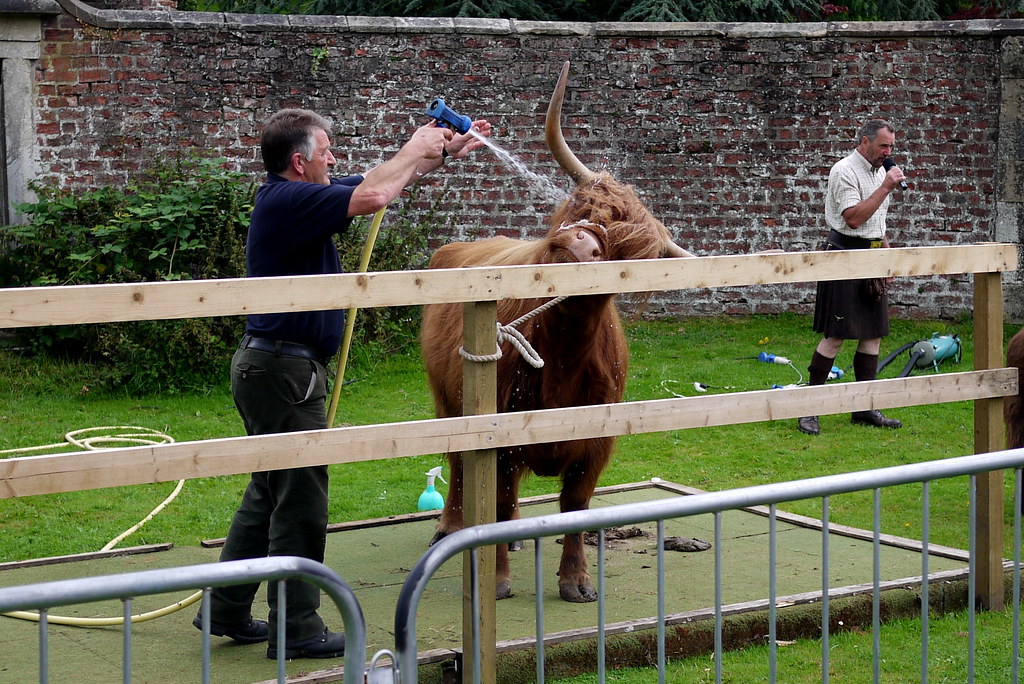
Ooooooh yeah, down a bit...That's it...


Susie likes having a good wash. She's a show heifer, so she needs to look her best before the judges come and see her. Today she only had a shampoo and blow-dry (no, really), but usually she'd have a bit of conditioner rubbed in too. Timotei is the best, apparently. It takes about 5 litres per cow. Coo.

We met Susie (Siusan) today at a family event in Glasgow, along with some of her friends. And her daughter, also called Susie:


Mum is Susie Ruadh ('red'), while daughter is Susie Dubh ('black'), because one day this wee calf will end up black all over, just like her dad. Susie Dubh was only born in April, while I think her mum must be at least four or so.

Susie Dubh lapped up all of the attention and enjoyed a good scratch or two, especially on her chest and all the hard-to-scratch places a cow might have (at the front anyway!). They have very soft and thick coats. I could've petted them all day.

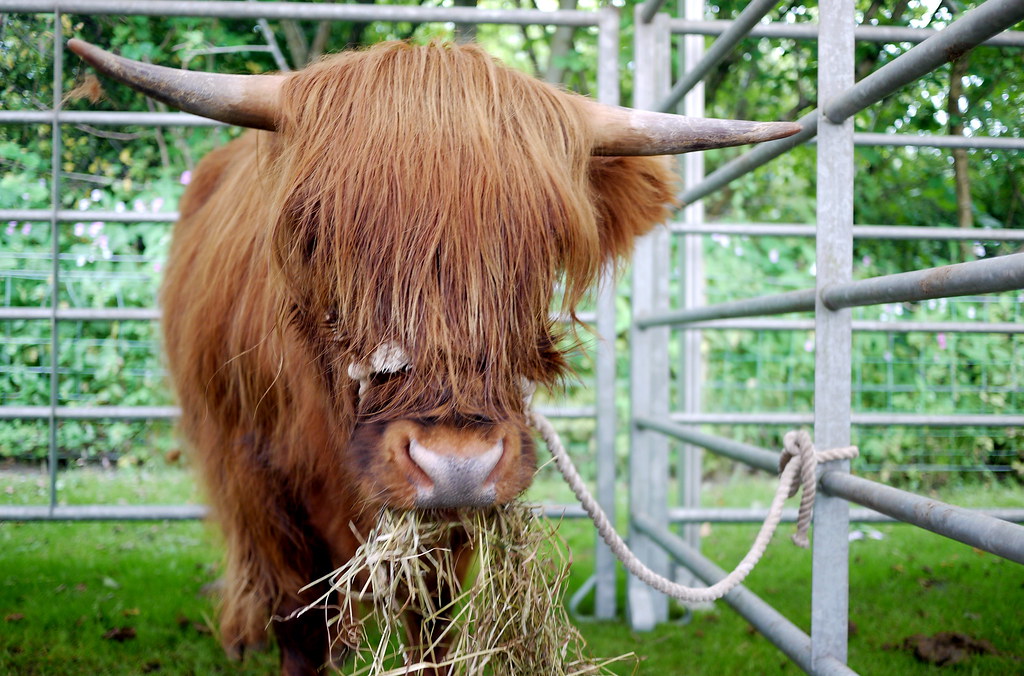
This is their friend, Una Ruadh:


In addition to a good bit of grass or hay, it seems they enjoy nibbling on zips and licking body warmers given half a chance. One little girl was horrified when she realised that her beautiful purple body warmer was covered in cow schleb. It seemed rude not to point out what the cow was doing to it once I noticed...

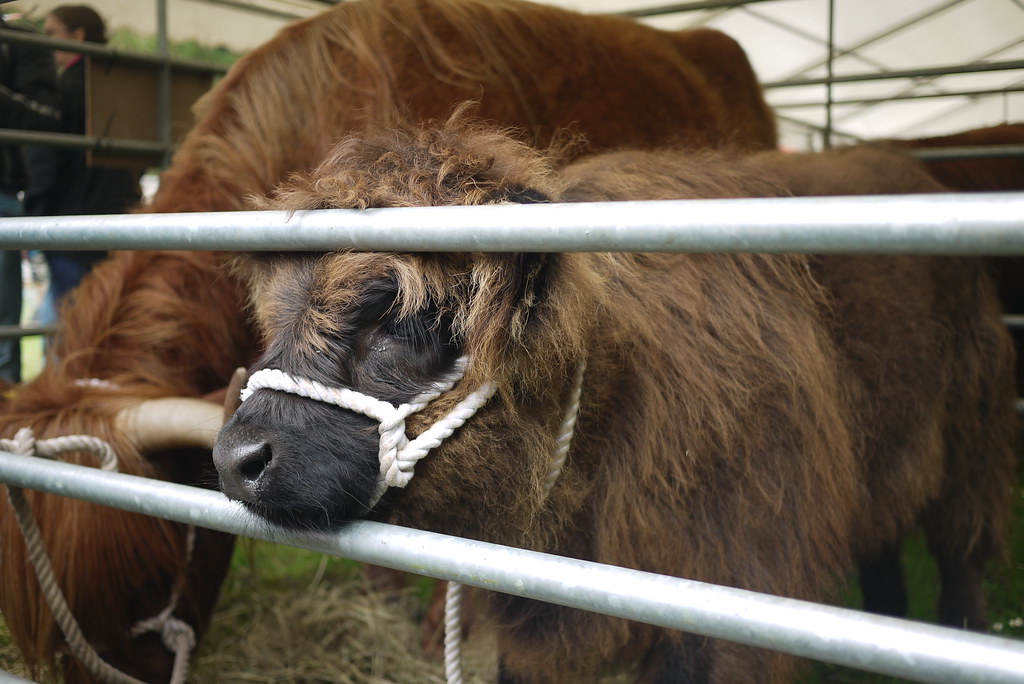
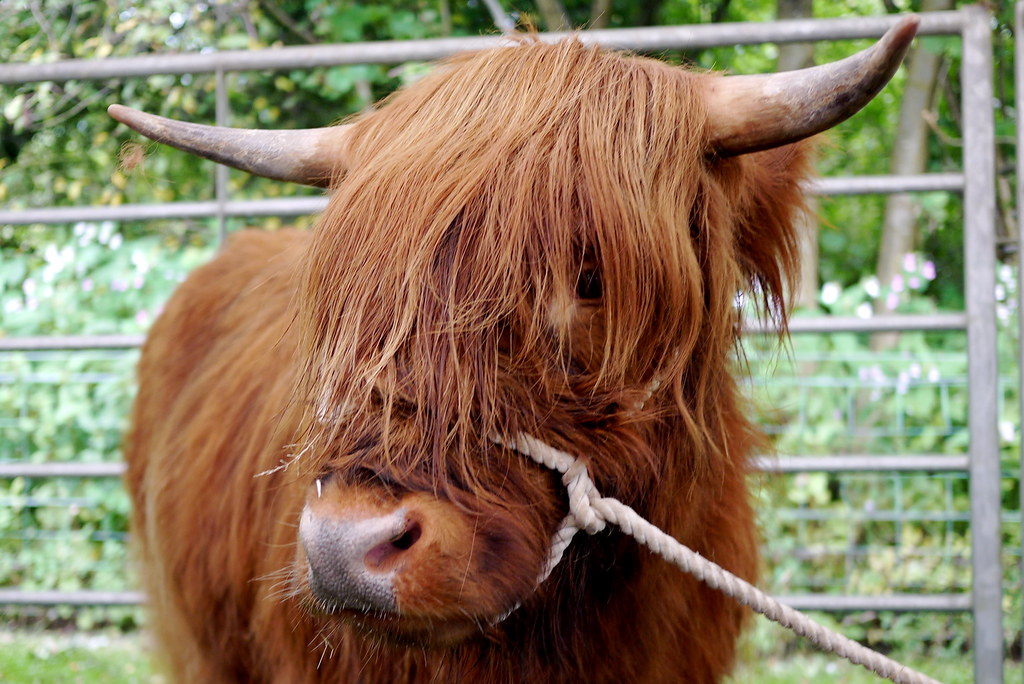
I don't think I noted this one's name down:


She's only a yearling, and is obviously unimpressed with being shown off to the great unwashed. Some of her friends had a little adventure recently, after a dog walker let their three dogs off their leads to run rampage through the country park where the herds of Highland cow's graze. As a result of the dogs giving the yearlings some unwanted attention, several took fright and stampeded, taking down fences and hedges until they ended up in the south-side of Glasgow. I think seven managed to escape from the park and end up in the city, and one of them apparently even wandered into a mechanic's garage, damaging a few cars before being rounded up safely and taken home (imagine explaining that one to the insurance company!). Luckily, none of them were injured, just a little freaked. If this is one of the heifers involved, she's not telling. She's feeling a bit coy:


Who, me?

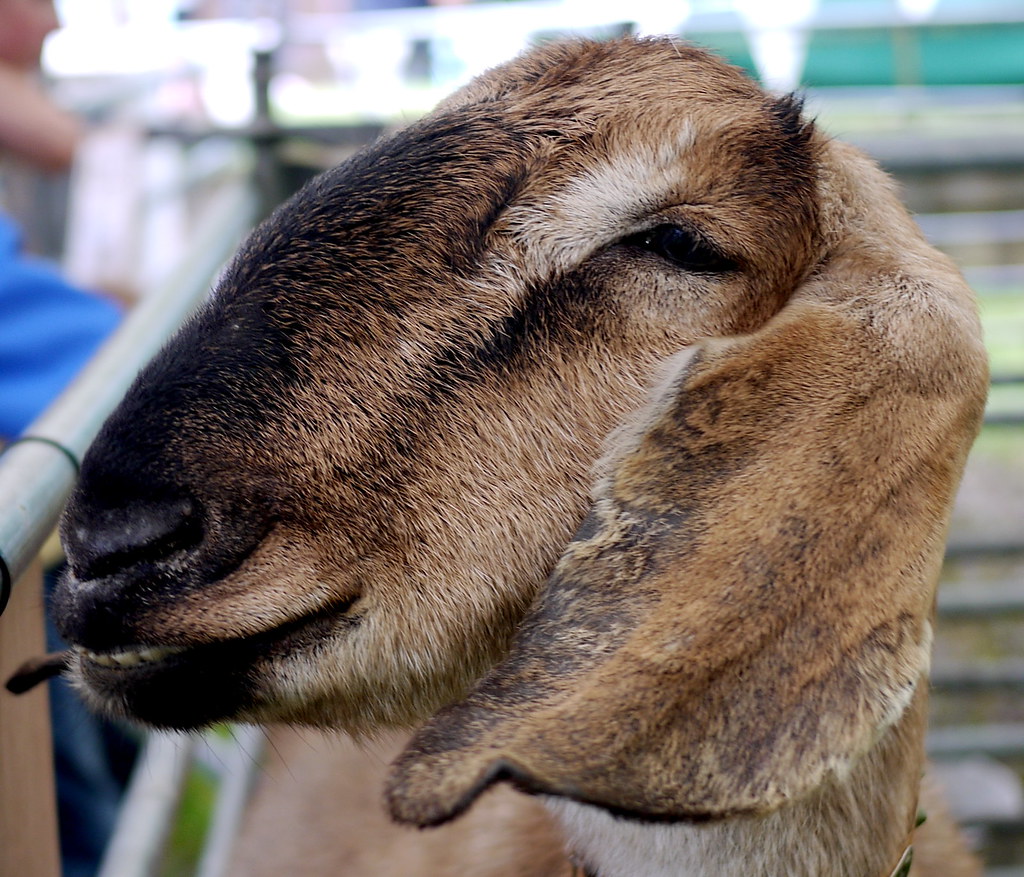
The heilan' coos had a few friends along too, including a very chirpy-looking Anglo-Nubian goat:


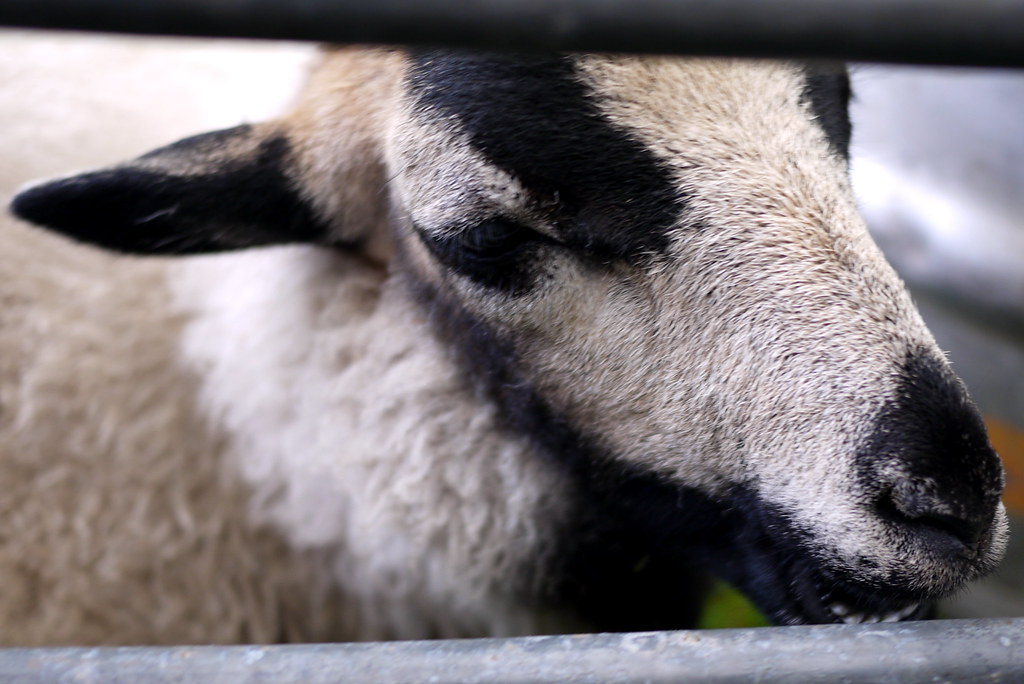
And a Welsh badger-faced lamb:


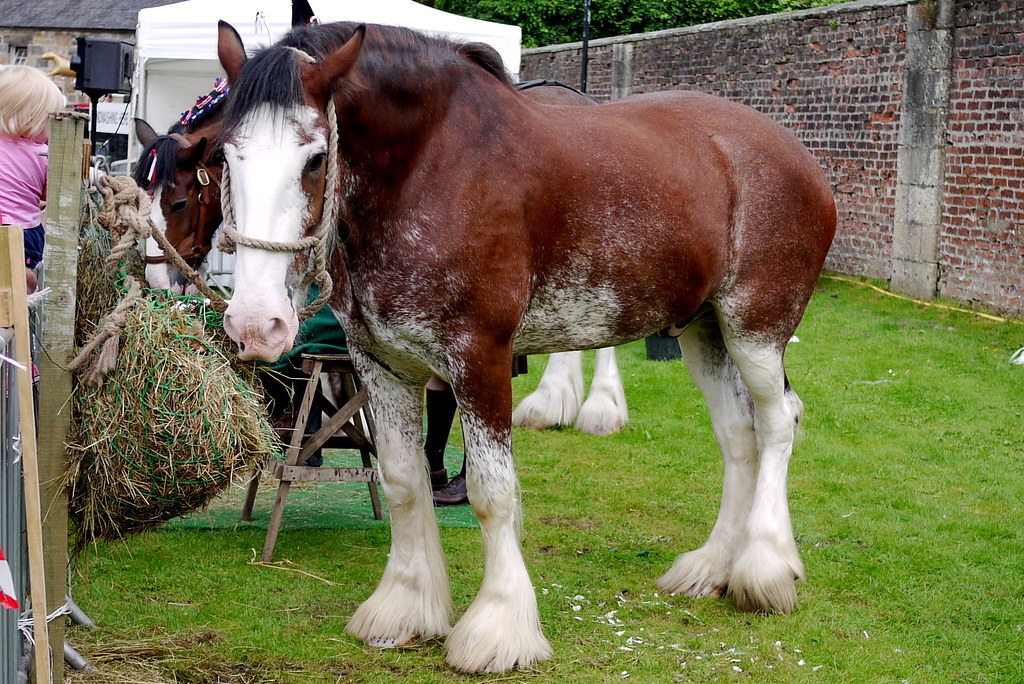
For once, I met some horses that didn't hate me - these were Clydesdales, called Duke and Baron:


They enjoyed a good scratch too.

So, to conclude: I got to pet some heilan' coo's, and now I can die happy...

Wednesday, 3 August 2011

Online research tips for the beginner

After seeing a few things around and about on the subject of books and the internet, as far as the beginner is concerned, I figured I'd put a few thoughts of my own together. Books - and other sources - are a tricky subject for the beginner because it's difficult to know where to start, and what to rely on. And especially when that involves looking on the internet.

It's all well and good being pointed towards a book list - even a short one aimed at beginners, like the one on the CR FAQ. I think the books listed there are excellent choices, but one problem a lot of folks have is investing the money in buying those books. There are plenty of places that these kinds of books can be found second hand at more than reasonable prices, but even so, that might be stretching an already non-existent budget too far for many these days.

There's always the option of trying to find them at the library, but that's not necessarily a satisfactory solution if you have to order them through Inter-Library Loan, if that's an option at all (I'm lucky I can get access to an academic library, because a lot of the books I want I couldn't get at my local library, unfortunately). It's important to remember that these books are recommended for a reason - they're not perfect, by any means, but they offer a lot of good information that wll give any fledgling reconstructionist a good start.

In the internet age, though, people are increasingly used to finding answers straight away, and looking things up on Google offers a much quicker and cheaper solution, and it might be tempting to ignore books that aren't freely available in favour of those that are. There are lots of books and articles available online, in full, along with plenty of websites dealing with various kinds of 'Celtic Paganisms' that might appeal to the beginner. The problem with this, of course, is that websites aren't necessarily always reliable or trustworthy, and nor are books. This post here on Discernment offers a lot of good advice on how to approach and assess the reliability of different sources, and Maya's essay here makes a good compliment to that. 

The internet can be incredibly useful as a tool for research, if it's used wisely. It can also be a minefield, but knowing where to look - and how - can help narrow things down. Instead of just doing a web search, using Google Scholar can help you find far more reliable sources than you normally would (though I find a lot of neo-pagan sources crop up there as well, and while that might not be so bad for some, they're not necessarily the sort of focus I'm looking for), and while much of it may not be freely available, you can often find a few gems that are downloadable as pdfs. For many, admittedly, this is just a quicker route to a rapidly expanding wishlist...
 
One of the biggest advantages researching online can offfer is all of those free books, and occasionally articles or journals that are fully available, for free. Again, though, it's a double-edged sword. It's tempting to assume that just because a book seems to be well-written and well-researched, and has an authoritative or academic tone, then it's all good. This isn't always the case, because the author often has their own approach and bias in how they look at the sources, so it often helps to know where they're coming from, and to read as widely as possible in order to try and balance one view, or one approach, with another. Those pointers I've linked to above will come in handy - I think at the most simplest level, the best thing to remember when you're reading something is asking the question where did that come from? Until you know, and can see it's from a good source, look elsewhere as well and try to verify the point. If it seems a little off the wall, it probably is.

When you're reading academic tomes in particular, it helps to know the kind of angle they're coming from. I've outlined some of the approaches to Celtic Studies and Archaeology here already, and bearing this in mind is a good way to make your own mind up on things. Reading books on the same subject from these different approaches might leave you with conflicting views on certain things, and you're going to have to make your own mind up and decide what you think is right. When you start doing your own research, you'll find that there are rarely any quick answers.

There's sometimes a tendency to dismiss older books in favour of newer ones, simply because they're old and therefore out of date. Most of those books and articles that are available online are out of print, and yes, it's a good thing to remember that there's often a lot wrong with older books, simply because of the way approaches to research and interpretation have changed over the years. But that doesn't automatically make new books better, or strip those older books of any value whatsoever. There's a lot of stuff in those older sources that come in very handy to the modern reconstructionist, not least because there are translations of material that have since been relatively ignored. Since these older sources are now out of copyright they are often easily found online, in full, and this is where we come back to the issue of relying on the internet, and these free sources, in our reading.

Aside from Google Scholar, some of the best places to start looking are on archive.org, sacred-texts.com, or Google Books, and there's also a huge library of Scottish-focused books at Electric Scotland as well as lots of books on the Isle of Man at isleofman.com. (Scribd can also be a minefield of useful books, but they're not always books that are copyright free and there's a tendency for them to disappear once they're discovered, so it can be hit or miss.)

And that's nice and all, but when you're being cautioned about these books being potentially problematic sources, where do you start? While I would say that the histories that you can find are often very outdated in approach and you're probably better off sticking with more up to date books, one of the biggest strengths of some of these old sources is that they can contain eye-witness accounts of customs and traditions that have since died out or only continue privately. Many of these can be found in old journals (for example, when I was researching stuff for the Michaelmas struan, I found some particularly useful articles at archive.org).

Alexander Carmichael's Carmina Gadelica is one of the best sources to look if you're wanting inspiration for practices:

Volume 1
Volume 2
Volume 3

There are six volumes in all, but because of the way they were published, over several decades, not all of them are out of copyright yet. The full six volume set will probably set you back a pretty penny, but you can buy an abridged version that just contains the English translations cheaply, which makes a good starting place. With the abridged version you lose the Gàidhlig and the extensive notes/glossary and indexing that you find in the full volume set. Then again, the first two volumes in particular are the most helpful to the aspiring reconstructionist, because later volumes were 'improved' and 'polished' more so than the first two. The volumes available online are therefore perhaps the most helpful for the beginner (though the others shouldn't be ignored, by any means).

Compare Carmichael's work with Douglas Hyde's Religious Songs of Connacht, and you'll see a lot of similarities along the way, which is especially helpful if you want to work out your own songs or prayers and base them on, and it goes to show that what Carmichael recorded on those remote islands can be just as useful for the Irish Reconstructionist as the Scottish, or simply Gaelic (labels are a tricky thing).

Looking on archive.org, you'll find a wealth of good stuff if you look up Folklore journals, or the Celtic Review, or search for well known and prolific authors like Kuno Meyer and Whitley Stokes. Much of this work will be outdated, and especially in the case of the translations provided by Meyer and Stokes, are much in need of looking at again in a modern context. This is happening, but it isn't necessarily widely available, and in the meantime we can find some gems in albeit somewhat imperfect formats.

As for websites, maryjones.us is a great starting point, which is good for a reconstructionist in particular, and links that I've posted previously, like to the Ulster Institutional Repository and the Carmichael Watson Project. Looking at the various universities who offer Celtic Studies as a discipline can also be helpful, such as Ulster, Belfast, Dublin, Glasgow, Edinburgh, Aberdeen, Cambridge, Berkeley, Harvard, and so on. Otherwise - generally speaking - a good way to determine the reliability of a website is that if it actively sparkles, it's probably not too good as far as historical accuracy and research go. References also help.