Saturday, 6 August 2011

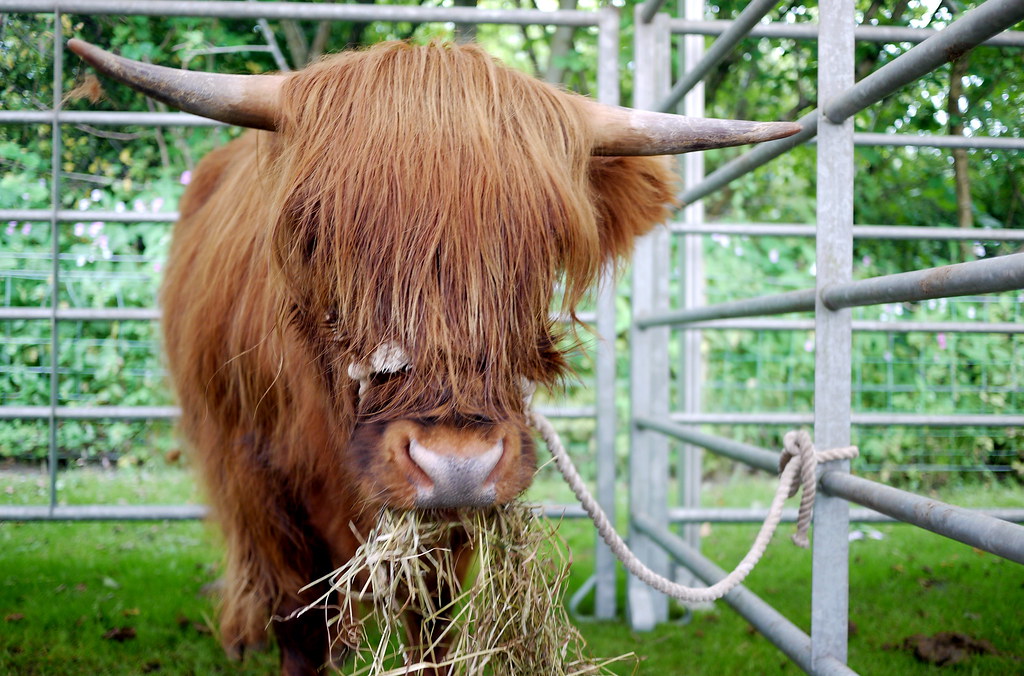
Heilan' coo's mostly...

Ooooooh yeah, down a bit...That's it...


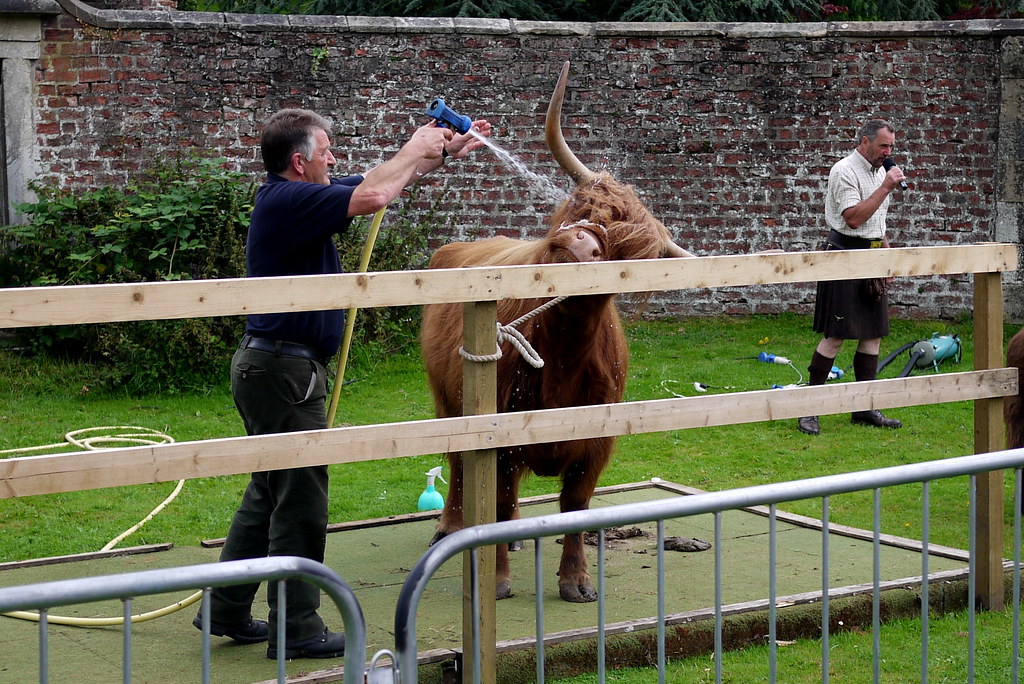
Susie likes having a good wash. She's a show heifer, so she needs to look her best before the judges come and see her. Today she only had a shampoo and blow-dry (no, really), but usually she'd have a bit of conditioner rubbed in too. Timotei is the best, apparently. It takes about 5 litres per cow. Coo.

We met Susie (Siusan) today at a family event in Glasgow, along with some of her friends. And her daughter, also called Susie:


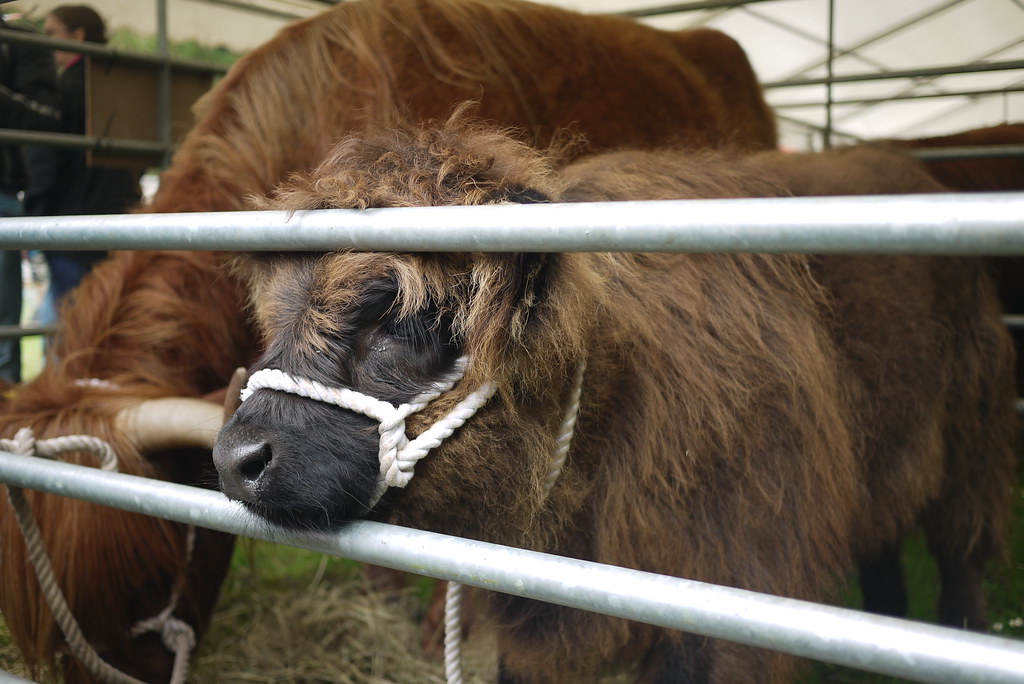
Mum is Susie Ruadh ('red'), while daughter is Susie Dubh ('black'), because one day this wee calf will end up black all over, just like her dad. Susie Dubh was only born in April, while I think her mum must be at least four or so.

Susie Dubh lapped up all of the attention and enjoyed a good scratch or two, especially on her chest and all the hard-to-scratch places a cow might have (at the front anyway!). They have very soft and thick coats. I could've petted them all day.

This is their friend, Una Ruadh:


In addition to a good bit of grass or hay, it seems they enjoy nibbling on zips and licking body warmers given half a chance. One little girl was horrified when she realised that her beautiful purple body warmer was covered in cow schleb. It seemed rude not to point out what the cow was doing to it once I noticed...

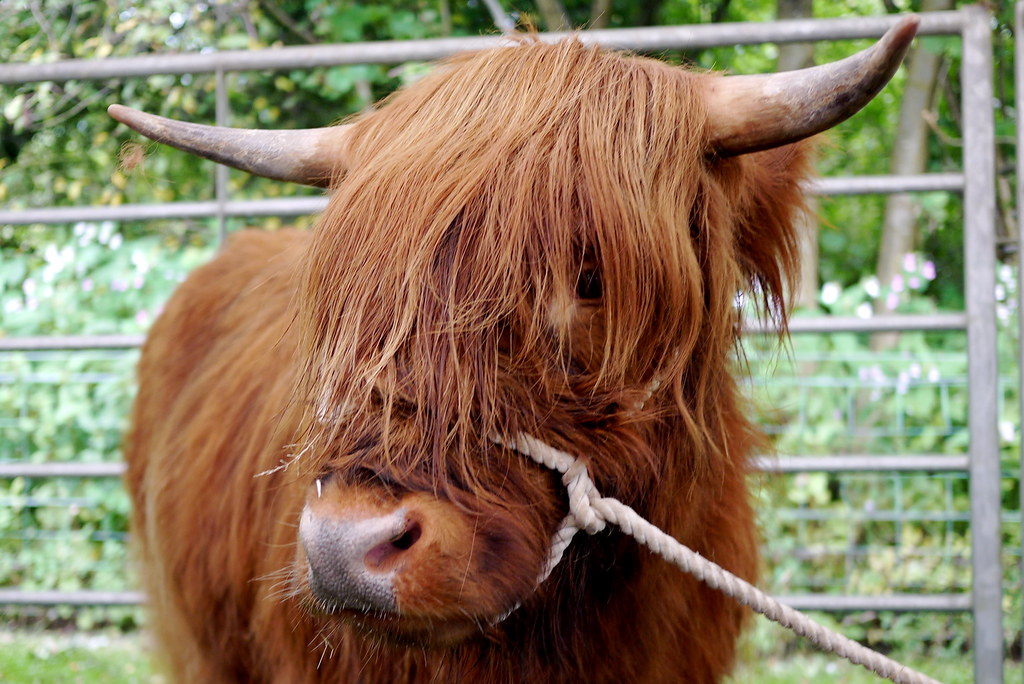
I don't think I noted this one's name down:


She's only a yearling, and is obviously unimpressed with being shown off to the great unwashed. Some of her friends had a little adventure recently, after a dog walker let their three dogs off their leads to run rampage through the country park where the herds of Highland cow's graze. As a result of the dogs giving the yearlings some unwanted attention, several took fright and stampeded, taking down fences and hedges until they ended up in the south-side of Glasgow. I think seven managed to escape from the park and end up in the city, and one of them apparently even wandered into a mechanic's garage, damaging a few cars before being rounded up safely and taken home (imagine explaining that one to the insurance company!). Luckily, none of them were injured, just a little freaked. If this is one of the heifers involved, she's not telling. She's feeling a bit coy:


Who, me?

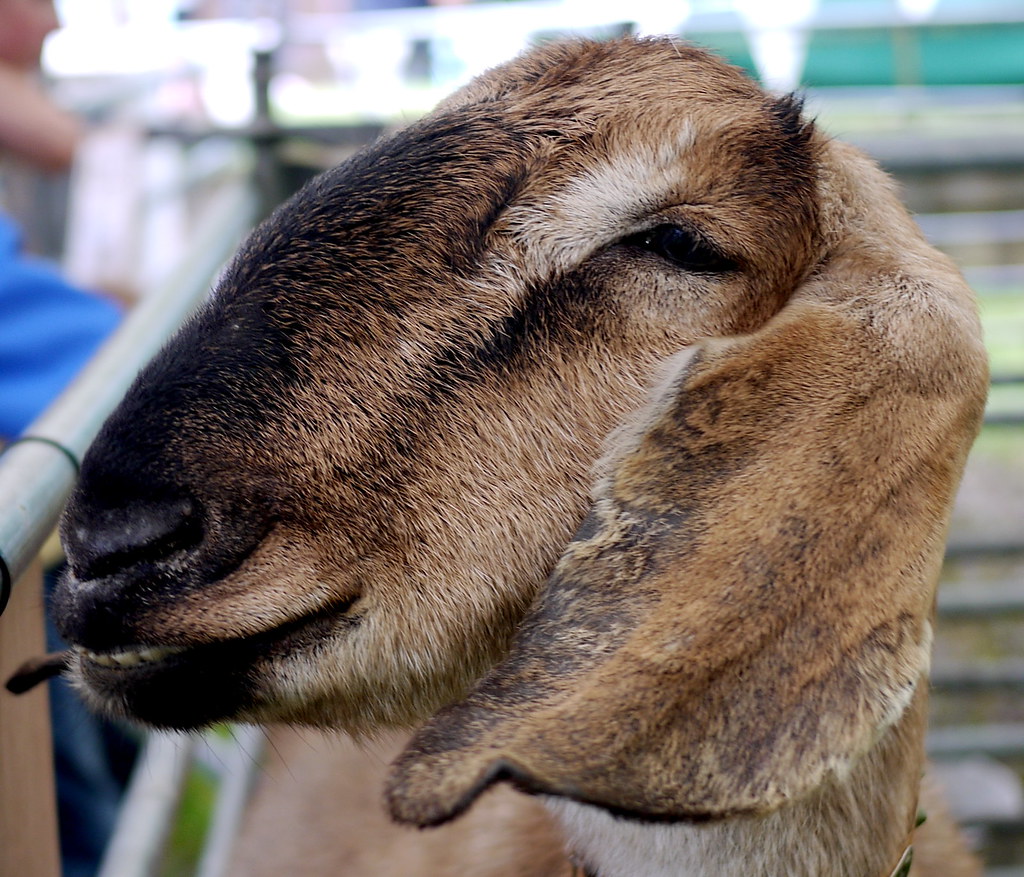
The heilan' coos had a few friends along too, including a very chirpy-looking Anglo-Nubian goat:


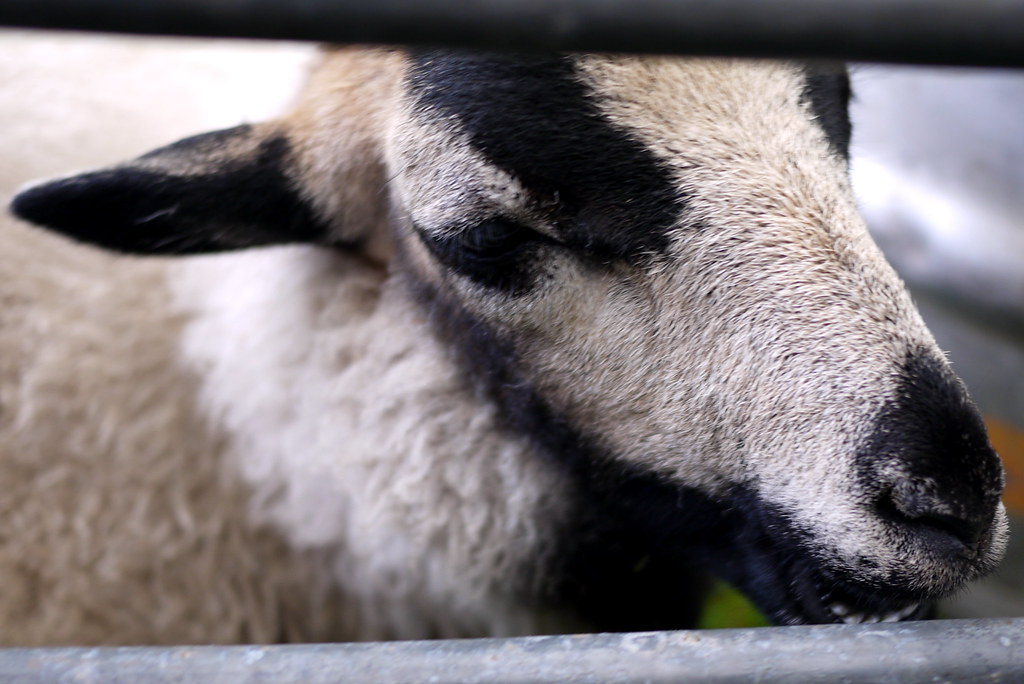
And a Welsh badger-faced lamb:


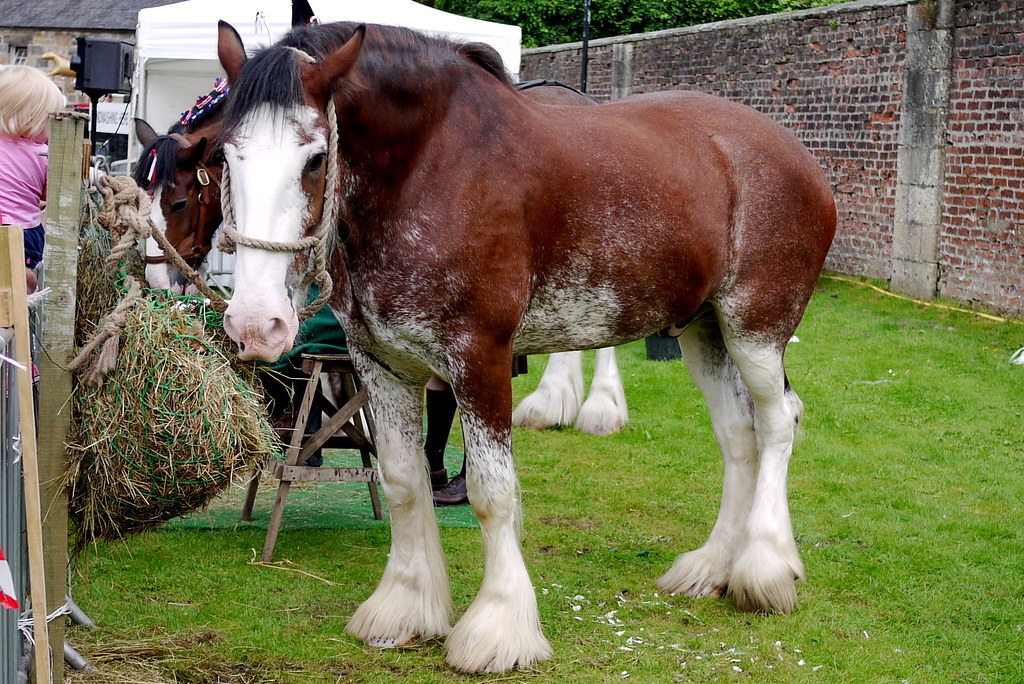
For once, I met some horses that didn't hate me - these were Clydesdales, called Duke and Baron:


They enjoyed a good scratch too.

So, to conclude: I got to pet some heilan' coo's, and now I can die happy...

Wednesday, 3 August 2011

Online research tips for the beginner

After seeing a few things around and about on the subject of books and the internet, as far as the beginner is concerned, I figured I'd put a few thoughts of my own together. Books - and other sources - are a tricky subject for the beginner because it's difficult to know where to start, and what to rely on. And especially when that involves looking on the internet.

It's all well and good being pointed towards a book list - even a short one aimed at beginners, like the one on the CR FAQ. I think the books listed there are excellent choices, but one problem a lot of folks have is investing the money in buying those books. There are plenty of places that these kinds of books can be found second hand at more than reasonable prices, but even so, that might be stretching an already non-existent budget too far for many these days.

There's always the option of trying to find them at the library, but that's not necessarily a satisfactory solution if you have to order them through Inter-Library Loan, if that's an option at all (I'm lucky I can get access to an academic library, because a lot of the books I want I couldn't get at my local library, unfortunately). It's important to remember that these books are recommended for a reason - they're not perfect, by any means, but they offer a lot of good information that wll give any fledgling reconstructionist a good start.

In the internet age, though, people are increasingly used to finding answers straight away, and looking things up on Google offers a much quicker and cheaper solution, and it might be tempting to ignore books that aren't freely available in favour of those that are. There are lots of books and articles available online, in full, along with plenty of websites dealing with various kinds of 'Celtic Paganisms' that might appeal to the beginner. The problem with this, of course, is that websites aren't necessarily always reliable or trustworthy, and nor are books. This post here on Discernment offers a lot of good advice on how to approach and assess the reliability of different sources, and Maya's essay here makes a good compliment to that. 

The internet can be incredibly useful as a tool for research, if it's used wisely. It can also be a minefield, but knowing where to look - and how - can help narrow things down. Instead of just doing a web search, using Google Scholar can help you find far more reliable sources than you normally would (though I find a lot of neo-pagan sources crop up there as well, and while that might not be so bad for some, they're not necessarily the sort of focus I'm looking for), and while much of it may not be freely available, you can often find a few gems that are downloadable as pdfs. For many, admittedly, this is just a quicker route to a rapidly expanding wishlist...
 
One of the biggest advantages researching online can offfer is all of those free books, and occasionally articles or journals that are fully available, for free. Again, though, it's a double-edged sword. It's tempting to assume that just because a book seems to be well-written and well-researched, and has an authoritative or academic tone, then it's all good. This isn't always the case, because the author often has their own approach and bias in how they look at the sources, so it often helps to know where they're coming from, and to read as widely as possible in order to try and balance one view, or one approach, with another. Those pointers I've linked to above will come in handy - I think at the most simplest level, the best thing to remember when you're reading something is asking the question where did that come from? Until you know, and can see it's from a good source, look elsewhere as well and try to verify the point. If it seems a little off the wall, it probably is.

When you're reading academic tomes in particular, it helps to know the kind of angle they're coming from. I've outlined some of the approaches to Celtic Studies and Archaeology here already, and bearing this in mind is a good way to make your own mind up on things. Reading books on the same subject from these different approaches might leave you with conflicting views on certain things, and you're going to have to make your own mind up and decide what you think is right. When you start doing your own research, you'll find that there are rarely any quick answers.

There's sometimes a tendency to dismiss older books in favour of newer ones, simply because they're old and therefore out of date. Most of those books and articles that are available online are out of print, and yes, it's a good thing to remember that there's often a lot wrong with older books, simply because of the way approaches to research and interpretation have changed over the years. But that doesn't automatically make new books better, or strip those older books of any value whatsoever. There's a lot of stuff in those older sources that come in very handy to the modern reconstructionist, not least because there are translations of material that have since been relatively ignored. Since these older sources are now out of copyright they are often easily found online, in full, and this is where we come back to the issue of relying on the internet, and these free sources, in our reading.

Aside from Google Scholar, some of the best places to start looking are on archive.org, sacred-texts.com, or Google Books, and there's also a huge library of Scottish-focused books at Electric Scotland as well as lots of books on the Isle of Man at isleofman.com. (Scribd can also be a minefield of useful books, but they're not always books that are copyright free and there's a tendency for them to disappear once they're discovered, so it can be hit or miss.)

And that's nice and all, but when you're being cautioned about these books being potentially problematic sources, where do you start? While I would say that the histories that you can find are often very outdated in approach and you're probably better off sticking with more up to date books, one of the biggest strengths of some of these old sources is that they can contain eye-witness accounts of customs and traditions that have since died out or only continue privately. Many of these can be found in old journals (for example, when I was researching stuff for the Michaelmas struan, I found some particularly useful articles at archive.org).

Alexander Carmichael's Carmina Gadelica is one of the best sources to look if you're wanting inspiration for practices:

Volume 1
Volume 2
Volume 3

There are six volumes in all, but because of the way they were published, over several decades, not all of them are out of copyright yet. The full six volume set will probably set you back a pretty penny, but you can buy an abridged version that just contains the English translations cheaply, which makes a good starting place. With the abridged version you lose the Gàidhlig and the extensive notes/glossary and indexing that you find in the full volume set. Then again, the first two volumes in particular are the most helpful to the aspiring reconstructionist, because later volumes were 'improved' and 'polished' more so than the first two. The volumes available online are therefore perhaps the most helpful for the beginner (though the others shouldn't be ignored, by any means).

Compare Carmichael's work with Douglas Hyde's Religious Songs of Connacht, and you'll see a lot of similarities along the way, which is especially helpful if you want to work out your own songs or prayers and base them on, and it goes to show that what Carmichael recorded on those remote islands can be just as useful for the Irish Reconstructionist as the Scottish, or simply Gaelic (labels are a tricky thing).

Looking on archive.org, you'll find a wealth of good stuff if you look up Folklore journals, or the Celtic Review, or search for well known and prolific authors like Kuno Meyer and Whitley Stokes. Much of this work will be outdated, and especially in the case of the translations provided by Meyer and Stokes, are much in need of looking at again in a modern context. This is happening, but it isn't necessarily widely available, and in the meantime we can find some gems in albeit somewhat imperfect formats.

As for websites, maryjones.us is a great starting point, which is good for a reconstructionist in particular, and links that I've posted previously, like to the Ulster Institutional Repository and the Carmichael Watson Project. Looking at the various universities who offer Celtic Studies as a discipline can also be helpful, such as Ulster, Belfast, Dublin, Glasgow, Edinburgh, Aberdeen, Cambridge, Berkeley, Harvard, and so on. Otherwise - generally speaking - a good way to determine the reliability of a website is that if it actively sparkles, it's probably not too good as far as historical accuracy and research go. References also help.
What can I say? Sometimes I'm a bit slow...

Thanks to some random and unrelated Googling, I accidentally discovered that the Carmichael Watson project has a blog.

Given the time of year an' all, I thought I'd just leave a pointer to a very handy article on the tradition of the Corn Dolly (or Cailleach) in Scotland:

Once a widespread European custom was to form a corn dolly or maiden out of the last sheaf at harvest time. Traditions of such customs were still in living memory during the 1960s in Scotland, and perhaps they are still being carried out in some parts of Europe.
I really should pay more attention to these things. Lots of good stuff there...

Sunday, 31 July 2011

Mountains, mostly

A very happy Lùnastal to you all!

I'll be waiting for my blueberries to ripen in the garden before I start my own celebrations, like I usually do, and it looks like they'll be at least another week yet. In the meantime I've been doing a few bits and pieces in preparation - some pictures with the kids, along with planning for things the kids and I can do together - making butter, some shortbread, cranachan and bannocks, and having a proper go at making some Lùnastal crowdie this time, and thinking of playing some games we can all play (nothing too physical for me, though. Hmph).

Anyway, during the summer holidays we were planning a few outings at least, with a holiday up in the far north of Scotland, and a trip down to England to see my family. An unexpected tax bill has pretty much scuppered those ideas, but seeing as my husband got some camping gear for his birthday we decided to go on a short camping trip this weekend - just an over night stay, but that suited me fine considering we were kind of experimenting with how my back would tolerate a long journey and sleeping in a tent (the answer being, the tent was fine, but not so happy with being stuck in a car).

We were originally thinking of heading to Perthshire so I could indulge myself with a trip to Tigh nam Bodach (perhaps my husband thought I might finally shut up about it...); but with the kids in tow and it being situated in a fairly remote location, and the uncertain back factor, a trek to those parts seemed doomed to wailing from tired children, or me. Instead we decided to head to Glen Coe, with the tent, the kids and the dogs in tow, and so we set off on Saturday morning in glorious sunshine.

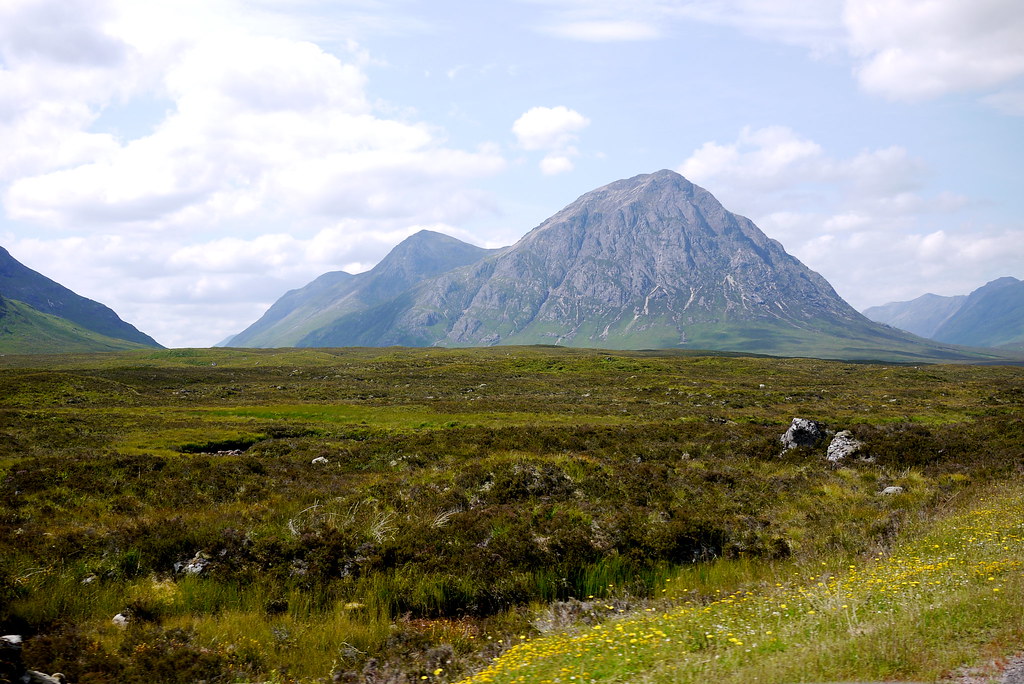
The roads were busy through Loch Lomond, but the traffic thinned out considerably once we turned off onto the road to Glen Coe and we had a good run. The route takes you through Rannoch Moor - which is just beautiful. Empty though the roads were, it seemed it was mainly because everyone had stopped in the few parking places available. We couldn't stop and take a good look around, so I had to take a few snaps out of the window along the way:


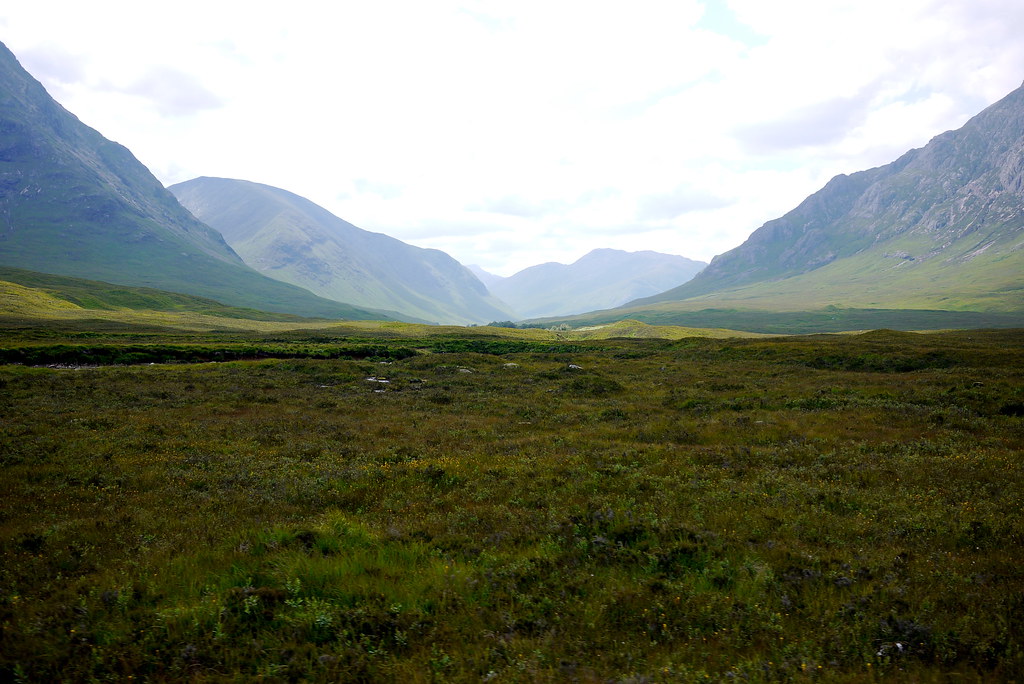
The Rannoch Moor is the start of the Highlands 'proper' - technically I think the Highland Line starts at Ben Lomond, but the sign welcoming you to the Highlands is situated right as you enter the moor. Here's another view:


Aaaand:


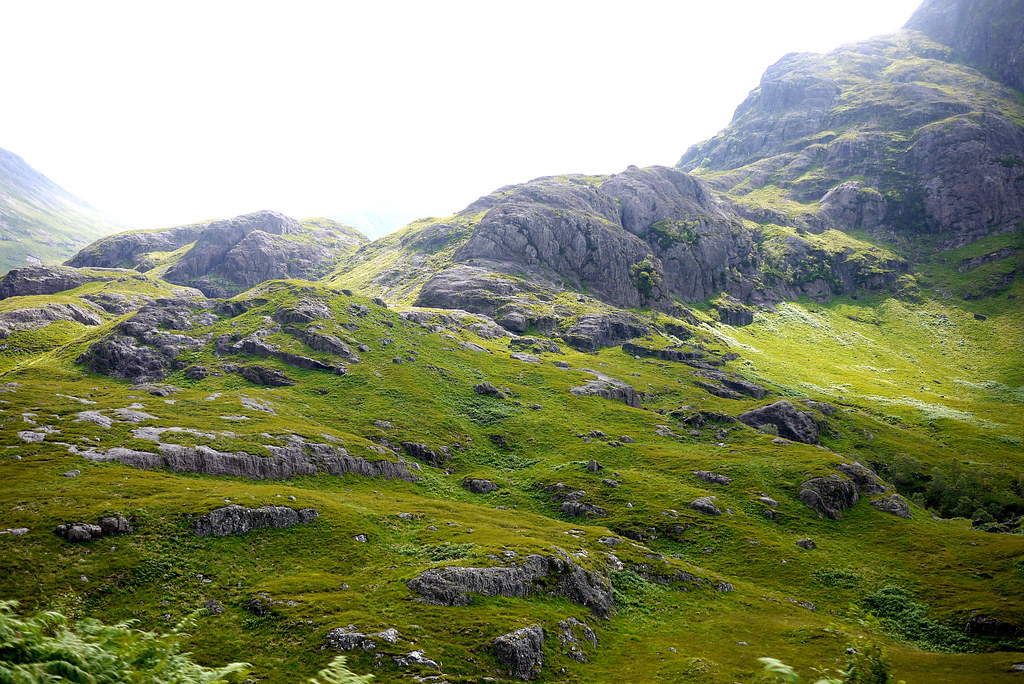
As you get to the end of the moor you enter into Glen Coe, and the landscape closes in, with just a road winding through the mountains:


Some very fine mountains, too:


We pitched our tent at the campsite next to the Glen Coe visitor centre, and headed off to find a park for the kids to run off some steam before dinner and then bedtime. My husband managed to rip his only pair of shorts while he put the tent up, so there was a stop to find a new pair of trousers, too...

In the evening, I walked the dogs along an old path that eventually led into Glen Coe village; along the way I stumbled across the remains of an old blackhouse (and kicked myself for not having my camera). According to the information board, nine trees were planted around the house to commemorate the nine people were killed there during the Glen Coe massacre, but legend has it that there was a tenth - a small boy, whose terrified screams made a soldier pause and think twice about killing the poor child in cold blood. The soldier decided he couldn't bring himself to do it, so cut one of the boy's fingers off instead, and wiped the blood on his sword to convince his superior the boy was dead. Years later, the old soldier returned to the glen and stopped for a drink at the pub. He got drunk and began rambling on to the bar man about his regrets at the terrible things he'd done during the massacre, but for the one life he saved - the wee boy, whose finger he'd cut off. The bar man listened intently, and then, when the old soldier had finished, he held up a hand and showed a finger was missing.

I wonder how many stories like that there are.

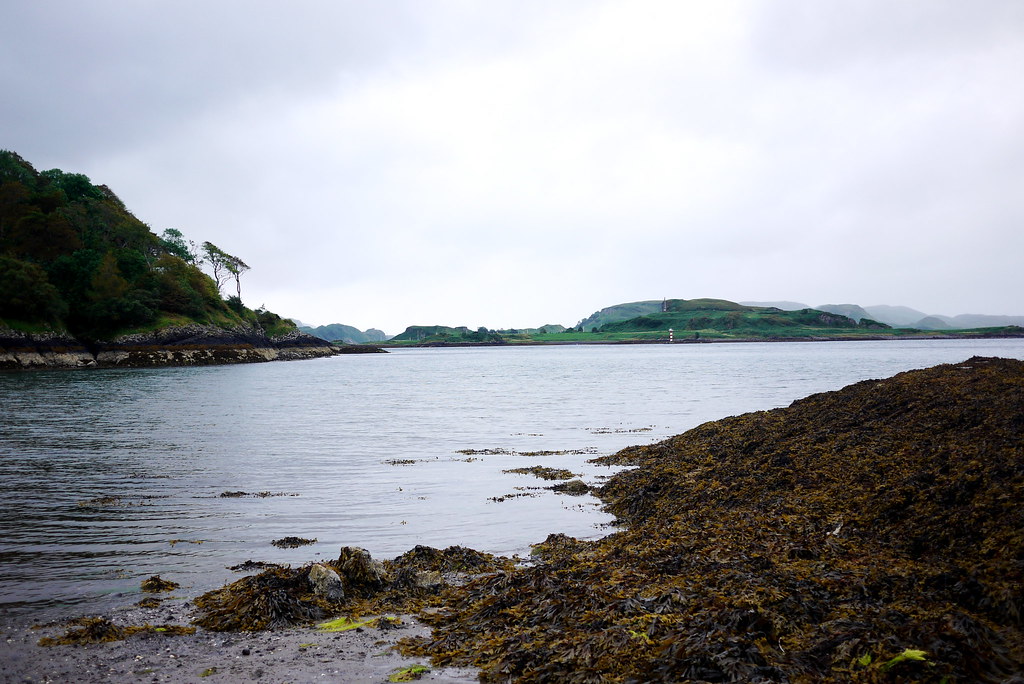
After a very uncomfortable night, thanks to a slowly deflating mattress and being punched in the face twice by Rosie's nocturnal fidgeting, we got up bright and early and had our breakfast, packed up, and began heading home. The weather had taken a turn for the worse during the night, so it was mostly damp and dismal today. We took a detour along the coastal route, though, taking in Oban and stopping at a beach near Dunollie castle, so the dogs could get some exercise:


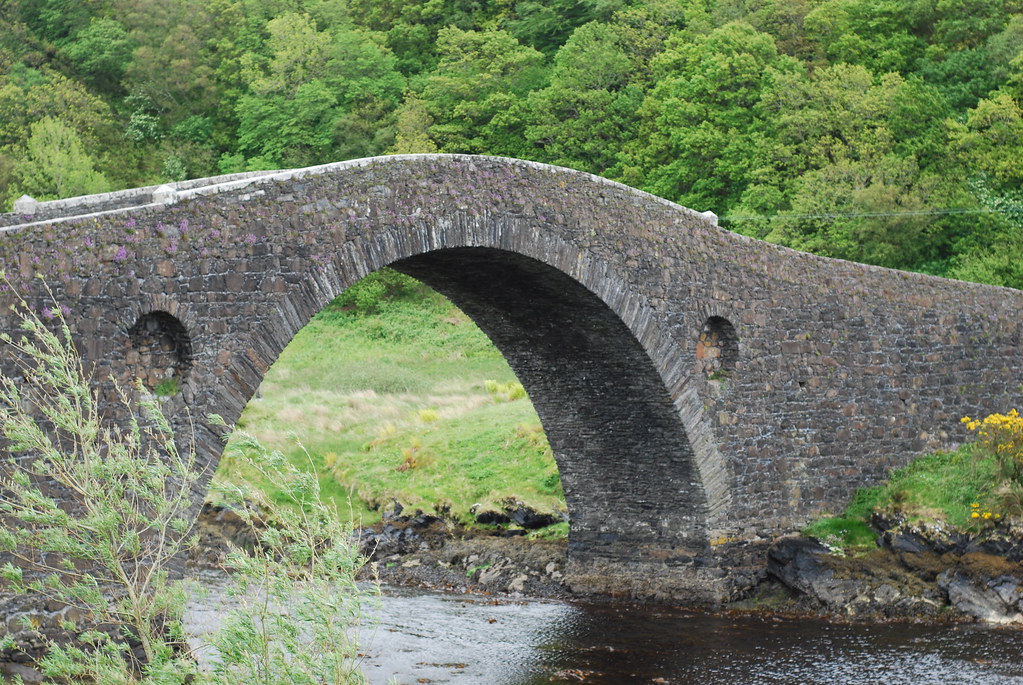
And then we headed to the Isle of Seil. We went there a couple of years ago, but that time we only went over the bridge and had a brief stop before heading back. This is the bridge (taken on our last trip when the weather was only a little better than this time):


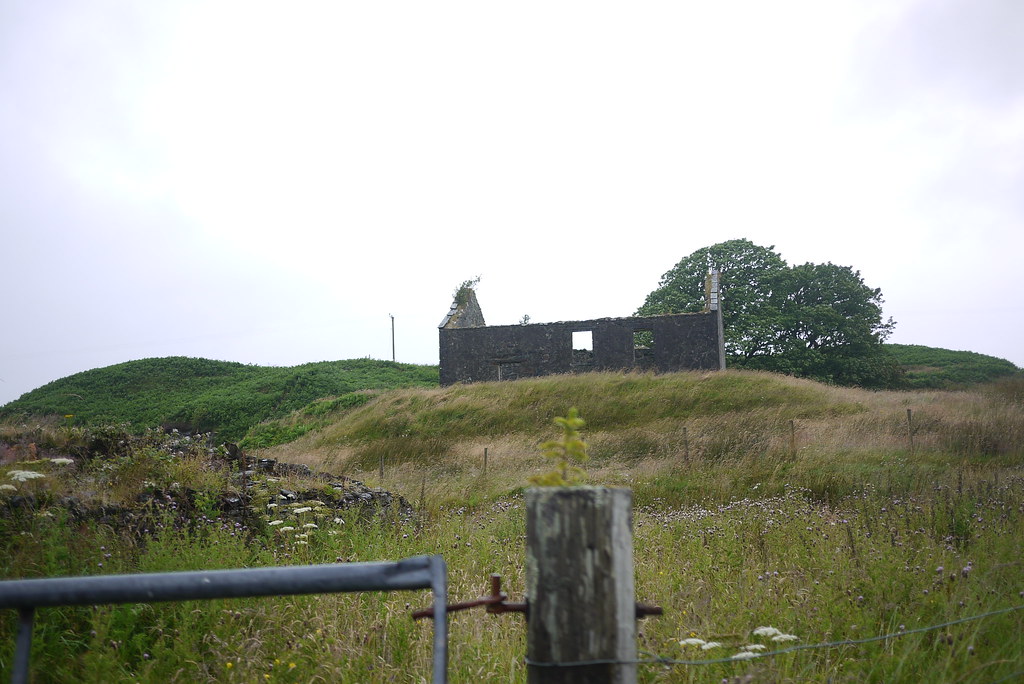
The Atlantic Bridge in fact - the only bridge to cross the Atlantic Ocean. As you can see, it's not very wide at this point! Seil itself is a beautiful island - the dismal weather kind of made it even more so, in a way. The low cloud gave it an ethereal feel. On our travels we saw another abandoned house - a little like the one I saw the day before, but I think this one might be a little more recent:


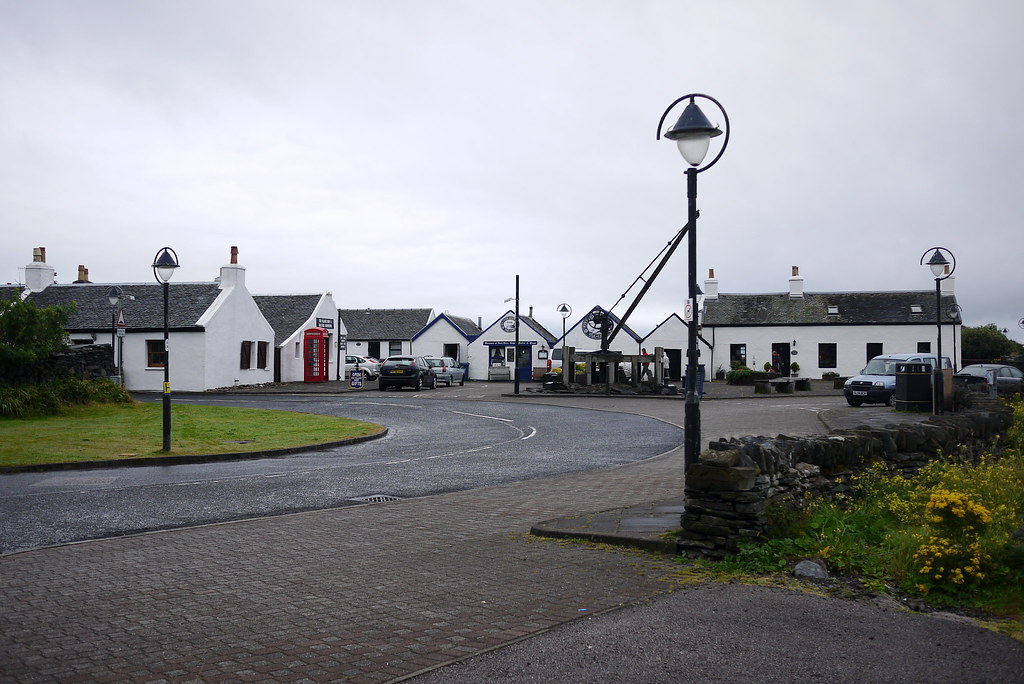
We stopped for lunch in a village (I can't remember the name of it, but the locals call it Easdale - which is actually the island where slate is quarried right opposite); lunch was goooood, and the village itself couldn't really get much more Scottish:


Replete with ye olde phonebox. Then, after another dog walk, it was time to make a push for home. We made our way through Kilmartin Glen and passed Dunadd (one of my favourite places, which we also visited a few years ago), but it was getting too late to stop if we wanted to get back home for dinner and time to let the kids decompress before bed. It was nice to see it, though, albeit briefly.

The best thing, though - the Highlands in the height of midgie season, and no midgie bites. All thanks to this stuff. Seriously. It's like a miracle.

Thursday, 21 July 2011

Book Review: Highland Heathenry

Update: Please note that this book is no longer available.
 
Highland Heathenry: Ritual Formula for Gaelic Heathens
Ikindé Skréja Ominnsaer

Finally, another offering for a Celtic Reconstructionist's bookshelf; like the last one I reviewed that was aimed at such an audience, I bought it through Lulu, so it's a self-published work. And like the previous book, a large part of this one focuses on material from the Carmina Gadelica. Where they differ is that while Morgan Daimler's book perhaps offers more scope in the amount of charms offered, Highland Heathenry offers more detail on ritual outlines as a whole, as well as both English and Gàidhlig versions of the charms that have been chosen for the book, and reworked and 'de-constructed' for a CR audience.

The book is aimed primarily at the beginner, or anyone looking for an introduction to ritual within CR - specifically Scottish (Gàidhlig) practice. It's very short, which should be a good thing for anyone looking for something that isn't too overwhelming; the content presented here is clear and to the point, beginning with clear definitions for certain words and terms that the author uses throughout, and the reader is encouraged to go and do their own research as well.

The layout is clear and the use of some of the illustrations from the Carmina Gadelica gives a nice touch to the overall look and feel of the book. It's a little smaller than A4 in size, and considering the fact that many of the charms and rituals offered throughout the book cover more than one page, the size helps if you want to sit down and study what's going on here without having to constantly flick through.

Where the book falls down, I think, is in some of the details. Some are minor and probably more a matter of taste - I would quibble that for a CR book, 'heathenry' isn't the most appropriate term to use because (as far as I'm aware) most associate it with a specifically Norse practice. It would also have been nice to see more thorough and consistent referencing throughout (though there is some).

It has to be said that there are some fairly fundamental problems to be found here as well, that go beyond quibbles. I think this is truly unfortunate; what the book aims to deliver is good, it's just the problems all add up to having to question whether or not the book as a whole is workable without at least some major revision. Some of the information offered is just inaccurate - for example, the bile is a sacred tree that stands at the heart of a tuath's territory, not "a pile of stones with a flat table-topper slate." I think what's being referred to here is actually a dolmen, and these are common to Ireland (and neolithic), but not Scotland, and nor is there any evidence that they were used as altars by the Celts. There is also reference to the arms of the triskele representing the Dagda, Lugh, and Ogma, and also the cycle of life from childhood, adulthood, to old age, which is based on a questionable resource; the meaning of the triskele is by no means known for certain, although there are many modern interpretations. As UPG these are not something I can debate, but here they are apparently presented as fact, and that's where the problem lies.

The inclusion of Rhiannon and 'Toranis' as deities in a book that encourages specifically Gaelic practice, and also their assignations as deities of particular elements (albeit in a Gaelic elemental context, not Classical) is completely out of place to me, as is the use of the Welsh names for the solstices and equinoxes - Alban Arthuan, Alban Eiler, Alban Heruin, and Alban Elved. I suspect these names may have origins in modern druidic practice as well, which puts them doubly out of place.

A fair few of the charms will be ones that most recons will already be familiar with and are likely to have adapted for use themselves, so it's good to see Gàidhlig versions of these readily on offer and available for a reconstructionist audience. There are some that I find problematic, though, and at least one of them appears in a completely different context than it was originally meant; for the Bealltainn celebrations, Carmichael's Red Water Charm has been used as a 'Bealltainn exorcism' in the morning. As far as I'm aware, exorcisms are not a pre-Christian concept, and the charm itself is originally meant to be a healing charm for kidney stones. The use of the charm and the idea in general just seem thoroughly out of place, even inappropriate here.

At times, the Gàidhlig that's offered is also a little problemmatic. Spelling is a recurring problem - mixing both old and modern orthography, as well as a lot of spelling mistakes, and some errors are downright unfortunate (the Diesel Turn, instead of the the Deiseil Turn), but not something that couldn't be corrected in further editions with thorough proofing. As it is, though, while these will be easily spotted by anyone who knows what they're looking for, it will make the job of reading through and correctly pronouncing certain parts for others, who may be less advanced or confident in their understanding of Gàidhlig, more difficult.

However, while I can't claim to be advanced in my studies of Gàidhlig, I suspect that the problem may go deeper than spelling and orthography, with some parts of the Gàidhlig itself. For one, I have reservations with the use of the word 'deathachan' as the Gàidhlig for 'gods'; as far as I'm aware, the accepted plural is 'diathan,' and as far as I can tell the only source for 'deathachan' having this meaning is Alexander Carmichael himself. While it's possible this is an archaism, I suspect given the context of Carmichael's use of the word that it's more likely to be his own extrapolation, and so the accuracy of it seems questionable. Over all, it gives cause for concern about the reliability of the transliterations here.

Books that are aimed at a purely Celtic Reconstructionist audience are still very thin on the ground, and like the last one I reviewed this one is self-published; given the fact that the CR community is probably still very small, and self-publishing allows greater editorial control over the content without having to compromise with a publishing house, I think this is the way that most CR books in future will go. The main downside to this is that proofreading is often an issue, and it puts the author at a disadvantage in terms of advertising their work compared to an established publishing house, and many must also rely solely on online sales rather than those from a bookshop; maybe most people buy their books online nowadays anyway, but there are certainly those who would still prefer to be able to look at something before they buy it (edit for clarity: though in this instance there is a preview option for the introduction and blurb).

As such, reviews like this are certainly going to be one way that any self-published author will hope to garner at least a few sales. I do regret that I can't give this book a better review, but when all is said and done, I've tried to be honest and objective in what I find just as with any other book I review here. Ultimately, I find that the problems with the book are a severe detriment to what it's trying to achieve. Although over all it's aims are good; I'm just not sure it's quite there.