After the last article I put up on the website - which ended up receiving an amazing amount of attention - thanks to some generous plugging by Erynn - I really thought that I'd kind of covered all I could think of on the subject; there were bits I'd originally intended to expand on but didn't find any place for them in the articles as I wrote them.
I'd figured that the next article to write was obvious and inevitable - the next stop was the daoine sìth (I'll try to avoid the 'f' word). I've had a bugger of a time writing it, though. From putting my back out and the drugs preventing me from being able to concentrate enough to research and write, to just realising that I was going about it all wrong, it's been a long time coming, and a process that's kinda reminiscent of pulling teeth.
I realised that the subject was too narrow considering the focus I'd been taking as far as the gods and the other two are concerned. I'd done gods, I'd done ancestors, but I hadn't done anything about the spirits, and so I had to scrap my original idea and take things in a different direction, broadening the scope a little. I'm not entirely sure that I'm happy with the end result, to be honest - I'm limited by lack of experience in being able to talk much about dealing with foreign spirits in other countries, for one. But this is what I ended up with:
Gods and Spirits
It's something that's been on my mind a lot this year so far, though. I might still get round to covering the daoine sìth in a separate article, but in some ways it's not going to be easy because I've already done a lot here there and everywhere else. A lot of it will inevitably be repetitious, but it's difficult to figure out just what needs to be repeated.
Ho hum. Lots of things need doing. So little time to do it...
Sunday, 12 June 2011


Monday, 6 June 2011
Hmmm...
I see this has been doing the rounds in a few places I lurk, and I couldn't not comment:
Clonycavan Man’s hair contains an imported gel. Old Croghan Man has a leather amulet, decorated in the fashionable continental style, on his arm. It represents the sun, with which Irish kingship is closely associated. Both men also had their nipples sliced before they died. Together, these features suggest that the men were kings. The king’s nipples represented the life-giving sun. Their cutting suggests that their power was being ritually decommissioned.
Both men appear to have been “killed” three times: by strangulation, by stabbing and by drowning. However ritualised, Old Croghan Man’s death was garishly violent: he was bound with hazel rods threaded through holes in his upper arms, stabbed in the chest, struck in the neck, decapitated and cut in half. (All that has been found are his torso and arms.) But the violence was not mere sadism. “This,” says Eamonn Kelly of the National Museum of Ireland, “isn’t done for torture or to inflict pain. It’s a triple killing because the goddess to whom the sacrifice is made has three natures. She’s goddess of sovereignty, of fertility and of war and death. So they’re making sacrifice to her in all her forms, and the king has to die three deaths.”
I can just imagine the pained expression on my old professor's face as he'd say, "Weeeeeell, we shouldn't read too much into these things..."
Thursday, 2 June 2011
Saturday, 28 May 2011
In the garden, before another review
In spite of the gloriousness of April, May has been a total wash out. Earlier this week most of Scotland was battered by storms and heavy winds that got up to over 130mph. I'm not sure how strong they were round here, but it was enough to knock more than a few trees down around the village, and closed the coastal road even heading into Greenock - generally more sheltered than the road heading south into Largs.
This is the sort of weather we're more used to in late autumn or winter - it was so cold yesterday that we finally gave in and put the heating back on for a wee bit again. Suffice it to say, the cold, rain, and lack of sunshine means there's not much happening in the vegetable patch at the moment, and unless the weather improves dramatically then I'm not sure we'll have much to show for it come the autumn. Not that I've been able to do much in the garden anway.
One success is this:
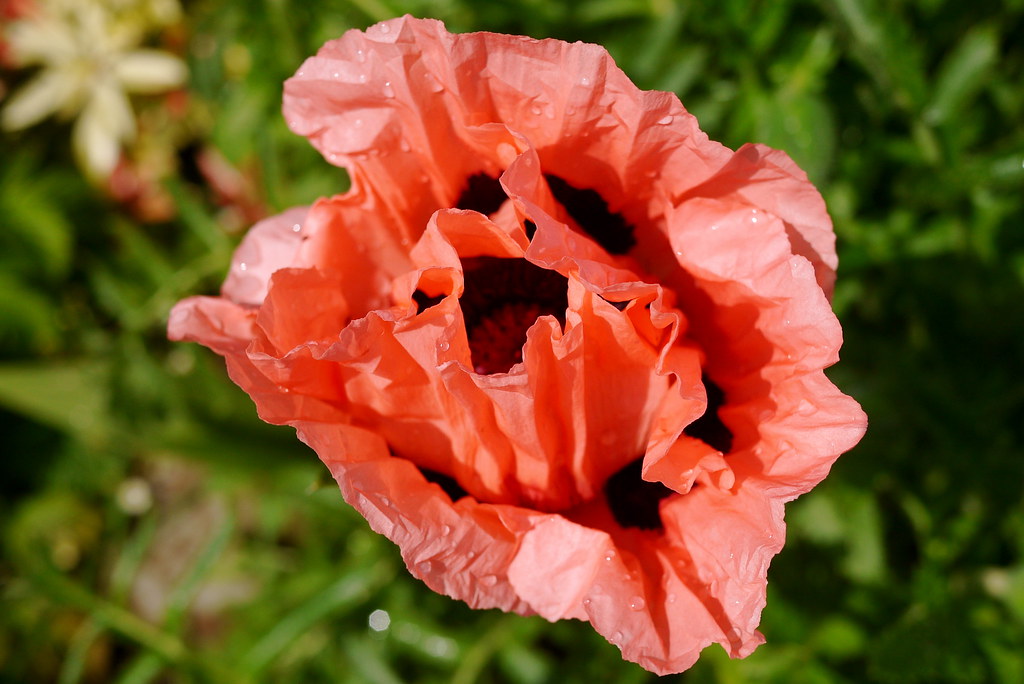
The poppies are in full bloom at the moment, a bright antidote to the dismal grey sky. When I originally planted them I was under the impression that they were going to be proper red ones - these seem a little washed out and I presume that's just the variety, or maybe poor soil quality (or a bit of both).
I've sown some more to put out in the front garden, but these poppies are growing in the patch of flowerbed out the back that I set aside for a wee spiritual focal point. They're growing in between a small cairn I've built to comemmorate my ancestors, and a small pond I use as a focal point to put some offerings out when I'm gardening and weeding (sadly neglected this year, but Rosie is keen on tending things with offerings of daisies and buttercups when she thinks no one's looking).
The poppies themselves are dedicated to the memory of one of my grandads - Poppy, as I called him - who was a gardener. I'm glad they've come along so well since I planted them three years ago now. If only I could say the same for the vegetable patch...
But now, another review.
The Year in Ireland
Kevin Danaher
This is another one of those seminal books that should go on every aspiring reconstructionist's booklist if they happen to have an interest in Ireland. It's one of those books that I love so much that I'm hard-pressed to find much to say about it that's particularly negative.
Do you want chapters covering just about everything you want to know about the Irish festival calendar? Check. Do you want it illustrated? Check. A good read? Check check check. That's about all you need to know, really.
It's set within a very Catholic festival year so not everything will be relevant to a polytheistic context, but it does do a good job of giving a good idea of the cultural context in which you'll find the festivals. The book is laid out well, with each chapter dealing with a different festival, meaning that some of them are only a page long, if that. For the longer chapters there are various subheadings to help break everything up and make it easier to dip into for reference - definitely a good thing because I don't find the index at the back to be particularly detailed or helpful.
Danaher gives a good amount of detail for the more popular festivals, and covers a goodly amount of ground in terms of the scope of his research and the dissemination of it. For anyone wanting to get to grips with ideas for things to do for the festivals then this is really the first place you'll want to look, and it will give a lot of inspiration. I've mentioned other books that are a good supplement to this over the course of the reviews I've done, but this book will really be your go-to book, unless you want to start delving into journals and more specialised areas of research, or lengthier and more concentrated books like Máire MacNeill's The Festival of Lughnasa, or Sean O'Duinn's The Rites of Brigid.*
This is not a quick read by any means, I've found. It's not a massive tome but it does pack a lot of stuff into it, and there's a lot for the beginner to chew on. Had it been written by a not so accomplished author, it would probably be overwhelming in that respect, but Danaher is not only an excellent writer, he also seems to be genuinely passionate about his subject, and that shines through in his work and helps carry the reader along, I think. Plus, it's the sort of book that's good for dipping into every now and then - picking it up to read the relevant chapters as you go along through the year. For the beginner, I would recommend getting hold of a copy of this as soon as you possibly can.
* I thought I'd reviewed this already - and I'm still semi-convinced I did, but can't find it. This review here, from a promising new blogger, does a good job of pretty much mirroring my thoughts on it.
This is the sort of weather we're more used to in late autumn or winter - it was so cold yesterday that we finally gave in and put the heating back on for a wee bit again. Suffice it to say, the cold, rain, and lack of sunshine means there's not much happening in the vegetable patch at the moment, and unless the weather improves dramatically then I'm not sure we'll have much to show for it come the autumn. Not that I've been able to do much in the garden anway.
One success is this:
The poppies are in full bloom at the moment, a bright antidote to the dismal grey sky. When I originally planted them I was under the impression that they were going to be proper red ones - these seem a little washed out and I presume that's just the variety, or maybe poor soil quality (or a bit of both).
I've sown some more to put out in the front garden, but these poppies are growing in the patch of flowerbed out the back that I set aside for a wee spiritual focal point. They're growing in between a small cairn I've built to comemmorate my ancestors, and a small pond I use as a focal point to put some offerings out when I'm gardening and weeding (sadly neglected this year, but Rosie is keen on tending things with offerings of daisies and buttercups when she thinks no one's looking).
The poppies themselves are dedicated to the memory of one of my grandads - Poppy, as I called him - who was a gardener. I'm glad they've come along so well since I planted them three years ago now. If only I could say the same for the vegetable patch...
But now, another review.
The Year in Ireland
Kevin Danaher
This is another one of those seminal books that should go on every aspiring reconstructionist's booklist if they happen to have an interest in Ireland. It's one of those books that I love so much that I'm hard-pressed to find much to say about it that's particularly negative.
Do you want chapters covering just about everything you want to know about the Irish festival calendar? Check. Do you want it illustrated? Check. A good read? Check check check. That's about all you need to know, really.
It's set within a very Catholic festival year so not everything will be relevant to a polytheistic context, but it does do a good job of giving a good idea of the cultural context in which you'll find the festivals. The book is laid out well, with each chapter dealing with a different festival, meaning that some of them are only a page long, if that. For the longer chapters there are various subheadings to help break everything up and make it easier to dip into for reference - definitely a good thing because I don't find the index at the back to be particularly detailed or helpful.
Danaher gives a good amount of detail for the more popular festivals, and covers a goodly amount of ground in terms of the scope of his research and the dissemination of it. For anyone wanting to get to grips with ideas for things to do for the festivals then this is really the first place you'll want to look, and it will give a lot of inspiration. I've mentioned other books that are a good supplement to this over the course of the reviews I've done, but this book will really be your go-to book, unless you want to start delving into journals and more specialised areas of research, or lengthier and more concentrated books like Máire MacNeill's The Festival of Lughnasa, or Sean O'Duinn's The Rites of Brigid.*
This is not a quick read by any means, I've found. It's not a massive tome but it does pack a lot of stuff into it, and there's a lot for the beginner to chew on. Had it been written by a not so accomplished author, it would probably be overwhelming in that respect, but Danaher is not only an excellent writer, he also seems to be genuinely passionate about his subject, and that shines through in his work and helps carry the reader along, I think. Plus, it's the sort of book that's good for dipping into every now and then - picking it up to read the relevant chapters as you go along through the year. For the beginner, I would recommend getting hold of a copy of this as soon as you possibly can.
* I thought I'd reviewed this already - and I'm still semi-convinced I did, but can't find it. This review here, from a promising new blogger, does a good job of pretty much mirroring my thoughts on it.
Another review, this time, four for the price of one...
This next review is long overdue - as some of the first books I ever bought for myself once I finally decided to take the plunge into Celtic Reconstructionism, they've been instrumental to my path and my research, and their value cannot be overstated.
The Silver Bough: Volume I-IV
F. Marian McNeill
Coming in at four volumes, the full set for the series may set you back a pretty penny if you indulge yourself in one go, but I can tell you straight away that these books are well worth it. I'd originally intended to review them all separately, on their own merits, but in the end I decided that was pointless seeing as I'm not sure they can be fully appreciated without reading each book, and many of their strengths and weakness are the same or very similar. I figured I'd probably just end up repeating myself.
First of all, I'll give an idea of what each volume covers:
The Silver Bough Volume I: Scottish Folk-Lore and Folk-Belief
Here we have an introduction to various aspects of folklore, from witchcraft and fairies, to different types of charms and folk practices. Of all the introductory tomes to the subject, I think this is the most accessible and strikes the right balance between hitting all the right bases without overloading the reader.
The Silver Bough Volume II: A Calendar of Scottish National Festivals Candlemas to Harvest Home
Covering Candlemas, Easter, Bealltainn, Lúnastal and the harvest festivals including Michaelmas, this is probably the best place to start if you want to find out anything about these festivals. Again, it's accessible and detailed, but won't overload. For some subjects - like Bealltainn - various different aspects of it are covered in several chapters, but for the most part this is the sort of book you can dip into as and when you get to each particular time of year to get an understanding of what the festivals are about, and for ideas of what you can do.
The Silver Bough Volume III: A Calendar of Scottish National Festivals Hallowe'en to Yule
Covering a slightly shorter period of the year, but with good reason because there's a lot to pack in. Chapters include covering Samhainn, Christmas, Yule, Hogmanay, and Handsel Monday. Much of what you'll find for Samhainn/Hallowe'en is also covered - with more additional details - in McNeill's standalone book, Hallowe'en: Its Origin Rites and Ceremonies in the Scottish Tradition.
The Silver Bough Volume IV: The Local Festivals of Scotland
Covering the different local festivals, grouped loosely by the time of year (although there's some need for a bit of backwards and forwards here). Of the four volumes, this one is probably of least immediate value and relevance to the beginner, but it gives good additional details for when you want to get stuck in a bit further, or are looking for customs that might relate to somewhere you have heritage from.
The value of these books - and the love I have for this author - cannot be overstated. Although I'd unreservedly recommend the whole set to anyone, however, that doesn't mean that they're not without their problems...
The first volume was published in 1957, with subsequent volumes coming out every couple of years thereafter. This means that not everything is necessarily as up to date as you might hope, and some of the interpretations given by McNeill aren't necessarily solid. I tend to be more forgiving of things like that in older books such as these, but they need commenting on all the same - McNeill's frequent mention of druids, and linking customs with 'ancient druid practices' need to be ignored, for example, because there's simply no evidence to support what she's saying there.
Likewise, because much of McNeill's research is based upon older books, it helps to know what you're dealing with there. She goes along with Fraser and his The Golden Bough sometimes, and for the Cailleach, for example, she draws upon MacKenzie's work. It has to be said that he's not necessarily the most reliable source for that kind of thing even if he is interesting. It helps to be a little circumspect there.
References are given throughout the volumes but in trying to follow up on some things, McNeill hasn't been as thorough as I would have liked. Having familiarised myself with a lot of the stuff she's drawn her research from I can see where bits have come from now, but it does cause a headache or two if you don't know to start with. What she does reference, however, is sound - she doesn't try to fudge anything with giving references that don't really follow what she's saying, so over all you'll find she's quite reliable.
Because of the cost involved in getting hold of all four volumes - not outrageous, but not necessarily within everyone's means - I've tried to find alternatives. The Scottish volumes of British Calendar Customs are a good substitute, but unless you can find them from the library you probably won't have much luck buying them and I would say they're probably not as readable as McNeill anyway. Sheila Livingstone's Scottish Customs, and Scottish Festivals, both draw heavily from McNeill, are cheaper and less detailed, and might do well for someone who's a little daunted by the prospect of getting stuck into four volumes right away. I reviewed those as well, and found them to be a little problemmatic, though, so my recommendation there comes with a bit of a qualifier.
The Silver Bough is by no means the only thing you'll ever need to read, but it does give a fantastic start, I think. Along with Ronald Black's The Gaelic Otherworld, I would recommend the first three volumes (at the least) as must-haves for the beginner.
The Silver Bough: Volume I-IV
F. Marian McNeill
Coming in at four volumes, the full set for the series may set you back a pretty penny if you indulge yourself in one go, but I can tell you straight away that these books are well worth it. I'd originally intended to review them all separately, on their own merits, but in the end I decided that was pointless seeing as I'm not sure they can be fully appreciated without reading each book, and many of their strengths and weakness are the same or very similar. I figured I'd probably just end up repeating myself.
First of all, I'll give an idea of what each volume covers:
The Silver Bough Volume I: Scottish Folk-Lore and Folk-Belief
Here we have an introduction to various aspects of folklore, from witchcraft and fairies, to different types of charms and folk practices. Of all the introductory tomes to the subject, I think this is the most accessible and strikes the right balance between hitting all the right bases without overloading the reader.
The Silver Bough Volume II: A Calendar of Scottish National Festivals Candlemas to Harvest Home
Covering Candlemas, Easter, Bealltainn, Lúnastal and the harvest festivals including Michaelmas, this is probably the best place to start if you want to find out anything about these festivals. Again, it's accessible and detailed, but won't overload. For some subjects - like Bealltainn - various different aspects of it are covered in several chapters, but for the most part this is the sort of book you can dip into as and when you get to each particular time of year to get an understanding of what the festivals are about, and for ideas of what you can do.
The Silver Bough Volume III: A Calendar of Scottish National Festivals Hallowe'en to Yule
Covering a slightly shorter period of the year, but with good reason because there's a lot to pack in. Chapters include covering Samhainn, Christmas, Yule, Hogmanay, and Handsel Monday. Much of what you'll find for Samhainn/Hallowe'en is also covered - with more additional details - in McNeill's standalone book, Hallowe'en: Its Origin Rites and Ceremonies in the Scottish Tradition.
The Silver Bough Volume IV: The Local Festivals of Scotland
Covering the different local festivals, grouped loosely by the time of year (although there's some need for a bit of backwards and forwards here). Of the four volumes, this one is probably of least immediate value and relevance to the beginner, but it gives good additional details for when you want to get stuck in a bit further, or are looking for customs that might relate to somewhere you have heritage from.
The value of these books - and the love I have for this author - cannot be overstated. Although I'd unreservedly recommend the whole set to anyone, however, that doesn't mean that they're not without their problems...
The first volume was published in 1957, with subsequent volumes coming out every couple of years thereafter. This means that not everything is necessarily as up to date as you might hope, and some of the interpretations given by McNeill aren't necessarily solid. I tend to be more forgiving of things like that in older books such as these, but they need commenting on all the same - McNeill's frequent mention of druids, and linking customs with 'ancient druid practices' need to be ignored, for example, because there's simply no evidence to support what she's saying there.
Likewise, because much of McNeill's research is based upon older books, it helps to know what you're dealing with there. She goes along with Fraser and his The Golden Bough sometimes, and for the Cailleach, for example, she draws upon MacKenzie's work. It has to be said that he's not necessarily the most reliable source for that kind of thing even if he is interesting. It helps to be a little circumspect there.
References are given throughout the volumes but in trying to follow up on some things, McNeill hasn't been as thorough as I would have liked. Having familiarised myself with a lot of the stuff she's drawn her research from I can see where bits have come from now, but it does cause a headache or two if you don't know to start with. What she does reference, however, is sound - she doesn't try to fudge anything with giving references that don't really follow what she's saying, so over all you'll find she's quite reliable.
Because of the cost involved in getting hold of all four volumes - not outrageous, but not necessarily within everyone's means - I've tried to find alternatives. The Scottish volumes of British Calendar Customs are a good substitute, but unless you can find them from the library you probably won't have much luck buying them and I would say they're probably not as readable as McNeill anyway. Sheila Livingstone's Scottish Customs, and Scottish Festivals, both draw heavily from McNeill, are cheaper and less detailed, and might do well for someone who's a little daunted by the prospect of getting stuck into four volumes right away. I reviewed those as well, and found them to be a little problemmatic, though, so my recommendation there comes with a bit of a qualifier.
The Silver Bough is by no means the only thing you'll ever need to read, but it does give a fantastic start, I think. Along with Ronald Black's The Gaelic Otherworld, I would recommend the first three volumes (at the least) as must-haves for the beginner.
Subscribe to:
Posts (Atom)