I started off trying to revise a piece I did about fire a while ago - probably one of the very earliest articles I wrote. I wanted to flesh it out and add proper references and all that, because when I originally began posting stuff I never bothered. The lack of referencing made it difficult for me to go over stuff and look at the material I'd collected again, and it didn't really help anyone else either, I quickly found. Without references, for all anyone knows, I'm pulling this stuff out of my arse. And I might be over-cautious in my referencing these days, but for the most part it's because I want to be thorough, and I want people to be able to look stuff up if they need or want to. Even if by 'people' I mean just me. Don't take my word for it, neh?
So I started off thinking it was going to be a simple task, for the most part, because I had a vague idea of what needed to be added in. I ended up getting a little frustrated, though, because aside from the fact the fact that the subject kept expanding - more background was need! - I fairly sure, from my reading elsewhere, that Nagy's book The Wisdom of the Outlaw would be good reading on the subject. Kim McCone's Pagan Past and Christian Present references Nagy a lot in his chapter on 'Fire and the Arts,' anyway. Unfortunately, in this respect, my attempts to get a hold of Nagy's book have been thwarted so far.
Four Courts Press have been promising to re-publish it 'soon' for about two years at least now, and whether that's because of financial constraints on their end, or it's being revised thoroughly by the author and the process has been held up...or whatever...I don't know. All I know is that I pre-ordered a copy a good few years ago now, all excited at the prospect of a new edition, and I suspect that my credit card details have got fed up being stuck with the publisher and have wandered off elsewhere by now...And I can get it from the library, except it's been checked out for the past couple of visits I've made, and is now checked out until March at least, if I remember right. Boo. Hiss.
Being thwarted in this respect, I looked elsewhere. And so the subject began to expand and evolve even more into something entirely different. The direction it took wasn't entirely surprising, but until now (since finishing the last set of articles), it's not something I've ever really been interested in...
I ended up researching the whole idea of creation myth in an Irish context. There isn't one, but there are hints, and the whole symbolism and meaning surrounding the concept of fire - especially in relation to water - is pretty much the starting point in that respect. Kinda. So as the idea grew, I wrote, and as I wrote, the focus evolved. And at times, I had no idea where the hell I was going with this. For one, I'm not entirely comfortable with Indo-European studies, and this is a subject that inevitably relies a lot on it in drawing most conclusions by way of comparison. Sometimes these make sense, and are clear. Sometimes, given the resources I have to hand, I couldn't help but feel that some parts have been slightly fudged over in order to fit a hypothesis of they're all the same in the end.
But still. Sometimes my brain, and my books, take me to unexpected places. In some ways, it's kinda like having a holiday, because with folklore you can let it speak more for itself and in a way I prefer doing that. This is a far more speculative area, by comparison, so it allows a little freedom as well as frustration of interpretation, I guess.
I've never really been one to lament the lack of a creation myth or find it problematic, really. On the one hand, I'm aware that without it we miss out on one of the most fundamental aspects of cultural beliefs and outlooks. But on the other, with everything else we have, I've always felt we can get a pretty good idea of the basics at least. We see origin stories on a much smaller level all the time in Gaelic tradition, and in some way at least they often encompass creation as well. In a way, I can't help but feel that these are part and parcel of the whole concept anyway.
In spite of my frustrations with finding some books I wanted, I'm very thankful to one person in particular for their help in locating one article that I would otherwise have missed out on. They'll remain nameless, unless they'd prefer otherwise, but my thanks go out nonetheless because it helped me out of a real hole I found myself stuck in.
Other than that, there's nothing much else to say, other than I might change my mind about what I've written and completely write over it at some point as new information comes to light...I try to be as comprehensive as I can with this, so I may add, tweak, or revise completely at some point as new sources come to light. But here it is in all its glory for now. My only hope is that it makes sense(!):
Creation myth(s)
A few things I haven't done include linking in the basic concept of fire-in-water in relation to the Otherworldly well of Segais, which bears the fire-in-water motif and also seems to link in with trees and, by extension, the sacred tree (the bile); also the point that the duile all seem to fit neatly into the scheme of the three realms, with the exception of fire (or 'spark'), that seems to transcend. I'm not sure if they fit here, or in later articles that might now need revising. Or something. And I do think I could add something about the Cauldron of Poesy, but I'd like to hunt up some good commentary about that before I form an opinion on that...
OK, I'm just thinking out loud now...
Wednesday, 29 December 2010


New tomb found near Heuneburg
Well this is exciting:
Speigel
Unlike other tombs found in the area, this one seems to be intact, so it'll be very interesting to see what they find there. Pretty amazing that they dug the whole thing out and moved it intact to preserve it properly.
German archeologists have unearthed a 2,600-year-old Celtic tomb containing a treasure of jewellery made of gold, amber and bronze.
The subterranean chamber measuring four by five meters was uncovered near the prehistoric Heuneburg hill fort near the town of Herbertingen in south-western Germany. Its contents including the oak floor of the room are unusually well preserved. The find is a "milestone for the reconstruction of the social history of the Celts," archeologist Dirk Krausse, the director of the dig, said on Tuesday.
Speigel
Unlike other tombs found in the area, this one seems to be intact, so it'll be very interesting to see what they find there. Pretty amazing that they dug the whole thing out and moved it intact to preserve it properly.
Tuesday, 21 December 2010
Newgrange video
Just thought I'd post a link to a video of the sunrise at Newgrange, here. Alas I wasn't able to watch it on one of the webcams that were being streamed - I had the joys of my daughter's nursery class Nativity play to go to. So rather than watch the sun rise, or go out myself and take some wonderfully evocative photos of a Scottish solstice sunrise, I instead have pictures of my daughter dressed as a pink 'Christmas fairy' dancing round a small boy who looked decidedly unimpressed at being forced to dress as a Christmas tree. Don't ask me what that's all about, I've no idea. Especially as far as the story of the Nativity goes...
The article that goes with the video is worth a read as well, and there's some good stuff here to, if you haven't already seen it and are looking for a bit of time to kill. We had a bit of sun for once this morning, and the weather has been giving some great scenes recently, like this one:
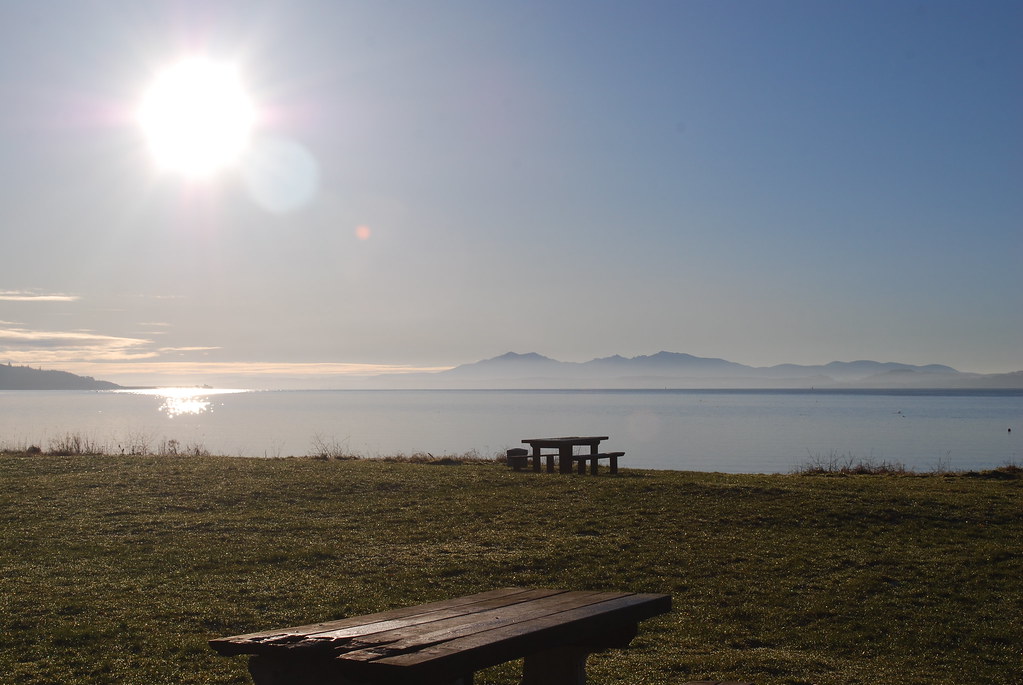
It's easy to imagine Manannán lurking in those mists.
But today I saw some spectacular views of the sea almost completely still and all patchy with ice, and the clouds hanging low and swirling around over it all. I might try to see if I can get a shot tomorrow - unfortunately I was on the bus so couldn't stop today.
For me, any celebrations at this time of year are the usual family-oriented ones, leading up to Hogmanay, which is the main focus of my celebrations at this time of year. Whatever you're celebrating, I hope you have a good one.
The article that goes with the video is worth a read as well, and there's some good stuff here to, if you haven't already seen it and are looking for a bit of time to kill. We had a bit of sun for once this morning, and the weather has been giving some great scenes recently, like this one:
It's easy to imagine Manannán lurking in those mists.
But today I saw some spectacular views of the sea almost completely still and all patchy with ice, and the clouds hanging low and swirling around over it all. I might try to see if I can get a shot tomorrow - unfortunately I was on the bus so couldn't stop today.
For me, any celebrations at this time of year are the usual family-oriented ones, leading up to Hogmanay, which is the main focus of my celebrations at this time of year. Whatever you're celebrating, I hope you have a good one.
Sunday, 12 December 2010
Book Review: Land of Women
Land of Women: tales of sex and gender from early Ireland
Lisa Bitel
No book is perfect, and I often find myself split 50/50 on my opinion of what I think of a particular work. I think this book is a fine example of that problem - I see good and bad, and find myself conflicted about it overall. The bibliography and references are great, and give me plenty to go on. I find some of it useful in my research...but there's this lurking sense of disappointment, too.
I think I can overcome the flaws this time, unlike, say, Dames' Mythic Ireland. I really wanted to like that book too, but all things considered the interpretations were just a bit too bonkers for me to really recommend it confidently to anyone, other than for curiosity...
This book isn't bonkers, at all, really. But my problems with it still leave a bittersweet taste...I think the problems fall into two camps: One is the lack of balance to the arguments and evidence presented overall, and the other is the author's bias in some of her interpretations that I find disagreeable and distracting.
The way the chapters are laid out give a repetitiveness and skewed view to everything discussed that becomes difficult to overcome when read from start to finish. The arguments and evidence are laid out clearly and confidently, but each chapter tends to end up falling on the negative, rather than a balanced view, and on reflection, I think that has a lot to do with the fact that many of those points were oft repeated. No bad thing for referencing and dipping into, to be fair, but I felt that overall it wasn't such a good thing for readability. Yes, I get the point, now can we move on....No? Oh...
Each chapter follows a basic premise - looking at certain aspects of women's life in early Ireland - and I suppose given the evidence to deal with it's inevitable that the picture is going to be very negative, all things considered. What I mean is, we can look to the laws and penitentials and so on, to see what life was really like, but that's all skewed to an ideal that was never really a reality, and it's all skewed against the favour of women. But in practice, the lines were not so clearly drawn, all of the time, necessarily. And while this is all very definitely acknowledged and discussed, my reading of it seemed like this comment was an afterthought, and often contradictory to the overall tone. I'm aware, however, that it's a trap that's easily fallen into, and one that I may have unintentionally fallen into myself with the latest load of articles I've done covering marriage. So maybe I'm not one to talk there.
A hard dose of reality for the romanticists? Definitely not a bad thing. I just think in the end I would've preferred the points to be hammered home somewhat closer to the middle ground. But another problem I have with this book - a problem of perspective more than anything - is the treatment of the likes of Medb, Badb, and the Morrigan as purely literary creations and imaginings. No sense that while the author herself may see them only as that - creations - those writing about them at the time may have thought otherwise, or understood that those before them saw things differently, at least. That kind of grated, and the bias towards this interpretation really skewed things in a light that I didn't agree with.
As I said, though, there's a lot going for the book as well. My disappointment is probably proportionate to my high hopes for it (having dipped into it on Google books and thinking it was good). As a resource, it's useful and gives plenty of food for thought, and since it's well-referenced, any arguments you may have with it can go on endlessly with yourself if you really want to. Like any book it has it's flaws, and I suppose I just really wish they weren't as disagreeable as they seem. On this one, I'd definitely recommend reading before judging.
Lisa Bitel
No book is perfect, and I often find myself split 50/50 on my opinion of what I think of a particular work. I think this book is a fine example of that problem - I see good and bad, and find myself conflicted about it overall. The bibliography and references are great, and give me plenty to go on. I find some of it useful in my research...but there's this lurking sense of disappointment, too.
I think I can overcome the flaws this time, unlike, say, Dames' Mythic Ireland. I really wanted to like that book too, but all things considered the interpretations were just a bit too bonkers for me to really recommend it confidently to anyone, other than for curiosity...
This book isn't bonkers, at all, really. But my problems with it still leave a bittersweet taste...I think the problems fall into two camps: One is the lack of balance to the arguments and evidence presented overall, and the other is the author's bias in some of her interpretations that I find disagreeable and distracting.
The way the chapters are laid out give a repetitiveness and skewed view to everything discussed that becomes difficult to overcome when read from start to finish. The arguments and evidence are laid out clearly and confidently, but each chapter tends to end up falling on the negative, rather than a balanced view, and on reflection, I think that has a lot to do with the fact that many of those points were oft repeated. No bad thing for referencing and dipping into, to be fair, but I felt that overall it wasn't such a good thing for readability. Yes, I get the point, now can we move on....No? Oh...
Each chapter follows a basic premise - looking at certain aspects of women's life in early Ireland - and I suppose given the evidence to deal with it's inevitable that the picture is going to be very negative, all things considered. What I mean is, we can look to the laws and penitentials and so on, to see what life was really like, but that's all skewed to an ideal that was never really a reality, and it's all skewed against the favour of women. But in practice, the lines were not so clearly drawn, all of the time, necessarily. And while this is all very definitely acknowledged and discussed, my reading of it seemed like this comment was an afterthought, and often contradictory to the overall tone. I'm aware, however, that it's a trap that's easily fallen into, and one that I may have unintentionally fallen into myself with the latest load of articles I've done covering marriage. So maybe I'm not one to talk there.
A hard dose of reality for the romanticists? Definitely not a bad thing. I just think in the end I would've preferred the points to be hammered home somewhat closer to the middle ground. But another problem I have with this book - a problem of perspective more than anything - is the treatment of the likes of Medb, Badb, and the Morrigan as purely literary creations and imaginings. No sense that while the author herself may see them only as that - creations - those writing about them at the time may have thought otherwise, or understood that those before them saw things differently, at least. That kind of grated, and the bias towards this interpretation really skewed things in a light that I didn't agree with.
As I said, though, there's a lot going for the book as well. My disappointment is probably proportionate to my high hopes for it (having dipped into it on Google books and thinking it was good). As a resource, it's useful and gives plenty of food for thought, and since it's well-referenced, any arguments you may have with it can go on endlessly with yourself if you really want to. Like any book it has it's flaws, and I suppose I just really wish they weren't as disagreeable as they seem. On this one, I'd definitely recommend reading before judging.
Saturday, 11 December 2010
Unexpected guests
There must be something in the water, because I've been having thoroughly odd dreams lately. One I had yesterday seemed to involve Lugh, and I can only really half-remember it all now but it seems that he really wanted to make himself known even if I didn't see him. These things don't happen very often to me, so I'm inclined to think that I should do more than simple offerings and libations in the garden to acknowledge him.
He and I have unfinished business, it seems, after all these years of not really wanting much to do with each other, and so I'm pondering on that, and trying to figure things out. A lot of my efforts over the past year or so have been aimed at really connecting with the underlying themes of Lùnastal, and of course he's intimately connected with the whole thing.
These past few Lùnastal festivals I've felt that I've had some success with it all, and while I think I can still build on that and really cement my practices into something solid, I've never really had the expectation that Lug himself would really want much to do with me. Maybe my dream is telling me different. Maybe my dream is telling me that deep down I think otherwise. Either way, it seems I should try. If someone comes knocking then one should be a good host, even if you invited them in the first place...
At Lùnastal I had a stab at doing some praise poetry in Lug's honour - I'm not a poet by any stretch and really, I figured it was personal and not being a professional I should keep it to myself. On the one hand, it seemed to be well-received, so that was something...On the other hand, there was something unfinished to it. Maybe that's it. Maybe I should finish it. Or try. I dunno.
So here it is, I'm offering it up. As I said, I'm no poet so it's nothing fantabulous, but it comes in honesty and earnest, if anything, and that's all I can do, really. While I've tweaked bits here and there just now, the overall form and feel has been kept, so it has the idea that this is being said towards the end of the celebrations, after the games and the feasting, in front of the fire:
In Praise of Lug
Oh Lug son of Ethliu,
Many-skilled and wise,
I sing my praises to you,
Renown that is plain.
Oh Lug of lofty deeds,
Golden are the fields,
Heavy hang the fruits,
Ripeness of fame.
Oh Lug of pure form,
Bright is the smile,
That smiles on you,
Beloved is the name.
Oh Lug of peace,
Peace to this earth,
The fruits of labour,
Each year the same.
These offerings I give to you,
These games I’ve held for you,
This fire that burns for you,
In your name.
Peace be with you,
Peace on this land.
He and I have unfinished business, it seems, after all these years of not really wanting much to do with each other, and so I'm pondering on that, and trying to figure things out. A lot of my efforts over the past year or so have been aimed at really connecting with the underlying themes of Lùnastal, and of course he's intimately connected with the whole thing.
These past few Lùnastal festivals I've felt that I've had some success with it all, and while I think I can still build on that and really cement my practices into something solid, I've never really had the expectation that Lug himself would really want much to do with me. Maybe my dream is telling me different. Maybe my dream is telling me that deep down I think otherwise. Either way, it seems I should try. If someone comes knocking then one should be a good host, even if you invited them in the first place...
At Lùnastal I had a stab at doing some praise poetry in Lug's honour - I'm not a poet by any stretch and really, I figured it was personal and not being a professional I should keep it to myself. On the one hand, it seemed to be well-received, so that was something...On the other hand, there was something unfinished to it. Maybe that's it. Maybe I should finish it. Or try. I dunno.
So here it is, I'm offering it up. As I said, I'm no poet so it's nothing fantabulous, but it comes in honesty and earnest, if anything, and that's all I can do, really. While I've tweaked bits here and there just now, the overall form and feel has been kept, so it has the idea that this is being said towards the end of the celebrations, after the games and the feasting, in front of the fire:
In Praise of Lug
Oh Lug son of Ethliu,
Many-skilled and wise,
I sing my praises to you,
Renown that is plain.
Oh Lug of lofty deeds,
Golden are the fields,
Heavy hang the fruits,
Ripeness of fame.
Oh Lug of pure form,
Bright is the smile,
That smiles on you,
Beloved is the name.
Oh Lug of peace,
Peace to this earth,
The fruits of labour,
Each year the same.
These offerings I give to you,
These games I’ve held for you,
This fire that burns for you,
In your name.
Peace be with you,
Peace on this land.
Subscribe to:
Posts (Atom)