Tuesday, 21 December 2010

Newgrange video

Just thought I'd post a link to a video of the sunrise at Newgrange, here. Alas I wasn't able to watch it on one of the webcams that were being streamed - I had the joys of my daughter's nursery class Nativity play to go to. So rather than watch the sun rise, or go out myself and take some wonderfully evocative photos of a Scottish solstice sunrise, I instead have pictures of my daughter dressed as a pink 'Christmas fairy' dancing round a small boy who looked decidedly unimpressed at being forced to dress as a Christmas tree. Don't ask me what that's all about, I've no idea. Especially as far as the story of the Nativity goes...

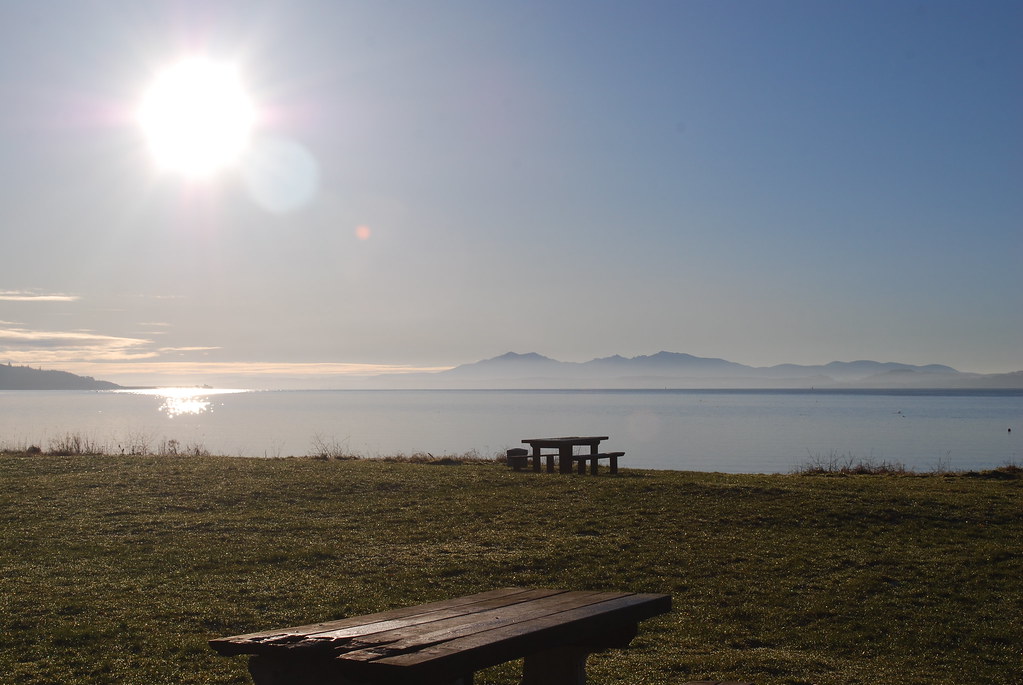
The article that goes with the video is worth a read as well, and there's some good stuff here to, if you haven't already seen it and are looking for a bit of time to kill. We had a bit of sun for once this morning, and the weather has been giving some great scenes recently, like this one:


It's easy to imagine Manannán lurking in those mists.

But today I saw some spectacular views of the sea almost completely still and all patchy with ice, and the clouds hanging low and swirling around over it all. I might try to see if I can get a shot tomorrow - unfortunately I was on the bus so couldn't stop today.

For me, any celebrations at this time of year are the usual family-oriented ones, leading up to Hogmanay, which is the main focus of my celebrations at this time of year. Whatever you're celebrating, I hope you have a good one.

Sunday, 12 December 2010

Book Review: Land of Women

Land of Women: tales of sex and gender from early Ireland
Lisa Bitel

No book is perfect, and I often find myself split 50/50 on my opinion of what I think of a particular work. I think this book is a fine example of that problem - I see good and bad, and find myself conflicted about it overall. The bibliography and references are great, and give me plenty to go on. I find some of it useful in my research...but there's this lurking sense of disappointment, too.

I think I can overcome the flaws this time, unlike, say, Dames' Mythic Ireland. I really wanted to like that book too, but all things considered the interpretations were just a bit too bonkers for me to really recommend it confidently to anyone, other than for curiosity...

This book isn't bonkers, at all, really. But my problems with it still leave a bittersweet taste...I think the problems fall into two camps: One is the lack of balance to the arguments and evidence presented overall, and the other is the author's bias in some of her interpretations that I find disagreeable and distracting.

The way the chapters are laid out give a repetitiveness and skewed view to everything discussed that becomes difficult to overcome when read from start to finish. The arguments and evidence are laid out clearly and confidently, but each chapter tends to end up falling on the negative, rather than a balanced view, and on reflection, I think that has a lot to do with the fact that many of those points were oft repeated. No bad thing for referencing and dipping into, to be fair, but I felt that overall it wasn't such a good thing for readability. Yes, I get the point, now can we move on....No? Oh...

Each chapter follows a basic premise - looking at certain aspects of women's life in early Ireland - and I suppose given the evidence to deal with it's inevitable that the picture is going to be very negative, all things considered. What I mean is, we can look to the laws and penitentials and so on, to see what life was really like, but that's all skewed to an ideal that was never really a reality, and it's all skewed against the favour of women. But in practice, the lines were not so clearly drawn, all of the time, necessarily. And while this is all very definitely acknowledged and discussed, my reading of it seemed like this comment was an afterthought, and often contradictory to the overall tone. I'm aware, however, that it's a trap that's easily fallen into, and one that I may have unintentionally fallen into myself with the latest load of articles I've done covering marriage. So maybe I'm not one to talk there.

A hard dose of reality for the romanticists? Definitely not a bad thing. I just think in the end I would've preferred the points to be hammered home somewhat closer to the middle ground. But another problem I have with this book - a problem of perspective more than anything - is the treatment of the likes of Medb, Badb, and the Morrigan as purely literary creations and imaginings. No sense that while the author herself may see them only as that - creations - those writing about them at the time may have thought otherwise, or understood that those before them saw things differently, at least. That kind of grated, and the bias towards this interpretation really skewed things in a light that I didn't agree with.

As I said, though, there's a lot going for the book as well. My disappointment is probably proportionate to my high hopes for it (having dipped into it on Google books and thinking it was good). As a resource, it's useful and gives plenty of food for thought, and since it's well-referenced, any arguments you may have with it can go on endlessly with yourself if you really want to. Like any book it has it's flaws, and I suppose I just really wish they weren't as disagreeable as they seem. On this one, I'd definitely recommend reading before judging.

Saturday, 11 December 2010

Unexpected guests

There must be something in the water, because I've been having thoroughly odd dreams lately. One I had yesterday seemed to involve Lugh, and I can only really half-remember it all now but it seems that he really wanted to make himself known even if I didn't see him. These things don't happen very often to me, so I'm inclined to think that I should do more than simple offerings and libations in the garden to acknowledge him.

He and I have unfinished business, it seems, after all these years of not really wanting much to do with each other, and so I'm pondering on that, and trying to figure things out. A lot of my efforts over the past year or so have been aimed at really connecting with the underlying themes of Lùnastal, and of course he's intimately connected with the whole thing.

These past few Lùnastal festivals I've felt that I've had some success with it all, and while I think I can still build on that and really cement my practices into something solid, I've never really had the expectation that Lug himself would really want much to do with me. Maybe my dream is telling me different. Maybe my dream is telling me that deep down I think otherwise. Either way, it seems I should try. If someone comes knocking then one should be a good host, even if you invited them in the first place...

At Lùnastal I had a stab at doing some praise poetry in Lug's honour - I'm not a poet by any stretch and really, I figured it was personal and not being a professional I should keep it to myself. On the one hand, it seemed to be well-received, so that was something...On the other hand, there was something unfinished to it. Maybe that's it. Maybe I should finish it. Or try. I dunno.

So here it is, I'm offering it up. As I said, I'm no poet so it's nothing fantabulous, but it comes in honesty and earnest, if anything, and that's all I can do, really. While I've tweaked bits here and there just now, the overall form and feel has been kept, so it has the idea that this is being said towards the end of the celebrations, after the games and the feasting, in front of the fire:

In Praise of Lug
Oh Lug son of Ethliu,
Many-skilled and wise,
I sing my praises to you,
Renown that is plain.

Oh Lug of lofty deeds,
Golden are the fields,
Heavy hang the fruits,
Ripeness of fame.

Oh Lug of pure form,
Bright is the smile,
That smiles on you,
Beloved is the name.

Oh Lug of peace,
Peace to this earth,
The fruits of labour,
Each year the same.

These offerings I give to you,
These games I’ve held for you,
This fire that burns for you,
In your name.

Peace be with you,
Peace on this land.

Friday, 10 December 2010

Book review: Scottish Customs from the Cradle to the Grave

Scottish Customs from the Cradle to the Grave
Margaret Bennett

For once, I'm not sure I have much to say about a book. In a good way. Because I really can't think of much to say other than: I like it.

As far as finding information on various life passages, this about the only book you need to start you off. Like British Calendar Customs, it's more like a source book, with excerpts from various different authors from around the seventeenth century onwards. Bennett gives a bit more commentary than Banks did, but it's still quite light and lets the excerpts speak for themself.

The book covers customs associated with childbirth, baptism, courtship, marriage, through to death. It's all laid out in a logical order and the various different subjects that come under each chapter are well-grouped together, so finding things is easy.

One of the most charming bits about the book is that Bennett herself contributes some of the material from her own diaries and memories, as well as those of her family and students. You get the impression that not only is she passionate about the subject, she's the sort of person you could talk to for hours on end about it all, and she'd always come up with something you've never heard before.

The source material also includes bits from newspaper articles and interviews that Bennett herself (or her students) have recorded, so you get a good mix - more than most books offer. It's very dense and thorough. I can see that might be offputting for anyone wanting to read it from start to finish (and to be honest, I didn't - this is the sort of book I've had for years and have picked at various chapters as needed until I'm done), but as a resource it's excellent. It doesn't give everything you need to know, but it gives a good solid start so you can go on to hunt up more information if you want to. Does it have its limits? Yes. (For one I'd like to have seen more discussion of handfastings). But the solidness of this book far outweighs the slight niggles you might have.

Monday, 6 December 2010

Catching up on reviews

Feeling kind of bereft with nothing to write about at the moment - I'm picking at bits, but I haven't really decided on what to do next, yet, and I need to go to the library again at some point before the new year, if possible, so I should really get a move on I suppose...Then again, I didn't get to the library last weekend because of the snow, and it doesn't look as though it's going anywhere anytime soon. So maybe not.

But in the meantime, I've got a few reviews to catch up on from my last batch of library books and a bit of extra reading I've done.

I know. Exciting

British Calendar Customs: Scotland Vol III - June to December, Christmas, the Yules
Mrs M MacLeod Banks

This is one of those books that have been like trying to get hold of the holy grail: So impossible to find, you end up wondering if they actually exist...

Well this one does, apparently, although I can't vouch for volumes one and two because it seems they've gone missing from the library where I spotted this volume purely by chance. I've seen the books referenced a lot in some of the reading I've been doing over the years, so obviously I had to have a look, even if I'm missing out on the other two.

I suppose given my quest and my happiness at getting hold of a copy, it was invevitably going to be a bit of a let down - it didn't blow my socks off, let's put it that way - but it did offer some good bits and pieces here and there that I found useful. Really, my lack of excitement about it is more to do with the fact that I'm already familiar with most of it by now, and that's not the fault of the book or the author.

The book is a collection of excerpts from other works, so it's only natural that it draws from all of the usual suspects - Alexander Carmichael, Revd. Napier, Campbell, Pennant, Martin, Gregor, and so on. In that respect it's very useful if you don't have access to all of the works themselves because it's all handily compiled in one place (or, three volumes) because it excerpts all of the relevant bits under the relevant day. In this day and age it's not so much of a plus, really, if you have internet access and can look them all up on archive.org. I probably would have been a lot more excited about the book if I couldn't do that.

The book is ordered by month, with excerpts listed for relevant days that have particular customs associated with them, and Banks makes her own contributions and a little commentary here and there as well. For the most part, though, she lets the material speak for itself, unless it's necessary to add context (June starts off with a lot of Bealltainn customs that have been shifted from the start of May, for example, so she adds commentary here - this was all especially useful, or would've been when I was doing research on that).

The larger entries are also subdivided by subject matter, though the layout there is a bit confusing and repetitive. You still have to sift through the chapter, because sometimes a subject is listed again with more information later on, so it could have been a real plus but it ends up a bit of a headache if you want to make a quick reference to something. That's a minor inconvenience, really, though.

One really useful aspect of the book is that it makes a good compliment to F. Marian McNeill's work in The Silver Bough. McNeill doesn't always reference things in as much detail as would be helfpul to do more research on something she touches on, I find, but here you get the sense of a lot of bits and pieces that McNeill's drawn from but hasn't necessarily mentioned. This alone makes me want to get hold of the other volumes by Banks, but alas, it seems it's not meant to be just yet.

Ultimately, I can't say I love this book, but if Scottish folklore is your bag, I'd definitely recommend adding this one to your list. If anything, it's an excellent resource for the lazy researcher...