I find myself in a bit of a pickle.
It seems I've had partial success since yesterday's post, as Lady Cattra Shadow the Scarlet Cat has at least taken down the articles she ripped from my site (as you'll no doubt see if you click on the links of my previous post). I'm thankful for that, and appreciate her quick response on that matter at least.
Unfortunately, it appears she's still passing off some of my photos of the turnip lanterns I've carved over the past few years as her own, or she's at least using them without permission for the sake of making her own buttons and illustrations for other people's articles she's hosting on her sites. See this?
Those are the first turnips I ever carved. And now they've been sparklified and are more sparkly than Edward Cullen in glorious daylight, so people can use it to link to her blog.
You'll also find this picture of another turnip, from another year, being used in a few places:
Possibly more pictures elsewhere as well, I don't know.
And I've asked once again for her to remove them, and once again, I've received no response from her. I think that's poor show. But really, now I'm stuck with two options: Leave her be, except for a quiet rambly snark to myself here on my blog, or b) issue takedown notices through the DMCA with both Blogspot and Photobucket to force her to stop using my work.
Option b) seems overkill. I mean, yes, this is the internet and of course it's SRS BZNS, and yes, it would be within my right to do so as the copyright holder for those pictures - it's thoroughly (legally and morally) wrong to use my work without regard for copyright laws or even my thoughts on the matter, but still. If I do that Lady Cattra will more than likely lose her blogs and Photobucket albums for breaching their terms and conditions, and all I really want is for her to stop using my pictures. It's not too much to ask, surely?
Why does this annoy me so much? Honestly, I'm surprised at myself that I'm annoyed. I mean, they're only pictures, aren't they? And it's not like this sort of thing has never happened on the internet before...It's rife within the neopagan community in particular.
To be fair, this is the first time that this sort of thing has happened with my work, that I'm aware of, so it's kind of new territory for me. And my dismay is not so much that somebody's taken my stuff (it's not like it's uncommon, as I said), but that the person who took those articles, and continues to use my pictures, has an outlook that is so antithetical to my own. Her beliefs and my beliefs are apparently very different, spiritually, and we don't find ourselves in agreement on many points, I think.
People have asked to use my work and my pictures before now, and I've always said yes because they asked, and I was more than happy to share and help a friend out, or whatever, because the people asking have generally been on the same wavelength as me. Had I the choice in this case, though, I would not choose to have my work associated with someone like that, not least because they don't seem to see anything wrong with just taking things as they please to suit their own purpose and blog stats. Although I have to say I'm amused at the fact that Lady Cattra appears keen to prevent people from stealing her work (or the other articles she's copied and pasted from elsewhere, that is - try right clicking on one of her pages). Clearly she thinks it's wrong for people to do it to her, but doesn't hold those same standards for herself. Hmm.
Plus, it's just rude.
I put time and effort into my research and writing. I enjoy doing it, and I enjoy sharing it - and I might as well do something with it. Realistically, though, I know that once I put them out there, there's not a lot I can do beyond that. People will take from them what they will, good or bad - ideas and interpretations that maybe I didn't intend, on the one hand, or on the other, I'm well aware of the fact that there are some unscrupulous people out there who are more than happy to pass them off as their own. Or they see a pretty picture, and decide to use it as their own.
To me, though, those pretty pictures are memories. Those are pictures of intimate spiritual experiences that I've chosen to share on my blog or website because I believe that in doing so, maybe it will give people a better idea of what reconstructionism is all about, in that it's not just about reading and book lists and researching and talking about stuff. It's about doing and living, and expressing one's beliefs, too (and it's not just me who's doing this, I hasten to add. I'm not special or nuffink). But in sharing what I do, I learn about myself, too, and it helps me figure out what works and what doesn't as I evolve along this path. Sometimes I look back and see what I can do that would work better, sometimes it's other people that help me figure stuff out. For someone to come along and blithely take those photos without a second thought other than 'those'll look great on my blog!', that kind of irks me a little. It's disrespectful.
But as I said, in making a choice to share this stuff, I open myself up to various problems, not least having my stuff stolen. And they're only pictures, aren't they, really? Unless I want to take a legal route, for the sake of some pictures on someone's blog in an insignificant corner of the internet, there's not a lot I can do, other than make it very clear that I'm not happy about it.
I suppose I should be flattered. But it's kind of like being flattered that a burglar chose my house to nick stuff from, rather than them next door with the bigger house and nicer fixtures and fittings. It's not flattering, really. Not at all.
Really, it's about respect.
Friday, 26 November 2010
Thursday, 25 November 2010
Huh
So I got a comment on my flickr account asking to use one of my photos for a St Andrew's edition of a food magazine (website thing, that is). Cool, I think. How flattering. So of course I say yes - they can use the picture with the proper credit, and I thank them for asking. Because it's always nice when people ask before using your things, especially on the internet when some people are under the impression that the whole thing is 'public domain'.
I don't expect payment for it - I used to work for a local newspaper so I know how difficult it is to produce these things and make a living from it, but they offered to put my name on it and want to send me a wee something as a show of appreciation. A wee something's really not necessary (and I'm a little leery of giving out my address to random people on the internet, to be honest, even nice people who work for magazines), but it's a nice gesture.
But I did wonder how they found the photo, so I did an image search and sure enough, it's the first result for 'brodick bannocks' on Google, so that makes sense. It's also the second result on the image search. Except that photo isn't linking to my flickr account, or my website where I use the photo. No, it's linking to someone's blog. How rude, I thought, nicking my photo like that without asking. So I take a look. And find that they've ripped a whole load of pages of recipes, including the photos, from my website. And my article on Samhainn.
See: The Blog - Recipes
See: My website - one, two, three, four, aaaaand five
See: The Blog - Samhainn
See: My Samhainn article
Oh, and the blog author's ripped a picture of the turnips I carved a few years ago to make an icon to link to another website, plus a few more for image links, and they've reposted the Samhainn article again. Without any attribution.
Now that's just really rude. And ironic, considering the fact that they have a little icon saying 'Blog with Integrity' on their side bar.
I've left comments asking for the articles to be removed, but whether that does anything I don't know. The comments are being screened, so people won't see it even if the blog owner ignores it. I wouldn't be so annoyed if they'd at least given some credit, and asked first.
Plagiarism's bad, y'all.
EDIT:
Seems it was worse than I realised, even. She's also ripped:
Turnip carving
Celebrating Samhainn - Scottish style
Samhainn divination
Compiling screen captures, just in case...
I don't expect payment for it - I used to work for a local newspaper so I know how difficult it is to produce these things and make a living from it, but they offered to put my name on it and want to send me a wee something as a show of appreciation. A wee something's really not necessary (and I'm a little leery of giving out my address to random people on the internet, to be honest, even nice people who work for magazines), but it's a nice gesture.
But I did wonder how they found the photo, so I did an image search and sure enough, it's the first result for 'brodick bannocks' on Google, so that makes sense. It's also the second result on the image search. Except that photo isn't linking to my flickr account, or my website where I use the photo. No, it's linking to someone's blog. How rude, I thought, nicking my photo like that without asking. So I take a look. And find that they've ripped a whole load of pages of recipes, including the photos, from my website. And my article on Samhainn.
See: The Blog - Recipes
See: My website - one, two, three, four, aaaaand five
See: The Blog - Samhainn
See: My Samhainn article
Oh, and the blog author's ripped a picture of the turnips I carved a few years ago to make an icon to link to another website, plus a few more for image links, and they've reposted the Samhainn article again. Without any attribution.
Now that's just really rude. And ironic, considering the fact that they have a little icon saying 'Blog with Integrity' on their side bar.
I've left comments asking for the articles to be removed, but whether that does anything I don't know. The comments are being screened, so people won't see it even if the blog owner ignores it. I wouldn't be so annoyed if they'd at least given some credit, and asked first.
Plagiarism's bad, y'all.
EDIT:
Seems it was worse than I realised, even. She's also ripped:
Turnip carving
Celebrating Samhainn - Scottish style
Samhainn divination
Compiling screen captures, just in case...
Monday, 15 November 2010
Hibernation and reviews
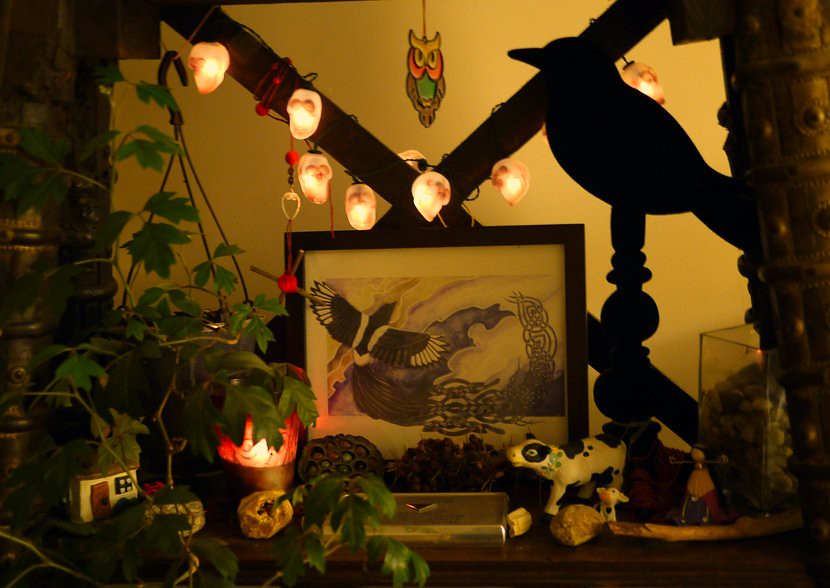
My hearth shrine, decorated with the tasteful skull-shaped lights for Samhainn...
It's been an odd transition period from summer-half to winter-half round here. Interminable rain and grey skies, and now gloriously frosty and sunny mornings (followed by more rain), and although I celebrated Samhainn two weeks ago now it feels like the transition into winter has only just secured itself and sunk its teeth in. The cold's making me feel kind of hibernaty - no bad thing when I have a pile of books to get through.
I got a pile of articles from my last trip to the library, and some of them are really good. Some of them I haven't got round to yet, but I thought it might be useful to give a brief rundown of the good ones before I go on to do a book review....
- Women, milk and magic at the Boundary Festival of May
Patricia Lysaght
This one is from Lysaght's Milk and Milk Products book (not the most inspiring title), which is a collection of essays on all things dairy in the Gaelic and Scandinavian world (primarily) from a historical perspective. I didn't read the whole book, but did pick at a few of the articles - well worth a read, especially some of the Scandinavian stuff that show the similarities between the folk customs surrounding milk charms and protecting the 'produce' (toradh, as the Gaels would call it). But this article stood out, so it was worth photocopying - it's a good overview of Bealtaine in Ireland, and includes a good amount of modern folklore and customs that were recorded by the Folklore Commission in the 1940s in particular (something that most other sources tend to lack). I shall probably use it to take a look at updating my Bealltainn article at some point.
- Hearth-Prayers and other Traditions of Brigit: Celtic Goddess and Holy Woman
Séamas Ó Catháin
From JRSAI Vol, 122, 1992. I was hoping for the article to have far more information about Irish hearth-prayers than it actually did, but still, this was a good read. If oddly tangential at times. But I did get some useful stuff from it, not least a slightly different version of an Irish smooring prayer:
Coiglímse an tine mar a choiglíonns cách,
I rake this fire like everyone else,
Bríd ina bun agus Muire ina barr;
Brigid below it with Mary on top;
Dhá aingle déag d'aingle na ngrást,
Twelve angels of the angels of the graces,
Ag cumhdach mo thí-sa go lá.
Protecting my house till down.
And the point that aingeal is referenced in both Irish and Scottish versions, and refers to either angels, or fire. As a non-linguist, the clever ambiguities of the language can't be appreciated without articles like this to help me...
- 'Handfasting' in Scotland
A. E. Anton
In the Scottish Historical Review, Vol 37, 1958.
Trying to figure out the whole debate around handfasting has been a bit of a bugger, quite frankly, because everyone knows that handfasting is an Anciente Celtic form of marriage. But it isn't (in the historical sense), although most sources arguing against it refer to each other rather than the historical sources that would be actually helpful. Yes, the argument may be convincing, but how about going into some detail, eh? Seeing as everyone references this article in arguing against handfasting-as-marriage, it seemed sensible to go to the source. It's thorough, and yes, it's convincingly argued (ha), although it's taken more than a few reads to absorb it all properly. I'm glad I got hold of it, though. TLDR: Handfasting comes from the Anglo-Saxon word handfæstung, which referred to the custom of shaking hands on agreement of a contract. In this case, a contract of betrothal - an agreement to marry at some point in future.
And so, onto the book review, one of my latest library snags:
Marriage in Ireland
Art Cosgrove (Ed.)
Originally published in 1985, this is a collection of essays on marriage throughout the history of Ireland. Each chapter is written by a different author, and covers a distinct period in history - from marriage in early Ireland, through to the twentieth century. The exception to the rule is Caoimhín Ó Danachair's (KevinDanaher's) article on 'Marriage in Irish folk tradition', and it really stood out for me as the best of the lot (also, the most helpful, to be fair).
The weakest eassy was the first - 'Marriage in early Ireland' by Donnchadh Ó Corráin. It's well written and informative, to be sure, but having gone into the subject in great detail already it seems that there are better sources to look at this (Bart Jaksi's chapter in 'The Fragility of Her Sex?', Fergus Kelly's Early Irish Law, and Daibhi Ó Cróinín's Early Medieval Ireland spring to mind), and for the most part it's probably safe to say that this is simply for the reason that those sources are more up to date and thorough. I couldn't help but feel that some of the issues were fudged a little here, but the article was sparser in references than I'd've liked it to have been, so it was difficult to follow up or check some of the points that seemed a little off (mainly linguistic points, possibly a matter of odd spelling).
Cosgrove's own chapter on 'Marriage in medieval Ireland' was a good read, and helpful for my reasearch, too, and the rest of the chapters were good too, though less relevant and therefore of slightly less interest to my aims. The last chapter in particular, 'Marriage in Ireland in the twentieth century' was more than a little dull for me, but then statistics have never really been my thing. It will surely be useful to anyone who needs (or wants) to know about marriage statistics of socio-economic groups, or rates of illegitimacy and so on. Me? Not so much.
Ó Danachair's article takes a slight detour from the chronology and focuses on folk memory, which he defines as being around 200 hundred years or so, and folk traditions. What you find here is pretty much what you'd expect from the author - good research, good writing, and engaging to boot. In many respects, this chapter gives a personality to the people being talked about in the other chapters, and while there was a little bit of overlapping in subject matter here and there between this article and the preceding one, on 'Pre-famine Ireland', it at least added to my understanding rather than made me switch off.
One thing I would liked to have seen is some mention, at least, of 'Teltown marriages' and the debate surrounding them, along with the problem of nineteenth century authors, in particular, heavily romanticising and even purposely rusticating the whole subject. OK, so that's two things. But this is a fairly small book, and to be fair there's only so much that you can cram in in such a short space. What it does offer is good, the few reservations I have with the first article aside, and it focuses on historical record, rather than general. I could quite happily have got stuck into a whole lot more, though.
Saturday, 6 November 2010
Like an annoying thing on an annoying day, with annoying sprinkles on top...
My oh my, how time flies. No sooner did I go to the library, than a month suddenly vanished and I had to return my books. In my head, it's been a few weeks, tops. But no, the books I got from the grown up library (as the kids call it, because I had to explain why they couldn't come too, and that's all I could think of) were due back today.
I didn't get around to reading even half of what I was intending to, but I did get the research I needed done, at least. I kind of ran out of steam with the Understanding the Universe book - not that it's not good, it just wasn't scratching the itch I was hoping it would and in the end I just didn't finish it. I have a more pressing itch to scratch at the moment, so I might go back to it at some point, because while I was at the caravan I did make good progress with it and I might as well go the whole hog.
I don't like to hold on to books during term time, in case someone else needs them (because if they get recalled, I won't be able to return them immediately, necessarily. Which would be expensive for me and inconvenient for everyone else), so I've returned all but one of them - British Calendar Customs: Scotland - because I'm fairly sure nobody will miss that for another month or so, and when I get the chance I really want to get stuck into it.
This time, at the grown up library, I remembered to take my book list. So that's an improvement on last time at least. I managed to get the articles I wanted to hunt up, and a few of the books I forgot. Yay. But this is also where the annoying part comes in, because I've been trying to work on my next article - on marriage this time, following on from the pieces I did on Afterlife and Ancestors, and then Death and Burial - and I've kind of hit a wall. Marriage is unexpectedly complicated.
I thought it would be difficult in the sense that there's not much to go on in terms of pre-Christian evidence (and there isn't, in terms of ritual pointers, which is what I really want to know about), but noooooo, there's a whole lot of other things to consider, too. I thought it would be a matter of cup rituals - a maiden bestowing a cup of on her intended to signify her acceptance of him, and then vice versa when he accepts it, and so on...then early medieval Irish marriage laws...then more recent folklore evidence. But not so much.
Research has been a hard slog and I seem to have collected a huge amount to sift through - more so than usual, and I'm already at the point where I know I'm going to have to split the whole thing into at least three parts. This is partly to do with the fact that I want to be comprehensive, and I want to show that marriage as it was is a very limiting topic for some in the present day. But my general aim in writing these articles is to give an overview of historical practices and outlooks, and that kind of conflicts with my own views on the subject. I'm fine with that, but at the same time I'm leery of how my attempts at being somewhat objective, at least, might be construed.
Marriage and babies was an ideal, yes. The laws didn't recognise gay and lesbian partnerships as being applicable for marriage unions (although homosexual relations in and of themselves weren't condemned either), and choosing not to have kids? Unheard of. It allowed for men to have more than one wife, but not women. And so on. As I said, it's complicated. And I'm leery of coming across as saying heterosexual marriage, between a man and woman (who subjugates herself to her husband) is the norm and the ideal in a reconstructionist and Gaelic Polytheist context, while trying to come across as even vaguely objective. I'm leery of coming across as saying that a man and woman should marry so they can have babies. End of. Because although to all intents and purposes I'm a walking embodiment of the heterosexual 'norm' - married, two kids, housewife - I don't think that should be the case for everyone. I don't think that those who choose alternatives to the 'norm' should be marginalised, because with modern technology, modern medicine, modern laws, we simply don't live in a world where such a narrow view should be considered to be desirable. I guess I have to have more of an editorial slant on the subject than I usually prefer, just to be clear.
But I'm kind of digressing. My main problem in writing the article is that there are still bits that I don't feel like I fully understand - not just that I'm not sure I can articulate properly, but I'm just not sure of at all. It's affecting my ability to put down the research I've collated into something even vaguely coherent. There seem to be a lot of holes, and there are conflicting opinions that all seem to confidently state that this is how it was, which then contradict everyone else. Which makes it evident that I need to do more research to fill in a few gaps before I can make up my mind with confidence.
This is where the really annoying part for today comes in. On my list of forgotten items that I managed to pick up today, was Bart Jaski's Early Irish Kingship and Succession. On a whim, I bought a copy of The Fragility of Her Sex? a while ago, because it was relatively cheap and I figured it would get me out of a research blackhole quicker than getting a copy from the library would, since the articles seemed to cover the issue of marriage in early medieval Ireland (turns out: not so much, but what I did find was useful, at least). Jaski has an article on marriage in there, and it was very helpful to what I needed to know, in parts, if not wholesale. I managed to piece bits of the rest together from here and there (and gods bless Google Scholar, Google Books, and Archive.org in my endeavour), and started to feel that at least as far as the cup-bearing issue, and the early Irish law were concerned, I had it covered. Then I looked up 'marriage' in the index of Early Irish Kingship and Succession, and the first thing that I looked at detailed almost everything I've written so far. If not word for word, then pretty much in the same order and not really disagreeing with anything I've said so far.
So much for my attempts at original research. I've basically followed in the footsteps of someone else already, for no good reason, because I should've just got his book instead - and could've, if I'd remembered the damn book list a month ago. I mean, it really looks like a bad case of plagiarism, cheekily disguised by the fact that I've attempted to make it look like I haven't by just referencing the same sources...It's a bit of a bummer, to say the least. Or maybe I should feel buoyed by my apparently on-the-nose research skills.
But it's not all bad - oh no and definitely definitely not. In looking up some of the journals for articles I wanted to photocopy, as usual I picked a few of the other volumes off the shelf and had a quick flick through. As luck would have it, I found a good article called 'The Drink of Death' that essentially looks at the inversion of the cup motif, in relation to the king's marriage to the land, along with an article on tattooing in insular Celtic tradition by Charles MacQuarrie. I read the latter on the train home, and it offers a lot of food for thought, not least in the fact that he points out that as far as the Picts and woad go, they are said to have painted themselves. It's iron needles that they and other insular tribes (certain, and specific tribes, MacQuarrie suggests) used for tattooing, and these tattoos tended to be of animals on the face, arms (close to the wrist) or thigh. They were either indicative of some sort of 'bloodthirsty' pact (i.e. uncivilised, pagan), or else an expression of some sort of spiritual (civilised but arguably not necessarily Christian, given the precedents) ideal. So basically, considering the next tattoo I have in mind, it's all cool beans. Although I doubt it will be on my face...
I didn't get around to reading even half of what I was intending to, but I did get the research I needed done, at least. I kind of ran out of steam with the Understanding the Universe book - not that it's not good, it just wasn't scratching the itch I was hoping it would and in the end I just didn't finish it. I have a more pressing itch to scratch at the moment, so I might go back to it at some point, because while I was at the caravan I did make good progress with it and I might as well go the whole hog.
I don't like to hold on to books during term time, in case someone else needs them (because if they get recalled, I won't be able to return them immediately, necessarily. Which would be expensive for me and inconvenient for everyone else), so I've returned all but one of them - British Calendar Customs: Scotland - because I'm fairly sure nobody will miss that for another month or so, and when I get the chance I really want to get stuck into it.
This time, at the grown up library, I remembered to take my book list. So that's an improvement on last time at least. I managed to get the articles I wanted to hunt up, and a few of the books I forgot. Yay. But this is also where the annoying part comes in, because I've been trying to work on my next article - on marriage this time, following on from the pieces I did on Afterlife and Ancestors, and then Death and Burial - and I've kind of hit a wall. Marriage is unexpectedly complicated.
I thought it would be difficult in the sense that there's not much to go on in terms of pre-Christian evidence (and there isn't, in terms of ritual pointers, which is what I really want to know about), but noooooo, there's a whole lot of other things to consider, too. I thought it would be a matter of cup rituals - a maiden bestowing a cup of
Research has been a hard slog and I seem to have collected a huge amount to sift through - more so than usual, and I'm already at the point where I know I'm going to have to split the whole thing into at least three parts. This is partly to do with the fact that I want to be comprehensive, and I want to show that marriage as it was is a very limiting topic for some in the present day. But my general aim in writing these articles is to give an overview of historical practices and outlooks, and that kind of conflicts with my own views on the subject. I'm fine with that, but at the same time I'm leery of how my attempts at being somewhat objective, at least, might be construed.
Marriage and babies was an ideal, yes. The laws didn't recognise gay and lesbian partnerships as being applicable for marriage unions (although homosexual relations in and of themselves weren't condemned either), and choosing not to have kids? Unheard of. It allowed for men to have more than one wife, but not women. And so on. As I said, it's complicated. And I'm leery of coming across as saying heterosexual marriage, between a man and woman (who subjugates herself to her husband) is the norm and the ideal in a reconstructionist and Gaelic Polytheist context, while trying to come across as even vaguely objective. I'm leery of coming across as saying that a man and woman should marry so they can have babies. End of. Because although to all intents and purposes I'm a walking embodiment of the heterosexual 'norm' - married, two kids, housewife - I don't think that should be the case for everyone. I don't think that those who choose alternatives to the 'norm' should be marginalised, because with modern technology, modern medicine, modern laws, we simply don't live in a world where such a narrow view should be considered to be desirable. I guess I have to have more of an editorial slant on the subject than I usually prefer, just to be clear.
But I'm kind of digressing. My main problem in writing the article is that there are still bits that I don't feel like I fully understand - not just that I'm not sure I can articulate properly, but I'm just not sure of at all. It's affecting my ability to put down the research I've collated into something even vaguely coherent. There seem to be a lot of holes, and there are conflicting opinions that all seem to confidently state that this is how it was, which then contradict everyone else. Which makes it evident that I need to do more research to fill in a few gaps before I can make up my mind with confidence.
This is where the really annoying part for today comes in. On my list of forgotten items that I managed to pick up today, was Bart Jaski's Early Irish Kingship and Succession. On a whim, I bought a copy of The Fragility of Her Sex? a while ago, because it was relatively cheap and I figured it would get me out of a research blackhole quicker than getting a copy from the library would, since the articles seemed to cover the issue of marriage in early medieval Ireland (turns out: not so much, but what I did find was useful, at least). Jaski has an article on marriage in there, and it was very helpful to what I needed to know, in parts, if not wholesale. I managed to piece bits of the rest together from here and there (and gods bless Google Scholar, Google Books, and Archive.org in my endeavour), and started to feel that at least as far as the cup-bearing issue, and the early Irish law were concerned, I had it covered. Then I looked up 'marriage' in the index of Early Irish Kingship and Succession, and the first thing that I looked at detailed almost everything I've written so far. If not word for word, then pretty much in the same order and not really disagreeing with anything I've said so far.
So much for my attempts at original research. I've basically followed in the footsteps of someone else already, for no good reason, because I should've just got his book instead - and could've, if I'd remembered the damn book list a month ago. I mean, it really looks like a bad case of plagiarism, cheekily disguised by the fact that I've attempted to make it look like I haven't by just referencing the same sources...It's a bit of a bummer, to say the least. Or maybe I should feel buoyed by my apparently on-the-nose research skills.
But it's not all bad - oh no and definitely definitely not. In looking up some of the journals for articles I wanted to photocopy, as usual I picked a few of the other volumes off the shelf and had a quick flick through. As luck would have it, I found a good article called 'The Drink of Death' that essentially looks at the inversion of the cup motif, in relation to the king's marriage to the land, along with an article on tattooing in insular Celtic tradition by Charles MacQuarrie. I read the latter on the train home, and it offers a lot of food for thought, not least in the fact that he points out that as far as the Picts and woad go, they are said to have painted themselves. It's iron needles that they and other insular tribes (certain, and specific tribes, MacQuarrie suggests) used for tattooing, and these tattoos tended to be of animals on the face, arms (close to the wrist) or thigh. They were either indicative of some sort of 'bloodthirsty' pact (i.e. uncivilised, pagan), or else an expression of some sort of spiritual (civilised but arguably not necessarily Christian, given the precedents) ideal. So basically, considering the next tattoo I have in mind, it's all cool beans. Although I doubt it will be on my face...
Friday, 5 November 2010
Some more bits on Orkney (and Shetland)
I'm not sure if the following is an update on the previous article I posted a while back, about the discovery of a Neolithic tomb in somebody's back garden, but if it is then work has started on excavating it:
See the BBC article
There's a link at the bottom of the article to some videos by one of the archaeologists working at the site. Definitely worth a watch. And I feel sorry for them - as exciting as the dig must be, the weather at the moment must be miserable.
There's also a piece (a few months old now) on how it's looking like Neolithic houses on Orkney were painted:
Over on Shetland, a prehistoric house has been discovered during the building works for a gas plant, with lots of unusual features. See The Shetland Times for more details.
All I can say is, I'm sooo saving my pennies for a holiday next year.
See the BBC article
There's a link at the bottom of the article to some videos by one of the archaeologists working at the site. Definitely worth a watch. And I feel sorry for them - as exciting as the dig must be, the weather at the moment must be miserable.
There's also a piece (a few months old now) on how it's looking like Neolithic houses on Orkney were painted:
"There has been evidence at some other Neolithic sites where paint pots have been found with remains of pigment but they were considered to be for personal adornment rather than being used on a wider scale for the decoration of buildings.
"This is a first for the UK, if not for northern Europe.
"The use of colour in this particular way was always suspected but this is the first concrete evidence we have of it."
He added: "It is not Rembrandt though, it is pretty basic designs."
Over on Shetland, a prehistoric house has been discovered during the building works for a gas plant, with lots of unusual features. See The Shetland Times for more details.
All I can say is, I'm sooo saving my pennies for a holiday next year.
Subscribe to:
Posts (Atom)