Following on from the recent ritual article over on Gaol Naofa, I decided to have another go at an article I started a while ago and kind of got distracted with and left for a bit. This one is on (De)constructing Reconstructionist Ritual, and aims to explore the different elements that can make up formal ritual in a Gaelic Polytheist context. It's not so much a how-to guide as it is an idea of what you can incorporate into your own rituals.
I haven't had much time for writing recently, but I do have a few bits and pieces I want to work on when I can...
Monday, 26 July 2010


Tuesday, 20 July 2010
Cthulhu carrots
I for one welcome our new carroty overlords...

A couple of the carrots started to flower - which I wasn't expecting because I was under the impression that they didn't do that until the second year - but I figured it was time to pull them, and this is what I got. Using the power of Google, and then my sister imparting the sum total of her knowledge of carrot-growing ("You've got to pull them in the evening!"), I made sure to do just that to avoid attracting carrot fly. And promptly got attacked by the wee midgie feckers instead. Bastards. But no pain, no gain, I guess. I got a modest crop in the end:
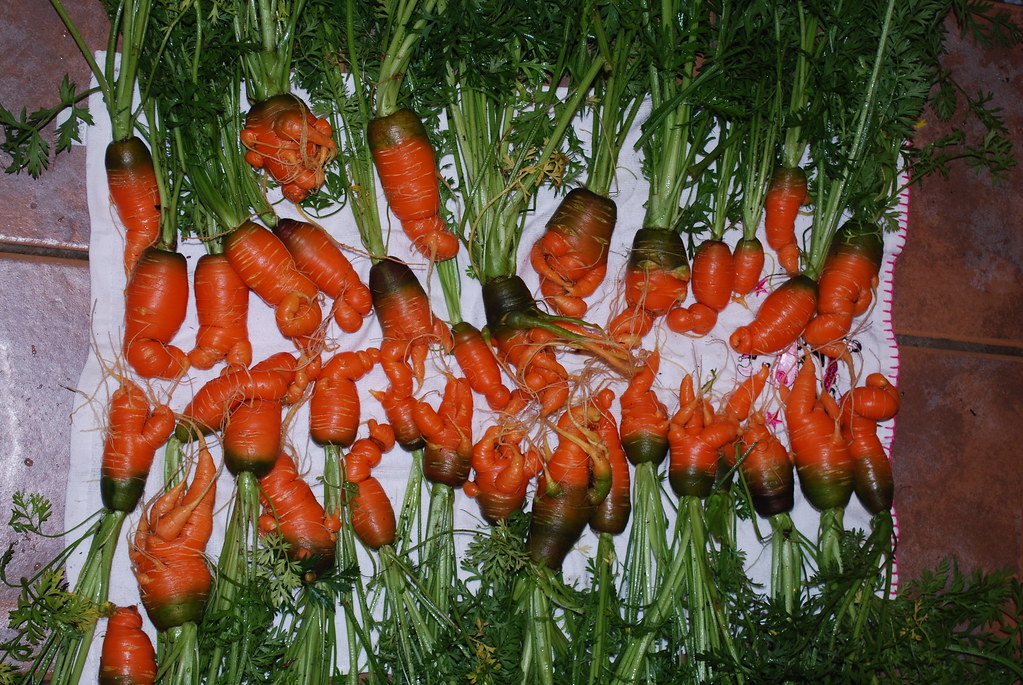
Only a few got munched on by something, which caused them to split right down the side. Most of them are impressively mutoid due to my own fault - being too shy to thin them out in case I killed them (because the kids helped sow the seeds I didn't always manage to make sure there was only one seed per pot). And I suspect I didn't water them enough during the drought last month - it was very hot and dry, and even watering them twice a day wasn't enough, it seems. You can see where they've had a last minute growth spurt once the incessant rain started again this month. The corkscrews, like this:
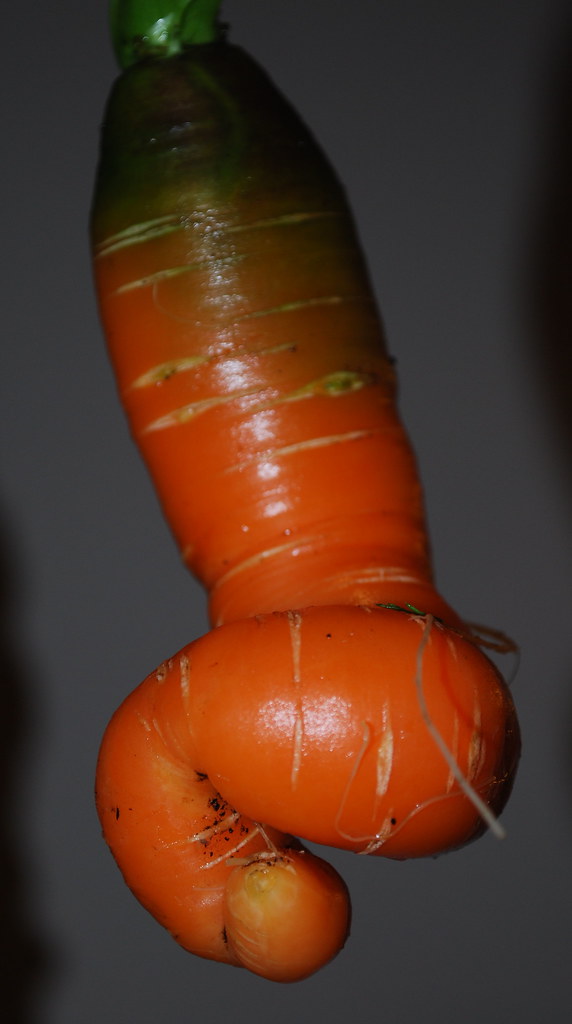
...I would guess are the result of being grown in the bags and just running out of room. They're tasty either way, but having shown Rosie my proud efforts, she flinched and ran off, commenting, "I don't like them, mummy, they're scary!" Tom, on the other hand, decided, "They're all quite funny! ...Hey, this one looks like an octopus!"
I have a batch of seedlings to put in today, in the hopes of getting another crop out of the growing season. And this time I've thinned them out.
Having bonded with my neighbour a bit over our respective vegetable gardening, I put in some radishes at the last minute after Jim told me they were quick and easy to grow. He wasn't wrong:
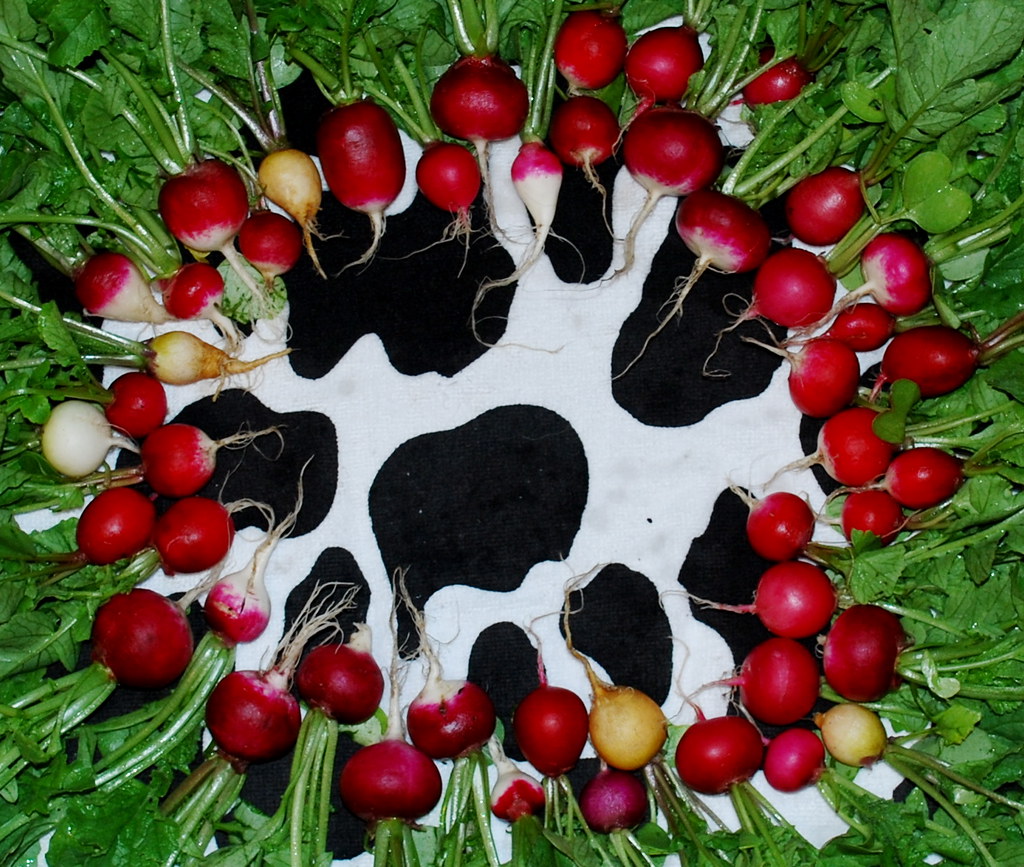
I bought two packets, one which said they'd be ready in a month, and the other, which was a 'novelty selection' of radishes of varying colours, that said they'd be ready in two to three months. So I figured if I put them in at the same time, I could stagger the crops slightly. But no, they've all come out at the same time after about two months of growing, I think. They're probably a little overripe - they're not a crunchyas the ones you buy in the supermarket, anyway, so I'll need to keep an eye on the next batch and pick them a bit sooner. These ones were kind of abandoned to the rain.
So, so far, success! I think the beetroots and then the onions will be next.
A couple of the carrots started to flower - which I wasn't expecting because I was under the impression that they didn't do that until the second year - but I figured it was time to pull them, and this is what I got. Using the power of Google, and then my sister imparting the sum total of her knowledge of carrot-growing ("You've got to pull them in the evening!"), I made sure to do just that to avoid attracting carrot fly. And promptly got attacked by the wee midgie feckers instead. Bastards. But no pain, no gain, I guess. I got a modest crop in the end:
Only a few got munched on by something, which caused them to split right down the side. Most of them are impressively mutoid due to my own fault - being too shy to thin them out in case I killed them (because the kids helped sow the seeds I didn't always manage to make sure there was only one seed per pot). And I suspect I didn't water them enough during the drought last month - it was very hot and dry, and even watering them twice a day wasn't enough, it seems. You can see where they've had a last minute growth spurt once the incessant rain started again this month. The corkscrews, like this:
...I would guess are the result of being grown in the bags and just running out of room. They're tasty either way, but having shown Rosie my proud efforts, she flinched and ran off, commenting, "I don't like them, mummy, they're scary!" Tom, on the other hand, decided, "They're all quite funny! ...Hey, this one looks like an octopus!"
I have a batch of seedlings to put in today, in the hopes of getting another crop out of the growing season. And this time I've thinned them out.
Having bonded with my neighbour a bit over our respective vegetable gardening, I put in some radishes at the last minute after Jim told me they were quick and easy to grow. He wasn't wrong:
I bought two packets, one which said they'd be ready in a month, and the other, which was a 'novelty selection' of radishes of varying colours, that said they'd be ready in two to three months. So I figured if I put them in at the same time, I could stagger the crops slightly. But no, they've all come out at the same time after about two months of growing, I think. They're probably a little overripe - they're not a crunchyas the ones you buy in the supermarket, anyway, so I'll need to keep an eye on the next batch and pick them a bit sooner. These ones were kind of abandoned to the rain.
So, so far, success! I think the beetroots and then the onions will be next.
Tuesday, 13 July 2010
Shameless self-promotion...
As part of my role as Leas-Uachtearán (Vice-President) of An Chullacht Ghaol Naofa, I've been working on a number of things with Uachtearán Treasa Ní Chonchobhair over the past few months since my appointment. It's not always easy trying to get things done when life has a nasty habit of getting in the way, so I'm pleased to announce the publication of our article Ritual within Gaelic Polytheism.
Credit goes Treasa for being the driving force behind the article as a whole, but thanks must also go to Kathryn and the founder of Gaol Naofa, Tomás, for their valuable critiques and suggestions to improve on what Treasa and I came up with.
I do hope, as ever, that you enjoy the article. Questions, comments and critiques are welcome.
Credit goes Treasa for being the driving force behind the article as a whole, but thanks must also go to Kathryn and the founder of Gaol Naofa, Tomás, for their valuable critiques and suggestions to improve on what Treasa and I came up with.
I do hope, as ever, that you enjoy the article. Questions, comments and critiques are welcome.
Monday, 12 July 2010
Midsummer
Midsummer's come and gone and with it, so has the sun, it seems. But we're still getting some pretty impressive sunsets. See?

Very dramatic. June was a very dry month for us, so the return of the rain is good for the garden, at least. Everything's coming along in leaps and bounds now.
For midsummer, I took the kids to the beach for a picnic with the intention of making some offerings - plans had to slightly change though, because we ran into our neighbours and they joined us for the afternoon, so offerings were somewhat surreptitiously done as we left, after a lovely afternoon in good company instead. It was quite a momentous afternoon, too - Mungo was brave and attempted a swim in the sea. Although I don't think he's in any hurry to try it again.
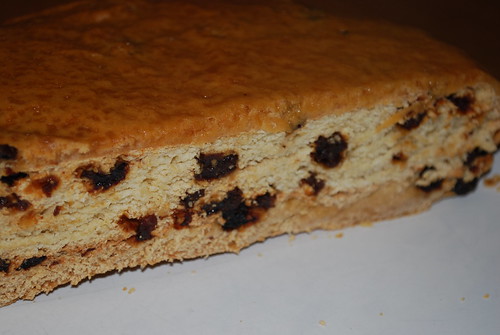
After starting Margaret Fay Shaw's Folk Songs and Folk-lore of South Uist a while ago, I found a recipe for a proper festival strùthan - a traditional version using barley, and a more modern version using flour. It was perfect timing, so I decided to try out the flour version, in the evening, and had some success with it. Sort of? I made it as thin as I possibly could by hand, but it rose more than I was expecting as it baked in the oven. It was also difficult to gauge how doughy the caudle should be, so that bit I had to wing and possible ended up with something a bit too paste-y rather than doughy. It kind of ended up rock solid and brick-like once the strùthan cooled. I tried some fresh from the oven and it was tasty, but chewy, but it definitely needed to be thinner - at least half as thin as it turned out. I would guess it would be quite solid but brittle then, once it cooled.
This is how it looked:
And this is the recipe, based on Shaw's description:
Ingredients
1 lb flour
1 tsp baking soda (bicarbonate of soda)
Salt
Sour milk - enough to make a dough
Caraway seeds, currants or raisins
Mix the ingredients together, using enough milk to make a pliable dough. Shape the dough into a flat round and bake on a girdle, or 'not too hot' oven. Turn about half way through cooking to make sure it bakes evenly.
For the caudle:
Ingredients
3 tbsp treacle (golden syrup)
2 tbsp milk
1 tbsp sugar
Flour
Mix the ingredients together, using enough flour to make a 'dough' that will stick to the strùthan. Cover the strùthan and return to the oven until ready.
If I'd got it the right thickness, then I imagine it would have been quite tasty, even after it had cooled. I saved some for the kids to have the next day, but when I tried to cut it, I couldn't even make a dent in it. I decided to bin it - seeing as it was basically inedible, I didn't want to leave it as an offering, but the rest of it that I'd left out fresh from the oven seemed to have been well received, along with some Orkney beer.
I didn't do much else for the day, just kept it quiet and simple (and nursed a mild case of sunburn from the beach). And somehow it's mid-July already, how did that happen?
Very dramatic. June was a very dry month for us, so the return of the rain is good for the garden, at least. Everything's coming along in leaps and bounds now.
For midsummer, I took the kids to the beach for a picnic with the intention of making some offerings - plans had to slightly change though, because we ran into our neighbours and they joined us for the afternoon, so offerings were somewhat surreptitiously done as we left, after a lovely afternoon in good company instead. It was quite a momentous afternoon, too - Mungo was brave and attempted a swim in the sea. Although I don't think he's in any hurry to try it again.
After starting Margaret Fay Shaw's Folk Songs and Folk-lore of South Uist a while ago, I found a recipe for a proper festival strùthan - a traditional version using barley, and a more modern version using flour. It was perfect timing, so I decided to try out the flour version, in the evening, and had some success with it. Sort of? I made it as thin as I possibly could by hand, but it rose more than I was expecting as it baked in the oven. It was also difficult to gauge how doughy the caudle should be, so that bit I had to wing and possible ended up with something a bit too paste-y rather than doughy. It kind of ended up rock solid and brick-like once the strùthan cooled. I tried some fresh from the oven and it was tasty, but chewy, but it definitely needed to be thinner - at least half as thin as it turned out. I would guess it would be quite solid but brittle then, once it cooled.
This is how it looked:
And this is the recipe, based on Shaw's description:
Ingredients
1 lb flour
1 tsp baking soda (bicarbonate of soda)
Salt
Sour milk - enough to make a dough
Caraway seeds, currants or raisins
Mix the ingredients together, using enough milk to make a pliable dough. Shape the dough into a flat round and bake on a girdle, or 'not too hot' oven. Turn about half way through cooking to make sure it bakes evenly.
For the caudle:
Ingredients
3 tbsp treacle (golden syrup)
2 tbsp milk
1 tbsp sugar
Flour
Mix the ingredients together, using enough flour to make a 'dough' that will stick to the strùthan. Cover the strùthan and return to the oven until ready.
If I'd got it the right thickness, then I imagine it would have been quite tasty, even after it had cooled. I saved some for the kids to have the next day, but when I tried to cut it, I couldn't even make a dent in it. I decided to bin it - seeing as it was basically inedible, I didn't want to leave it as an offering, but the rest of it that I'd left out fresh from the oven seemed to have been well received, along with some Orkney beer.
I didn't do much else for the day, just kept it quiet and simple (and nursed a mild case of sunburn from the beach). And somehow it's mid-July already, how did that happen?
Tuesday, 22 June 2010
Review: By Land, Sea and Sky by Morgan Daimler
OK, maybe one more review then...
IMPORTANT! Please note that this review only applies to the first edition of the book. A revised edition has since been released and changes have been made to it taking on board some of the comments that the author received in various places. This includes changes with the formatting and the addition of some of the author's own material. Bearing this in mind, some of the comments I've made in the review below will no longer apply, and as I've yet to read the latest edition I can't offer any comments relating to what you'll now found. I'm leaving the review here for the meantime because as far as I'm aware the general focus and scope of the book is still the same, but I hope to be able to do an updated version at some point.
By Land, Sea and Sky: A selection of Repaganized Prayers and Charms from Volumes 1 & 2 of the Carmina Gadelica
Morgan "Láirbhán" Daimler
I saw this book being mentioned in a few places and then it was reviewed on Celtic Scholar, which ultimately piqued my interest. It's the first time I've bought a self-published book (I think....) so I wasn't too sure what to expect on that front. The first thing I'd like to comment on, in that respect, is the fact that Lulu seems to have employed Professor Farnsworth from Futurama to send out the confirmation emails - "Good news! Your purchase has been dispatched!" But that's probably not particularly relevant to anything, really...
Secondly, I'm impressed by the quality of the book itself - it's not going to fall apart after a few flick throughs, so that's good. But it does suffer from a few of the criticisms that regularly get trotted out when anyone talks about self-publishing books, and the main ones are formatting/proofing and layout. The whole book is double spaced and while it's not a huge negative, I think some differentiation between the prayers and charms and the introductions and commentary to them would make it easier to read, and flow better overall. Sometimes my brain took a while to catch up with the fact that I was reading a paragraph, not another verse.
The title of the book gives a good clue as to what it's all about; it pretty much does what it says on the tin, so to speak. I have to admit I was surprised at just how many prayers, charms and so on that are included - it's quite comprehensive, and covers all the main areas and a few of the more specialised ones like healing, divination, and different kinds of magical charms.
They're all grouped by subject matter and have a brief introduction for each song so it's easy to find whatever it is you're looking for. One of the strengths of the book is that the author gives a clear idea of her approach and process in reworking the verses (although I wonder if 'repaganizing' is necessarily the right word in some cases?), and she also often gives suggestions for how to perform them.
It's left to the reader to decide how best to incorporate them into practice, so it allows for a variety of approaches and has an appeal beyond CR - the book is clearly aimed at 'Celtic Spirituality' as a whole, rather than just reconstructionists. It's well-researched in this respect, and quite light on detail in the sense that it wouldn't overwhelm the beginner, but as a reconstructionist (or maybe just me being me) I found it veering towards the danger of being a little too light at times, perhaps. The aim of the book is to provide examples of liturgy, not and in-depth examination and elucidation of rituals or CR, though, so I guess that's my problem, not the book's. It would have been nice to have seen it, though...
The author identifies as an Irish Reconstructionist Druid, and this shows in her choices of deities that are incorporated into the verses. There's plenty of room to adapt them to your own focus and deities, though, but more than anything I think the value of this book is that it shows polytheists of various stripes just how the material can be approached and adapted, coming at it from a non-Wiccan perspective.
There still aren't many books out there that cater for (or even account for) a Celtic Reconstructionist audience, so it's always good to see someone doing something about it.
EDIT: I've since revised my review of the book, which is available here. In the interests of transparency I'll be leaving this one as is. However, the more I thought about it, the more I felt there were some things I mentioned only in passing here that I should have concentrated on in more depth, and the more I thought about it, the more I felt that I should edit the review to reflect that. It would be unfair of me to do that without making a note of it, at least.
IMPORTANT! Please note that this review only applies to the first edition of the book. A revised edition has since been released and changes have been made to it taking on board some of the comments that the author received in various places. This includes changes with the formatting and the addition of some of the author's own material. Bearing this in mind, some of the comments I've made in the review below will no longer apply, and as I've yet to read the latest edition I can't offer any comments relating to what you'll now found. I'm leaving the review here for the meantime because as far as I'm aware the general focus and scope of the book is still the same, but I hope to be able to do an updated version at some point.
By Land, Sea and Sky: A selection of Repaganized Prayers and Charms from Volumes 1 & 2 of the Carmina Gadelica
Morgan "Láirbhán" Daimler
I saw this book being mentioned in a few places and then it was reviewed on Celtic Scholar, which ultimately piqued my interest. It's the first time I've bought a self-published book (I think....) so I wasn't too sure what to expect on that front. The first thing I'd like to comment on, in that respect, is the fact that Lulu seems to have employed Professor Farnsworth from Futurama to send out the confirmation emails - "Good news! Your purchase has been dispatched!" But that's probably not particularly relevant to anything, really...
Secondly, I'm impressed by the quality of the book itself - it's not going to fall apart after a few flick throughs, so that's good. But it does suffer from a few of the criticisms that regularly get trotted out when anyone talks about self-publishing books, and the main ones are formatting/proofing and layout. The whole book is double spaced and while it's not a huge negative, I think some differentiation between the prayers and charms and the introductions and commentary to them would make it easier to read, and flow better overall. Sometimes my brain took a while to catch up with the fact that I was reading a paragraph, not another verse.
The title of the book gives a good clue as to what it's all about; it pretty much does what it says on the tin, so to speak. I have to admit I was surprised at just how many prayers, charms and so on that are included - it's quite comprehensive, and covers all the main areas and a few of the more specialised ones like healing, divination, and different kinds of magical charms.
They're all grouped by subject matter and have a brief introduction for each song so it's easy to find whatever it is you're looking for. One of the strengths of the book is that the author gives a clear idea of her approach and process in reworking the verses (although I wonder if 'repaganizing' is necessarily the right word in some cases?), and she also often gives suggestions for how to perform them.
It's left to the reader to decide how best to incorporate them into practice, so it allows for a variety of approaches and has an appeal beyond CR - the book is clearly aimed at 'Celtic Spirituality' as a whole, rather than just reconstructionists. It's well-researched in this respect, and quite light on detail in the sense that it wouldn't overwhelm the beginner, but as a reconstructionist (or maybe just me being me) I found it veering towards the danger of being a little too light at times, perhaps. The aim of the book is to provide examples of liturgy, not and in-depth examination and elucidation of rituals or CR, though, so I guess that's my problem, not the book's. It would have been nice to have seen it, though...
The author identifies as an Irish Reconstructionist Druid, and this shows in her choices of deities that are incorporated into the verses. There's plenty of room to adapt them to your own focus and deities, though, but more than anything I think the value of this book is that it shows polytheists of various stripes just how the material can be approached and adapted, coming at it from a non-Wiccan perspective.
There still aren't many books out there that cater for (or even account for) a Celtic Reconstructionist audience, so it's always good to see someone doing something about it.
EDIT: I've since revised my review of the book, which is available here. In the interests of transparency I'll be leaving this one as is. However, the more I thought about it, the more I felt there were some things I mentioned only in passing here that I should have concentrated on in more depth, and the more I thought about it, the more I felt that I should edit the review to reflect that. It would be unfair of me to do that without making a note of it, at least.
Subscribe to:
Posts (Atom)