And like buses, they all come at the same time...
Scottish Fairy Belief
Lizanne Henderson and Edward J Cowan
If I had to summarise this one, I'd just have to say: Meaty goodness.
This is a book that does pretty much what it says on the cover. If there's just one book you're after for all your introductory needs to the subject, then this is the one for you. If I have to convince you further, then by all means, read on...
This is an academic text, and (from what the blurb tells me) it's a groundbreaking one too, since it's the first modern study of the subject. First and foremost, it aims to give an outline of the main themes of fairy belief, its history and motifs and so on. As an academic text, it starts by introducing some of the general theory of the study of fairy belief, which is useful for studies in general, not just putting the book into a wider context. It helps you become aware of the problems in the material used - especially, for example, in the reliability of the witch trials, which can provide a huge amount of information on fairy belief and folk customs, as well as confessions of dubious veracity, the evidence being skewed to conform to the latest theories on witchcraft, and so on.
Getting into the meat of it, each chapter covers a different area - the nature of fairy belief and the lore, how they were (and are) perceived, the influence of the Reformation and the witchcraft trials, and in particular, one chapter is dedicated to Robert Kirk and The Secret Commonwealth. To be honest, I'm hard pressed to find much negative to say about it - it's well-referenced and well laid out, well-written, and doesn't veer into dense paragraphs full of jargon and Teh Big Wurdz. And for the most part, it's an engaging read. And it will certainly do a good job of disabusing anyone with the notion that fairies a really just terribly terribly misunderstood, and actually quite nice.
I suppose the biggest negative of the book is that it assumed a more in-depth knowledge of history than the casual reader might have. For me it was the Reformation, and so forth - that's not my period of interest, really, so I'm a little hazy on it these days, and found it distracting at times.
It's a thorough work, although I'm sure it only touches the surface, really, but it's a very satisfying read and definitely worth it. It would probably be best appreciated if you already have a bit of an idea of the subject, with something like Evans-Wentz's The Fairy-Faith in Celtic Countries at the least. And I've yet to read Narváez's The Good People (I've only managed a flick through), but I think these would complement each other well. And speaking of complements:
Fantastical Imaginations: The Supernatural in Scottish History and Culture
Lizanne Henderson (Ed.)
This book is more of a mixed bag, for me, and maybe it's because of what it is: a collection of essays on various supernatural subjects in Scottish history. In reading this kind of thing - collections - sometimes it's difficult to fully appreciate the book as a whole because each author will naturally have a different voice, and as far as reading the book from cover to cover is concerned, I sometimes find it difficult to get into the book's flow. I guess my feelings about this book were inevitably going to be a bit more muted than most books I read.
So yes, there were some chapters I struggled to wade through at times, and maybe it's not just the different voices to contend with, chopping and changing from almost conversational, to more formal, or the subject moving from something that's engaging to something that's really not (I'm not sure I'll ever manage some enthusiasm for the Scottish Enlightenment)...I think a big part of the problem for me is that because there's such a limited amount of space (I presume) that each author has, sometimes the points they try to make just don't seem to be fully developed, or explored thoroughly enough, to feel well made.
There were some good articles - I really enjoyed Valentina Bold's article on "The Wicker Man: Virgin Sacrifice in Dumfries and Galloway," for one, which brought together all the elements of Scottish folk practice that were incorporated into the film, mixed in with a brief analysis of the film itself; Margaret Bennett's "Stories from the Supernatural: From Local Memorate to Scottish Legend" had some nice bits and pieces on modern survivals that caught my eye (with regards to the planting of rowan trees in Scotland, even today); and Juliette Wood's "Lewis Spence: Remembering the Celts" was a good read, too.
But then there was John MacInnes' "The Church Traditional Belief in Gaelic Society" which I didn't feel quite lived up to my expectations (largely, I think, to a general lack of references to some things I'd've been interested in following up). And Hugh Cheape's "The Material Culture of Charms and Amulets" disappointed me in the sense that there wasn't much in the way of anything new (references-wise) for me to go hunting for, but it was otherwise a good article and probably one of the best ones in the book.
I bought this with Scottish Fairy Belief because I figured they'd go well together, and given the dates of their publication (2001 and 2009) I decided to read this one second, because I figured reading the earlier book would give me a better grounding in the subject so I could appreciate the articles in this later work more. Even though the articles in Fantastical Imaginations cover more than just fairy belief, I certainly think I did benefit from keeping that order, but maybe my slight disappointment with this book was coloured by how much I enjoyed the first one.
Ultimately, there are lots of good essays here, but really I think it's the sort of thing that's of most interest to the more advanced reader who wants to get more in-depth information on this particular subject.
Sunday, 23 May 2010


Book review: Witta
Just to break things up, I'll put this review separately to the previous post:
Witta: An Irish Pagan Tradition
Edain McCoy
Now here's a little slice of neopagan history...
Really, perhaps this book is best forgotten. Perhaps I shouldn't review it. But then again, I've reviewed Buckland's PectiWita effort, so really it's only fair. It would be rude not to.
Way back when this was first published, in all of 1993, there was a huge explosion in the neopagan market for this kind of stuff. Wicca was well-established by this time, and Hutton had yet exploded a few myths on that with his Triumph of the Moon, and so people were starting to wonder about the alternatives out there, looking for something more...specific to their tastes.
So along come books like Witta, this one offering the Old Religion of Ireland in a neatly packaged, suitably green (of course) cover. It's not Wicca, but it sure as hell looks like it (there's the "Wiccan or Wittan Rede", the four elements, the ritual tools like the knife or sword, the wand, the chalice, the besom, and pentagrams agogo). But wait! It's not a rip off because many of these things are natural additions to the tradition over time. And of course it looks like Wicca, because really it's just a sister religion to it. Gardner brought us Ye Olde Religion of Britain, y'see. Here's what it looks like on the other side of the Irish Sea...Both evolved in slightly different ways. Nyah.
In case you're wondering where the druids fit in to the picture, they were "the real power in Ireland" from around the second century BCE to the fourth century CE. But Witta, so the author tells us, has its origins in the earliest Celtic period, pre-druids. Witta continued, of course, and with the coming of the druids, they changed a lot about the Wittan religion, and often served "as a bridge between the matrifocal and patriarchal periods."
But, erm...What's actually Irish about it then? Classical elements? Drawing down the moon? Ritual robes? Cones of Power? Matriarchy?
It's certainly not the name, that's for sure. How McCoy came up with that and thought she could get away with it, I don't know. Or, if her claims that she learnt the tradition from an authentic Irish woman, in Ireland, are actually true, then more fool the author for not checking the basic facts.
But then, consider this gem, for one:
"Potatoes, Ireland's staple crop, were used magickally in spells for healing and fertility, and were also carved into various forms for image magick much as the mandrake root is today. Because they grew underground potatoes were sacred to the Goddess and used in female fertility rites. Potatoes have a grounding effect. If you feel frazzled and stressed out cuddle a potato."
Of course, the author does point out (elsewhere) that the potato is a latecomer to Ireland. But still. And in case you missed it the first time, let me repeat it:
THE AUTHOR SERIOUSLY ADVISES YOU TO CUDDLE A POTATO IN TIMES OF STRESS.
Really? Maybe I'm just an awful cynic. Maybe I'm seriously missing out on some seriously good potato cuddles. But I think I'll give it a miss.
Although on the plus side, there's less chance of getting infested with wee creepy crawlies such as hugging a tree presents...
There are so many other problems, as well. Cernunnos is neither an Irish god, nor a Greek name. Beltene, "Irish god of death"? Really? Seriously? Colcannon is an old Wittan tradition? Umm; The Burning Times™; and so on. Let us not forget the evil patriarchal penis either...
I suppose I should make it clear, it's not necessarily the system that's presented that I have a problem with - I mean, it essentially is just Wicca with shamrocks and potatoes slapped on - I mean, it does seem to have worked for some people and I wouldn't be surprised if there were still a few Wittans out there. Personally, though, it's not for me (I'm sure you're shocked and surprised). I've come across a few Wittans over the years, and most haven't lasted long on various fora because ultimately, when the majority of people tell you your religion isn't historically accurate at all, really, and the author who sold that religion has put such a heavy stress on its authenticity and historicity, having that undermined by other people doesn't tend to go down too well. And really, when you take away the potatoes, there's not much left that you can't find elsewhere.
The book is a contradiction in terms. It even contradicts itself from the front cover to the back - on the front, it's "An Irish Pagan Tradition", on the back it's "the Old Religion of Ireland" (emphasis mine). Make your mind up! Ultimately, I just don't see how anyone can come away from having read the book and not feel lied to, barefaced, and gladly skipping off the bank with your hard-earned cash.
Witta: An Irish Pagan Tradition
Edain McCoy
Now here's a little slice of neopagan history...
Really, perhaps this book is best forgotten. Perhaps I shouldn't review it. But then again, I've reviewed Buckland's PectiWita effort, so really it's only fair. It would be rude not to.
Way back when this was first published, in all of 1993, there was a huge explosion in the neopagan market for this kind of stuff. Wicca was well-established by this time, and Hutton had yet exploded a few myths on that with his Triumph of the Moon, and so people were starting to wonder about the alternatives out there, looking for something more...specific to their tastes.
So along come books like Witta, this one offering the Old Religion of Ireland in a neatly packaged, suitably green (of course) cover. It's not Wicca, but it sure as hell looks like it (there's the "Wiccan or Wittan Rede", the four elements, the ritual tools like the knife or sword, the wand, the chalice, the besom, and pentagrams agogo). But wait! It's not a rip off because many of these things are natural additions to the tradition over time. And of course it looks like Wicca, because really it's just a sister religion to it. Gardner brought us Ye Olde Religion of Britain, y'see. Here's what it looks like on the other side of the Irish Sea...Both evolved in slightly different ways. Nyah.
In case you're wondering where the druids fit in to the picture, they were "the real power in Ireland" from around the second century BCE to the fourth century CE. But Witta, so the author tells us, has its origins in the earliest Celtic period, pre-druids. Witta continued, of course, and with the coming of the druids, they changed a lot about the Wittan religion, and often served "as a bridge between the matrifocal and patriarchal periods."
But, erm...What's actually Irish about it then? Classical elements? Drawing down the moon? Ritual robes? Cones of Power? Matriarchy?
It's certainly not the name, that's for sure. How McCoy came up with that and thought she could get away with it, I don't know. Or, if her claims that she learnt the tradition from an authentic Irish woman, in Ireland, are actually true, then more fool the author for not checking the basic facts.
But then, consider this gem, for one:
"Potatoes, Ireland's staple crop, were used magickally in spells for healing and fertility, and were also carved into various forms for image magick much as the mandrake root is today. Because they grew underground potatoes were sacred to the Goddess and used in female fertility rites. Potatoes have a grounding effect. If you feel frazzled and stressed out cuddle a potato."
Of course, the author does point out (elsewhere) that the potato is a latecomer to Ireland. But still. And in case you missed it the first time, let me repeat it:
THE AUTHOR SERIOUSLY ADVISES YOU TO CUDDLE A POTATO IN TIMES OF STRESS.
Really? Maybe I'm just an awful cynic. Maybe I'm seriously missing out on some seriously good potato cuddles. But I think I'll give it a miss.
Although on the plus side, there's less chance of getting infested with wee creepy crawlies such as hugging a tree presents...
There are so many other problems, as well. Cernunnos is neither an Irish god, nor a Greek name. Beltene, "Irish god of death"? Really? Seriously? Colcannon is an old Wittan tradition? Umm; The Burning Times™; and so on. Let us not forget the evil patriarchal penis either...
I suppose I should make it clear, it's not necessarily the system that's presented that I have a problem with - I mean, it essentially is just Wicca with shamrocks and potatoes slapped on - I mean, it does seem to have worked for some people and I wouldn't be surprised if there were still a few Wittans out there. Personally, though, it's not for me (I'm sure you're shocked and surprised). I've come across a few Wittans over the years, and most haven't lasted long on various fora because ultimately, when the majority of people tell you your religion isn't historically accurate at all, really, and the author who sold that religion has put such a heavy stress on its authenticity and historicity, having that undermined by other people doesn't tend to go down too well. And really, when you take away the potatoes, there's not much left that you can't find elsewhere.
The book is a contradiction in terms. It even contradicts itself from the front cover to the back - on the front, it's "An Irish Pagan Tradition", on the back it's "the Old Religion of Ireland" (emphasis mine). Make your mind up! Ultimately, I just don't see how anyone can come away from having read the book and not feel lied to, barefaced, and gladly skipping off the bank with your hard-earned cash.
Books! And a review
Thanks to my lovely husband enabling a long overdue splurge on books, for my birthday, I'm now (or soon to be) the proud owner of:
The sacred trees of Ireland - A. T. Lucas
The Life and Legacy of Alexander Carmichael - Domhnall Uilleam Stiubhart
The Celtic Consciousness - Robert O' Driscoll
Dying for the Gods - Miranda Green
Irish Folk Medicine - Patrick Logan
Early Irish Lyrics - Gerard Murphy
Irish Trees: Myth, Legend and Folklore - Niall Mac Coitir
Early Irish Myth and History - Thomas O' Rahilly
So far I've only had the first book arrive, but it's short and sweet and I've devoured it already. Lovely stuff. Of the rest, I'm already kind of familiar with O'Rahilly's and Murphy's, and there's an article by Anne Ross about modern survivals in the O' Driscoll book that I'm interested in, so while it's out of date as a publication, there might still be some good stuff in there.
The rest of them, I've no real idea what to expect - I've heard good things about Mac Coitir's book, and Logan's book looks intriguing. It could be a good read if it's well-researched, anyway. And for the book about Alexander Carmichael, I'm not sure it will be the most scintillating of reads, but I'm hoping that it will have some useful stuff about the problems with the way he handled the material in the Carmina Gadelica ('cleaning' the songs up and so on).
There were a few books I was hoping to get my hands on, but just couldn't find for love nor money. Aspects of the Táin and Ulidia 2 have been on my wishlist for a while now, but just as I had the chance, they weren't available anymore. And I really wanted to get my own copy of MacQuarrie's The Waves of Manannán, but I could only find it for an even vaguely reasonable price through amazon, and it turned out they didn't actually have a copy available. I presume that meant they'd try and order it through the publisher, and assuming they were successful it would take an age to arrive, and as I might be away for a good part of the summer there doesn't seem much point ordering it now.
But since I'm behind on a few reviews, I might as well get them done now, with a quiet Sunday all to myself and lots of housework to avoid...
The sacred trees of Ireland
A. T. Lucas
This is a reprint of an article from Volume 68 of the Journal of the Cork Historical and Archaeological Society (1963), so it's been difficult to get hold of. It's not too long, but seeing as I've seen it referenced in a lot of places, it was one of those books (well, booklet, really) I had to have. And better still, when it arrived I discovered it was signed by the author himself, 'With Compliments'. Awww. Thanks.
Anyway, the main thing I was hoping to find was a good overview of the tradition of the bile, and for once I wasn't disappointed. Lucas gives the general definition of the bile as a sacred tree, but doesn't limit it to only the 'big' trees such as the ash, elm and yew; instead, he includes the smaller trees or bushes that are found in similar contexts (especially the hawthorn), and argues that the term 'craeb' (branch) often carries the same meaning as bile. He also makes the point that often the English translations you might read simply translate either word as tree, whereas really they carry a much deeper meaning, and so often analysis of a text based on the translation alone can be limiting.
For the main part of the article, the different types of bile are divided into six different categories. These are:
Lucas starts with the 'unassociated' trees - like the five main trees of Ireland, as outlined in "The Settling of the Manor of Tara," and arguably a later category that's almost included as an afterthought - of 'lone bushes' - comes under this heading, too. These are generally the lone hawthorns that are associated with fairies.
With each category, Lucas gives examples to support his ideas and gives a little analysis. It's probably fair to say the reading is a little dry, but as an article it does its job: it sticks to the facts, offers some ideas and opinions, and gives a solid foundation on which somebody could go into far more detail.
There are some good points to think about in here, and while it may lack as much detail as I might like (I'd like a good long dissertation, please), I probably can't complain too much because I'm fairly sure I always say that. And there's definitely meat here, with very little fat to trim.
The biggest downside to the article is finding it. It's not readily available to buy, and would probably be a pain to get hold of a copy without JSTOR access, and so you really do pay the price, considering the length of it (just shy of fifty pages or so). But it really is worth it if you're interested in the subject.
The sacred trees of Ireland - A. T. Lucas
The Life and Legacy of Alexander Carmichael - Domhnall Uilleam Stiubhart
The Celtic Consciousness - Robert O' Driscoll
Dying for the Gods - Miranda Green
Irish Folk Medicine - Patrick Logan
Early Irish Lyrics - Gerard Murphy
Irish Trees: Myth, Legend and Folklore - Niall Mac Coitir
Early Irish Myth and History - Thomas O' Rahilly
So far I've only had the first book arrive, but it's short and sweet and I've devoured it already. Lovely stuff. Of the rest, I'm already kind of familiar with O'Rahilly's and Murphy's, and there's an article by Anne Ross about modern survivals in the O' Driscoll book that I'm interested in, so while it's out of date as a publication, there might still be some good stuff in there.
The rest of them, I've no real idea what to expect - I've heard good things about Mac Coitir's book, and Logan's book looks intriguing. It could be a good read if it's well-researched, anyway. And for the book about Alexander Carmichael, I'm not sure it will be the most scintillating of reads, but I'm hoping that it will have some useful stuff about the problems with the way he handled the material in the Carmina Gadelica ('cleaning' the songs up and so on).
There were a few books I was hoping to get my hands on, but just couldn't find for love nor money. Aspects of the Táin and Ulidia 2 have been on my wishlist for a while now, but just as I had the chance, they weren't available anymore. And I really wanted to get my own copy of MacQuarrie's The Waves of Manannán, but I could only find it for an even vaguely reasonable price through amazon, and it turned out they didn't actually have a copy available. I presume that meant they'd try and order it through the publisher, and assuming they were successful it would take an age to arrive, and as I might be away for a good part of the summer there doesn't seem much point ordering it now.
But since I'm behind on a few reviews, I might as well get them done now, with a quiet Sunday all to myself and lots of housework to avoid...
The sacred trees of Ireland
A. T. Lucas
This is a reprint of an article from Volume 68 of the Journal of the Cork Historical and Archaeological Society (1963), so it's been difficult to get hold of. It's not too long, but seeing as I've seen it referenced in a lot of places, it was one of those books (well, booklet, really) I had to have. And better still, when it arrived I discovered it was signed by the author himself, 'With Compliments'. Awww. Thanks.
Anyway, the main thing I was hoping to find was a good overview of the tradition of the bile, and for once I wasn't disappointed. Lucas gives the general definition of the bile as a sacred tree, but doesn't limit it to only the 'big' trees such as the ash, elm and yew; instead, he includes the smaller trees or bushes that are found in similar contexts (especially the hawthorn), and argues that the term 'craeb' (branch) often carries the same meaning as bile. He also makes the point that often the English translations you might read simply translate either word as tree, whereas really they carry a much deeper meaning, and so often analysis of a text based on the translation alone can be limiting.
For the main part of the article, the different types of bile are divided into six different categories. These are:
- Trees associated with inauguration places
- Trees associated with ecclesiastical sites
- Trees associated with saints
- Trees associated with holy wells
- Trees associated with funerals
- 'Unassociated' sacred trees
Lucas starts with the 'unassociated' trees - like the five main trees of Ireland, as outlined in "The Settling of the Manor of Tara," and arguably a later category that's almost included as an afterthought - of 'lone bushes' - comes under this heading, too. These are generally the lone hawthorns that are associated with fairies.
With each category, Lucas gives examples to support his ideas and gives a little analysis. It's probably fair to say the reading is a little dry, but as an article it does its job: it sticks to the facts, offers some ideas and opinions, and gives a solid foundation on which somebody could go into far more detail.
There are some good points to think about in here, and while it may lack as much detail as I might like (I'd like a good long dissertation, please), I probably can't complain too much because I'm fairly sure I always say that. And there's definitely meat here, with very little fat to trim.
The biggest downside to the article is finding it. It's not readily available to buy, and would probably be a pain to get hold of a copy without JSTOR access, and so you really do pay the price, considering the length of it (just shy of fifty pages or so). But it really is worth it if you're interested in the subject.
Monday, 3 May 2010
Bealltainn
My brain is rebelling against the thought of going into great detail about what I did for Bealltainn (and it's pretty much the same as I always do, so there's not much more I can add...), so suffice it to Bealltainn was a farily low key celebration, but a much needed one.
There was butter-making and gardening:

Rosie decorated the cairn and decided the ladybird should be its official guardian and I put a cowslip in by the pond, as a festive Bealltainn decoration:
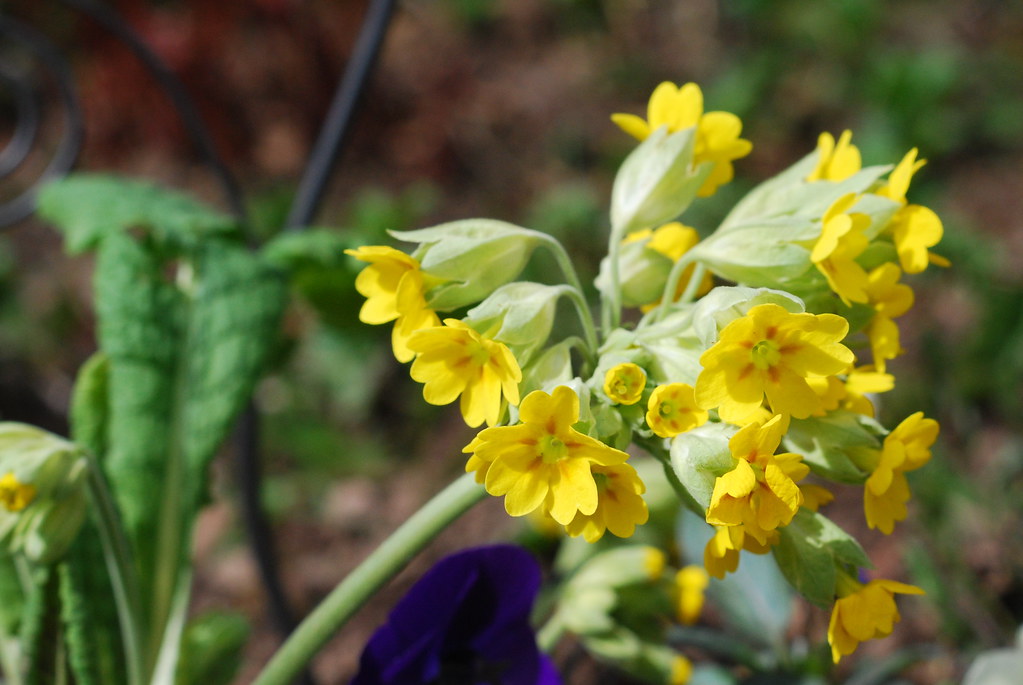
And so far it's looking quite festive and not under attack by slugs (yet)...
On the eve, feasting was had, ritual was done, offerings were made, the house was sained, plants blessed with the last of the water skimmed at Bealltainn last year, and charms were hung:
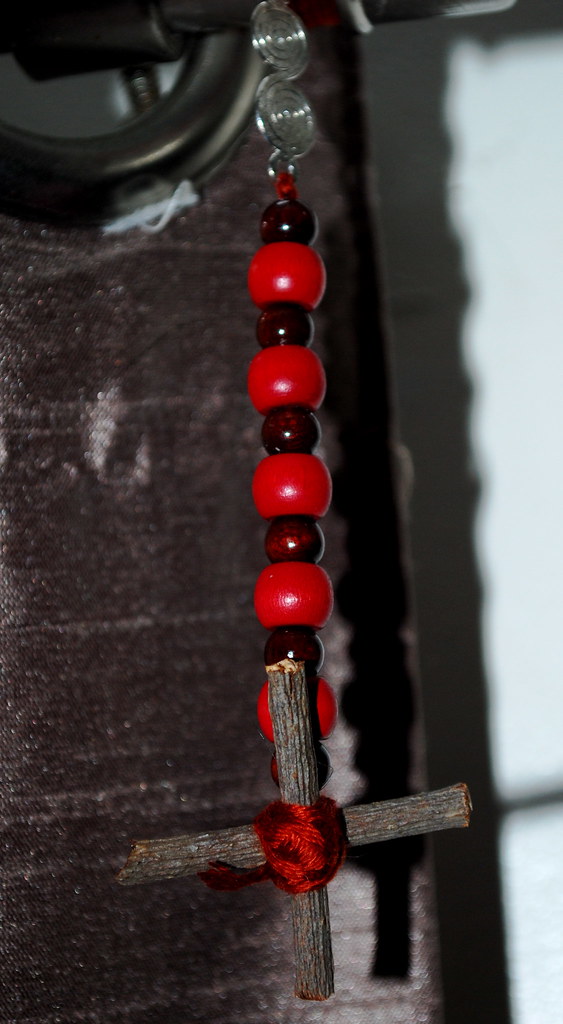
Bannocks and caudle were also made and offered (or sort of - I ran out of oatmeal for caudle, so had to make do with custard), and there was peace. As I sat outside as the sun began to set and watched the rooks come for the offerings, I found a stillness and peace in all the possibly maybes I seem to be wallowing in once again over what might be happening this summer with Mr Seren's work. There was a moment when a rook flew down and landed on the trellis and just stared at me for a while, as I stared at the rook before it hopped onto the terrace for a tidbit and flew off again. The sun came out and the wind died down, and there was just the evening chorus, the sound of kids playing in the distance and the warm, sweet air.
And once the summer was well and truly welcomed in, up went our summer mural, that we'd been working on during the week:
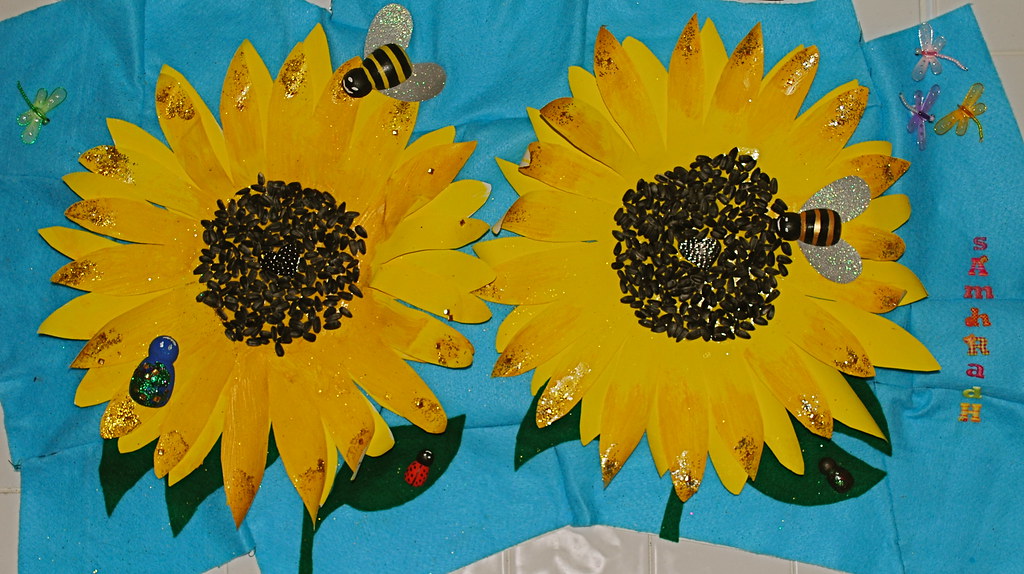
I was trying to avoid yet another floral theme, but the sunflowers were Tom's idea, because we were given sunflower seeds for Rosie's birthday and the kids have planted some. Tom decided that summer to him was about sun and flowers and bees, so this is what we came up with - I cut the shapes, they painted and glued, and I sewed the patchwork of felt to make the sky for the background. Rosie and I did the bugs (except for the dragon flies...), and of course there was the obligatory shiny stuff stuck on, too.
All in all it turned out exactly as I needed, I think. But other than that, I'm far too braindead to say anything intelligent about anything. And I've run out of coffee.
There was butter-making and gardening:
Rosie decorated the cairn and decided the ladybird should be its official guardian and I put a cowslip in by the pond, as a festive Bealltainn decoration:
And so far it's looking quite festive and not under attack by slugs (yet)...
On the eve, feasting was had, ritual was done, offerings were made, the house was sained, plants blessed with the last of the water skimmed at Bealltainn last year, and charms were hung:
Bannocks and caudle were also made and offered (or sort of - I ran out of oatmeal for caudle, so had to make do with custard), and there was peace. As I sat outside as the sun began to set and watched the rooks come for the offerings, I found a stillness and peace in all the possibly maybes I seem to be wallowing in once again over what might be happening this summer with Mr Seren's work. There was a moment when a rook flew down and landed on the trellis and just stared at me for a while, as I stared at the rook before it hopped onto the terrace for a tidbit and flew off again. The sun came out and the wind died down, and there was just the evening chorus, the sound of kids playing in the distance and the warm, sweet air.
And once the summer was well and truly welcomed in, up went our summer mural, that we'd been working on during the week:
I was trying to avoid yet another floral theme, but the sunflowers were Tom's idea, because we were given sunflower seeds for Rosie's birthday and the kids have planted some. Tom decided that summer to him was about sun and flowers and bees, so this is what we came up with - I cut the shapes, they painted and glued, and I sewed the patchwork of felt to make the sky for the background. Rosie and I did the bugs (except for the dragon flies...), and of course there was the obligatory shiny stuff stuck on, too.
All in all it turned out exactly as I needed, I think. But other than that, I'm far too braindead to say anything intelligent about anything. And I've run out of coffee.
Tuesday, 13 April 2010
I really should paint the fence...
Spring has been forgotten, it seems, and we've skipped from snow and frost straight to summer. If last year is anything to be judged by, I'll enjoy it while it lasts, because the weather is glorious right now, and no doubt it will be downhill from here on in.
Yesterday was good though - we went to Finlaystone, which the kids have dubbed 'Fiddlysticks,' and much fun was had by all. My mother-in-law, on arriving at the pirate ship tucked away in the forest, promptly transformed into Mad Moll the Queen of Pirates, and set about putting all the children who were playing there in prison, who then made elaborate plans to escape...The kids loved it, although my mother-in-law was thoroughly exhausted by the end of it.
Near the stream that runs through the estate, replete with waterfall:

We built a cairn on the bed of the stream (as a thank you, in my mind) and my mother-in-law got all archaeological with the children, using technical terms, but Rosie insisted it was, in fact, a spaceship actually:
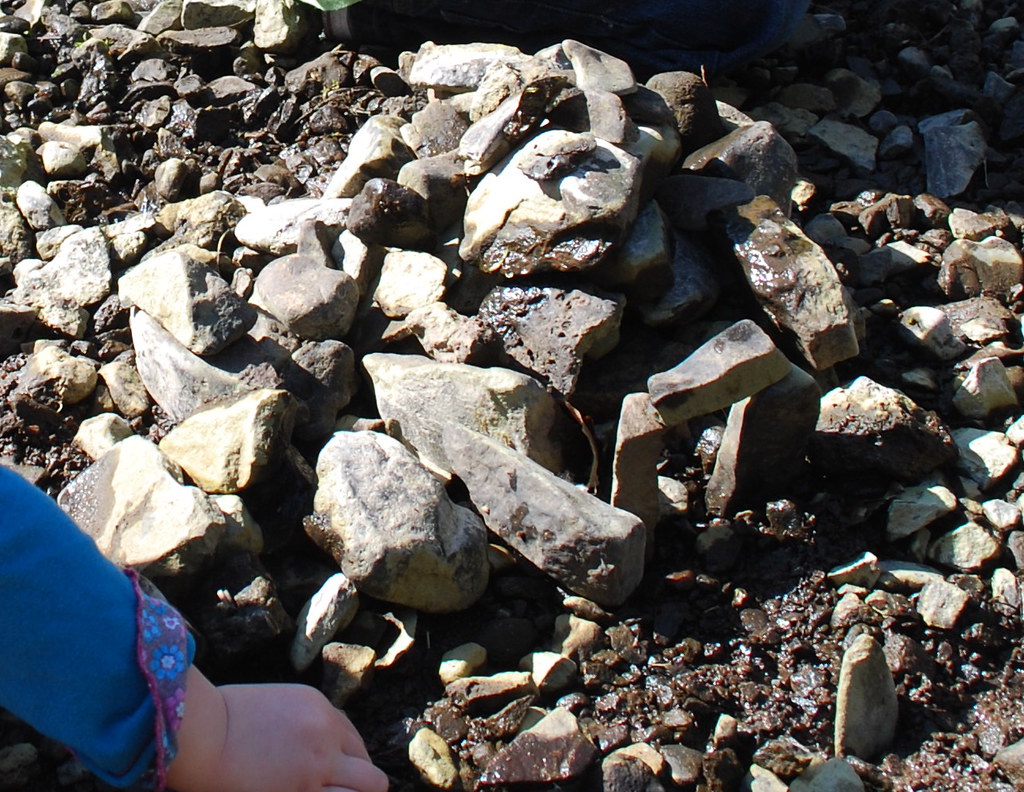
No trilithons and curbstones for Rosie, thankyouverymuch. Oh, alright. Maybe one.
I told my mother-in-law that we do this all the time when we go to the beach, and the other day I walked the dogs there just as the sun was setting and found that someone had made a wee stone circle, Callanish-style but surrounded by wooden posts at each corner, and a beer can stuck in the middle as if in offering to the sea. (It's a good way to try and appear considerate when littering, I suppose). I tried taking a photo of it on my phone but it was just too dark at that point. My mother-in-law, in turn, told me how they used to collect rocks from the beach near the caravan when my nieces were younger, so they could amuse themselves by piling them up when they were stuck at the caravan park. One year my father-in-law went there all alone, for a little respite, and amused himself (no doubt after several bottles of beer, vodka, or whatever it was he had to hand) by building a mini-stone circle on the lawn beside the caravan. He was so enamoured with it that he brought the rocks home and set them in concrete.
Today we took a trip into Glasgow to look for more clothes for Rosie's summer wardrobe, and got back in time to do a little gardening before dinner and dog walking. I treated myself to a blackcurrant and golden raspberry bush to flesh out my fruit harvest come the autumn, and I was pleased to find that the raspberry I already had (feared dead) was not only thriving, but I had another bush sprouting up nearby. So yay! The two new bushes have been planted, and I've stuck some bricks into the soil to make for stepping stones, so I can weed and pick more easily.
The rest of the bed's still in its early stages, and the chamomile has become a late casualty to the frost so now there's quite a gap to fill before the mint takes over. The growing season's started late, thanks to the weather, so there's not much to show except for wee shoots here and there, in amongst the straggly bushes (thanks to Mungo):
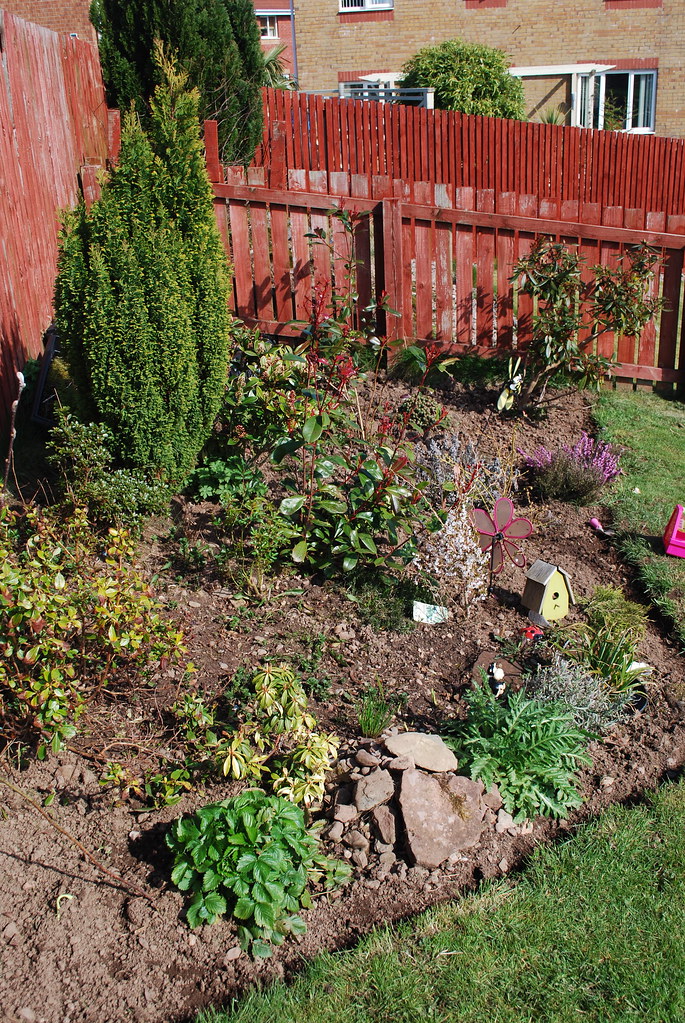
The first leaves of the rowan sapling, which I managed to not get in the photo for some reason, has its first leaves starting to unfurl, but I doubt we'll get any berries this year - it's still too young, I think. The alpine strawberries and the poppy's doing well, to the left and right of the stone pile that I've had a go at - finally - arranging into a small cairn (I took this yesterday, so you can't see the finished result yet). I built the cairn around a broken pair of scissors I found in the beds - for some reason it seemed apt at the time, and I'd always intended to put something in there. I don't know why the scissors sprang to mind, though. At the moment it's decorated with decorate red glass pebbles thanks to Rosie, who helped ('helped'), while Tom watered the flowers for me (by which I mean he made mud, near some of the flowers), but it's made me think that I should maybe decorate one of the larger stones - paint it or something. I'm not sure yet.
I've fixed the puddle (which the lavender is obscuring), with a new bowl that doesn't have holes in it, so it now retains water properly - although I was hoping to get something bigger so I could find some frogspawn and transplant it, to help control the midgies...I've had to make do for now, but the rushes are thriving in there at least.
Next to the puddle you might be able to see a white blob, which is actually a shell. I wasn't quite sure what to do with it, but Tom put it there and started putting daisies and buds from the heather plant into it, 'for the garden', he said:

So I've left it there and now Rosie's started to copy Tom as well. I admit, I'm surprised and pleased that Tom came up with the idea. It's such a simple thing, but it says so much about how they see the world around them.
I sowed some primroses to put around the puddle, but so far they haven't done anything so I'll have to get something from the garden centre, so it's all festive for Bealltainn. The rest of my DIY efforts have been a little more successful - we now have cauliflower, broccoli, beetroot (bleurgh), willd rocket, carrots, onions, leeks, basil, cabbage and 'caterpillar plants' sprouting, along with some sunflower seeds the nice neighbour gave us, which have begun sprouting as well. The cucumber and strawberries don't look hopeful, though - they've not done anything yet - but everything else is coming along nicely. I ordered some container bags as a cheaper option to proper containers, which have arrived and now we just need to get the compost and acclimatise the seedlings before planting them out.
And figure out what to do with all 40 cauliflowers I sowed...
I think I went a little overboard there, and while I know there will inevitably be some casualties, sowing and then having to transplant 40 cauliflowers at the same time seems to have been less than bright, as ideas go. I've managed to fob some off on other people, but that still leaves too many.
But in spite of that minor hiccup, there is exciting news:
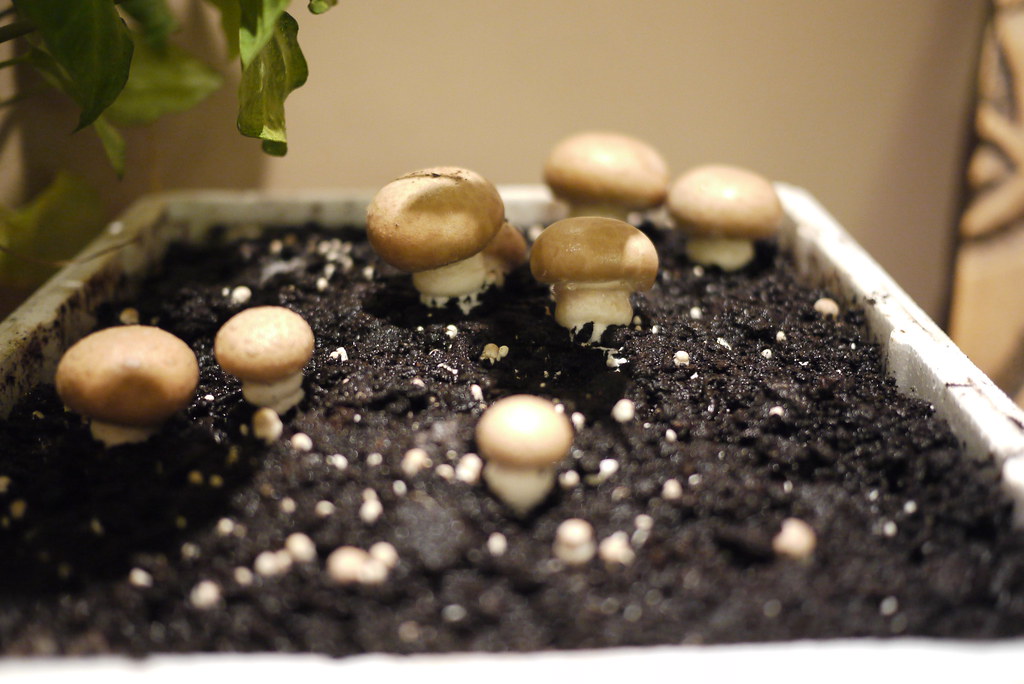
Mushrooms! It seems like they've taken for ever, but they're supposed to be somewhere cool and I'm not sure I really have somewhere cool enough, that isn't too cold, at the moment, so I'm sure that's slowed them down a little. I've already picked the first few, and have a few more ready to pick as well now, and there's plenty more to come as you can see by the small white blobs. I shall be using the ones that I've picked already for a mushroom risotto tomorrow, I think.
Really, I'm so excited that I've actually managed to grow something, all by myself, I'm like a big kid.
Yesterday was good though - we went to Finlaystone, which the kids have dubbed 'Fiddlysticks,' and much fun was had by all. My mother-in-law, on arriving at the pirate ship tucked away in the forest, promptly transformed into Mad Moll the Queen of Pirates, and set about putting all the children who were playing there in prison, who then made elaborate plans to escape...The kids loved it, although my mother-in-law was thoroughly exhausted by the end of it.
Near the stream that runs through the estate, replete with waterfall:
We built a cairn on the bed of the stream (as a thank you, in my mind) and my mother-in-law got all archaeological with the children, using technical terms, but Rosie insisted it was, in fact, a spaceship actually:
No trilithons and curbstones for Rosie, thankyouverymuch. Oh, alright. Maybe one.
I told my mother-in-law that we do this all the time when we go to the beach, and the other day I walked the dogs there just as the sun was setting and found that someone had made a wee stone circle, Callanish-style but surrounded by wooden posts at each corner, and a beer can stuck in the middle as if in offering to the sea. (It's a good way to try and appear considerate when littering, I suppose). I tried taking a photo of it on my phone but it was just too dark at that point. My mother-in-law, in turn, told me how they used to collect rocks from the beach near the caravan when my nieces were younger, so they could amuse themselves by piling them up when they were stuck at the caravan park. One year my father-in-law went there all alone, for a little respite, and amused himself (no doubt after several bottles of beer, vodka, or whatever it was he had to hand) by building a mini-stone circle on the lawn beside the caravan. He was so enamoured with it that he brought the rocks home and set them in concrete.
Today we took a trip into Glasgow to look for more clothes for Rosie's summer wardrobe, and got back in time to do a little gardening before dinner and dog walking. I treated myself to a blackcurrant and golden raspberry bush to flesh out my fruit harvest come the autumn, and I was pleased to find that the raspberry I already had (feared dead) was not only thriving, but I had another bush sprouting up nearby. So yay! The two new bushes have been planted, and I've stuck some bricks into the soil to make for stepping stones, so I can weed and pick more easily.
The rest of the bed's still in its early stages, and the chamomile has become a late casualty to the frost so now there's quite a gap to fill before the mint takes over. The growing season's started late, thanks to the weather, so there's not much to show except for wee shoots here and there, in amongst the straggly bushes (thanks to Mungo):
The first leaves of the rowan sapling, which I managed to not get in the photo for some reason, has its first leaves starting to unfurl, but I doubt we'll get any berries this year - it's still too young, I think. The alpine strawberries and the poppy's doing well, to the left and right of the stone pile that I've had a go at - finally - arranging into a small cairn (I took this yesterday, so you can't see the finished result yet). I built the cairn around a broken pair of scissors I found in the beds - for some reason it seemed apt at the time, and I'd always intended to put something in there. I don't know why the scissors sprang to mind, though. At the moment it's decorated with decorate red glass pebbles thanks to Rosie, who helped ('helped'), while Tom watered the flowers for me (by which I mean he made mud, near some of the flowers), but it's made me think that I should maybe decorate one of the larger stones - paint it or something. I'm not sure yet.
I've fixed the puddle (which the lavender is obscuring), with a new bowl that doesn't have holes in it, so it now retains water properly - although I was hoping to get something bigger so I could find some frogspawn and transplant it, to help control the midgies...I've had to make do for now, but the rushes are thriving in there at least.
Next to the puddle you might be able to see a white blob, which is actually a shell. I wasn't quite sure what to do with it, but Tom put it there and started putting daisies and buds from the heather plant into it, 'for the garden', he said:
So I've left it there and now Rosie's started to copy Tom as well. I admit, I'm surprised and pleased that Tom came up with the idea. It's such a simple thing, but it says so much about how they see the world around them.
I sowed some primroses to put around the puddle, but so far they haven't done anything so I'll have to get something from the garden centre, so it's all festive for Bealltainn. The rest of my DIY efforts have been a little more successful - we now have cauliflower, broccoli, beetroot (bleurgh), willd rocket, carrots, onions, leeks, basil, cabbage and 'caterpillar plants' sprouting, along with some sunflower seeds the nice neighbour gave us, which have begun sprouting as well. The cucumber and strawberries don't look hopeful, though - they've not done anything yet - but everything else is coming along nicely. I ordered some container bags as a cheaper option to proper containers, which have arrived and now we just need to get the compost and acclimatise the seedlings before planting them out.
And figure out what to do with all 40 cauliflowers I sowed...
I think I went a little overboard there, and while I know there will inevitably be some casualties, sowing and then having to transplant 40 cauliflowers at the same time seems to have been less than bright, as ideas go. I've managed to fob some off on other people, but that still leaves too many.
But in spite of that minor hiccup, there is exciting news:
Mushrooms! It seems like they've taken for ever, but they're supposed to be somewhere cool and I'm not sure I really have somewhere cool enough, that isn't too cold, at the moment, so I'm sure that's slowed them down a little. I've already picked the first few, and have a few more ready to pick as well now, and there's plenty more to come as you can see by the small white blobs. I shall be using the ones that I've picked already for a mushroom risotto tomorrow, I think.
Really, I'm so excited that I've actually managed to grow something, all by myself, I'm like a big kid.
Subscribe to:
Posts (Atom)