It's cutting it fine but I have most things I'll need for all the things I've been planning over the next few days for Samhainn - I'm sticking to my usual format of spreading everything over three days (well, nights, mostly), so I'll be starting tomorrow and finishing up on Sunday. Last year I ended up realising each day I celebrated had a kind of theme - starting with the ancestors as the main focus for the first day, the spirits for the second day, and the gods for the third day. It worked well so I'm planning on doing the same again.
Tomorrow, then, after Tom's fancy dress Hallowe'en party at nursery, I'll start on our winter mural for the kitchen with the kids. We did glittery snowflakes last year, but I think we'll save those for when Tom finishes nursery for the Christmas holidays. They feel a bit too 'festive' to do right now (bah humbug) and it will give us something to do then. We're going to try a wintery mountain scene, I think, and we can hang the snowflakes up later on. I'm not sure I posted a picture of the autumnal mural that we did at Lùnasdal, so here it is, just for the record:
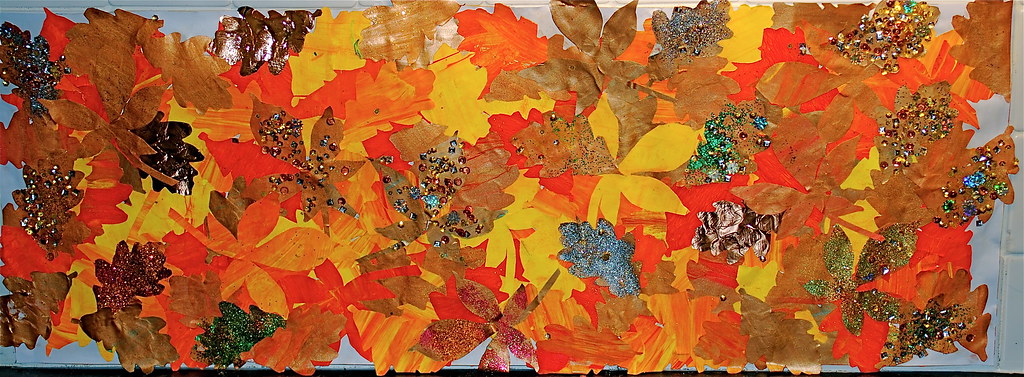
It's currently partially obscured by a giant pumpkin, though - I got one today, much to Mr Seren's disapproval because it's not traditional (although he didn't say anything until after I'd already bought it, so tough). I've got three tumshies to carve as well but I'll have to do those by myself, and the pumpkin seemed like it would be good fun for the kids to help scoop out the innards. It would be nice to include them in the festivities. And I'm willing to bet it's a bit easier than carving a turnip or two, at least...
If we have time I might bake some gingerbread men (or skeletons - Tom's going as a skeleton to his nursery party) that we can decorate as well, and I'll be saving some for the cranachan the day after. I've thought about putting some charms into the cream so everyone can dig in, but I think the kids are too young yet - maybe next year (and that'll give me time to plan for what I'll use as the charms...). I'll be making some treacle scones for games on Saturday as well - and I found this video about traditional Scots celebrations to show you what I'll try and do with them (it's only a short clip, from 1961), and we might try some dookin' for aipples if I can find something big enough for that.
Over the past week I've been trying to get the garden in order but the weather's been so wet that I've not done as much as I wanted - it'll do for the winter, though. Weather permitting, I want to build the cairn, in honour of my ancestors, beside the wee pond I've done, and bury the turnip lanterns I saved from last year so they can act as guardians in the coming year. I was hoping to get some nice rocks to dress the cairn with from the beach - larger ones so the cairn's a bit sturdier - but again, seeing as the weather's been so bad I haven't been able to yet. I was hoping to do the cairn tomorrow to fit in with my ancestral theme but I'll see how it goes. I'll be making some offerings to them, anyway.
Tom and Rosie are a bit young to go guising themselves just yet (we wouldn't get very far, accounting for Rosie's legs and my back, and she'd fall asleep in the pushchair if I took that), so instead we'll light the lanterns and put them in the window on the Saturday and give treats out to the guisers that come to our door. Hopefully we'll manage some games as well. After our feast and the kids are in bed I'll get down to my devotional stuff and light a fire in the garden (if it's dry enough...otherwise it's the hearth) as the focus - I'll perform the deiseal as usual, make some rowan charms, sain the house, take some ogam, make some offerings and leave a meal out for any visitors overnight after time to meditate.
In the morning I'll perform the frìth ritual and see if I have any better luck than last time I tried it (and at least the sun rises at a more reasonable hour now). Bannocks will be made for breakfast (Brodick bannocks, probably, the kids like them the best). And I'll finish the evening off with more offerings and some quiet contemplation to absorb everything.
Friday, 30 October 2009
Saturday, 24 October 2009
The first post...
I've been toying with the idea of doing a CR-only sort of blog for a while, which I can link to from Tairis without everyone being bored to death from having to wade through my more personal (and more frequent) posts. My aim is to give an idea of how I apply my research to what I actually do as far as my religious practice is concerned, if anyone's interested, and while that's kind of tied up with who I am and what I get up to in my personal life, I'm sure it's not absolutely necessary for you to get caught up in the minutiae there...
But maybe it would help to know a bit about me to start off with. Previously I've identified as a Wiccan - both solitary and as part of a traditional coven. I've dipped a toe into ceremonial magic, modern druidry and explored a few other paths in searching for what I'm looking for. I've identified as CR for a good five years now, in which time I've had a family and moved back to Scotland - first in the east near Edinburgh, and now on the west coast where I can admire views of the Highlands and Islands (almost) from my doorstep. But not quite.
My focus is very definitely Scottish, and my practises incorporate both my surroundings and my circumstances, so I suppose the best way to describe my focus is hearthy, but I also try to keep in touch with the more mystical aspects. I'm not a poet - a filid - a druid, or a warrior, but I do find there's a lot to learn from those who do practise those paths.
Over the next few...however much...I'm going to try and archive some of my old posts and then eventually I'll get round to maintaining this blog as a more up to date account of what I'm up to, what I'm reading, and sometimes, (when I'm feeling deep and meaningful) what I'm thinking.
What I do is constantly evolving, and hopefully you'll see that reflected here.
But maybe it would help to know a bit about me to start off with. Previously I've identified as a Wiccan - both solitary and as part of a traditional coven. I've dipped a toe into ceremonial magic, modern druidry and explored a few other paths in searching for what I'm looking for. I've identified as CR for a good five years now, in which time I've had a family and moved back to Scotland - first in the east near Edinburgh, and now on the west coast where I can admire views of the Highlands and Islands (almost) from my doorstep. But not quite.
My focus is very definitely Scottish, and my practises incorporate both my surroundings and my circumstances, so I suppose the best way to describe my focus is hearthy, but I also try to keep in touch with the more mystical aspects. I'm not a poet - a filid - a druid, or a warrior, but I do find there's a lot to learn from those who do practise those paths.
Over the next few...however much...I'm going to try and archive some of my old posts and then eventually I'll get round to maintaining this blog as a more up to date account of what I'm up to, what I'm reading, and sometimes, (when I'm feeling deep and meaningful) what I'm thinking.
What I do is constantly evolving, and hopefully you'll see that reflected here.
Sunday, 4 October 2009
Archive: Before Scotland - Alistair Moffat
Before Scotland
Alistair Moffat
This is one of those books that seems to promise so much to start with and then it all ends up falling a little flat. It started off so well and then...what the hell happened there?
As the title suggest, the book covers the history and pre-history of what eventually became Scotland. For the earliest pre-history I wasn't expecting too much because there's not really much that can be said that's particularly concrete about it, is there? But I was impressed with the way Moffat weaved a story of the pre-historic peoples and made them seem almost tangible - not dim and distant, living in a murky past of generalisations, but real: ancestors of the land. Understandably, given the nature of the evidence, Moffat has to draw from a much wider area than just Scotland for much of this section - not just to put the evidence from Scotland into context, but also to help flesh things out. His mentions of Doggerland were really interesting - not something I've really come across before and it really made me chew things over in a way I've never done before. In a way, though, it kind of distracted from the Scotland-specific information, and with a distinct lack of maps and specifying which country he was talking about sometimes, it wasn't always clear where he was referring to. Or which part of Scotland, even.
The biggest strength with these chapters was the way Moffat managed to paint such a vivid picture of the people and bring it into a modern context as well - pointing out the way in which many of the islanders still hunt the birds today, for example (although more for tradition than subsistence these days). It's strange to think that things like this have been literally going on for thousands of years and it's easy to romanticise and view it through rose-tinted glasses but I think Moffat manages to stay just on the right side of that.
But then I began having problems. First of all, Moffat seemed to jump from the Bronze Age right to the end of the Iron Age in the blink of an eye, which was disappointing. The emphasis on how people lived, from what the archaeology can tell us, changed to looking at the historical sources and the effects of the Romans - for the most part it's nothing you can't find elsewhere (although it is more up to date) with a few interesting tidbits here and there that piqued my interest. As soon as he got past the Bronze Age, gone was the way in which Moffat painted such a colourful picture of the Stone and Bronze Age people (terms that he eschews, for the most part, as many academics do these days...). Instead of drawing all the strands together into weaving a story like he did before, he seemed to stay a little aloof and detached. The tone changes from almost warm affection for the subject to verging on dry - which is not to say it gets dull or boring, it's just a big let down given the previous chapters.
And if I ever end up meeting the author? I somehow doubt that I'd ever have the balls to mention the Romans in front of him. The chapter on 'Caledonia' starts with more of a rant on the Romans and modern historians attitudes towards them, than dealing with the actual meat of the book...It's probably safe to say he's not a fan...I have to admit that when he started on about how the Romans did nothing for Scotland, in the longterm, my concentration wandered off into the land of Monty Python...WHAT'VE THE ROMANS EVER DONE FOR US?!
I don't want to be overly critical of the book - I wouldn't want anyone to be put off by my disappointment with some aspects of it because what you find here is solid - even with a distinct lack of any referencing (which is not good, but it's not meant to be an academic book so it's almost forgiveable, I s'pose). As an introduction to all of the different elements that contributed towards the making of Scotland, this is a great resource and in many ways it's refreshing. While it does seem that as soon Moffat starts getting into the meat of my favourite subject - the Celts - he loses some of his enthusiasm. I wonder if it's because he's covered it already in another book and he's trying to offer something different from that? Maybe he's just not keen on the labels, especially loaded ones (to some archaeologists) like 'Celts'? He certainly doesn't seem to be keen on the Romans, but at least he's upfront about that bias.
In spite of the slight disappointment, there's nothing terrible or bad here, it has to be said. There were still plenty of bits that caught my eye - the suggestion that many of the Pictish carvings were meant as offerings to the gods which were supposed to endure, for all to see, is worth exploring a bit more I think; Moffat suggests the 'tuning fork' on Pictish stones, for example, is a carved version of a broken sword. Instead of the sword being ritually broken and then being ceremoniously thrown into a bog or river, the carving lets the offering remain in sight, making it more permanent. To make the treaty that it commemorates more permanent?
There's good stuff to ponder and it's definitely worth a read (even if the change in tone half-way through makes it a little harder to stick with). For the absolute beginner it's maybe a bit broader in scope than you might be looking for to start off with, and in that respect, for something short and sweet I'd suggest something like Richard Hingley's Settlement and Sacrifice, and then something like Sally Foster's Picts, Gaels and Scots. What Before Scotland offers is something a little more up to date than authors like Foster does now, and it also helps puts the specifically Celtic stuff into a broader context that will help give a better idea of how Scotland came to be. Read it for the context, or as a good compliment to other books if you want something more up to date. Or just because it's a fun read (barring the last couple of chapters, that is....).
Alistair Moffat
This is one of those books that seems to promise so much to start with and then it all ends up falling a little flat. It started off so well and then...what the hell happened there?
As the title suggest, the book covers the history and pre-history of what eventually became Scotland. For the earliest pre-history I wasn't expecting too much because there's not really much that can be said that's particularly concrete about it, is there? But I was impressed with the way Moffat weaved a story of the pre-historic peoples and made them seem almost tangible - not dim and distant, living in a murky past of generalisations, but real: ancestors of the land. Understandably, given the nature of the evidence, Moffat has to draw from a much wider area than just Scotland for much of this section - not just to put the evidence from Scotland into context, but also to help flesh things out. His mentions of Doggerland were really interesting - not something I've really come across before and it really made me chew things over in a way I've never done before. In a way, though, it kind of distracted from the Scotland-specific information, and with a distinct lack of maps and specifying which country he was talking about sometimes, it wasn't always clear where he was referring to. Or which part of Scotland, even.
The biggest strength with these chapters was the way Moffat managed to paint such a vivid picture of the people and bring it into a modern context as well - pointing out the way in which many of the islanders still hunt the birds today, for example (although more for tradition than subsistence these days). It's strange to think that things like this have been literally going on for thousands of years and it's easy to romanticise and view it through rose-tinted glasses but I think Moffat manages to stay just on the right side of that.
But then I began having problems. First of all, Moffat seemed to jump from the Bronze Age right to the end of the Iron Age in the blink of an eye, which was disappointing. The emphasis on how people lived, from what the archaeology can tell us, changed to looking at the historical sources and the effects of the Romans - for the most part it's nothing you can't find elsewhere (although it is more up to date) with a few interesting tidbits here and there that piqued my interest. As soon as he got past the Bronze Age, gone was the way in which Moffat painted such a colourful picture of the Stone and Bronze Age people (terms that he eschews, for the most part, as many academics do these days...). Instead of drawing all the strands together into weaving a story like he did before, he seemed to stay a little aloof and detached. The tone changes from almost warm affection for the subject to verging on dry - which is not to say it gets dull or boring, it's just a big let down given the previous chapters.
And if I ever end up meeting the author? I somehow doubt that I'd ever have the balls to mention the Romans in front of him. The chapter on 'Caledonia' starts with more of a rant on the Romans and modern historians attitudes towards them, than dealing with the actual meat of the book...It's probably safe to say he's not a fan...I have to admit that when he started on about how the Romans did nothing for Scotland, in the longterm, my concentration wandered off into the land of Monty Python...WHAT'VE THE ROMANS EVER DONE FOR US?!
I don't want to be overly critical of the book - I wouldn't want anyone to be put off by my disappointment with some aspects of it because what you find here is solid - even with a distinct lack of any referencing (which is not good, but it's not meant to be an academic book so it's almost forgiveable, I s'pose). As an introduction to all of the different elements that contributed towards the making of Scotland, this is a great resource and in many ways it's refreshing. While it does seem that as soon Moffat starts getting into the meat of my favourite subject - the Celts - he loses some of his enthusiasm. I wonder if it's because he's covered it already in another book and he's trying to offer something different from that? Maybe he's just not keen on the labels, especially loaded ones (to some archaeologists) like 'Celts'? He certainly doesn't seem to be keen on the Romans, but at least he's upfront about that bias.
In spite of the slight disappointment, there's nothing terrible or bad here, it has to be said. There were still plenty of bits that caught my eye - the suggestion that many of the Pictish carvings were meant as offerings to the gods which were supposed to endure, for all to see, is worth exploring a bit more I think; Moffat suggests the 'tuning fork' on Pictish stones, for example, is a carved version of a broken sword. Instead of the sword being ritually broken and then being ceremoniously thrown into a bog or river, the carving lets the offering remain in sight, making it more permanent. To make the treaty that it commemorates more permanent?
There's good stuff to ponder and it's definitely worth a read (even if the change in tone half-way through makes it a little harder to stick with). For the absolute beginner it's maybe a bit broader in scope than you might be looking for to start off with, and in that respect, for something short and sweet I'd suggest something like Richard Hingley's Settlement and Sacrifice, and then something like Sally Foster's Picts, Gaels and Scots. What Before Scotland offers is something a little more up to date than authors like Foster does now, and it also helps puts the specifically Celtic stuff into a broader context that will help give a better idea of how Scotland came to be. Read it for the context, or as a good compliment to other books if you want something more up to date. Or just because it's a fun read (barring the last couple of chapters, that is....).
Tuesday, 29 September 2009
Archive: Symbol and Image/The Gods of the Celts - Miranda Green
Symbol and Image in Celtic Religious Art and The Gods of the Celts
Miranda Green
It's difficult not to lump these two books together in one way or another because in many ways they're pretty much the same book, just done in a slightly different way.
Of the two, The Gods of the Celts is the older and - I found - slightly less readable of the two. Partly it's a difference in formatting that makes Symbol and Image a better read; but mostly I think it's to do with the fact that Symbol and Image is more up to date in terms of information, and as a (only slightly, admittedly) more recent work Green seems to have developed her writing style which makes for a more engaging read overall. It has to be said that the illustrations in Symbol and Image also help to put what she's saying into a better context. What can I say? I like the pretty pictures...
For the most part Green covers Gaulish examples, and to a lesser extent she then covers the British and Gaelic evidence. This is usual - Green's area of expertise certainly lies in Gaul so that creates a natural bias, I suppose. When she covers things outside of this area she often relies on the work of Anne Ross, which is some cause for concern and caution. Much of Ross' work is valuable but now dated and Green doesn't make as much effort to balance out Ross' opinions with work from different authors who approach the subject from a different academic viewpoint as she does when she's more confident in her subject. First and foremost, though, Green is an archaeologist and not a Celticist as such, and it's important to remember this as you read.
Another problem with Green's work (in general) is her insistence on pigeon-holing deities into specific roles - sky-gods, sun-gods, chthonic deities and so on. This is a very Classical interpretation, which isn't necessarily appropriate in a Celtic context and it's a shame she doesn't really make much effort to consider or explore a more native view. The insistence on sun-gods is something that grates - what makes them sun-gods? Why the disparity between her interpretation and the distinct lack of any overt connections with the sun, or a solar role, in the surviving myths? Some exploration of this would have been nice, because otherwise it seems she's just regurgitating a commonly held view with little thought to whether it's actually correct or not. Neither does she really explain why she sees wheel-shaped iconography associated with some gods as being 'sun-wheels', except (as far as I could see) to reference an article written by herself. A little exploration of this would have been nice, to show some balance at least.
Having said all that, the books are actually quite good. One of Green's advantages is that she's able to write simply and clearly without losing her audience, and she does a good job of giving a good overview of the subject whilst also raising some points to ponder. Sometimes she delves a little too deeply into using jargon and technical terms without really explaining them (or maybe she just assumes the reader has a larger vocabulary than publishers tend to these days), but this was more of a problem with The Gods of the Celts than it was with Symbol and Image. To be fair, it's nothing a dictionary or a quick google can help to solve, though it could be annoying.
Symbol and Image focuses more on the deities and what their associated iconography and symbolism implies about their roles (so it kinda does what it says on the tin...). Each chapter focuses on a particular subject - the female image, the male image, triplism, the divine marriage, symbolism in the natural world, and what the style of the iconography itself implies. Within each chapter Green focuses on particular subheadings that are relevant - horned gods, iconography of birds, warrior cults and so on, as well as particular deities and divine couples.
The Gods of the Celts covers a lot of the same stuff, laid out in a different way. Chapters cover water gods and healing, war, death and the underworld, animals and animism, 'cults of sun and sky' and so on. The last example involves some gritting of teeth in particular, but in general these bits are easily read around if you find yourself disagreeing with it like I did. While there's a big overlap with Symbol and Image, The Gods of the Celts does a better job of giving a more rounded idea of Celtic religion and expression as a whole. Green goes into more detail about how the gods were worshipped and so it's a better read in that respect, because it probably caters more to what any budding Recon wants to know.
Because they're so similar, sometimes it seemed like Symbol and Image is a reworking of the first book but with a few more bits and pieces to add to the discussion. Each book has something unique to offer though, and they're both worth a read - they're not the be all and end all of the subject, but they're a good overview and Green gives good references and bibliographies to help you delve a little deeper if you want to. Since I found Symbol and Image to be a more engaging read, and better formatted, I'd suggest starting with that one if you're looking for a good book about the gods. The Gods of the Celts will do the job as well, and if you're looking to get a more rounded view as a beginner (or a refresher, or wider context, as a more advance type) - an idea of the religion and the gods - then start with The Gods of the Celts.
They're both good books to expand your general knowledge about Celtic religion, but bear in mind the continental and Romano-Celtic (encompassing Roman Britain as well, then) bias. You'll probably be disappointed if you're looking for a good indepth study of the Irish gods, for example, but even so they're worth a read if you want to get an idea of the different nuances in religious belief and expression across the various Celtic cultures.
Miranda Green
It's difficult not to lump these two books together in one way or another because in many ways they're pretty much the same book, just done in a slightly different way.
Of the two, The Gods of the Celts is the older and - I found - slightly less readable of the two. Partly it's a difference in formatting that makes Symbol and Image a better read; but mostly I think it's to do with the fact that Symbol and Image is more up to date in terms of information, and as a (only slightly, admittedly) more recent work Green seems to have developed her writing style which makes for a more engaging read overall. It has to be said that the illustrations in Symbol and Image also help to put what she's saying into a better context. What can I say? I like the pretty pictures...
For the most part Green covers Gaulish examples, and to a lesser extent she then covers the British and Gaelic evidence. This is usual - Green's area of expertise certainly lies in Gaul so that creates a natural bias, I suppose. When she covers things outside of this area she often relies on the work of Anne Ross, which is some cause for concern and caution. Much of Ross' work is valuable but now dated and Green doesn't make as much effort to balance out Ross' opinions with work from different authors who approach the subject from a different academic viewpoint as she does when she's more confident in her subject. First and foremost, though, Green is an archaeologist and not a Celticist as such, and it's important to remember this as you read.
Another problem with Green's work (in general) is her insistence on pigeon-holing deities into specific roles - sky-gods, sun-gods, chthonic deities and so on. This is a very Classical interpretation, which isn't necessarily appropriate in a Celtic context and it's a shame she doesn't really make much effort to consider or explore a more native view. The insistence on sun-gods is something that grates - what makes them sun-gods? Why the disparity between her interpretation and the distinct lack of any overt connections with the sun, or a solar role, in the surviving myths? Some exploration of this would have been nice, because otherwise it seems she's just regurgitating a commonly held view with little thought to whether it's actually correct or not. Neither does she really explain why she sees wheel-shaped iconography associated with some gods as being 'sun-wheels', except (as far as I could see) to reference an article written by herself. A little exploration of this would have been nice, to show some balance at least.
Having said all that, the books are actually quite good. One of Green's advantages is that she's able to write simply and clearly without losing her audience, and she does a good job of giving a good overview of the subject whilst also raising some points to ponder. Sometimes she delves a little too deeply into using jargon and technical terms without really explaining them (or maybe she just assumes the reader has a larger vocabulary than publishers tend to these days), but this was more of a problem with The Gods of the Celts than it was with Symbol and Image. To be fair, it's nothing a dictionary or a quick google can help to solve, though it could be annoying.
Symbol and Image focuses more on the deities and what their associated iconography and symbolism implies about their roles (so it kinda does what it says on the tin...). Each chapter focuses on a particular subject - the female image, the male image, triplism, the divine marriage, symbolism in the natural world, and what the style of the iconography itself implies. Within each chapter Green focuses on particular subheadings that are relevant - horned gods, iconography of birds, warrior cults and so on, as well as particular deities and divine couples.
The Gods of the Celts covers a lot of the same stuff, laid out in a different way. Chapters cover water gods and healing, war, death and the underworld, animals and animism, 'cults of sun and sky' and so on. The last example involves some gritting of teeth in particular, but in general these bits are easily read around if you find yourself disagreeing with it like I did. While there's a big overlap with Symbol and Image, The Gods of the Celts does a better job of giving a more rounded idea of Celtic religion and expression as a whole. Green goes into more detail about how the gods were worshipped and so it's a better read in that respect, because it probably caters more to what any budding Recon wants to know.
Because they're so similar, sometimes it seemed like Symbol and Image is a reworking of the first book but with a few more bits and pieces to add to the discussion. Each book has something unique to offer though, and they're both worth a read - they're not the be all and end all of the subject, but they're a good overview and Green gives good references and bibliographies to help you delve a little deeper if you want to. Since I found Symbol and Image to be a more engaging read, and better formatted, I'd suggest starting with that one if you're looking for a good book about the gods. The Gods of the Celts will do the job as well, and if you're looking to get a more rounded view as a beginner (or a refresher, or wider context, as a more advance type) - an idea of the religion and the gods - then start with The Gods of the Celts.
They're both good books to expand your general knowledge about Celtic religion, but bear in mind the continental and Romano-Celtic (encompassing Roman Britain as well, then) bias. You'll probably be disappointed if you're looking for a good indepth study of the Irish gods, for example, but even so they're worth a read if you want to get an idea of the different nuances in religious belief and expression across the various Celtic cultures.
Archive: Highland Heritage - Barbara Fairweather
Highland Heritage
Barbara Fairweather
This is not so much a book in its own right as a collection of booklets that were produced by the Glencoe and North Lorn Folk Museum in the 1970s, many of which are available to buy on their own. If you can find a copy of Highland Heritage going cheap then it's probably a good idea to invest in this, rather than buy them individually, but it seems Highland Heritage is hard to come by and I lucked out.
Subjects covered include the social calendar and customs, plantlore, farming, livestock, the Ballachulish slate quarry, the folklore of Glencoe, and a brief history of the area, along with selected excerpts from a wide variety of sources on Highland life and travels. Some chapters are more interesting than others, and more relevant to a CR context than others - these are:
The folklore of Glencoe and North Lorn
The Highland calendar and social life
Highland livestock and its uses
Highland wildlife
Highland plant lore
Which are both the chapter titles and the titles of the booklets if you want to look them up separately.
Of these, the chapters on folklore and the calendar don't offer anything you won't find anywhere else, but they do give a good idea of the lore that's specific to the area (which is often presented in a more general way in other books) so it's good if you want to concentrate on that because of ancestral heritage or something. The chapters on wildlife and plant lore offer a good overview of the subjects, and not being particularly au fait with herbalism, there was a lot that I hadn't seen before and was genuinely interesting to me. I can't say they offer anything very different from other books on plant lore, really, but it was different to me, at any rate.
The chapters towards the end of the book are almost entirely made up of excerpts which are mostly from the eighteenth and nineteenth centuries, but some are even older. On the plus side, there are some obscure and useful sources used - the sort of anecdotal evidence that help to lend some support to some of those folklore books written in the late nineteenth and early twentieth centuries that aren't so well referenced. I found a few references to bannocks that I thought were interesting, for one thing. For the student of Scottish history - particularly interested in everyday, domestic life - these chapters make a great resource. But to be fair, I couldn't say they make for the most thrilling of reads...
On the whole though, since each chapter was originally written as a booklet, they're all very general and lacking in any real depth, and as a book it feels a bit piecemeal and not very coherent. This makes it the sort of book you can pick through, rather than go through in one sitting - it's more suited to mine little tidbits from, when you want to get into the details details details, not so much when you want to look at the bigger picture. It's unfortunate, in that respect, that there's no indexing to help find those little gems more easily. Have some post-its or a pen and paper handy.
Taken on their own, as booklets, the more relevant chapters offer a good introduction to the subjects they cover (but not in a very analytical way, to be fair - it's all about the facts, not how to interpret those facts). In that sense they might appeal to a beginner lookng for a quick and easy read, but to be fair you're better off working through McNeill's The Silver Bough or Black's The Gaelic Otherworld in the long run. As a collection in Highland Heritage, though, it's probably going to appeal more to someone who wants to get beyond the usual suspects that tend to be high on the reading list. I wouldn't say it's a must have, but it's a good compliment.
Barbara Fairweather
This is not so much a book in its own right as a collection of booklets that were produced by the Glencoe and North Lorn Folk Museum in the 1970s, many of which are available to buy on their own. If you can find a copy of Highland Heritage going cheap then it's probably a good idea to invest in this, rather than buy them individually, but it seems Highland Heritage is hard to come by and I lucked out.
Subjects covered include the social calendar and customs, plantlore, farming, livestock, the Ballachulish slate quarry, the folklore of Glencoe, and a brief history of the area, along with selected excerpts from a wide variety of sources on Highland life and travels. Some chapters are more interesting than others, and more relevant to a CR context than others - these are:
The folklore of Glencoe and North Lorn
The Highland calendar and social life
Highland livestock and its uses
Highland wildlife
Highland plant lore
Which are both the chapter titles and the titles of the booklets if you want to look them up separately.
Of these, the chapters on folklore and the calendar don't offer anything you won't find anywhere else, but they do give a good idea of the lore that's specific to the area (which is often presented in a more general way in other books) so it's good if you want to concentrate on that because of ancestral heritage or something. The chapters on wildlife and plant lore offer a good overview of the subjects, and not being particularly au fait with herbalism, there was a lot that I hadn't seen before and was genuinely interesting to me. I can't say they offer anything very different from other books on plant lore, really, but it was different to me, at any rate.
The chapters towards the end of the book are almost entirely made up of excerpts which are mostly from the eighteenth and nineteenth centuries, but some are even older. On the plus side, there are some obscure and useful sources used - the sort of anecdotal evidence that help to lend some support to some of those folklore books written in the late nineteenth and early twentieth centuries that aren't so well referenced. I found a few references to bannocks that I thought were interesting, for one thing. For the student of Scottish history - particularly interested in everyday, domestic life - these chapters make a great resource. But to be fair, I couldn't say they make for the most thrilling of reads...
On the whole though, since each chapter was originally written as a booklet, they're all very general and lacking in any real depth, and as a book it feels a bit piecemeal and not very coherent. This makes it the sort of book you can pick through, rather than go through in one sitting - it's more suited to mine little tidbits from, when you want to get into the details details details, not so much when you want to look at the bigger picture. It's unfortunate, in that respect, that there's no indexing to help find those little gems more easily. Have some post-its or a pen and paper handy.
Taken on their own, as booklets, the more relevant chapters offer a good introduction to the subjects they cover (but not in a very analytical way, to be fair - it's all about the facts, not how to interpret those facts). In that sense they might appeal to a beginner lookng for a quick and easy read, but to be fair you're better off working through McNeill's The Silver Bough or Black's The Gaelic Otherworld in the long run. As a collection in Highland Heritage, though, it's probably going to appeal more to someone who wants to get beyond the usual suspects that tend to be high on the reading list. I wouldn't say it's a must have, but it's a good compliment.
Subscribe to:
Posts (Atom)
