It's that time of year again...More spiritual ponderings...
Labels are a tricky thing. Sometimes they can be as liberating as they can be confining. It's good to be able to say you're something; this is where I belong, this is where I am; to be able to say you have a home, a family that you share things with and lean on when needed; be inspired by or receive a timely boot up the arse as necessary.
But generally these labels come with responsibilities. Am I doing it right? Does the label still belong? Because there's not much point clinging to a label that no longer fits. It's kinda like weariing a pair of jeans you really really like the look of even though they don't suit you and there's a serious amount of muffin top going on. It's just not attractive. And if you're not honest with yourself and others, then you're not being honourable, and how can you do honour to the gods if it's based on a lie? Because ultimately, doing the right thing is what counts; finding truth.
So then sometimes, with wanting to live up to those labels you've set upon yourself along with some high expectations, the focus comes to be on doing it right (whatever that means), and then thinking about doing it right instead of actually doing anything, just to make sure that you're going to be doing it right. Combine all that with the worry that those experiences, the thoughts and feelings that come with practice and exploring a relationship with the gods, might not be True because this is an area well out of the comfort zone of being able to Cite Your Sources: That maybe those thoughts and feelings are just what you want to hear, because it feels good to be validated sometimes, so you don't have to worry about whether or not you're just plain bonkers...Suddenly in amongst the mental jumble you've just made it all gets disconnected, the threads get lost. Maybe it's just me. Not that I tend to over-analyse or anything.
For the most part a healthy dose of Get A Grip sorts it all out, and that's something I've been working on. I do, but I don't overthink what I'm doing. I do research and find inspiration in it, rather than letting it restrict me too much by getting bogged down on the minute details (although I like exploring the minute details sometimes; the trick is making sure I don't get lost in them), and now I've got to the point where I have a rhythm of practise that takes me through each day, each season. I find that sharing what I do, and reading about what other people do also helps to keep things in perspective. Although recently I've come to realise I've been slipping into over-analysing again (or veering close to it, anyway). I realise I've been hesitating, stalling a little.
My practises are constantly evolving as I gain a better understanding of what I think reconstructionism is and how it shapes what I do; I enjoy the challenge and I find the results to be incredibly personal and meaningful. And as I do, and then think about what I've been doing, what I've experienced, I get an idea of what I still need to work on to gain a better balance in my practises. I'm not there yet (and probably just as I think I've got it I'll find I need something slightly different), but I've got to a point where I think I have the basics down, for now.
But just as I feel like I've dealt with the distractions of getting settled into a new house, somewhere I can put roots down, and a feeling of being on a firmer footing with what I'm doing here, something happens: A realisation, finding myself going off in a different and unexpected direction. And as much as it's been a good thing, part of me is left feeling all off-kilter again, like I'm just learning about all this and finding my way again. So I've gone back to feeling like I'm stumbling around in the dark a little - especially when it comes to how I see the gods and my relationship with them. At times they still feel so...nebulous. And no, I don't expect (or want) it all to be laid out in a how to manual before me: this is how you do it, this is what you should expect to happen, and this is how you know you're doing it right...But sometimes, when it's just you and Them, you start to wonder if you're really not just plain bonkers after all, especially when things don't quite go how you were expecting them to.
Just when I thought I was getting to grips with the attention of one particular goddess who seemed to be making herself known, it's all gone a bit unexpected. This winter, my first winter here, I've really been feeling like I've been making some sort of connection with the Cailleach, and given the season that all makes sense. No real surprise, and it's nice to know that I'm getting something right, it seems. Finally I'm starting to feel like I'm getting a proper footing with where I am and what I'm doing, and it all feels like it fits into this landscape and into the context of my practises. But then it gets a little confusing because my attention is drawn back to Badb and deep down I still really don't know where she fits in, but I know that she's there and she'll bide until I figure it out. I can't help but feel there's a reason for her prodding at me, and so far I haven't felt it's because I'm supposed to devote myself to her. Yet, perhaps, if ever. Whatever the future holds, there are some things I need to figure out before I get a complete picture of things, but as much as I've made some progress on finding answers, I've started to feel like I'd come to a bit of a dead end.
There've been a lot of good discussions about the place recently, here on lj and some of the lists, and combined with some questions somebody asked me, it's all put a few thoughts in motion. I was asked about how I saw things with Badb these days, and whether the sticking point for me in the past had been that she's not a goddess who 'lives' here, but in Ireland. Or whether it was the context, only a tenuous connection between there being a historical link with Badb and Scotland - as in, she could have been brought over here, but there's nothing I've seen to suggest an overt link.
I don't believe the gods are tied to a place in a literal, physical sense (solely, anyway), so I replied the latter, but that in my meanderings and somewhat tentative practises (at times, anyway, I'm still a little leery of this mysticism stuff, as I've said in the past), I'd come to realise that perhaps I was over-emphasising the differences between Ireland and Scotland rather than recognising their joint heritage. One thing that brought it all home to me is that I've been doing some writing and research about Bealltainn, and in comparing the Scottish and Irish practices the similarities are striking (but I digress...). And then there's the fact that I can't help but feel that there's some sort of connection between Badb and the Irish side of my heritage, which I've always felt a deep affection for (especially because it's through my nan's side of the family), and because Badb seems to have her origins in the area my family's from.
So then came the question, do you think that Badb's presence has anything to do with your nan's condition, given the ancestry angle? Hmm, I thought, maybe. Good question. I've been trying to work on the whole ancestry aspect of my practises because it's the one area I've been feeling I need to think about more, and express more in what I do. There's something about honouring my ancestors in general that I'm fine with in a non-specific way, but it's a different matter when I think about those I've known personally, so I feel I've been shying away from that side of things because I don't want to 'bother' them. Which is odd, really, but it's something I'm going to have to get over, and I'm working on it.
And if I consider all this, then I can't help but think that yes, maybe that's got something to do with finding how Badb fits in, because deep down I feel that there's a reason, something I haven't been getting. Maybe I need to learn more about my ancestors, and if that's the case then my nan's key to that because she's the genealogist in the family, and the more I'm confronted with the thought of losing my last living grandparent (and vaguely sane member of the family) the more I feel the need to be able to honour her properly when the time comes. Even though she'll probably hang around for another 20 years or so...
So it's all led up to a bit of an AHA! moment, because finally things are all starting to feel like it fits together. Connections are being made and a new direction has opened up, and it's all because of a handy label I stuck on myself, and a handy label that other people use too, that brought me to meet people who have given me a good shove in the right direction this time. Or so it seems. It seems to be the right way to go; "it feels good", but it also "feels Right". All in all, I can say I'm on step one. Now I just have to see if it works...
Sunday, 1 March 2009


Friday, 20 February 2009
Archive: Irish Folklore - Bríd Mahon
Irish Folklore
Bríd Mahon
I've been wandering the internet looking for some good sources on folklore and practices (mostly practices, rather than folklore) and I spotted this book going cheap. After looking up the author and seeing that she's a well-respected expert on Irish folklife and traditional folktales, it seemed worth a punt.
I was hoping for a good heftty tome to arrive, but alas, what I ended up with was more like a compact and bijou glossy booklet, offering a fairly basic introduction to some of Ireland's better known tales and lore. It's good for what it is and it offers some tidbits about fairy lore and customs associated with weddings and baptisms and the like, but overall there just wasn't enough in there to really grab me.
It's very Cat'lic in tone, as a friend would probably say, so there's a lot of St Patrick and the miracles of St Brigid alongside retellings of tales like The Second Battle of Mag Tured. Written by an Irish native it gives a good feel for how the lore is taught and known in Ireland today, and the retellings of the tales give a good basic introduction to them along with the mythological landscape. It's lacking in depth, but it's a straightforward and easy read.
For someone starting out, or wanting to refresh their memories, then I think it's a good place to start if things like the Rees brothers' Celtic Heritage or Proinsias MacCana's Celtic Mythology are still a bit of a daunting prospect, but it's not nearly as useful.
Bríd Mahon
I've been wandering the internet looking for some good sources on folklore and practices (mostly practices, rather than folklore) and I spotted this book going cheap. After looking up the author and seeing that she's a well-respected expert on Irish folklife and traditional folktales, it seemed worth a punt.
I was hoping for a good heftty tome to arrive, but alas, what I ended up with was more like a compact and bijou glossy booklet, offering a fairly basic introduction to some of Ireland's better known tales and lore. It's good for what it is and it offers some tidbits about fairy lore and customs associated with weddings and baptisms and the like, but overall there just wasn't enough in there to really grab me.
It's very Cat'lic in tone, as a friend would probably say, so there's a lot of St Patrick and the miracles of St Brigid alongside retellings of tales like The Second Battle of Mag Tured. Written by an Irish native it gives a good feel for how the lore is taught and known in Ireland today, and the retellings of the tales give a good basic introduction to them along with the mythological landscape. It's lacking in depth, but it's a straightforward and easy read.
For someone starting out, or wanting to refresh their memories, then I think it's a good place to start if things like the Rees brothers' Celtic Heritage or Proinsias MacCana's Celtic Mythology are still a bit of a daunting prospect, but it's not nearly as useful.
Sunday, 1 February 2009
Archive: Là Fhèill Bhrìghde 2009
After receiving a lovely (and surprise) package from a friend earlier this week and discovering a very sad and slightly frosty dandelion in the garden, it seemed like a good time to celebrate Là Fhèill Brighde. I'd been intending to reorganise my little shelf of Important Shiny Things because some of the plants I'd put there when I set it all up hadn't done too well in such a shady spot and I'd had to move them. So it was a fantastic coincidence when my dear friend sent me a flocked Cryptic Crow (because how good is that name? I have my very own Cryptic Crow, nyah) and a wonderful print of one of Graywolf's paintings (of a magpie). Perfect for my shelf, to represent my connection with Badb, and my connection with the spirits through my obsession with magpies. So I dug out a frame that happened to be the perfect size for the picture, and onto my shelf they went:
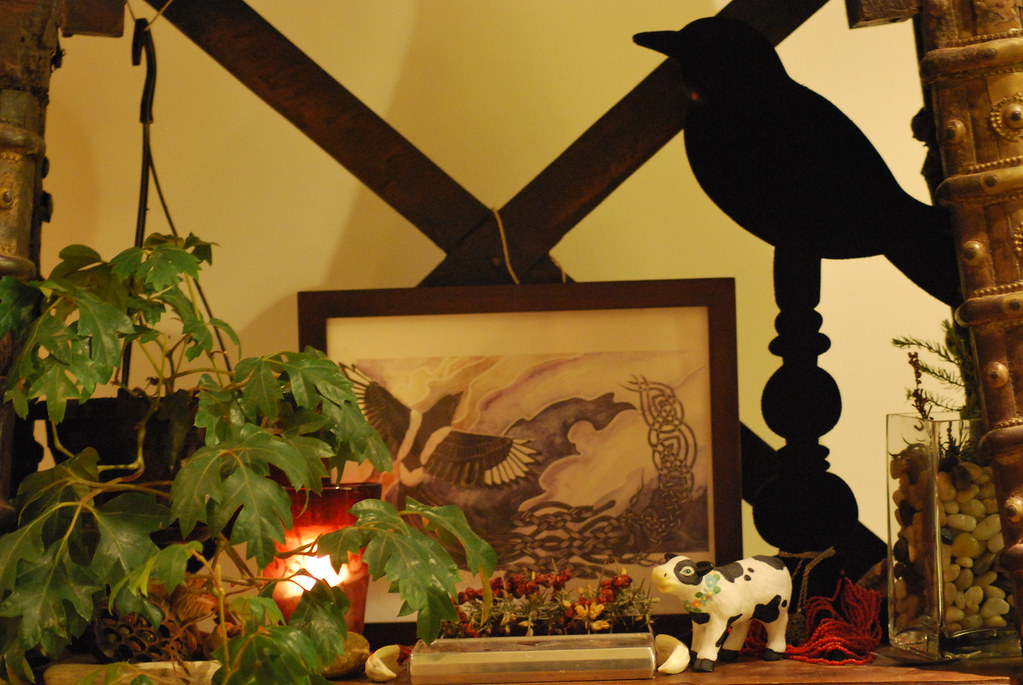
I've had the glass vase with polished pebbles in it for a while, not sure what to do with them, but once I'd put the crow up it seemed like the perfect place to put some offeratory herbs. All the bits and pieces are on there from the last time I posted, but I've added some amber beads around the votive glass and a red coral necklace (both traditionally having protective qualities) around the base of the crow with the prayer necklace given to me by someone very dear to me. The commemorative plaque that belonged to my granddad has the wild boar tusks from Graywolf either side, he'd appreciate that. The gorse and rowan berries are from Lùnasdal, and there's a space left for the applewood wand (I used it in my ritual for the evening, as I did last year). I also made a clay plaque, incised with a snake pattern and then painted, as a devotional offering (it's hiding behind the leaves, I think). I think I'll keep it there until I make another one for Bealltainn.
Rearranging it all took up a good chunk of my quiet time while Tom was at nursery and Rosie was napping on Wednesday, along with some sorting out some mundane things around the house. I went out to the garden to see what was left of my flower bed, too; Mungo's had pretty much everything I planted last year, so I'm going to have to replace it with nasty evil spikey things that will discourage his frolicking across it. He's ripped the top off of the rowan I planted last year but it still seems to be alive, it's got some buds starting to sprout on the trunk (but I think I'll have to thin them out a little). There were still some heathers holding on for dear life, the chamomile is thriving and some sage and hyssop were lurking quietly and trying not to be noticed. I was hoping the rosemary had survived, but no such luck, so I picked some of the white heather, hyssop and chamomile for offering to Badb and to inaugurate my newly organised shelf. I've done as much as I can do at the moment, but I think it needs some dangly possibly sparkly things. The magpie needs to feel at home, neh?
Picking Tom up from nursery, we took the dogs for a walk in the woods to see what we could see. There were still patches of snow and slush around, the gorse was in flower, a few of the trees were starting to bud, and the view was spectacular:

It never fails to grab me. When Bute and the mountains of Argyll are all hazy like that, it really is like you're looking into the Otherworld (or how I'd imagine it to be). Unfortunately, however, my sense of wonder and ponderings on such a magical view were broken by the sudden realisation that I'd left a candle burning on the shelf from when I'd made the offerings to Badb earlier. Mild panic ensued as I made a hasty retreat back home, convincing myself that the house was burning down. It wasn't, of course, and the candle had either burnt itself out or I'd remembered to blow it out after all.
Dinner followed, with roast lamb, potatoes roasted in a garlic butter, mash (mainly because some of the roasties disintegrated a little, I'd over par-boiled them), sprouts, carrots and cauliflower with a chestnut, orange and cranberry stuffing. I made enough for a plate for Bride as well, with some trepidation - does she like sprouts? It's a controversial choice of vegetable...
Once the kids were in bed, I made some more offerings to start things off, performed a saining with incense (the water I'd saved from last Bealltainn having been recently Rosie'd, but the incense seemed more appropriate for Bride anyway) and set about finishing off my dealbh Bride - I wasn't entirely happy with the result, because I was a little hampered by a lack of needle and thread and had to make do, but Rosie certainly seems to appreciate it; I nearly had to fight her for it after I stuffed it the day before. I laid it on a bed of straw and placed the apple wand with it, then went to the kitchen door and invited Bride to come in and took a while to meditate and contemplate. It's been a stressful start to the year with Tom starting nursery and not settling in too well to start with, along with several colds and a stomach bug (part of the reason why Tom freaked out, he started well but then he was sick at nursery and got scared because I wasn't there, with abandonment issues following. He's fine now, but it took a while), so with the weight of all the stress the saining and some time to really clear my head as well was welcome.
I did some divination with the ogam fews I made last year and seemed to get a good response from it. I pick three fews and read them as representing passing influences, present influences and future influences. I got hawthorn as the first pick which certainly seemed to make sense in terms of the general negativity the year seems to have started with, but the rest seemed fairly positive and seemed to indicate the saining had been effective and that my offerings so far had been accepted by Bride.
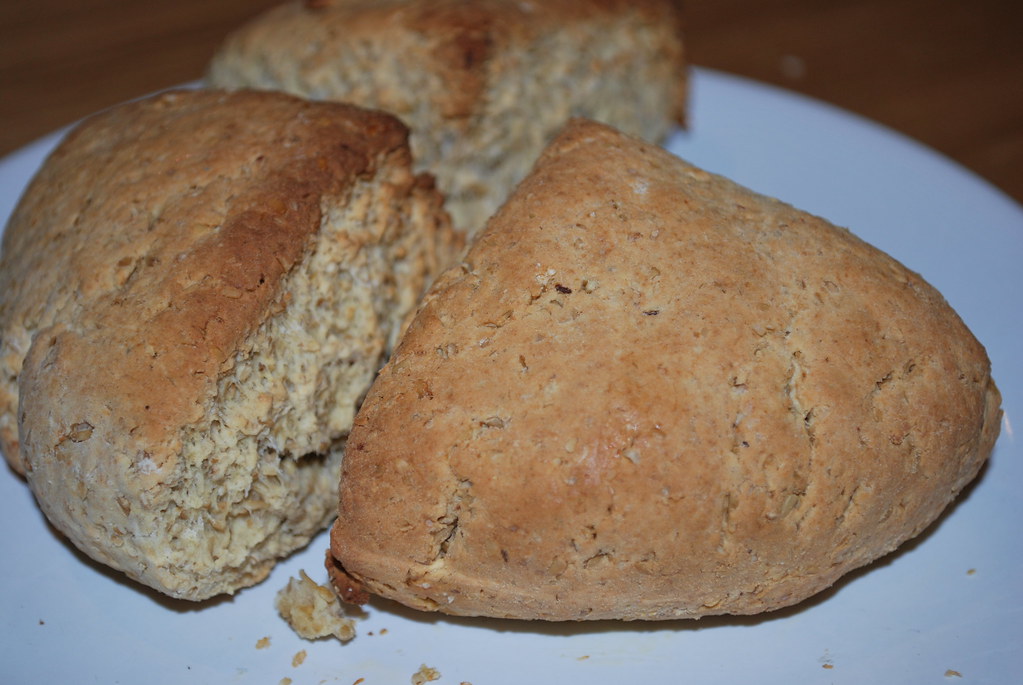 I was going to make the bannocks in the morning, but decided to make them that evening instead. This time I tried Fife bannocks, which are quite scone-ish in consistency. I was pleased with how they turned out, even if they did end up being a little overdone, and they didn't break, which was another good sign. I think I used a little bit too much milk, but they still cooked well and were easy to make.
A little relaxation followed, with a hot bannock, butter and jam, and I was off to bed, making sure the food for Bride was well out of the dogs' reach. I slept well and deeply, and I'm sure I had a very odd dream but can't remember it...As usual Tom and Rosie gave me the early morning wake up call and we had a cuddle in bed as I hoped to buy a few more minutes to ease myself into the day. The dogs seemed quiet, though, which was unusual because Mungo usually can't wait to be let out first thing, so I dragged myself out of bed and trudged downstairs to find the kitchen doors were wide open. I've no idea how that happened, unless Mungo's figured out how to unlatch two doors, and I took it as a pretty definitive sign that Bride had been...I'm guessing Mungo must've figured out some way of opening them, probably with the help on the kids fiddling with the latches with me knowing, but his timing was very apt. And I didn't give him too much of a stern look after I checked to make sure we hadn't been burgled.
Evidently Bride does like sprouts after all.
I've had the glass vase with polished pebbles in it for a while, not sure what to do with them, but once I'd put the crow up it seemed like the perfect place to put some offeratory herbs. All the bits and pieces are on there from the last time I posted, but I've added some amber beads around the votive glass and a red coral necklace (both traditionally having protective qualities) around the base of the crow with the prayer necklace given to me by someone very dear to me. The commemorative plaque that belonged to my granddad has the wild boar tusks from Graywolf either side, he'd appreciate that. The gorse and rowan berries are from Lùnasdal, and there's a space left for the applewood wand (I used it in my ritual for the evening, as I did last year). I also made a clay plaque, incised with a snake pattern and then painted, as a devotional offering (it's hiding behind the leaves, I think). I think I'll keep it there until I make another one for Bealltainn.
Rearranging it all took up a good chunk of my quiet time while Tom was at nursery and Rosie was napping on Wednesday, along with some sorting out some mundane things around the house. I went out to the garden to see what was left of my flower bed, too; Mungo's had pretty much everything I planted last year, so I'm going to have to replace it with nasty evil spikey things that will discourage his frolicking across it. He's ripped the top off of the rowan I planted last year but it still seems to be alive, it's got some buds starting to sprout on the trunk (but I think I'll have to thin them out a little). There were still some heathers holding on for dear life, the chamomile is thriving and some sage and hyssop were lurking quietly and trying not to be noticed. I was hoping the rosemary had survived, but no such luck, so I picked some of the white heather, hyssop and chamomile for offering to Badb and to inaugurate my newly organised shelf. I've done as much as I can do at the moment, but I think it needs some dangly possibly sparkly things. The magpie needs to feel at home, neh?
Picking Tom up from nursery, we took the dogs for a walk in the woods to see what we could see. There were still patches of snow and slush around, the gorse was in flower, a few of the trees were starting to bud, and the view was spectacular:
It never fails to grab me. When Bute and the mountains of Argyll are all hazy like that, it really is like you're looking into the Otherworld (or how I'd imagine it to be). Unfortunately, however, my sense of wonder and ponderings on such a magical view were broken by the sudden realisation that I'd left a candle burning on the shelf from when I'd made the offerings to Badb earlier. Mild panic ensued as I made a hasty retreat back home, convincing myself that the house was burning down. It wasn't, of course, and the candle had either burnt itself out or I'd remembered to blow it out after all.
Dinner followed, with roast lamb, potatoes roasted in a garlic butter, mash (mainly because some of the roasties disintegrated a little, I'd over par-boiled them), sprouts, carrots and cauliflower with a chestnut, orange and cranberry stuffing. I made enough for a plate for Bride as well, with some trepidation - does she like sprouts? It's a controversial choice of vegetable...
Once the kids were in bed, I made some more offerings to start things off, performed a saining with incense (the water I'd saved from last Bealltainn having been recently Rosie'd, but the incense seemed more appropriate for Bride anyway) and set about finishing off my dealbh Bride - I wasn't entirely happy with the result, because I was a little hampered by a lack of needle and thread and had to make do, but Rosie certainly seems to appreciate it; I nearly had to fight her for it after I stuffed it the day before. I laid it on a bed of straw and placed the apple wand with it, then went to the kitchen door and invited Bride to come in and took a while to meditate and contemplate. It's been a stressful start to the year with Tom starting nursery and not settling in too well to start with, along with several colds and a stomach bug (part of the reason why Tom freaked out, he started well but then he was sick at nursery and got scared because I wasn't there, with abandonment issues following. He's fine now, but it took a while), so with the weight of all the stress the saining and some time to really clear my head as well was welcome.
I did some divination with the ogam fews I made last year and seemed to get a good response from it. I pick three fews and read them as representing passing influences, present influences and future influences. I got hawthorn as the first pick which certainly seemed to make sense in terms of the general negativity the year seems to have started with, but the rest seemed fairly positive and seemed to indicate the saining had been effective and that my offerings so far had been accepted by Bride.
I was going to make the bannocks in the morning, but decided to make them that evening instead. This time I tried Fife bannocks, which are quite scone-ish in consistency. I was pleased with how they turned out, even if they did end up being a little overdone, and they didn't break, which was another good sign. I think I used a little bit too much milk, but they still cooked well and were easy to make.A little relaxation followed, with a hot bannock, butter and jam, and I was off to bed, making sure the food for Bride was well out of the dogs' reach. I slept well and deeply, and I'm sure I had a very odd dream but can't remember it...As usual Tom and Rosie gave me the early morning wake up call and we had a cuddle in bed as I hoped to buy a few more minutes to ease myself into the day. The dogs seemed quiet, though, which was unusual because Mungo usually can't wait to be let out first thing, so I dragged myself out of bed and trudged downstairs to find the kitchen doors were wide open. I've no idea how that happened, unless Mungo's figured out how to unlatch two doors, and I took it as a pretty definitive sign that Bride had been...I'm guessing Mungo must've figured out some way of opening them, probably with the help on the kids fiddling with the latches with me knowing, but his timing was very apt. And I didn't give him too much of a stern look after I checked to make sure we hadn't been burgled.
Evidently Bride does like sprouts after all.
Saturday, 10 January 2009
Archive: Seanchas Ìle - Donald Meek
Seanchas Ìle/Islay's Folklore Project
Foreword by Donald Meek
This book is part of a culture and heritage project run by the Columba Centre on the island, which started in 2005, and the majority of it is comprised of transcripts from Gaelic speaking islanders who talk about their experiences of growing up on the island, the tales they were brought up with, and a good portion of proverbs in the final chapter. Some of the transcripts of the tales and the interviews are available at the accompanying website, along with a few others that aren't in the book.
The book's aim is not just to present some of the lore that was collected, but to serve as a record of Islay Gaelic as well. Since I'm not a Gaelic speaker I can't fully appreciate the nuances in the colloquialisms peculiar to the island, but there's a glossary of some of the words in general that are used, as well as the names of particular birds and animals that are used on the island as well. It's refreshing to see a book on the subject giving such prominence to the language, with the Gaelic on the left-hand pages, and the English translation on the right-hand pages throughout, until the final chapter on proverbs and then the glossaries, where the Gaelic's given first and then the translation directly underneath or side-by-side.
In terms of the folklore, I was hoping for some good stuff on calendar customs in particular, but was a little disappointed on that front, aside from some interesting account of the Caileach Bhuain, the last sheaf of the harvest, and what they did with it (including a description of how it was made). More interesting, for me, was the chapter on Traditional Medicine and Food Ways. It wasn't as in-depth as I was hoping for - a criticism that could be aimed at the rest of the book, really - but it covered a lot of the basics like using dandelion milk to cure a wart, and how sphagnum moss was collected for the war effort, for use as a very porous sort of bandage. And cormorant, dulse, and limpet soup as tasty treats. You can download a few traditional recipes, if you want to have a go. So while it wasn't in depth, it gave a good general idea of how the islanders subsisted, before modern comforts changed a lot of that.
What really stood out was the personalities and humour of the people who were interviewed - most of whom seemed to be well into their eighties. One thing that made me laugh was:
There's no commentary, interpretation or in-depth analysis on the tales, anecdotes and interviews that are given, aside from a few notes explaining certain terms here and there, and a brief note on how the Gaelic has been transcribed at times to try and convey the slight differences in pronunciation for some words, so the transcripts are left to speak for themselves, a collection of firsthand accounts.
For the most part the bits where the interviewers have butted in during the course of the conversation have been left in, which sometimes helps give a sense of the rapport between interviewer and interviewee, and a sense of how the chat flowed, but other times it can be a little distracting as well. Overall, though, the sense it all gives is that it's the people that need to be remembered too, seeing as it's the people who make the island as much as the language and the culture. They speak with a warmth and a sadness of their childhoods, almost a frustration for all that's being lost as Gaelic diminishes and outsiders move in to live their dream of the Good Life - often at the expense of the islanders who can no longer afford to buy homes there. The tales and the fondness (or sometimes wryness) for the things that are talked about are quite evocative at times, and I found it hard not to empathise with their sense of plight. It's easy to get drawn in and start romantising the past.
There are some fantastic pictures throughout the book, and along with the rest of it, it makes a wonderful start at presenting what's been recorded - but really, that's what it is (as is made clear from the outset, to be fair) and that's what it feels like. It's a start. Hopefully at some point something more in-depth will be made available (or widely available, that is).
Short and sweet though it is, it comes with a reasonable price tag and a few gems that makes it a worthwhile read for anyone interested in this sort of thing. Maybe it's not essential reading, but I can't help but feel that this is the sort of thing I'd like to support, because funding is so hard to come by. It's all well and good looking at the Highlands and Islands as a whole, but it's books like this that help to serve as a reminder of the differences, as well as the similarities, that can be found across such varying geography, and it would be nice to see more being done, and more of the work that's already been done become available to a wider audience.
Foreword by Donald Meek
This book is part of a culture and heritage project run by the Columba Centre on the island, which started in 2005, and the majority of it is comprised of transcripts from Gaelic speaking islanders who talk about their experiences of growing up on the island, the tales they were brought up with, and a good portion of proverbs in the final chapter. Some of the transcripts of the tales and the interviews are available at the accompanying website, along with a few others that aren't in the book.
The book's aim is not just to present some of the lore that was collected, but to serve as a record of Islay Gaelic as well. Since I'm not a Gaelic speaker I can't fully appreciate the nuances in the colloquialisms peculiar to the island, but there's a glossary of some of the words in general that are used, as well as the names of particular birds and animals that are used on the island as well. It's refreshing to see a book on the subject giving such prominence to the language, with the Gaelic on the left-hand pages, and the English translation on the right-hand pages throughout, until the final chapter on proverbs and then the glossaries, where the Gaelic's given first and then the translation directly underneath or side-by-side.
In terms of the folklore, I was hoping for some good stuff on calendar customs in particular, but was a little disappointed on that front, aside from some interesting account of the Caileach Bhuain, the last sheaf of the harvest, and what they did with it (including a description of how it was made). More interesting, for me, was the chapter on Traditional Medicine and Food Ways. It wasn't as in-depth as I was hoping for - a criticism that could be aimed at the rest of the book, really - but it covered a lot of the basics like using dandelion milk to cure a wart, and how sphagnum moss was collected for the war effort, for use as a very porous sort of bandage. And cormorant, dulse, and limpet soup as tasty treats. You can download a few traditional recipes, if you want to have a go. So while it wasn't in depth, it gave a good general idea of how the islanders subsisted, before modern comforts changed a lot of that.
What really stood out was the personalities and humour of the people who were interviewed - most of whom seemed to be well into their eighties. One thing that made me laugh was:
"A crofter without much English is trying to explain to the Lowland vet what happened to his cow. In Gaelic he wanted to say:
'Chaidh i faotainn ann an sùil-chrith agus cha do chnàmh i a cìr fad trì làithean às a dhèidh' [She was in a deep bog and she never chewed the cud for three days]
The crofter translated the Gaelic literally which in English came out as:
'She was in the eye of the earth and she never boned her comb for three whole days.' "
There's no commentary, interpretation or in-depth analysis on the tales, anecdotes and interviews that are given, aside from a few notes explaining certain terms here and there, and a brief note on how the Gaelic has been transcribed at times to try and convey the slight differences in pronunciation for some words, so the transcripts are left to speak for themselves, a collection of firsthand accounts.
For the most part the bits where the interviewers have butted in during the course of the conversation have been left in, which sometimes helps give a sense of the rapport between interviewer and interviewee, and a sense of how the chat flowed, but other times it can be a little distracting as well. Overall, though, the sense it all gives is that it's the people that need to be remembered too, seeing as it's the people who make the island as much as the language and the culture. They speak with a warmth and a sadness of their childhoods, almost a frustration for all that's being lost as Gaelic diminishes and outsiders move in to live their dream of the Good Life - often at the expense of the islanders who can no longer afford to buy homes there. The tales and the fondness (or sometimes wryness) for the things that are talked about are quite evocative at times, and I found it hard not to empathise with their sense of plight. It's easy to get drawn in and start romantising the past.
There are some fantastic pictures throughout the book, and along with the rest of it, it makes a wonderful start at presenting what's been recorded - but really, that's what it is (as is made clear from the outset, to be fair) and that's what it feels like. It's a start. Hopefully at some point something more in-depth will be made available (or widely available, that is).
Short and sweet though it is, it comes with a reasonable price tag and a few gems that makes it a worthwhile read for anyone interested in this sort of thing. Maybe it's not essential reading, but I can't help but feel that this is the sort of thing I'd like to support, because funding is so hard to come by. It's all well and good looking at the Highlands and Islands as a whole, but it's books like this that help to serve as a reminder of the differences, as well as the similarities, that can be found across such varying geography, and it would be nice to see more being done, and more of the work that's already been done become available to a wider audience.
Saturday, 29 November 2008
Archive: Dunadd: An Early Dalriadic Capital - Alan Lane and Ewan Campbell
Dunadd: An Early Dalriadic Capital
Alan Lane and Ewan Campbell
I think it's fairly safe to say that this book is everything you ever wanted to know about Dunadd, with knobs on.
Given the detail involved - up to and including lists and catalogues of the finds and detailed analysis of soil reports and so on - it's probably safe to say that it's not going to be essential reading for most people interested in CR or Scottish history or archaeology, but it is likely to be one of those books that will be referenced in years to come if you happen to read more accessible ones.
The main remit of the book is to bring together the findings of the series of digs that were carried out there in the early 80's, which were aimed at finding evidence to date the site and give it a detailed chronology. The dig was successful in this, showing some occupation in the Iron Age, but mostly finding activity coming from the early medieval period, confirming that it was in use during the heyday of the Dál Riata.
That in itself doesn't make it of much interest from anything but an archaeology geeks perspective, really, but I bought it mainly because there's some good stuff on the idea of Dunadd being an inaugural site for the Dalriadic kings, both in terms of the history of people claiming that it was an inaugural site (it's a fairly recent idea), and in looking at whether there's any evidence to support such an idea (in short, yup). Like so many authors, they seem to shy away from going into the pre-Christian stuff in too much detail, but there are still some interesting points to ponder - the position of Dunadd in relation to the land, and the concentration of pre-historic monuments in the area seems to be a conscious connection with the past, legitimating the king's authority by his links with land and the evidence of the people before him.
There's also some good stuff on the history of Dunadd and Dál Riata in general, and the discussion at the end of the book brings it all together nicely. All this goes into a bit more detail than Saints and Sea-kings, and discusses points like the apparent contradiction between the history and the archaeology in more detail (the history says the Irish came to Scotland whereas the archaeology suggests the migration was the other way round); and concludes that the popular idea of the Irish taking over the area en masse, as we're told in historical records, isn't so clear cut, and that the Dariadic kings and the introduction of Gaelic to the area was probably a much slower process that happened through close trading links and cultural closeness between the two areas, rather than a political takeover at one point in time.
The main reason I bought it, though, is an article on interpreting the ogam inscription found near the summit of the site, by Katherine Forsyth, who argues that it's not Pictish gibberish as previously, but is indeed Gaelic. She discusses other studies of the ogam that have been carried out, and gives a tentative partial translation of the inscription as Finn manach, 'Finn the monk', or Fir(r) Manach, 'the men of Manaig' (with Forsyth favouring the former, rather than the latter translation). It's tempting to assume that this is referring to a monk involved in the inauguration of a king, but who can say for sure?
The book comes with a hefty price tag, so this was a luxury buy for me. I enjoyed it, and it's well written and well-referenced, but I wouldn't say it's essential reading and it's probably the sort of book to get out from the library to pick at the chapters that are of most interest, if you really want to, rather than to invest in.
Alan Lane and Ewan Campbell
I think it's fairly safe to say that this book is everything you ever wanted to know about Dunadd, with knobs on.
Given the detail involved - up to and including lists and catalogues of the finds and detailed analysis of soil reports and so on - it's probably safe to say that it's not going to be essential reading for most people interested in CR or Scottish history or archaeology, but it is likely to be one of those books that will be referenced in years to come if you happen to read more accessible ones.
The main remit of the book is to bring together the findings of the series of digs that were carried out there in the early 80's, which were aimed at finding evidence to date the site and give it a detailed chronology. The dig was successful in this, showing some occupation in the Iron Age, but mostly finding activity coming from the early medieval period, confirming that it was in use during the heyday of the Dál Riata.
That in itself doesn't make it of much interest from anything but an archaeology geeks perspective, really, but I bought it mainly because there's some good stuff on the idea of Dunadd being an inaugural site for the Dalriadic kings, both in terms of the history of people claiming that it was an inaugural site (it's a fairly recent idea), and in looking at whether there's any evidence to support such an idea (in short, yup). Like so many authors, they seem to shy away from going into the pre-Christian stuff in too much detail, but there are still some interesting points to ponder - the position of Dunadd in relation to the land, and the concentration of pre-historic monuments in the area seems to be a conscious connection with the past, legitimating the king's authority by his links with land and the evidence of the people before him.
There's also some good stuff on the history of Dunadd and Dál Riata in general, and the discussion at the end of the book brings it all together nicely. All this goes into a bit more detail than Saints and Sea-kings, and discusses points like the apparent contradiction between the history and the archaeology in more detail (the history says the Irish came to Scotland whereas the archaeology suggests the migration was the other way round); and concludes that the popular idea of the Irish taking over the area en masse, as we're told in historical records, isn't so clear cut, and that the Dariadic kings and the introduction of Gaelic to the area was probably a much slower process that happened through close trading links and cultural closeness between the two areas, rather than a political takeover at one point in time.
The main reason I bought it, though, is an article on interpreting the ogam inscription found near the summit of the site, by Katherine Forsyth, who argues that it's not Pictish gibberish as previously, but is indeed Gaelic. She discusses other studies of the ogam that have been carried out, and gives a tentative partial translation of the inscription as Finn manach, 'Finn the monk', or Fir(r) Manach, 'the men of Manaig' (with Forsyth favouring the former, rather than the latter translation). It's tempting to assume that this is referring to a monk involved in the inauguration of a king, but who can say for sure?
The book comes with a hefty price tag, so this was a luxury buy for me. I enjoyed it, and it's well written and well-referenced, but I wouldn't say it's essential reading and it's probably the sort of book to get out from the library to pick at the chapters that are of most interest, if you really want to, rather than to invest in.
Subscribe to:
Posts (Atom)