Thursday, 31 July 2008

Archive: Lùnasdal 2008

I've been meaning to do this post for a while now, but my brain's been refusing to get into gear lately...But since Mr Seren's taken Tom off my hands and Rosie (and Mungo) are asleep and I have a quiet moment, it's a good time to get some thoughts in order about Lùnasdal (Lammas, Lughnasadh, call it what you will)...As ever, if you're not all that interested in my spiritual practises, there's no need to read on. You won't be missing anything...

The weather's been very wet recently, and while it's been quite warm I've been working on the assumption that the crops and autmnal fruits will be taking a while yet to ripen, so I've decided to hold off on celebrations for a few weeks. The rowans are all pretty much ripe now but the blackberries have yet to even stop flowering, although I've seen some with berries that look like they're thinking about starting to ripen. Even the raspberries are still in season (I spotted some growing wild a week or so ago) and they're usually well on their way to getting past their best by now. Summer's definitely coming to an end, though, the thistles (and I'm not sure which type these are, if they are indeed thistles, but they're everywhere at the moment) are out in force:
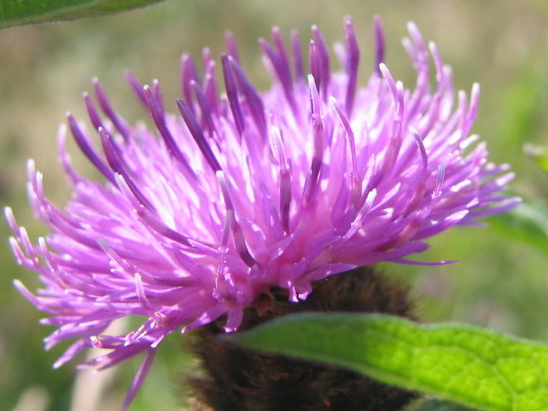
Thistle


Last year I made a real effort to get into the festive spirit because of all the festivals, Lùnasdal is generally the one I feel the least connection with. I kept things low key and not too ambitious, contemplative and meditative and found that was a good approach. I was living in Bo'ness then, overlooking the Forth, so I made my bannocks (or pancakes that time, as it turned out, to share with everyone else), sained (cleansed/warded) the house, made the usual evening feast, and took myself off for an evening walk with Eddie to make offerings of blackberries to Lugh and Tailtiu at the vantage point I used to visit for my daily meditations. I felt a strong connection then and my offerings seemed to be well received. More offerings, made in general this time, followed in the evening before I went to bed and I remember feeling Badb's presence quite strongly as I sat outside in the garden and meditated some more. The next day I took the kids off on a woodland walk and we saw the first crops being harvested as we went (which was pure synchronicity rather than purposeful timing of my celebrations).

This year I'm planning on keeping to the same general outline - making the festival bannocks, saining the house, putting up some rowan and making a good feast for everyone. Last year I didn't really put much emphasis on the first fruits aspect of the festival, so this year I was hoping to find some bilberries growing wild so I could take the kids out to pick them, but I've yet to find any. I've not really seen it mentioned as a Scottish custom specific to this time of year/festival but I do know that bilberry-picking is a popular pastime when they're in season, so it seems appropriate. I might see if the raspberries are still out and pick some for the cream crowdie I'll make for pudding, instead - the bushes are on the way to the beach so I can pick them as I make my way to make some offerings.

Seeing as the rowans are heavy with lots of berries this year I've been thinking about collecting some so I can dry them and make a necklace out of them. McNeill mentions that they were worn by 'common' women for protection as an alternative to red coral or amber necklaces that upper class ladies often wore for the same purpose. I have some amber beads as well, so I might experiment with them both and see how it turns out. If anything, I'm hoping it will make a nice adornment to my little sacred space in the kitchen, and be a good focus for concentrating and meditating on the meaning of the day and so on.

The sweeter bannocks I made at Bealltainn worked well so I think I'll do them again, and dinner will probably be the usual roast lamb or pork or whatever. I decided against planting any fruit or veg in the garden this year, not wanting to be too overambitious, so I don't really have anything to harvest from the garden in that sense. I did put some herbs in, so I might use some rosemary for the roast or something, in the spirit of harvesting some sort of 'crop' for my celebrations, and I'll probably bring some flowers in to decorate the house as well. I've been busy weeding and tending to the flowerbeds in anticipation of the day (I like to get the house in order for my celebrations, so it's nice and welcoming for my special 'guests', so to speak) and I've been pleased and surprised to see how much of what I've planted seems to have flourished. The rowan I planted seems to have settled in well - not much growth, but what growth there has been seems to be very healthy so far.

I'm sure there'll be more I'll think of to be doing, but that's all that springs to mind...

Tuesday, 8 July 2008

Archive: Early Irish Farming - Fergus Kelly

Early Irish Farming
Fergus Kelly

Cor blimey, this took a while to get hold of. After several attempts at ordering it from various places, I finally received an actual copy of it and I was going to be seriously annoyed if it turned out to be a steaming pile a horse manure. Thankfully, it didn't disappoint.

This one arrived on my doorstep with a very firm and formidable thud: packing in just over 750 pages, its size alone shows that its a meaty volume (tastes a bit like pork....). Don't worry, though. Around 150 pages are the indexes, glossaries, bibliography and selected translations of passages referred to in the text...So yes. I wouldn't say this is particularly light reading. It's thoroughly academic reading. It's an oddly fascinating read, though - by which I mean the title doesn't inspire much in the way of 'I simply must read this!' and yet, for the most part, I found it fairly easy to get through. The book's well laid out and the subjects are dealt with in a fairly logical order and unlike many of the more modern academic books I've read recently there's very little repetition throughout, which I was grateful for.

Kelly starts off with a good introduction and then goes on to cover what we know of early Irish farming, primarily through the law-texts of the seventh or eighth centuries with a healthy smattering of archaeological evidence thrown in to support the literature. First of all he looks at livestock - the types of animals that were typically kept on the farm, how they were managed and looked after throughout the year and the economic value they would have had. Offences that might be committed against livestock are then looked at, followed by the types of diseases. Kelly's attention then turns to crops, hunting, diet and then matters affecting the farm, labour and tools.

In terms of CR it might not seem to be such a great book to read - it's not about myths or festivals, say - but it does give a good insight into the more mundane, everyday aspects of life that can help to flesh out your practices and understanding of early medieval society. It's a good source to get an idea of why certain animals - cows and pigs in particular - were so important for one, but it also gives an idea of the sorts of things they did with the animals and the types of food they made which might make good dishes for festival occasions (Kelly notes that pork in particular was a popular meat to serve at these times, for example) if you want something more traditional. There's also a good summary of the types of plants and herbs they cultivated for brewing, dyeing and (to a lesser extent) for medicine, though I'm sure there are better sources to look at for this, and throughout there are some interesting tidbits thrown in where Kelly mentions things like the veneration of certain trees (the bile), evidence of pre-Christian thought or practice in terms of food taboos and the tarb-feis (the bull feast rite performed to determine the next king), and so on.

Kelly writes in an engaging manner* (as he does in Early Irish Law, which makes a good companion to this book) - and even when I got to the chapters on subjects that really weren't all that interesting - my life doesn't exactly feel enriched now I know about the finer details of the different types rods and goads that were used on the farm, or the penalties for all the different types of offences that might be committed against livestock and so forth, it has to be said - the lurches into dullness were forgivable. Unlike some authors who write about such specialised areas of interest, he doesn't fall into the trap of using teh big wurdz and dazzle the reader with a ton of jargon so the information he presents is much easier to absorb. I can appreciate that his frequent use of Irish or Latin words might be off-putting or distracting to some people who don't necessarily have a good grounding in early Irish legal terminology, though, even though he always gives a translation.

As an academic tome, there's not much to find fault with it. While parts may be dated now (having been originally published over a decade ago), generally these are things that are going to be of little relevance to anyone approaching it from a CR perspective, unless they're really keen on the intricacies of early Irish farming practice and so forth, and the book is invaluable for its presentation and in-depth referencing of primary source material (if not in-depth analysis, at times)...

The translations given in the appendices include the original Old or Middle Irish and extensive commentary on how he came to translate something in a particular way, or what a particularly obscure turn of phrase might mean and so on. Kelly also gives extremely thorough references and commentary on many of the interpretations he comes to throughout the book, even offering counter-arguments to point out a possibly different perspective, and the bibliography alone is invaluable if you want ideas for further reading.

Given the broad scope of the book, some parts felt a little less indepth than I would have liked them to be, but this is understandable - I would have liked some more stuff on food taboos, for example, but Kelly tends to present most things in a fairly neutral manner, providing a springboard for further study into various topics rather than getting down to the nitty gritty let's-look-at-it-from-all-angles.

I would say this is probably more on the advanced side of intermediate in terms of relevance and interest, providing some good fodder for more in-depth research, although the indexing and the straight-forward style of writing and presentation makes it perfect for just dipping into as a quick reference if you're not the sort to sit down and chew on it at great length. I do think it's worth it, though, especially with Kelly's Early Irish Law. Though take that with as much salt as you like - if you're like me and are tickled by discovering little things like battle-cries of "Fennockabo!" (anglicised form of feannóg abú! - "Hurra for the hooded crow!", apparently), then you'll probably agree. Otherwise, perhaps pick something else up instead.


* With the usual qualifier of "For an academic book, that is..."

Archive: Irish Folk Ways - E Estyn Evans

Irish Folk Ways
E Estyn Evans

If you ever have a desperate, burning need to know about the finer details of the sorts of pots, pans, tools and equipment the Irish used in that strange, unspecified time known as ‘the bygone era’, then this is the book for you.

Irish Folk Ways is not an easy book to sit down and get stuck into, because the detail on any subject Evans turns his attention to often tends to border on the anally retentive, mind-numbingly boring and Just. Plain. Dull. And this is me saying this, so I assure you – there's attention to detail, and there's this.

That’s not to say it’s a bad book. It’s very very good, in fact. In amongst all the detailsdetailsdetails are some hidden gems that you won’t find anywhere else, and I've found it particularly useful in finding more bits and pieces to flesh out my understanding of festival practices and lore, amongst other things.

Evans concentrates on all the different aspects of everyday life in Ireland, and for anyone who wants to go beyond the basics, I think this is a good place to look. An excellent place to look, even. I’d hesitate to recommend it as the very first book to read for anyone interested in starting out as a recon because I think the reader would end up either bored to tears and running away from reconstructionism for ever, or would think “where the hell's the good stuff?” (assuming the beginner wants to know the important stuff, like festivals, practices and so on). Evans does cover all this - and there's a lot of it - but you have to work for it. On the plus side, there's a very good index in the back so it's easy enough to pick all the good bits out, but for a beginner, something like Kevin Danaher's The Year in Ireland would be a much better place to start, providing some 'instant gratification' (as the enthusiastic gardening correspondent at the newspaper I used to work for would say...).

This book requires a certain amount of dedication, unless you happen to be the kind of person that lives for this sort of thing. If minutiae is your bag, then buy the book now. Otherwise, gird your loins and prepare yourself. I would say that this is on my 'should be read' list for anyone interested in Irish practices (and it's handy for a Scottish Reconstructionist like me, too, for comparison), but I've given fair warning...You're not likely to find it a thrilling read. You'll probably find you'll put it to good use as a reference book, though.

In short, this is probably the most anally retentive book EVAR. But I mean that in a good way.

Saturday, 28 June 2008

Archive: Folklore of Scottish Lochs and Springs - James M MacInlay

Folklore of Scottish Lochs and Springs
James M MacInlay

I'd had my eye on this one for a while, and seeing as it isn't available from the library, I eventually managed to convince myself that that was justification enough to buy it. Because, y'know...I might be missing out on something...It wasn't too expensive, either, so if it ended up being a pile of crap then I wouldn't have wasted too much money. (But of course, now you can just read it online...).

Thankfully, it didn't disappoint. Too much. The copy I got was a facsimile reprint of the original version from 1893 and considering its age, it's no surprise that it has all the usual problems of a book from this time period - the often somewhat self-conscious comments about how it's all a pile of silly superstition anyway, to point out that the author in no way believes in this sort of thing; the noble savage/primitives view of the Celts when referring to pre-Christian beliefs; an occasional smattering of Aryan ideology creeping in and frequent comparison with Egyptian, Syrian and Persian cultures, and so on. Unlike some books of this time, none of these elements are emphasised too heavily and MacInlay tends to use them to support his arguments of the Scottish evidence he presents, rather than the other way round.

I was hoping to find some good information about folklore and practices at wells in particular, especially the types of offerings that were left, and their associations with trees as well. I know. The things my brain ponders are just fascinating...But there are lengthy chapters on both of these, as well as chapters on charm-stones, water spirits, healing and their association with saints. Some chapters were more interesting and more relevant to my interests than others, and one minor annoyance I found as I got stuck into it was that times, much of the evidence provided wasn't about Scotland at all and came from England, Ireland or Wales, and refreshingly, occasionally, the Isle of Man, too. On the one hand this was interesting and helped to provide a wider context for the evidence of practices from Scotland, but on the other hand sometimes it was apparent that such evidence was being given because MacInlay didn't have anything to say about Scottish practices on the subject. One of the worst chapters for this was the chapter on Weather and Wells, which aside from the practice of sailors 'buying' a favourable wind was almost completely focused on lore from England. It was interesting to read, but not exactly relevant to the title of the book and I couldn't help but feel that it was being used to pad out the chapter, rather than inform.

In spite of this, there were some genuinely interesting bits and pieces to be found in the book, and MacInlay gave a lot of information about wells from urban centres as well as the more rural ones that modern books on folklore tend to focus on, as well as more general lore on lochs and other bodies of water. MacInlay also offers references to much older historical sources, as far back as the fourteenth century, which is invaluable considering the more modern books on subjects like this tend to refer to books like MacInlays, rather than the older sources, so he offers something different from a variety of angles.

I was particularly intrigued by the mention of a well in the city centre of Glasgow, where it's recorded that up until around the end of the eighteenth century it was common for small offerings made of tin-iron, shaped to look like various limbs or parts of the body, to be nailed to the tree that overshadowed the well (dedicated to St Thenew), presumably in thanks for its curative powers relating to those parts of the body. It struck me as being very reminiscent of the finds from the Gaulish shrine to Sequana. The chapter on charm-stones also offered some good stuff on serpent stones (which he describes as being usually made of brightly-coloured glass) and their use in curing cattle of disease and so forth, and he also offered a few bits on festival practices that I hadn't seen before (especially the practice of building gigantic towers at Lammas).

No references are given in the book, except when direct quotes are given (which isn't unusual for books this old), so sometimes there were certain things that MacInlay wrote that would have been good to follow up (like the description of the Lammas towers, for one). Unusually, however, he does provide a fairly comprehensive bibliography of the works he's referred to in the course of writing the book, which is invaluable, and he also offers some personal observations from his own fieldwork.

This is a very comprehensive work on the subject, and in spite of its problems it's certainly one I'm glad to have bought for future reference. Given its fairly narrow scope it's probably of most interest for someone who's got a good grasp of the basics and wants to get stuck into more of the specifics of certain areas of lore.

Monday, 23 June 2008

Archive: Iron Age Britain - Barry Cunliffe

Iron Age Britain
Barry Cunliffe

Always looking for some good books on the archaeology of Britain, and always hoping that at some point somebody will write one of these books that gives equal weighting to all parts of Britain rather than concentrating on southern England, I took a punt on this one and decided to give it a go.

I really should have been patient and got it out from the library...It's not bad, or awful. It's just not all that great either, and my credit card could have been happily sponked on something far better. As I said, it's not too bad - not to the point of being only good for kindling - but I do think it's bordering on cluttering up my crowded bookshelf, rather than gracing it.

Cunliffe does offer something different here, compared to other books on the subject, and to a certain extent this is useful. He starts off well, giving a good overview of the state of Late Bronze Age/Early Iron Britain and points out that while the start of the Iron Age generally heralds the start of the Celtic period proper, there are a number of social factors and changes that can be seen in the archaeological record that started in the Late Bronze Age that also had their hand in shaping what we see of the Iron Age and the start of the Celtic period (such as the change in settlements and farming, etc), making the boundaries between Celtic and pre-Celtic much more fluid than they might sound.

After introducing a little background, Cunliffe goes on to look at the people, how they lived, how they farmed and the politic and social evidence that can be interpreted from the archaeology of the period...This is all good stuff. He even takes care to emphasise the regional differences that can be seen, stressing local factors that seem to have shaped the way people lived and evolved in the various parts of Britain, and takes a look at each area separately. This is also good stuff, and quite a refreshing approach, but this is also where the book starts to fall down.

It's partly not Cunliffe's fault; there isn't a good amount of evidence to draw from to treat all areas with equal detail, so like other authors (Miranda Green, Simon James, say), there's an inevitable bias towards the south and places like Danebury that have been more fully excavated (by Cunliffe himself, as it happens).

The main problem comes after the first few chapters that deal exclusively with the archaeology, when Cunliffe tries to give context to it with heavy use of Classical sources - in most cases drawing from the usual suspects like Caesar, Tacitus, Diodorus Siculus and so on - without much analysis or even consideration of the inherent problems in using them. Did they have an agenda in what they wrote? Were they writing from direct observation or conforming to established 'facts' and stereotypes that previous authors had popularised (as was common)? And so on...He uses a healthy smattering of Gaulish references from the Classical sources to help provide context for the British evidence, but without any useful discussion or background surrounding the sources he uses, it all ends up being not too helpful, and it raised more concerns for me than it helped to provide a fuller picture as was obviously intended.

My biggest bugbear with the book is his treatment of religion and beliefs, though. Taking a passage from Caesar, where he says that above all gods they worship Mercury, Cunliffe goes on to point out that Mercury was considered to be 'inventor of all arts' and points out that the Dagda fulfilled a similar role in Irish myth, and then goes on to talk about the Irish gods as if they were British as well. It seems to me that it would have been better to take a look at the post-Roman evidence that shows the variety of localised, along with the more widespread deities that could be found across Britain instead, rather than being fairly dismissive and conflationist.

His analysis of burial practice is better, though he largely goes into any great detail in terms of burials providing evidence for warriors in society, rather than focusing on what the practices implies about ritual and beliefs. But his treatment of evidence for the ritual year is woeful. Here he applies the typical Samhain/Imbolc/Beltane/Lughnasadh divisions and cites evidence of Imbolc and Lughnasadh being celebrated in Gaul as well, from the Coligny calendar, but offers no consideration of any possible evidence to support such a division in Britain itself in this period and so gives the idea that these are well established facts. There isn't much in the way of conclusive contemporary evidence for the ritual calendar in Britain, but some mention of the analysis of bones supporting the idea of spring/autumn feasting (based on the age of the animals slaughtered) would have been a good idea, I think.

All these problems can be found in Cunliffe's The Ancient Celts, but this book has by far more redeeming qualities that can forgive such poor scholarship. Cunliffe is an archaeologist, not a Celticist, so like Miranda Green his writing suffers when he focuses on subjects outside of this. The Ancient Celts offers a better understanding of how archaeologists interpret the material they find, and gives a good grounding in understanding how the antiquarian/academic study of the Celts has evolved over time...Iron Age Britain doesn't offer this and focuses more on giving the facts rather than interpretation. It's unfortunate that Cunliffe doesn't offer any references or even a bibliography in the book, so it's difficult to look up whether things like the mention of the Coligny calendar are sound (and why no mention of 'the three nights of Samonios' (and whether that might be linked to Beltane/Samhain) that can also be found on it?), though to be fair this might be more to do with the publisher than Cunliffe himself.

Ultimately...you could do a lot worse, but if you have some hard earned cash to spend on something genuinely helpful in terms of CR, then I'd prioritise your spending elsewhere.