Scottish Witchcraft Lore
Alexander Polson
I was actually looking for Thomas Davidson's Rowan Tree and Red Thread when I was at the library, but it's another one of those books that's gone missing. This one was lurking in the sad and forlorn space where Davidson's book should have been, and after a quick flick and noticing a chapter on charms and countercharms, I decided it was worth a more in-depth look.
It seems I have something of a taste for these old books, because like Napier's book, I actually quite enjoyed this one. It didn't start off too well, with an overview of witchcraft and its history that put it firmly in the Deal with the Devil camp, but then Polson managed to rationlise the complete mismatch of the reports from the witch trials with the example of more modern practices, by simply saying something along the lines of, "They don't do all the dancing on the heath and pacts with the devil anymore, and these days they're not all old and ugly. Some of them still believe they're calling on the devil for their power, but that's just superstition and delusion..." This in itself was quite impressive fuzzy logic at work!
Once he gets into the meat of the book and gets into his stride, it gets much more interesting. He relates an interview he did with a modern witch, and asks her how she got her reputation and the sorts of charms she did. He takes a brief look at how witches in general tend to get their reputations, which is something that intrigued me because in books this old it's not something that is often analysed - usually the belief in witchcraft is dismissed as silly superstition and nothing more is said. Here, Polson gives examples and stories to illustrate his point, but like most of the book there are no references given at all, and this gets frustrating at times (a limited bibliography is given at the end, with all the usual suspects along with some one I hadn't heard of).
Then he goes on to look at some of the more famous witch trials (that generally seemed to involve actual wise women and men, rather than those who were accused out of a personal grudge with little basis in fact), and looks at the types of charms and countercharms that were performed often on a daily basis by people and the wise men and women they went to when all else failed, along with ways of averting or curing the evil eye, and then all the sorts of tricks that witches were supposed to be able to get up to like levitation and making themselves invisible. One thing that was revealing in all this is that no real distinction is made between the everyday practices of the people and wise men and and women that helped protect and prevent against those who performed the 'dark arts'. Occasionally the distinction between 'white' and 'black' magic is made, but implicit in all this is Polson's unstated view that really it's all essentially the same.
A few things that caught my eye were descriptions of the countercharms that were used, which essentially seemed to be the same as the sop seile ('spittle-wisp') but minus the straw, that Campbell describes in The Gaelic Otherworld as being performed around the home or on new cattle, particularly at Bealltuinn and Lunasdal. There was also a tale explaining why juniper was no longer used to help break a case of the evil eye over someone - a girl began ailing and wasting away for no apparent reason, and after doctors could do nothing for her it was decided that the only cause could be a case of evil eye. To remove it, certain customs were observed, and branches of juniper were collected, fresh and green. The house was sealed up as well as possible, and certain incantations were said as the juniper was put to the fire and caused great amounts of smoke to fill the house. In spite of the girl's increasingly laboured breathing, more and more was put on the fire until the girl couldn't breathe at all, and died. Distraught, the father went made and burned the house down with everything in it. Such a cautionary tale meant that the practice gradually died out (even though it's very reminiscent of McNeill's detailing of the water and juniper rite performed at Hogmanay).
It's things like this that I find most useful, and Polson takes care to personalise his examples by illustrating them with tales rather than run through a fairly dry list of 'they did this, this or this to make their cows give milk again..." Better still, it's not just a rehashing of things you'll find elsewhere so for me (from my somewhat admittedly still limited exploration of the subject), it added something new. Sadly, at over £80, it won't be joining my bookshelf on a more permanent basis just yet.
Saturday, 17 May 2008


Friday, 16 May 2008
Archive: Ogam
After several attempts I've finally finished a few sets of ogam staves, and seeing as I'm sure you're all really interested in seeing my efforts, I thought I'd share....
The first set I tried to do sometime last year went missing during the move, Mr Seren probably thinking it was an 'art' project that Tom had been doing. Once we moved I began to think about making another set, and seeing as there was plenty of driftwood to choose from at the beach, I toyed with the idea of collecting some to use for the staves.
I decided to wait for a while and try establishing a relationship with the place first, it didn't feel right just taking the wood, so every time we've gone to the beach I've been leaving offerings and libations and doing a bit of meditation (in between running after Tom to save him from launching himself into the waves). The beach is in a very exposed position and takes the full brunt of winds and storms that come our way, so it had a very desolate, stark feel to it, but now I seem to have worked up some sort of contact with the place it's starting to feel a little more welcoming.
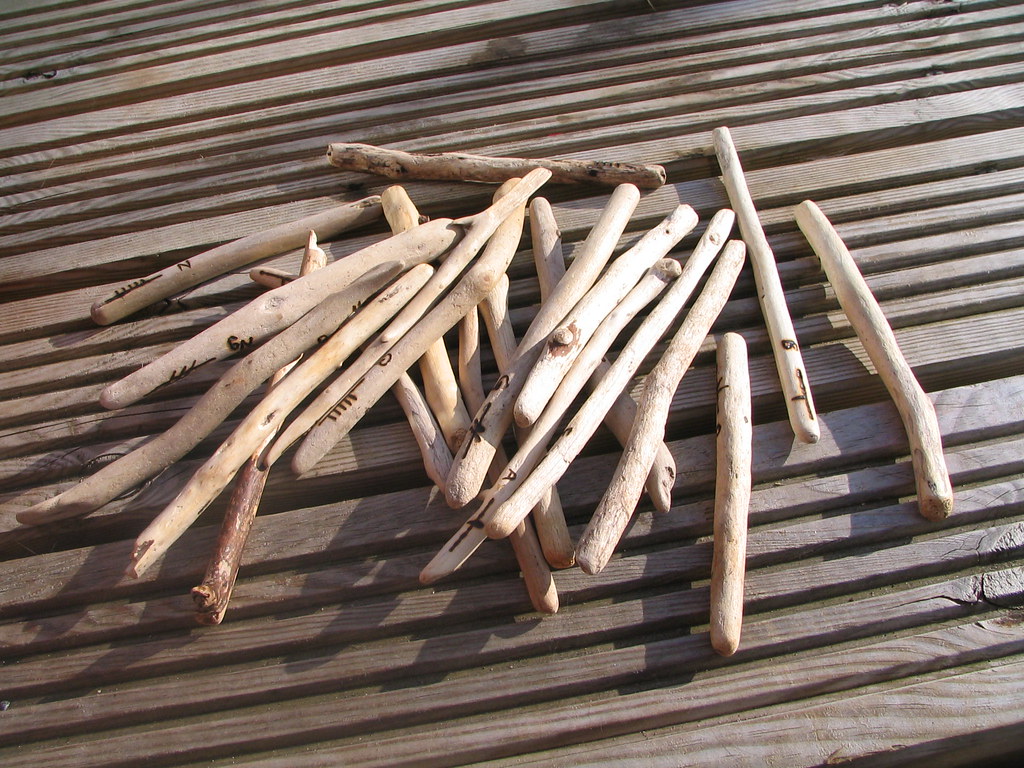
I collected some driftwood about mid-April and let it dry thoroughly before trying to etch the ogam into it with a pyrograph (after practicing on lollipop sticks, seeing as I've never used one before). I chose ones that were similar sizes, and were already nice and smooth so I wouldn't have to bother sanding them down or anything, to keep them nice and 'natural'. The etching was fairly easy to do, and for the first set (which I used at Bealltainn), I used long thin pieces and left them fairly plain, which I hoped would make them good for picking out from the bunch rather than throwing and reading the spread:
The next set I did, I made with shorter sticks - about 4 inches at the most. They didn't look like much so I decided to paint them according to their colour correspondences in Erynn's book:
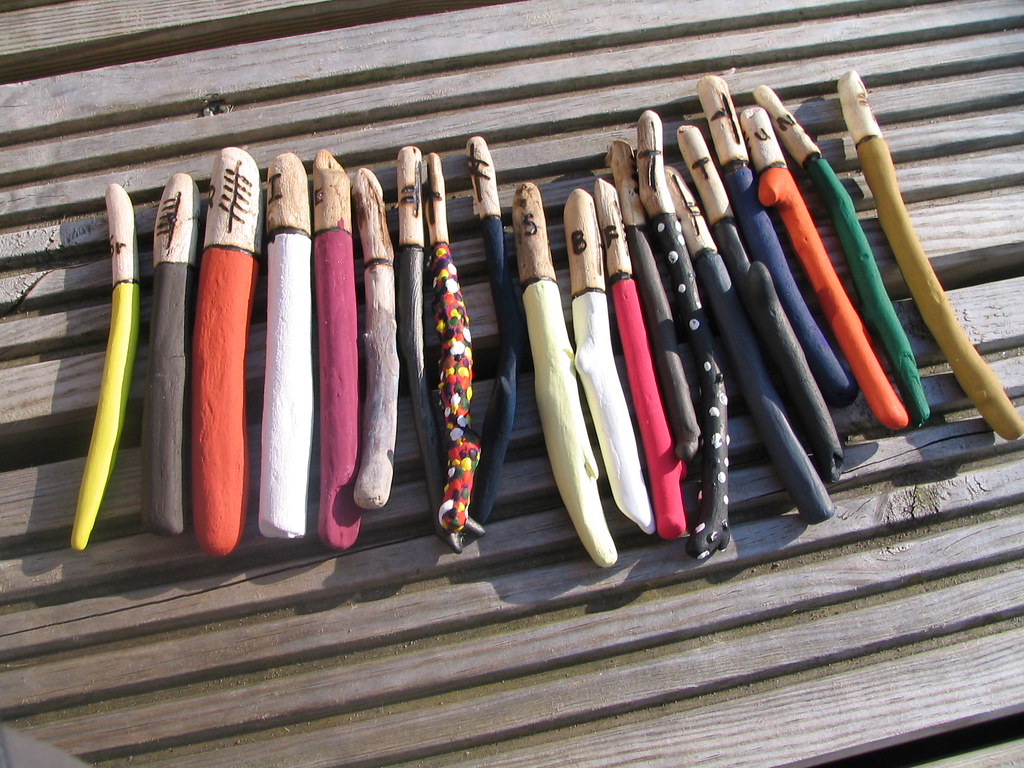
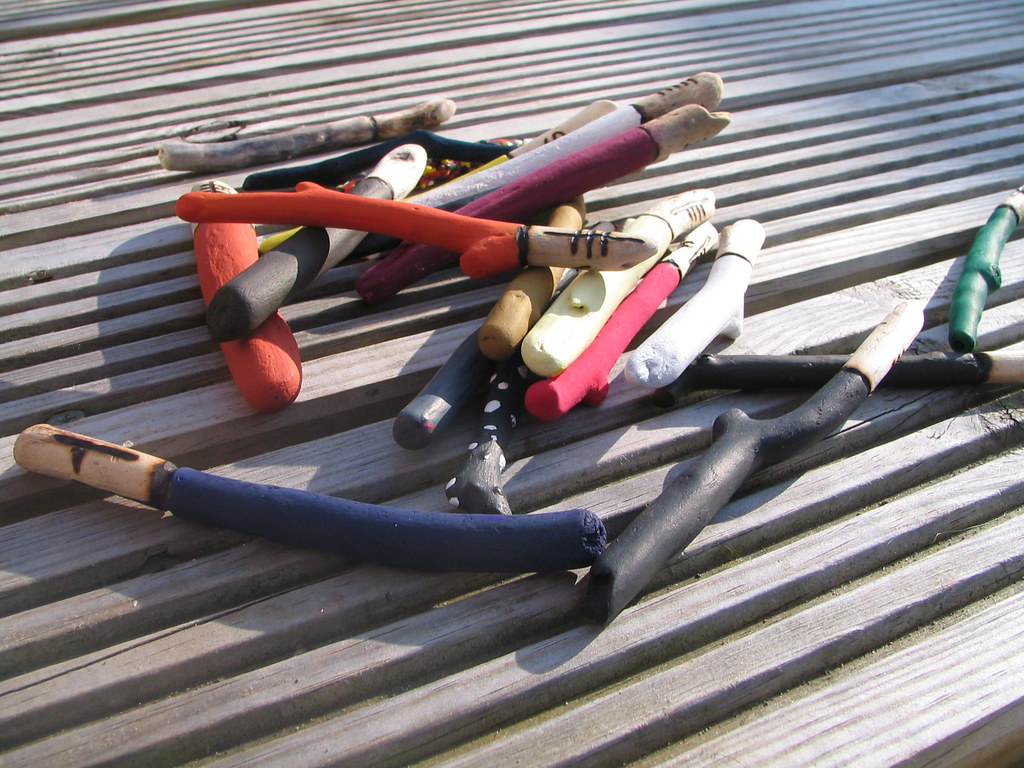
I just used gouache to paint them, and I'm quite pleased with how they've turned out on the whole. The wood's quite soft which makes pyrographing them quite easy, although I'm sure I can do a better job with a bit of practice. It would be nice to try some with decorative designs, but I think that might be beyond my 'artistic' skills...
I'm starting to think that some of them might need tweaking, colour-wise (I tried a 'bruised' effect for h-uath and it looked good until it dried, for a start - I should have waited until it dried to layer it on), before I varnish them or find a good sealant to make sure the paint doesn't rub off because they seem a little delicate just now. I'll use a matt varnish so they shouldn't look too different from how they do now.
I'm hoping that by using them, I'll be able to develop the more experiential, rather than intellectual, side of my practices. Divination is something I'm quite good at generally (for myself, anyway), so it seems like a good avenue of approach for me to start relying on my more intuitive side. We'll just have to see how it goes.
EDIT: I ended up using beeswax as a sealant, which has been very effective. And smells nice.
The first set I tried to do sometime last year went missing during the move, Mr Seren probably thinking it was an 'art' project that Tom had been doing. Once we moved I began to think about making another set, and seeing as there was plenty of driftwood to choose from at the beach, I toyed with the idea of collecting some to use for the staves.
I decided to wait for a while and try establishing a relationship with the place first, it didn't feel right just taking the wood, so every time we've gone to the beach I've been leaving offerings and libations and doing a bit of meditation (in between running after Tom to save him from launching himself into the waves). The beach is in a very exposed position and takes the full brunt of winds and storms that come our way, so it had a very desolate, stark feel to it, but now I seem to have worked up some sort of contact with the place it's starting to feel a little more welcoming.
I collected some driftwood about mid-April and let it dry thoroughly before trying to etch the ogam into it with a pyrograph (after practicing on lollipop sticks, seeing as I've never used one before). I chose ones that were similar sizes, and were already nice and smooth so I wouldn't have to bother sanding them down or anything, to keep them nice and 'natural'. The etching was fairly easy to do, and for the first set (which I used at Bealltainn), I used long thin pieces and left them fairly plain, which I hoped would make them good for picking out from the bunch rather than throwing and reading the spread:
The next set I did, I made with shorter sticks - about 4 inches at the most. They didn't look like much so I decided to paint them according to their colour correspondences in Erynn's book:
I just used gouache to paint them, and I'm quite pleased with how they've turned out on the whole. The wood's quite soft which makes pyrographing them quite easy, although I'm sure I can do a better job with a bit of practice. It would be nice to try some with decorative designs, but I think that might be beyond my 'artistic' skills...
I'm starting to think that some of them might need tweaking, colour-wise (I tried a 'bruised' effect for h-uath and it looked good until it dried, for a start - I should have waited until it dried to layer it on), before I varnish them or find a good sealant to make sure the paint doesn't rub off because they seem a little delicate just now. I'll use a matt varnish so they shouldn't look too different from how they do now.
I'm hoping that by using them, I'll be able to develop the more experiential, rather than intellectual, side of my practices. Divination is something I'm quite good at generally (for myself, anyway), so it seems like a good avenue of approach for me to start relying on my more intuitive side. We'll just have to see how it goes.
EDIT: I ended up using beeswax as a sealant, which has been very effective. And smells nice.
Thursday, 15 May 2008
Archive: Scottish Placenames...
Scottish Place-Names by WFH Nicolaisen
Celtic Placenames of Scotland by WJ Watson
My wandering brain's been wondering about evidence for deities in Scotland recently, so I decided to pick this one up. I've seen a few authors confidently asserting that Banff takes its name from the Irish deity Banbha, along with Slamannan taking its name from Manannan (sorry, I've yet to figure out the shortcuts to put in the proper accents) and wanted to get to the bottom of it, because these were just casual mentions without anything of substance to back it up. Since I studied onomastics at uni (it's a fancy word for the study of proper names, which probably makes it sound more interesting than it actually is), I had an idea of the books to look at, and I eventually managed to get hold of them.
Watson's book was the first comprehensive look at the subject, way back in the 1930s, and it wasn't until the 70s when Nicolaisen published his book that the subject had anything of substance added to it. It's a very neglected area of study, then, and I have to admit, my enthusiasm for it will never match that of the authors or my lecturer, who's hard at work trying to bring the field into the twenty-first century with some 'exciting' new discoveries. Perhaps if academics were more willing to look into the pre-Christian evidence I'd be a bit more interested, but because it's such an uncertain area of study with very little in the way of hard facts, I suppose it's understandable that most academics won't put their neck on the line.
Anyway...Looking at Watson's book first, I'd say of the two this was the most readable, although considering the fact that both books deal with a very specialised area, I think it's safe to say it will only appeal to people who really want to know about this stuff. Watson confines himself to examining Celtic placename evidence only, so on the one hand I found it more relevant to me, because obviously that's where my interest lies, but on the other hand this means it lacks much in the way of context. Nicolaisen's book examines all the languages that have affected the evolution of placenames in Scotland and to ignore the non-Celtic influences does mean you're only getting half the picture, so to speak.
There's plenty of useful stuff here (which I'll go into later, comparing with Nicolaisen), and the style of writing is a little more accessible. The style of language is perhaps a little antiquated and dated these days, but it's not like having to plough through Shakespeare or Chaucer. Watson also has a tendency to ramble and go off on tangents somewhat, so at times it feels like there are some conclusions and adequate analysis missing from what's being discussed before a different subject is introduced. Being focused on Celtic placenames means it's more comprehensive than Nicolaisen's work, but Nicolaisen does a good job of picking up on the most important points in Watson's work (particularly the example of pit- placenames as evidence of the spread of the Picts) and updating them or even refuting them. This means that it's very difficult to consider either book in isolation, because while I prefer Watson, Nicolaisen provides some important additions.
Nicolaisen' book is still the main text for study in this field, and it's understandable. Unlike Watson's book, Nicolaisen takes a much more critical view of the subject and takes care to introduce the key issues affecting the subject, like language change and how it's affected the changes in placenames which might not be so apparent to those studying it - after all, we only see what gets recorded. It's not just that it's more up to date that makes it a 'better' book in this respect, it's been consciously written for a more modern academic audience, and addresses the needs of that audience. Nicolaisen also goes beyond just listing what the placenames mean like Watson tends to, and explores what implications name elements in particular might have in terms of their spread - such as evidence for the spread of Christianity, cults of saints within the church, and cultural groups, for example. While Watson does this too, it gets lost at time in his tangents.
It's perhaps because of this critical, academic (and dry) approach that I just don't like Nicolaisen's book (that and the fact that the majority of it formed the basis of some of the most boring lectures of my life, so I admit I'm not without bias here) because generally it isn't all that readable. At times Nicolaisen labours the point somewhat, and in the introduction goes into excruciating detail in examining the evolution of the names that Falkirk has had - from the earliest evidence of Egglesbreth to Varia Capella and then Fawkirk to Falkirk, all of which overlap slightly and seemed to have co-existed with later names for a time, and all of which translate as "the speckled church", thus proving that in some places at least, languages didn't just immediately replace old ones but existed side by side with them for some time and people had at least some understanding of both. He then essentially dismisses the importance of the point by saying that Falkirk is a rare example of this, leaving one to wonder why the hell he's just spent a whole chapter banging on about it...
What follows is an overview of the different languages that have shaped the placenames of Scotland, from English, to Scandinavian, to Gaelic, P Celtic (which he defines as Cumbric and Pictish), and the elusive 'pre-Celtic'. It's this last chapter on 'pre-Celtic' names that's the most interesting in terms of what I was looking for, for pre-Christian evidence, but on the whole it's unsatisfactory because Nicolaisen is fairly dismissive of the subject and seems loath to go into any detail about it.
It's Watson who points to the Banff/Banbha connection, and hints at a connection between Slamannan and Manannan (but seems to conclude, inconclusively, that it is in fact related to the Manau tribe and has something to do with a rock), and also mentions examines the meaning of the river Clyde and relates *Clota to a river goddess. Nicolaisen makes no mention of Banff or Slamannan in this context (though he does translate Slamannan as 'hill or moor of the Manau'), but does refute the Clota/river goddess connection: "Clyde is much more likely to have been a primary river-name. We are not denying that there was Celtic river-worship, but it should not be assumed for rivers whose names permit a straightforward 'profane' explanation." Although he has a point - assumptions shouldn't be made, and this is what Watson essentially does in equating the name as a goddess - this is hardly a thorough examination or refutation of the name, and it would be nice to see something that looks at the subject in more depth. Likewise, Watson's examination of other names associated with bodies of water could do with expanding on.
As much as you might notice how much I don't like the book in terms of style, it can't be denied that Nicolaisen's book is an important piece of work and in a sense my bias against it is probably doing it a disservice to some degree. If you're at all interested in linguistics and placenames in general, then both books are an important addition to the shelf, just don't expect to be entertained while you're learning.
Celtic Placenames of Scotland by WJ Watson
My wandering brain's been wondering about evidence for deities in Scotland recently, so I decided to pick this one up. I've seen a few authors confidently asserting that Banff takes its name from the Irish deity Banbha, along with Slamannan taking its name from Manannan (sorry, I've yet to figure out the shortcuts to put in the proper accents) and wanted to get to the bottom of it, because these were just casual mentions without anything of substance to back it up. Since I studied onomastics at uni (it's a fancy word for the study of proper names, which probably makes it sound more interesting than it actually is), I had an idea of the books to look at, and I eventually managed to get hold of them.
Watson's book was the first comprehensive look at the subject, way back in the 1930s, and it wasn't until the 70s when Nicolaisen published his book that the subject had anything of substance added to it. It's a very neglected area of study, then, and I have to admit, my enthusiasm for it will never match that of the authors or my lecturer, who's hard at work trying to bring the field into the twenty-first century with some 'exciting' new discoveries. Perhaps if academics were more willing to look into the pre-Christian evidence I'd be a bit more interested, but because it's such an uncertain area of study with very little in the way of hard facts, I suppose it's understandable that most academics won't put their neck on the line.
Anyway...Looking at Watson's book first, I'd say of the two this was the most readable, although considering the fact that both books deal with a very specialised area, I think it's safe to say it will only appeal to people who really want to know about this stuff. Watson confines himself to examining Celtic placename evidence only, so on the one hand I found it more relevant to me, because obviously that's where my interest lies, but on the other hand this means it lacks much in the way of context. Nicolaisen's book examines all the languages that have affected the evolution of placenames in Scotland and to ignore the non-Celtic influences does mean you're only getting half the picture, so to speak.
There's plenty of useful stuff here (which I'll go into later, comparing with Nicolaisen), and the style of writing is a little more accessible. The style of language is perhaps a little antiquated and dated these days, but it's not like having to plough through Shakespeare or Chaucer. Watson also has a tendency to ramble and go off on tangents somewhat, so at times it feels like there are some conclusions and adequate analysis missing from what's being discussed before a different subject is introduced. Being focused on Celtic placenames means it's more comprehensive than Nicolaisen's work, but Nicolaisen does a good job of picking up on the most important points in Watson's work (particularly the example of pit- placenames as evidence of the spread of the Picts) and updating them or even refuting them. This means that it's very difficult to consider either book in isolation, because while I prefer Watson, Nicolaisen provides some important additions.
Nicolaisen' book is still the main text for study in this field, and it's understandable. Unlike Watson's book, Nicolaisen takes a much more critical view of the subject and takes care to introduce the key issues affecting the subject, like language change and how it's affected the changes in placenames which might not be so apparent to those studying it - after all, we only see what gets recorded. It's not just that it's more up to date that makes it a 'better' book in this respect, it's been consciously written for a more modern academic audience, and addresses the needs of that audience. Nicolaisen also goes beyond just listing what the placenames mean like Watson tends to, and explores what implications name elements in particular might have in terms of their spread - such as evidence for the spread of Christianity, cults of saints within the church, and cultural groups, for example. While Watson does this too, it gets lost at time in his tangents.
It's perhaps because of this critical, academic (and dry) approach that I just don't like Nicolaisen's book (that and the fact that the majority of it formed the basis of some of the most boring lectures of my life, so I admit I'm not without bias here) because generally it isn't all that readable. At times Nicolaisen labours the point somewhat, and in the introduction goes into excruciating detail in examining the evolution of the names that Falkirk has had - from the earliest evidence of Egglesbreth to Varia Capella and then Fawkirk to Falkirk, all of which overlap slightly and seemed to have co-existed with later names for a time, and all of which translate as "the speckled church", thus proving that in some places at least, languages didn't just immediately replace old ones but existed side by side with them for some time and people had at least some understanding of both. He then essentially dismisses the importance of the point by saying that Falkirk is a rare example of this, leaving one to wonder why the hell he's just spent a whole chapter banging on about it...
What follows is an overview of the different languages that have shaped the placenames of Scotland, from English, to Scandinavian, to Gaelic, P Celtic (which he defines as Cumbric and Pictish), and the elusive 'pre-Celtic'. It's this last chapter on 'pre-Celtic' names that's the most interesting in terms of what I was looking for, for pre-Christian evidence, but on the whole it's unsatisfactory because Nicolaisen is fairly dismissive of the subject and seems loath to go into any detail about it.
It's Watson who points to the Banff/Banbha connection, and hints at a connection between Slamannan and Manannan (but seems to conclude, inconclusively, that it is in fact related to the Manau tribe and has something to do with a rock), and also mentions examines the meaning of the river Clyde and relates *Clota to a river goddess. Nicolaisen makes no mention of Banff or Slamannan in this context (though he does translate Slamannan as 'hill or moor of the Manau'), but does refute the Clota/river goddess connection: "Clyde is much more likely to have been a primary river-name. We are not denying that there was Celtic river-worship, but it should not be assumed for rivers whose names permit a straightforward 'profane' explanation." Although he has a point - assumptions shouldn't be made, and this is what Watson essentially does in equating the name as a goddess - this is hardly a thorough examination or refutation of the name, and it would be nice to see something that looks at the subject in more depth. Likewise, Watson's examination of other names associated with bodies of water could do with expanding on.
As much as you might notice how much I don't like the book in terms of style, it can't be denied that Nicolaisen's book is an important piece of work and in a sense my bias against it is probably doing it a disservice to some degree. If you're at all interested in linguistics and placenames in general, then both books are an important addition to the shelf, just don't expect to be entertained while you're learning.
Sunday, 11 May 2008
Archive: Scottish Customs/Scottish Festivals - Sheila Livingstone
Scottish Customs and Scottish Festivals
Sheila Livingstone
These are two separate books by the same author, but seeing as they basically go hand in hand, I might as well lump them together.
I saw them recommended on a college book list somewhere so thought I'd give them a go. I wasn't really expecting much in the way of new information, so when they arrived any high hopes I might have had weren't exactly dashed. Livingstone draws heavily on McNeill's The Silver Bough as a source, so for the most part it's a rehashing of that work. This is good and bad in a way, because they're shorter volumes and there's only two of them. In that sense, it will cost a lot less to buy them than all four volumes of McNeill's work and being shorter, there's less detail to overwhelm someone who's new to the subject, if they're looking for a basic nuts and bolts sort of introduction. They're much easier to get hold of than McNeill's work, and therefore much cheaper as well.
That said, I did find some elements to be problematical, mainly Livingstone's emphasis on the customs and festivals relating back to the Druids. It was alllllll about the druids, when really there's nothing concrete to prove such a link; McNeill does this too, to be fair, and it's clear that this is where Livingstone's drawing her information from. Being a relatively recent book, though, I would have expected it to reflect a more modern attitude to the issue. It's easy to read around, but I found it very (and probably unreasonably) grating.
The Scottish Customs book is perhaps a little more useful than the Scottish Festivals book because it offers a little more in the way of detail, and is less reliant on McNeill. It splits the customs into different headings like Birth, Death, Marriage and so on, and then details the customs under separate sub-headings, making it good for flicking through and quick reference. It covers pretty much the same stuff as Margaret Bennett's Scottish Customs from Cradle to the Grave (which is the one I'd recommend for quality and quantity of information), but Livingstone's book is less academic and therefore a little more readable, in some respects, because it takes a more conversational, less analytical tone.
My first port of call would still be The Silver Bough, but as I said, the advantage of Livingstone's books are that they're more accessible and easily available. I'd recommend them with the caveat to be a little more circumspect about the druid issue than Livingstone is, for starters.
Sheila Livingstone
These are two separate books by the same author, but seeing as they basically go hand in hand, I might as well lump them together.
I saw them recommended on a college book list somewhere so thought I'd give them a go. I wasn't really expecting much in the way of new information, so when they arrived any high hopes I might have had weren't exactly dashed. Livingstone draws heavily on McNeill's The Silver Bough as a source, so for the most part it's a rehashing of that work. This is good and bad in a way, because they're shorter volumes and there's only two of them. In that sense, it will cost a lot less to buy them than all four volumes of McNeill's work and being shorter, there's less detail to overwhelm someone who's new to the subject, if they're looking for a basic nuts and bolts sort of introduction. They're much easier to get hold of than McNeill's work, and therefore much cheaper as well.
That said, I did find some elements to be problematical, mainly Livingstone's emphasis on the customs and festivals relating back to the Druids. It was alllllll about the druids, when really there's nothing concrete to prove such a link; McNeill does this too, to be fair, and it's clear that this is where Livingstone's drawing her information from. Being a relatively recent book, though, I would have expected it to reflect a more modern attitude to the issue. It's easy to read around, but I found it very (and probably unreasonably) grating.
The Scottish Customs book is perhaps a little more useful than the Scottish Festivals book because it offers a little more in the way of detail, and is less reliant on McNeill. It splits the customs into different headings like Birth, Death, Marriage and so on, and then details the customs under separate sub-headings, making it good for flicking through and quick reference. It covers pretty much the same stuff as Margaret Bennett's Scottish Customs from Cradle to the Grave (which is the one I'd recommend for quality and quantity of information), but Livingstone's book is less academic and therefore a little more readable, in some respects, because it takes a more conversational, less analytical tone.
My first port of call would still be The Silver Bough, but as I said, the advantage of Livingstone's books are that they're more accessible and easily available. I'd recommend them with the caveat to be a little more circumspect about the druid issue than Livingstone is, for starters.
Archive: The Scottish Cellar - F Marian McNeill
The Scottish Cellar
F Marian McNeill
This is a sister companion to another book, The Scots Kitchen. Whereas The Scots Kitchen deals with recipes and customs associated with food and cooking, this book focuses on drink.
It's less heavy on the recipes than the other book, focusing more on the culture and customs associated with drinks, drinking and hospitality. The focus is mainly relatively modern customs and culture from around the eighteenth century onwards, and the emphasis on the provision of hospitality, and the different types of hospitality (in the home, in the taverns and so on) was illuminating for me. McNeill also includes drinking songs (with music provided) and blessings from a variety of sources that I haven't seen before, so that was useful and interesting.
There are still plenty of recipes to brew your own wines and ales, or make caudle, sowens (a type of gruel/drink), whisky nog and things like that. I was hoping to find some pointers about the Bealltainn caudle that was made as a drink (rather than the batter), but was disappointed on that score, and was expecting a little more folklore than there turned out to be. Over all there's plenty to be getting on with if I ever wanted to make my own brews for libations or whatever (hawthorn or rowanberry liquer would seem apt), though, and McNeill goes into particular detail about her efforts to find, or reconstruct, an authentic 'Pictish' heather ale.
McNeill writes in a style that I'd call 'jolly hockey sticks' - what ho! - and that might be hard for some readers to get used to because it's very dated and can be hard to read at times. The recipes also use a lot of ingredients that probably aren't widely available any more, and use measurements that are outdated (and would have to be converted into cups and so forth for anyone across the Pond) so some of them are of limited use. It shouldn't be too difficult to modernise them, once you've looked up what some of the terms mean as well (I've no idea what 'sack' is, as an ingredient).
Overall, the book was interesting, but not overwhelmingly so. It was cheap at least, and I'm tempted to go looking for a more up to date book that covers similar recipes in a more straightforward manner, using modern terms and measurements that perhaps offer substitutes for ingredients that aren't necessarily available anymore.
F Marian McNeill
This is a sister companion to another book, The Scots Kitchen. Whereas The Scots Kitchen deals with recipes and customs associated with food and cooking, this book focuses on drink.
It's less heavy on the recipes than the other book, focusing more on the culture and customs associated with drinks, drinking and hospitality. The focus is mainly relatively modern customs and culture from around the eighteenth century onwards, and the emphasis on the provision of hospitality, and the different types of hospitality (in the home, in the taverns and so on) was illuminating for me. McNeill also includes drinking songs (with music provided) and blessings from a variety of sources that I haven't seen before, so that was useful and interesting.
There are still plenty of recipes to brew your own wines and ales, or make caudle, sowens (a type of gruel/drink), whisky nog and things like that. I was hoping to find some pointers about the Bealltainn caudle that was made as a drink (rather than the batter), but was disappointed on that score, and was expecting a little more folklore than there turned out to be. Over all there's plenty to be getting on with if I ever wanted to make my own brews for libations or whatever (hawthorn or rowanberry liquer would seem apt), though, and McNeill goes into particular detail about her efforts to find, or reconstruct, an authentic 'Pictish' heather ale.
McNeill writes in a style that I'd call 'jolly hockey sticks' - what ho! - and that might be hard for some readers to get used to because it's very dated and can be hard to read at times. The recipes also use a lot of ingredients that probably aren't widely available any more, and use measurements that are outdated (and would have to be converted into cups and so forth for anyone across the Pond) so some of them are of limited use. It shouldn't be too difficult to modernise them, once you've looked up what some of the terms mean as well (I've no idea what 'sack' is, as an ingredient).
Overall, the book was interesting, but not overwhelmingly so. It was cheap at least, and I'm tempted to go looking for a more up to date book that covers similar recipes in a more straightforward manner, using modern terms and measurements that perhaps offer substitutes for ingredients that aren't necessarily available anymore.
Subscribe to:
Posts (Atom)